What You Can Tow Behind a Side-by-Side
It's incredibly frustrating when you invest in a powerful side-by-side, envisioning all the ways it will make work and play easier, only to realize that navigating the rules around towing can feel like slogging through deep mud. You want to use your machine to its full potential, whether it's hauling feed on the farm or taking gear to a remote hunting camp, but figuring out what's allowed and, more importantly, what's safe can be a real head-scratcher. This guide is here to cut through the confusion and give you a clear picture of what you can realistically and legally tow behind your side-by-side in Alabama, focusing on practical advice and common scenarios.
Understanding Alabama's Stance on Towing with Off-Road Vehicles
Alabama's laws regarding off-road vehicles (ORVs) like ATVs and side-by-sides often leave a lot unsaid when it comes to specific operational details, especially concerning towing. Unlike passenger vehicles, where trailer weight ratings, hitch classifications, and braking requirements are crystal clear, ORVs exist in a different regulatory landscape. This ambiguity can be both a blessing and a curse: a blessing because it allows for more common-sense judgment on private land, but a curse because it means fewer explicit guidelines for public spaces, leaving you to piece together implied rules.
For most folks in Alabama, a side-by-side is a workhorse, a utility vehicle designed to tackle rough terrain and assist with tasks that a truck simply can't reach. The ability to tow is often a primary reason for choosing a UTV over an ATV. Whether it's a small utility cart for hauling timber, a feeder for wildlife, or tools for property maintenance, the expectation is that your machine can handle it. The key distinction, however, always comes down to where you are riding and who owns the land.
The Legal Grey Areas and Practical Realities
One of the biggest frustrations for side-by-side owners is the lack of specific state-level laws directly addressing towing capacity or regulations for off-road vehicles on private property. You won't find a chapter in the Alabama code that says, "Thou shalt not tow more than X pounds with thy side-by-side on thine own fifty acres." This absence of explicit law means that on private land, safety and landowner rules become paramount. If you own the land, you're generally responsible for the safety of your operations. If you're on someone else's property, like a hunting lease or a friend's farm, their rules dictate what you can and cannot do.
However, this doesn't mean it's a free-for-all. The spirit of safety and responsible operation still applies. Overloading your side-by-side, even on private property, can lead to accidents, damage to your machine, or injury to yourself or others. The legal system might not have a specific "towing with UTV" violation, but negligence laws could still come into play if an accident occurs due to unsafe towing practices. Always remember that common sense and manufacturer guidelines are your best friends in these grey areas.
Distinguishing Between Public and Private Property Towing
The moment you venture from private land to public land, the rules shift dramatically. This distinction is crucial for understanding what you can tow. On your own property, or land where you have explicit permission, the primary concern is safety and not exceeding your machine's capabilities. You're generally free to tow farm implements, hunting stands, or even a small trailer with firewood, provided you do so responsibly and within the limits of your side-by-side. Many Alabama owners use their side-by-sides as essential tools on their farms or timber tracts, often towing cultivators, small seed spreaders, or recovery equipment.
Conversely, towing on public lands, such as state parks, national forests, or Wildlife Management Areas (WMAs), is a completely different ballgame. These areas typically have much stricter regulations, often prohibiting or severely limiting towing. Their rules are designed to protect the natural environment, minimize trail damage, and ensure the safety of all users. For instance, while you might be able to tow a deer out on a WMA, pulling a utility trailer full of camping gear might be explicitly forbidden. Understanding [Alabama Public Use Versus Private Use] helps clarify these distinctions. Always check with the specific land manager or park office before you hitch up a trailer on public access land.
Practical Considerations for Towing Safely with Your Side-by-Side
Towing with a side-by-side, even the most robust utility model, requires a thoughtful approach to safety and mechanical limits. Unlike towing with a full-size pickup truck, where capabilities are often well beyond typical loads, UTVs have more defined boundaries. Pushing those boundaries can lead to dangerous situations, premature wear on your machine, or even outright failure. It's not just about what you can attach, but what your specific side-by-side can safely handle.
The power of a side-by-side can sometimes lull owners into a false sense of security regarding its towing prowess. Yes, they are incredibly capable, especially in low-range gears, but their lighter weight, shorter wheelbase, and different braking systems mean they handle a loaded trailer very differently than a road-legal vehicle. Always prioritize safety over convenience, and when in doubt, lighten the load or make multiple trips.
Machine Capacity and Manufacturer Guidelines
The absolute first thing you need to know when considering towing anything with your side-by-side is its towing capacity. This information is always found in your owner's manual. It's usually listed as two figures: maximum gross trailer weight (GTW) and maximum tongue weight. The GTW is the total weight of the trailer and its cargo. The tongue weight is the downward force exerted by the trailer's hitch onto your UTV's hitch receiver. Both are critical. Exceeding either of these limits can severely compromise your side-by-side's handling, braking, and stability.
Think of it this way: if your owner's manual states a 1,500-pound towing capacity, that doesn't mean you can just hook up any trailer. You also need to consider the tongue weight, which might be 150 pounds. If you put too much weight on the tongue, your front wheels can lift, reducing steering and braking effectiveness. Too little tongue weight, and the trailer can sway dangerously. Always aim for about 10-15% of the GTW as tongue weight. You might consider aftermarket parts from a company like SuperATV that offers enhanced suspension components, which could help maintain stability, though they don't increase the manufacturer's stated towing capacity itself. Your side-by-side is designed with certain parameters, and respecting those limits is key to longevity and safety.
Types of Trailers and Loads Commonly Towed
Side-by-sides are incredibly versatile, and the types of loads they tow reflect this. In Alabama, especially across the state's vast rural landscapes, you'll often see UTVs towing:
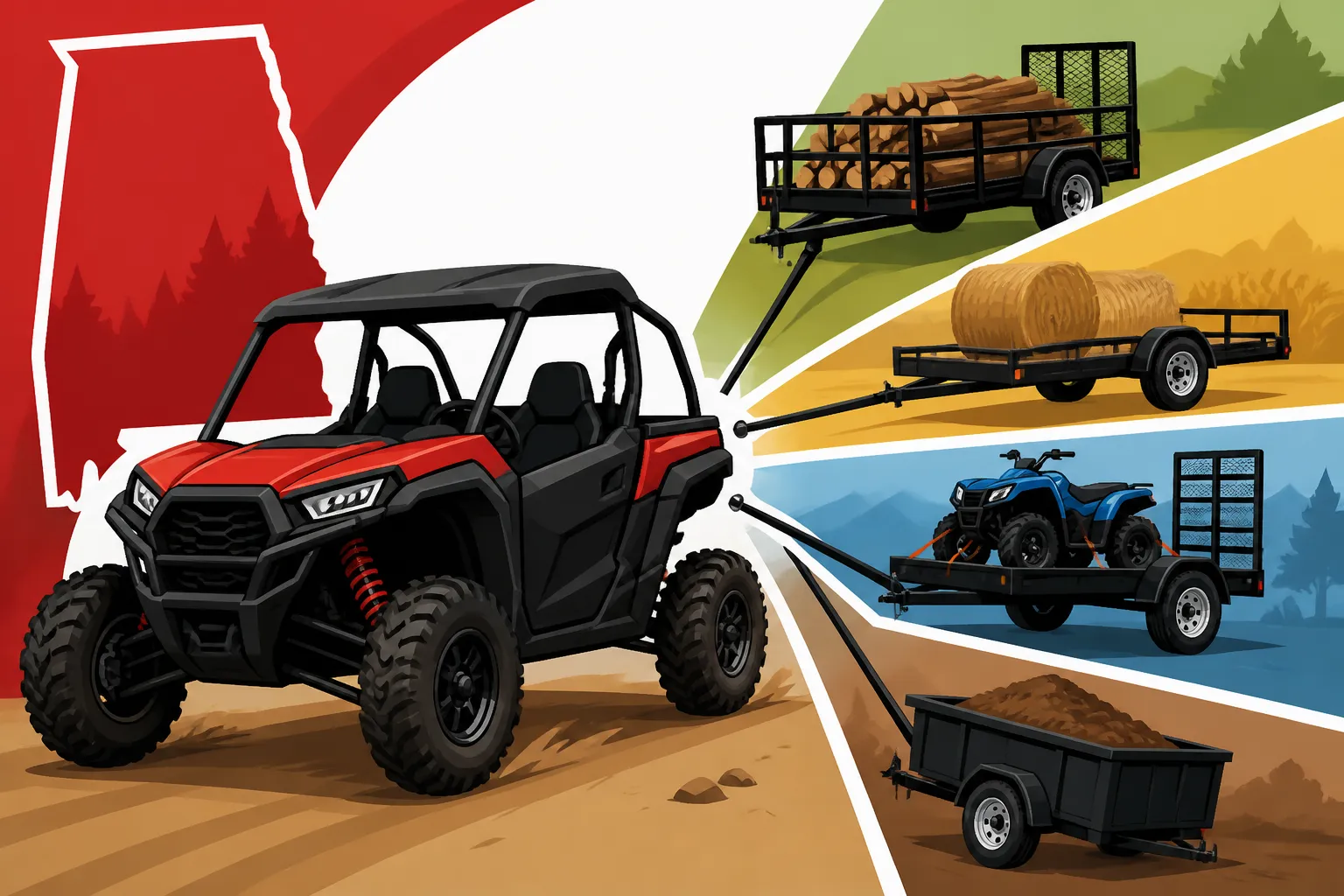
- Small Utility Trailers: These are perhaps the most common, used for hauling everything from bags of feed and hay bales on a farm near Cullman, to firewood for a campsite in the Bankhead National Forest (where permitted), or tools for fence repair. They are usually single-axle, open-top trailers.
- Hunting Carts/Trailers: Purpose-built to haul game, tree stands, feeders, and other hunting gear, these are invaluable for getting equipment into remote areas. Many hunters use them to retrieve a harvested deer or hog from dense woods.
- Light Farm Implements: For smaller operations, a side-by-side can often pull a small drag harrow, a food plot planter, a sprayer, or even a log splitter. These implements are designed to be towed by lighter vehicles, making the UTV a perfect fit for maintaining food plots or small gardens.
- Water Tanks: For fire suppression or irrigation in areas without readily available water, small water tanks on trailers are often towed by UTVs.
- Debris and Yard Waste: Around the home or cabin, a side-by-side can be incredibly useful for hauling leaves, branches, and other yard debris to a burn pile or compost area.
Regardless of what you're towing, proper load securement is non-negotiable. Loose cargo can shift, throwing off your balance and potentially causing an accident. Use ratchet straps, bungees, or cargo nets to ensure everything stays put. Remember, [Alabama Rules for Towing With a UTV] focus heavily on safe operation, which includes properly securing your load.
Essential Towing Accessories and Upgrades
To ensure safe and efficient towing, investing in the right accessories and potential upgrades for your side-by-side is a smart move. While your UTV likely came with a basic hitch receiver, some enhancements can significantly improve your towing experience and safety, especially if you plan on regular or heavier hauling.
First and foremost, ensure you have the correct ball mount and hitch ball for your trailer. Match the ball size (e.g., 1-7/8 inch, 2 inch) to your trailer's coupler, and choose a ball mount that provides the right drop or rise to keep your trailer level. A level trailer tracks better and puts less strain on your hitch. Many companies, including SuperATV, offer a range of heavy-duty receiver hitches and ball mounts designed specifically for the stresses of off-road towing, which can be a significant upgrade from a stock setup.
Consider trailer lights, even if you're only planning off-road towing. If you ever have to cross a road, even for a short distance, or if you're out near dusk, having functional tail lights, brake lights, and turn signals on your trailer dramatically increases visibility. While not always legally required off-road, it's a critical safety feature. Some UTVs have a factory wiring harness for trailer lights, but aftermarket kits are also available. For heavier loads, especially those approaching your UTV's maximum capacity, a trailer brake controller can be a lifesaver. This system allows your UTV to activate the trailer's brakes, preventing the trailer from pushing your UTV during deceleration and improving stopping distance. Not all UTVs are set up for brake controllers, so check your manual or consult with an expert.
Finally, consider suspension or tire upgrades. While these won't increase your official towing capacity, a stiffer spring rate or heavy-duty shock from a company like SuperATV can help prevent excessive sag when you have a significant tongue weight, maintaining better ground clearance and stability. Upgrading to a more robust, stiffer sidewall tire can also provide better stability under load, especially on uneven terrain.
Towing on Public Lands and Specific Scenarios in Alabama
The allure of towing gear deep into Alabama's public lands is strong, but the reality is that these areas come with a complex web of regulations. What's perfectly acceptable on your private forty acres could lead to a citation on public property. Understanding these nuances is vital for avoiding trouble and ensuring you can enjoy your machine responsibly. It's never safe to assume that if you can drive your side-by-side there, you can tow anything you want behind it.
Different types of public lands have different missions and, consequently, different rules. A state-managed OHV park, focused on recreational riding, will have a different set of towing allowances than a Wildlife Management Area, which prioritizes wildlife conservation and hunting access. Ignoring these distinctions isn't just a risk of a fine; it can also harm the very trails and environments you want to enjoy.
Rules in OHV Parks and WMAs
If you plan to visit a designated Off-Highway Vehicle (OHV) park in Alabama, like Stony Lonesome OHV Park or Minooka Park, you'll find that their rules regarding towing are typically quite specific, and often restrictive. These parks are designed primarily for recreational riding, not for hauling large amounts of gear. Many parks may prohibit trailers altogether on certain trails or limit them to very small, single-axle units for specific purposes. This is usually to prevent trail damage, manage congestion, and ensure the safety of all riders on varied terrain. Always check the park's official website or call them directly before you load up a trailer. What you can tow inside [Stony Lonesome OHV Park in Alabama] or [Minooka Park Riding in Alabama] will be explicitly stated in their rules.
Wildlife Management Areas (WMAs) in Alabama operate under a different set of guidelines, often managed by the Alabama Department of Conservation and Natural Resources. While the primary purpose of WMAs is wildlife conservation and hunting, they do often allow ATVs and side-by-sides for specific activities. Towing on WMAs is usually restricted to very specific purposes, such as game retrieval. For instance, you might be allowed to tow a small cart to retrieve a deer, but you would likely not be permitted to tow a utility trailer full of lumber or camping supplies. These rules are in place to minimize impact on the habitat and to prevent activities unrelated to wildlife management. Always consult the specific WMA's regulations, which are usually available online or at kiosks, regarding [Alabama Game Retrieval Rules] and what equipment is permitted.
Towing on Farm Land and Timber Properties
This is where side-by-sides truly shine as work vehicles, and generally, where towing is least restricted by state law. On private farms, ranches, and timber properties across Alabama, UTVs are indispensable. You'll see them towing:
- Feed and Supplies: Hauling bags of feed to livestock or wildlife feeders is a daily task for many Alabama farmers and landowners.
- Tools and Equipment: Transporting chainsaws, fencing tools, pumps, and other implements to remote sections of a property.
- Small Agricultural Implements: From disc harrows for food plots to spreaders for fertilizer or seed, UTVs are often used for light-duty farming tasks.
- Timber and Brush: Small quantities of cut timber, brush, or debris can be easily moved with a side-by-side and utility trailer.
On these private lands, the primary "rules" are those set by the landowner and, most importantly, common sense safety. Overloading, speeding, or operating on unstable ground can quickly turn a useful tool into a hazard. If you're using your UTV for agricultural tasks, it might even fall under different classifications for registration purposes, which can affect things like road crossings. Understanding [Alabama Rules for a Farm Machine] can be helpful in these scenarios. When accessing [Alabama Timber Company Land Access], always be sure to adhere to their specific rules regarding vehicle use and towing, as these companies often have strict liability and environmental policies.
Towing and Road Crossings
Here's where things get particularly tricky and potentially illegal. In Alabama, ATVs and side-by-sides are generally not street legal. This fundamental rule makes any kind of towing on public roads, beyond the briefest and most necessary crossing, problematic. While a side-by-side might be powerful enough to tow a significant load, the state's statutes are clear: these machines are designed for off-road use. Attempting to tow a trailer for any extended distance on a public road or highway in Alabama can lead to serious legal consequences, including fines and potential impoundment of your machine.
There are very limited exceptions, such as crossing a road at a 90-degree angle to access another section of private property, or operating on specific county roads if a local ordinance allows it. However, even in these rare instances, towing a trailer significantly complicates the situation. A trailer increases your overall length, reduces maneuverability, and adds to stopping distance – all factors that make road use more dangerous and draw more attention from law enforcement. You must understand [Crossing a Road on an ATV in Alabama] and [Alabama Rules for Crossing a Highway] to grasp just how narrow these allowances are, and how much risk is involved when a trailer is attached. The safest approach is to assume that if you're on a public road, towing with your side-by-side is not permitted, and certainly not advisable.
| Towing Location | Typical Legal/Rule Authority | Common Practice | Key Considerations |
|---|---|---|---|
| Private Land | Landowner's discretion, common sense, manufacturer limits | Widely accepted for utility, farm, hunting tasks | Prioritize machine capacity, load securement, personal safety. No specific state towing laws. |
| OHV Parks | Park-specific rules and regulations | Often restricted to small trailers or prohibited entirely | Check park's official website/call before arrival. Rules aim to prevent trail damage and ensure safety. |
| WMAs | AL DCNR regulations for specific WMA | Limited to specific purposes like game retrieval | Consult WMA's specific guidelines. Typically no recreational trailer towing allowed. |
| Public Roads | Alabama state law, local ordinances (if applicable) | Generally prohibited; exceptions are rare and brief. | ATVs/UTVs are not street legal. Towing on public roads significantly increases legal risk. |
| Farm Roads | Landowner, potentially local farm-use rules | Common for farm implements and supplies | Still prioritize safety; if crossing public roads, limited to brief, direct crossings. |
Disclaimer
This article is for general informational purposes only and does not constitute professional advice. Laws, prices and regulations vary by location and change over time. Consult a qualified professional for guidance on your specific situation.