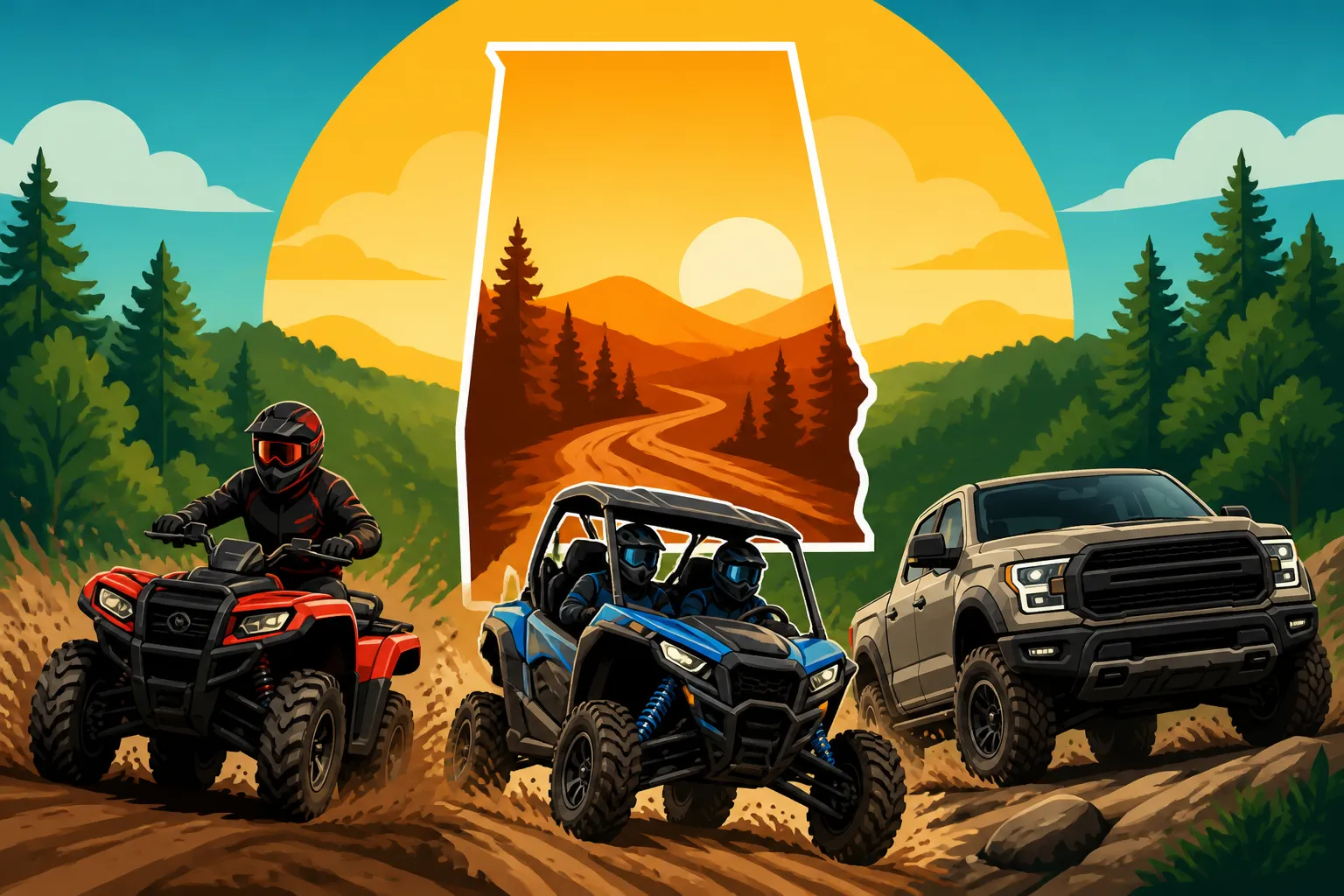
Trails for Bikes, Quads and Trucks
Finding an Alabama trail that fits a dirt bike, ATV, side-by-side, or 4×4 truck can be harder than it sounds. A route that welcomes one vehicle may restrict another because of width, land ownership, seasonal closures, or trail conditions. This guide explains how to compare riding areas, check access before towing, and choose a route your whole group can use.
How to choose Alabama trails for bikes, quads, and trucks
Start with the vehicle, not the trail name
“Off-road trail” can mean very different things. A narrow path cut for a dirt bike may be too tight for an ATV, while a route suitable for a quad might not have the width, turning space, or ground clearance a side-by-side needs. A full-size 4×4 truck needs still more room, and a trail that allows one type of vehicle does not automatically allow the others.
It also helps to clarify what you mean by “bike.” If you mean a dirt bike or other off-highway motorcycle, look for motorized routes that specifically allow motorcycles. If you mean a mountain bike, check for nonmotorized trail access instead. Some parks separate motorized and nonmotorized uses, and using the wrong trail can create safety problems for everyone.
Before settling on a destination, check the vehicle-specific rules and the physical limits of the route. Ask about width restrictions, vehicle classes, one-way sections, gates, and any limits on riding outside designated areas. If your group includes different machines, compare the rules for each one. The guide to [Alabama Trails That Allow Side-by-Sides] can help narrow down options for UTV riders, while [Alabama Trails That Allow 4×4 Trucks] is a useful starting point for truck access.
Match the route to your group’s comfort level
A route described as easy may still feel demanding if it is wet, rutted, steep, or unfamiliar. A novice rider on a small quad may find a rocky climb stressful even when an experienced driver in a larger machine sails up it. For a mixed-experience group, look for routes with room to turn around or choose an easier line rather than committing everyone to a difficult obstacle.
Ask whether the area has marked difficulty levels and how those ratings are used. A park may rate a whole trail, while another may identify separate obstacles or alternate routes. If the information is unclear, call the park or land manager and describe your actual machine, not just the fact that it is an ATV or UTV. A specific question such as “Can a stock four-seat side-by-side use this route?” is more helpful than asking whether the park is “UTV friendly.”
It’s also worth reading [Alabama Trail Difficulty Ratings] before planning a trip. Ratings can help you compare options, but they are not a promise that every section will feel the same on every day. Rain, recent maintenance, traffic, and the rider’s experience can all change how a route feels.
Where to look for riding areas in Alabama
Private OHV parks can be easier to plan around
For a first trip or a group with several kinds of machines, a dedicated off-highway vehicle park can be a practical place to start. These parks are set up for recreational riding and may offer marked routes, posted rules, parking, or other visitor facilities. You still need to check the park’s current vehicle rules, access conditions, and operating information before leaving home.
Stony Lonesome OHV Park near Bremen and Minooka Park near Jemison are two Alabama destinations riders may want to investigate. Their names are a starting point, not a substitute for checking what is open and permitted for your particular vehicle. Ask whether a dirt bike, quad, side-by-side, or 4×4 truck is allowed on the routes you plan to use, and whether any route is limited by width or vehicle type. For background on those locations, see [Stony Lonesome OHV Park in Alabama] and [Minooka Park Riding in Alabama].
A private park’s rules may also cover things that are easy to overlook when you are focused on the trails: helmets, passengers, youth riders, pets, waivers, noise, and where trailers can be parked. If you are bringing a group, confirm that everyone’s machine fits the park’s allowed categories. One person’s trail-ready truck does not make a truck route available to the whole group.
Public land needs route-by-route checking
Public land can offer a rewarding ride, but access is not necessarily open-ended. In a national forest or another public area, only designated routes may be available to motorized vehicles, and different routes can have different vehicle restrictions. A road that appears on a general map may not be an authorized ATV or UTV route. Gates, signs, seasonal restrictions, and local closures matter.
Do not assume that a route is open because it is visible on a phone map or because you see tire tracks. Confirm access with the responsible land manager and follow signs on the ground. In areas where hunting, timber operations, weather, or habitat protection affect access, conditions may change. If a route is closed, using it anyway can damage the land and create trouble for future riders.
Start with a broad overview such as [Alabama ATV Trails: Where to Ride], then verify each candidate location directly. For county-managed areas, [Alabama County Parks Open to OHVs] may help you identify places to research. A map app such as onX Offroad can help you orient yourself and compare route lines, but treat it as a planning aid rather than permission to ride. Check the managing agency’s rules and current notices before relying on any mapped route.
Compare the main options before you tow
The right destination depends on your vehicle, the kind of ride you want, and how much time you have for checking access. This comparison is a planning framework—not a guarantee that any particular route is open to every vehicle.
| Riding option | Often a good fit for | What to confirm before going |
|---|---|---|
| Dedicated OHV park | Groups looking for designated motorized riding areas | Allowed vehicle types, route limits, hours, fees, closures, and rider rules |
| Public forest routes | Riders prepared to follow designated-route rules | Which routes are open to your vehicle, permit requirements, gates, and seasonal access |
| County or local OHV area | Riders seeking a managed local destination | Whether motorized riding is allowed and which machines the area accepts |
| Informal-looking trail or track | Nobody should assume access | Land ownership, written permission, legal route status, and posted restrictions |
How to check access and conditions before you leave
Verify that every machine is allowed
Make a list of the machines in your group, including approximate width and whether each one is a motorcycle, ATV, side-by-side, or full-size truck. Then compare that list with the riding area’s rules. If the website uses broad terms such as “ORV” or “OHV,” ask what those terms include. A label can cover several machine types in conversation while the actual rules distinguish among them.
When contacting a park or land manager, ask direct questions: Is my machine class allowed? Are there width or weight limits? Are all routes open to it, or only some? Are there restrictions for passengers or young riders? Is the area open on the day we plan to arrive? If you cannot get a clear answer, do not treat silence as approval.
Use onX Offroad or another mapping tool to review the general route layout and help you plan where to meet or turn around. Then compare the map with official park or agency information. A displayed track may be outdated, may cross private property, or may not show a closure. Bring a backup plan rather than building the day around one unverified line on a screen.
Check weather, closures, and ground conditions
Alabama red clay can become slick after rain, and a route that felt manageable in dry weather may turn into a challenge when it is wet. Ruts can deepen, slopes can become harder to climb, and muddy sections may hide rocks or uneven ground. Conditions also affect recovery: a truck or UTV that gets stuck may need more help than the group brought.
Check the park or land manager’s updates close to your departure, especially after heavy rain or a storm. Ask whether any trails are closed or limited, and whether the current surface is suitable for your machine. The planning advice in [Alabama Trail Conditions Before You Tow] is particularly useful if your trip depends on hauling a larger vehicle or navigating remote access roads.
Think beyond the riding surface, too. A route may be open but still awkward for a long trailer, a low-clearance tow vehicle, or a group arriving in separate cars. Confirm where to park and unload, whether there is room to turn around, and whether the access road is suitable for your tow setup. It is much less frustrating to discover a tight parking area before the trip than after you have arrived with a loaded trailer.
Plan for navigation and a safe turnaround
Download or save the information you need before entering areas where cell reception may be unreliable. Carry the park’s rules and a map you can consult offline, and agree on a meeting point in case riders become separated. If the group uses several machines, set a pace that allows the least experienced rider to keep up without feeling pressured.
Decide in advance what you will do if a trail becomes too difficult. A safe turnaround is a better outcome than forcing a machine into an obstacle it cannot handle. Keep enough fuel, water, and basic recovery equipment for the route and the conditions, and let someone outside the riding group know where you plan to go and when you expect to return.
A mapping app can help you stay oriented, but it should not replace judgment on the ground. If a marked route appears to enter a closed area, private land, or a route that does not fit your machine, stop and reassess. onX Offroad may help with trip planning and location awareness, but posted signs and the land manager’s directions should guide where you ride.
Getting a mixed group ready for the ride
Agree on rules and expectations before arrival
The person who organized the trip should share the destination, access rules, and basic plan with everyone before the convoy leaves. That gives riders time to ask about machine restrictions, equipment, or experience level rather than discovering a problem at the entrance. If a park requires waivers or has separate rules for minors and passengers, make sure the right adults know what is expected.
For mixed vehicle groups, identify who is leading and who is bringing recovery equipment. A truck, UTV, quad, and dirt bike may have different speeds and handling characteristics, so a single fast pace rarely works well. Agree that nobody will pressure another rider into an obstacle, and decide how the group will regroup at trail intersections.
Good trail manners make shared routes safer and more enjoyable. Slow down around other riders, give people room to pass where it is safe, avoid roosting dirt toward others, and stay on authorized routes. Do not widen a trail by driving around mud or an obstacle; that can damage vegetation and create a new unauthorized track. [Alabama Trail Etiquette Locals Expect] offers more context for considerate riding.
Use a simple pre-trip checklist
Before you load up, review the essentials with the group:
- Confirm that each machine type is allowed at the destination and on the routes you intend to use.
- Check current access notices, weather, and trail conditions with the park or managing agency.
- Verify parking, unloading space, opening information, and any required permits or paperwork.
- Save maps and directions for offline use, and choose a clear meeting point.
- Match the route to the least experienced rider and the least capable machine in the group.
- Pack appropriate protective gear, water, fuel, and basic recovery supplies.
- Share the itinerary and return plan with someone who is not riding.
That checklist may seem fussy when everyone is eager to get moving, but it prevents common trip problems: arriving at a closed gate, finding out a truck is not permitted, or learning that a route is too difficult for part of the group. A few phone calls and a little map checking can save a long tow and a disappointing day.
Whether you ride a dirt bike, quad, side-by-side, or truck, the best Alabama route is one that is legal for your machine, open when you arrive, and suitable for the people in your group. Start with the vehicle rules, verify the route with the land manager, and let current conditions—not just a map line or a friend’s old story—shape your plan.
Disclaimer
This article is for general informational purposes only and does not constitute professional advice. Laws, prices and regulations vary by location and change over time. Consult a qualified professional for guidance on your specific situation.