Checking Whether a Park Still Operates
An Alabama riding park can look open online and still have a closed gate, a changed schedule, or trails temporarily unavailable after heavy rain. That is a frustrating surprise when you have already loaded the trailer and driven toward Bremen, Cullman, or Jemison. This guide explains how to check whether a park is operating, what to confirm before leaving, and how to make a backup plan.
Start with the park’s own information
Check more than one official channel
Begin with the park’s own website or social media pages, then look for recent posts or notices about operating days, closures, reservations, and access conditions. A general listing that says a park exists is not the same as confirmation that it is currently open to riders. Look for a clear statement about the date you plan to visit, not just a general description of the park.
Pay attention to details that are easy to miss. A park may be open only on particular days, close parts of its trail system, or require advance reservations for a riding day or campsite. Its riding area may also operate on a different schedule from its campground or other facilities. If you see an old announcement about a closure, look for a newer update that explicitly says the park has reopened.
When the website and social page disagree, do not guess which one is newer or more accurate. Note what each one says, then contact the park directly. For more on comparing conflicting location information, see When Two Sources List Different Addresses for a Park.
Look for recent, specific updates
A recent post that names a closure date, a changed schedule, or a reopening is more useful than a page that simply lists regular hours. A post from a few days ago about trail conditions may also be more relevant than a calendar that has not been updated in a while. Check whether the information refers to the riding area itself or only to camping, events, or another part of the property.
Be cautious with third-party map listings and old reviews. A map pin may remain visible long after a business changes its hours or operations, and a review describing a past visit does not confirm that the same access is available now. Search results can also surface old event notices or outdated park details. Treat those as clues to investigate, not as confirmation.
This is where a tool such as onX Offroad can help with route planning and understanding the surrounding area, but a map app should not be treated as proof that a park is open. Use it to orient yourself and check the route; use the park’s own recent information or direct confirmation to establish whether you can ride.
Contact the park before you tow
Ask a clear set of questions
If the park’s information is incomplete, call or send a message before setting out. A vague question such as “Are you open?” may not get you the details you need. Explain when you hope to visit and what you plan to do. For example, ask whether the riding area will be open that day, whether your type of machine is allowed, and whether you need to reserve or complete anything before arrival.
Ask about any conditions that could change your plan: weather-related closures, trail sections that are unavailable, temporary access restrictions, or a special event affecting ordinary riding. If you are bringing a side-by-side, a youth quad, or a larger group, mention that. A park’s answer may depend on machine type, age rules, group arrangements, or current trail conditions.
It is also worth confirming practical arrival details, such as where riders should enter and whether the office or gate will be staffed when you arrive. If you are planning to camp, ask separately whether the riding area and your chosen campsite are both available. These are different questions, and a campsite reservation does not necessarily confirm that the trails will be open.
If the website or phone line is unhelpful
An outdated website, a full voicemail box, or a missed call does not automatically mean the park has closed. It also does not establish that the park is open. Try the park’s other official contact channels, check for a recent announcement, and allow time for a response if you are planning ahead. Avoid relying on a single old phone number or a listing copied across multiple directories.
If you still cannot get a clear answer, decide whether the trip is worth making without confirmation. That depends on the distance, your group, and how costly a wasted drive would be. A nearby rider with a flexible day may accept more uncertainty than a family towing several hours with a reserved campsite. The farther you are traveling, the more useful a direct confirmation becomes.
For a more detailed approach to contact problems, see Calling a Park When the Website Is Dead. If the park does not list clear operating days, Alabama Parks Closed Midweek can help you think through why a regular schedule may not apply every day.
Confirm the details that can derail the trip
Check schedule, access, and reservation requirements
Before you leave, write down the date and the operating information you confirmed. Check whether the park has separate hours for weekdays, weekends, holidays, or special events. Do not assume that a schedule shown for one season applies throughout the year. A park may adjust its hours, riding access, or services as conditions change.
Ask whether you need a reservation, day pass, waiver, or other check-in step. Some facilities may accept walk-ins under certain conditions, while others may require advance planning. If the park uses an online reservation system, make sure you have completed the relevant step and saved the confirmation where you can find it without cell service.
If you are planning to ride at a place such as Stony Lonesome or Minooka Park, verify details for the specific date rather than assuming a past visit or an old listing tells you what to expect. Park conditions and schedules can change. For broader planning, see Alabama Riding Areas That Take Reservations and Alabama Trail Conditions Before You Tow.
Ask about weather and trail closures
Alabama weather can make trail access change quickly. Heavy rain may leave clay trails slick, rut-prone, or temporarily closed, even when the park itself remains open. A park may allow visitors onto some routes while restricting others. Ask whether recent rain has affected the trails you intend to ride, and whether there is a posted closure or current condition update.
Do not interpret “open” as “every trail is open.” If your group is counting on a particular loop, terrain feature, or route, ask about that specific area. A rider who is happy with an easy day on accessible trails may be fine with partial access; a group planning a long or technical ride may want to know exactly what remains available before committing.
Look for a recent trail notice and ask the park how it applies to your planned ride. Alabama Trail Closures After Rain covers the issue in more detail. If you use onX Offroad to review nearby routes or mark a backup destination, remember that route information does not replace a park’s confirmation about access or trail status.
| What to confirm | Why it matters | A useful question |
|---|---|---|
| Riding area open on your date | General hours may not cover closures or special events | “Will riders be admitted on the day we plan to visit?” |
| Machine type allowed | Rules may differ for quads, dirt bikes, and side-by-sides | “Are our machines permitted on the trails open that day?” |
| Trail conditions | Rain or maintenance may restrict specific routes | “Are any trails closed or difficult to access right now?” |
| Reservation or check-in steps | A visit may require advance arrangements | “Do we need a reservation, pass, or completed waiver before arrival?” |
| Camping availability | Campsites and riding access may have separate availability | “Is the riding area open, and is our campsite available?” |
| Entry location and arrival process | Old map pins may not show the correct entrance | “Where should we enter, and what should we do when we arrive?” |
Make a backup plan before departure
Choose a realistic alternative
A backup plan is not just another park name saved on your phone. Check the alternative’s operating information, distance, access rules, and availability before you rely on it. Otherwise, you may arrive to find that both destinations are closed, require arrangements you did not make, or do not allow the machines in your group.
Compare the alternatives based on the trip you actually want. If your first choice has challenging terrain and your backup is better suited to beginners, make sure everyone in the group is comfortable with that difference. Consider whether you have enough fuel, daylight, and time to reach the second location. A backup several hours away may not be useful once you are already on the road.
You can use onX Offroad to help orient yourself to nearby riding areas and routes, but confirm each potential destination independently. A visible route or location does not guarantee that riding is authorized or that the park is accepting visitors. For location-specific ideas, explore Alabama Riding Near Birmingham or Alabama Trails Near Cullman, then verify each park’s own rules and availability.
Keep the information easy to use on the road
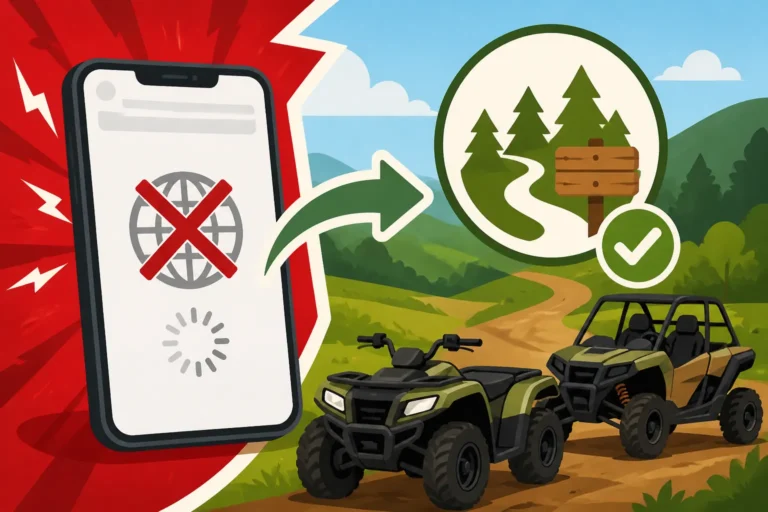
Save the park’s contact details, confirmation message, reservation information, and directions before you leave. Cell coverage can vary along rural routes and in wooded areas, so do not assume you can retrieve a webpage or reply to a message at the gate. A screenshot or saved note can prevent a lot of fumbling when you are traveling with passengers and equipment.
If someone else is driving, share the plan with the whole group: which entrance to use, what time you expect to arrive, what the park confirmed, and what you will do if access changes. This is especially helpful when several vehicles are meeting from different parts of the state. A clear meeting plan keeps one person from waiting at the wrong entrance while another is trying to reach the park.
Before you hook up the trailer, do one final check for a new closure notice or schedule change. Then confirm that the route and arrival details you saved still make sense. Those few minutes can spare you a long detour, a disappointed group, and an avoidable drive back home.
Disclaimer
This article is for general informational purposes only and does not constitute professional advice. Laws, prices and regulations vary by location and change over time. Consult a qualified professional for guidance on your specific situation.