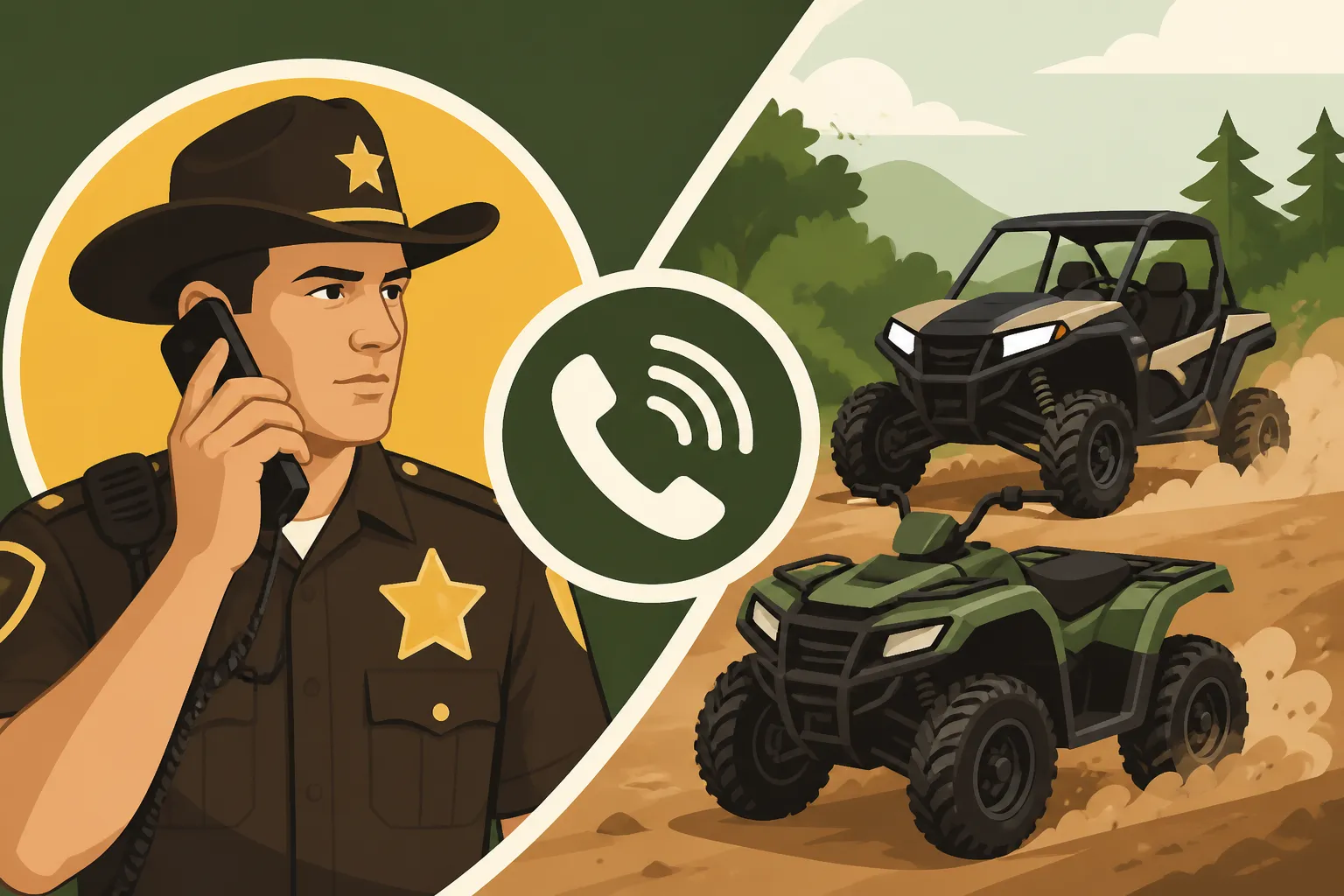
Calling an Alabama Sheriff Before You Ride
It’s a tale as old as time for Alabama ATV and UTV enthusiasts: you want to enjoy your machine, maybe even use it for quick trips on nearby roads, but the rules feel like a tangled mess of red tape and conflicting advice. This guide is here to untangle that confusion, validating your frustration with the mixed messages and showing you exactly why and how reaching out to your local sheriff's department directly is often the most reliable first step to understanding what’s permissible in your specific neck of the woods.
Why Local Law Enforcement Is Your Most Reliable Source
Let's be honest, figuring out the rules for riding your ATV or UTV on public roads in Alabama can feel like trying to hit a moving target while blindfolded. You read something online, hear a different story from a buddy, and then the guy at the local hardware store tells you something else entirely. It’s enough to make anyone throw their hands up in exasperation. The core problem is that while Alabama has a state law that largely prohibits off-highway vehicles on public roads, local jurisdictions sometimes have their own ordinances or interpretations that can either make things a bit clearer or, frankly, even more confusing. This is precisely why your local sheriff's department isn't just a source of information; they are the most direct and authoritative source for what applies in your county.
The Problem with General State Law
Alabama’s state law regarding off-highway vehicles, like ATVs and UTVs, is pretty clear on one major point: generally, these machines are not designed or permitted for public road use. The state statute often points to federal motor vehicle safety standards (FMVSS) as the benchmark, and the vast majority of ATVs and UTVs simply don't meet these stringent requirements. This means they lack things like Department of Transportation (DOT) approved tires, specific lighting, windshields, and other safety features required for street-legal vehicles. Trying to modify a standard ATV or UTV with a [Alabama UTV Street Legal Conversion] kit often won't change its fundamental classification under state law, as the core structure and manufacturing intent are still for off-road use.
However, the state law also has some specific carve-outs, such as for agricultural use or crossing roads in particular ways. But these exceptions are often interpreted locally. What one deputy considers "farm use" might be different from another, leading to inconsistent enforcement and a lot of headaches for riders. This ambiguity is why relying solely on the general state statute, without understanding local nuances, can lead you down the wrong path and potentially result in a citation.
The Role of Local Ordinances and Interpretations
Here’s where it gets really tricky and why calling your local sheriff is paramount. While state law sets the overarching framework, many Alabama cities and counties have the power to enact their own ordinances that might further restrict or, in rare cases, even permit certain types of off-road vehicle use on specific local roads. For example, a small rural town might have an ordinance allowing golf carts on certain streets, and some people might mistakenly think this applies to UTVs, or they might have specific rules for farming communities. [Alabama City Ordinance Lookups] can be a bewildering task, as not all are easily found online or clearly worded.
The sheriff's department, through their deputies patrolling your area, is the primary enforcer of both state law and any relevant local ordinances in unincorporated areas of the county. They are on the ground every day, dealing with real-world scenarios, and their office can provide the most accurate and up-to-date information for your specific location. This local knowledge is invaluable and bypasses the often-conflicting advice you might get elsewhere.
Why Relying on Forums and Buddies Is Risky
It’s natural to ask your riding buddies or scour online forums for advice. There's a wonderful community spirit among off-roaders, and often people genuinely want to help. However, the information you get this way, while well-intentioned, is often anecdotal, outdated, or specific to a different county or even a different state. What’s legal in Blount County might be strictly forbidden in Baldwin County. What someone heard from a friend of a friend two years ago might no longer be true.
Furthermore, relying on unverified information leaves you legally vulnerable. If you're pulled over and cited, telling the deputy, "My buddy told me it was okay," isn't going to hold up in court. The only advice that truly counts comes from the authorities responsible for enforcing the law in your area. They have the most current information and, importantly, their guidance can sometimes be documented, providing you with a clearer understanding and potentially a defense if needed.
Understanding Alabama's State Law on Off-Road Machines
Before you even pick up the phone, having a basic grasp of what Alabama's state law generally says about ATVs and UTVs on public roads will help you frame your questions better. It’s not about becoming a legal expert, but knowing the common sticking points can guide your conversation with law enforcement. The Alabama Legislature has defined these vehicles and set parameters for their use, which largely restrict them from the paved and unpaved public road systems we use for cars and trucks.
The Core Prohibition: Not for Public Roads
The foundational principle in Alabama, as in many states, is that ATVs and UTVs are primarily designed for off-road use. The state’s off-road vehicle statute explicitly addresses this, making it clear that these machines are not considered "motor vehicles" in the same vein as cars, trucks, or motorcycles for public highway purposes. This distinction is crucial. It means they typically don't have the necessary safety equipment or design features to comply with federal standards for road-going vehicles. Think about it: most quads lack turn signals, rearview mirrors, proper headlights and taillights for highway visibility, and seat belts, not to mention the specialized tires that are great for mud but terrible for pavement. [Alabama's Federal Standard Barrier to Road Use] is a real and significant hurdle.
This general prohibition is designed for safety, protecting both the ATV/UTV rider and other motorists. The differences in speed, braking, stability, and visibility between an off-road machine and a passenger car on a public road are substantial, leading to increased accident risks.
Exceptions for Farm and Utility Use
Now, here’s where a little wiggle room might exist, but it's important to understand the narrowness of these exceptions. Alabama law does acknowledge that off-road vehicles can be legitimate tools for agriculture and certain utility functions. For example, if you're a farmer needing to move a piece of equipment from one field to another across a public road, there are often provisions for this. Similarly, utility workers might use them for maintaining power lines or pipelines that cross public rights-of-way. [Alabama Farm Use and Road Riding] is a specific topic that comes up frequently.
However, these exceptions are usually tied to the purpose of the ride, not just the type of machine. You can't just throw a hay bale on your UTV and declare it "farm use" for a joyride to town. The use must be directly related to the agricultural or utility operation. Furthermore, there might be stipulations about the time of day, visibility, and even the maximum distance you can travel on a public road under these exceptions. This is another area where local interpretation by the sheriff's department becomes critical.
What About Crossing a Road?
Another common question that comes up is whether you can simply cross a public road to get from one private property to another, or to access a trail. Alabama law generally allows for crossing a highway, but usually under very specific conditions. These conditions often include coming to a complete stop, yielding to all traffic, and making the crossing at a ninety-degree angle to the road, essentially taking the shortest path possible across the roadway. [Crossing a Road on an ATV in Alabama] is not a green light to ride down the road for any distance.
This exception is not an invitation to ride along a road, even for a short distance. It’s strictly for traversing the asphalt to reach a destination on the other side. This is another critical distinction that a local deputy can help clarify for the specific roads and intersections in your area. It’s always better to err on the side of caution and understand the precise limitations before you find yourself in a bind.
What to Ask When You Call the Sheriff
So, you’ve decided to make the call. That’s a fantastic step! But don’t just say, "Can I ride my quad on the road?" You need to be specific to get truly helpful information. Preparing a list of clear, concise questions will ensure you get the most out of the conversation and prevent misunderstandings. Remember, the goal is to get information that is directly applicable to your machine and your riding intentions.
Be Specific About Your Machine
The first thing to clarify is the exact type of machine you own. Is it a traditional ATV (a quad, one rider straddling it)? Or is it a UTV/side-by-side (multiple riders, steering wheel, bucket seats)? The legal definitions in Alabama can sometimes differentiate between these, impacting how rules are applied. For instance, [Alabama ATV Width and Weight Limits] are generally more restrictive than [Alabama ROV Width and Weight Limits], though both face similar road prohibitions.
You’ll want to mention your machine's make, model, and year if it feels relevant, though generally, the type (ATV vs. UTV) is more important for road use questions than the specific brand. Also, be ready to describe any modifications you've made, particularly those that might be considered for "street legal" conversion, even if you suspect they won't make it legal. For instance, if you've added SuperATV mirrors or turn signals, mention that, but don’t assume these make your machine compliant. The officer will be thinking about federal standards first and foremost.
Pinpoint the Specific Roads and Areas
Don’t just ask about "county roads" generally. Alabama counties can be huge, and rules might vary even within a single county, especially if certain areas are incorporated cities. Be ready to name specific roads, or even cross streets, where you're considering riding. "Can I ride my UTV on County Road 14 between Highway 31 and Smith Road?" is a much better question than "Can I ride on a county road?" This level of detail helps the sheriff's office give you precise guidance rather than a generic answer.
Also, specify if these are paved roads, dirt roads, or gravel roads. While the state law generally doesn't differentiate between paved and unpaved public roads for ATV/UTV use, some local ordinances might. Knowing the exact location and type of road helps the officer check for any hyper-local rules that might apply. [Do Alabama County Roads Have Their Own ATV Rules?] is a question best answered by the local authority.
Clarify Your Intended Use
As we discussed, the purpose of your ride can sometimes trigger a limited exception. Are you planning to cross the road to get to hunting land? Are you moving farming equipment between fields? Are you simply trying to get to a neighbor’s house a mile down a quiet residential street?
Be upfront about your intentions. "I need to get my quad from my farm on one side of County Road X to my pasture on the other side, about a quarter-mile down the road. Is that permissible, and if so, what are the conditions?" This honest and detailed approach gives the sheriff’s office the full picture and allows them to provide the most accurate advice under the specific exceptions related to agricultural, utility, or road-crossing scenarios. Remember that general recreational riding on public roads is almost universally prohibited.
Preparing for the Conversation
Making that call can feel a bit daunting, but a little preparation goes a long way. This isn't an interrogation; it's a request for clarity and guidance from public servants whose job it is to ensure public safety and enforce laws. Being polite, organized, and focused will help you get the answers you need efficiently.
Gather Your Information Before Calling
Before you dial, have all your pertinent information ready. This includes:
- The exact type of machine (ATV, UTV, year, make).
- Specific road names, county numbers, or geographical markers for your intended route.
- A clear articulation of your purpose for riding on those roads.
- Any specific modifications, like lights or mirrors, that you've installed, even if you know they don't make it "street legal."
- A pen and paper (or a note-taking app) to write down details, including the name of the person you spoke with, the date, and the specific advice given.
Having these details at your fingertips shows you're serious about compliance and respectful of their time. It also prevents you from fumbling for answers or having to call back with follow-up questions you could have asked initially.
Be Polite and Patient
Law enforcement agencies are busy. When you call, be prepared for potential hold times or for the person answering the phone to direct you to another department or individual. When you do connect with someone, introduce yourself, state your reason for calling clearly and concisely, and be unfailingly polite. Phrases like "I'm calling to respectfully inquire about ATV/UTV use on public roads in my area" set a positive tone.
Remember, the person you're speaking with is there to help, but they might need to consult statutes or other officers. Patience is key. If they tell you they need to get back to you, thank them and ask for a timeframe. A courteous approach is more likely to yield helpful and detailed responses.
Ask for Written Confirmation (If Possible)
While a verbal confirmation is a good start, having something in writing is always better. You can ask if there's any official documentation, such as a local ordinance document, or a written policy statement that you could be directed to. You might also ask if they would be willing to send an email summarizing their advice, particularly if it's a complex scenario involving farm use or road crossings.
Understandably, not every department or every officer will be able to provide written confirmation for every inquiry. However, simply asking demonstrates your diligence and desire for clarity. Even if you only get a verbal answer, meticulously documenting the conversation—who you spoke to, when, and what was said—provides a valuable record for your own peace of mind. This step helps establish [Proving You Own an Untitled Machine] through diligence.
Potential Outcomes and Next Steps
Once you've made the call and received guidance from your local sheriff's department, you'll have a much clearer picture of what's allowed. The outcomes can vary significantly depending on your location and specific circumstances. Understanding what these outcomes might mean for your riding plans is crucial for responsible off-road vehicle ownership.
The "No" Answer and What It Means
For many inquiries about riding ATVs or UTVs on public roads in Alabama, the most common answer you'll receive from law enforcement will likely be a straightforward "no." This is not a reflection on you or your machine; it's simply a reiteration of the state's general prohibition against these vehicles on public roadways. It means that, within the jurisdiction of that sheriff's department, your off-road vehicle is not legally permitted for road use, even for short distances or seemingly minor crossings, unless it falls under an extremely narrow and specific exception that applies to your situation.
If you receive a "no," it's vital to respect that answer. Attempting to ride your machine on public roads despite being told it's not allowed can lead to serious legal consequences, including fines, impoundment of your vehicle, and even more severe penalties if an accident occurs. [Alabama Penalties for Illegal Road Riding] can be quite substantial. This outcome should prompt you to explore alternative riding locations where your machine can be enjoyed legally and safely.
The "Yes, Under Specific Conditions" Answer
In some, rarer cases, you might receive a "yes," but it will almost certainly come with a laundry list of conditions. This usually applies to situations like specific agricultural use, utility work, or very limited road crossings. For example, the sheriff might say, "Yes, you can cross County Road 10 to get from your field to your barn, but you must stop completely, yield to all traffic, and only travel directly across the road at a 90-degree angle. No riding along the shoulder."
These conditions are not suggestions; they are legal requirements. It’s absolutely critical that you understand and strictly adhere to every single stipulation. Failure to do so could result in you violating the very permission you were granted, leading to the same penalties as if you had received a "no" answer. Make sure to write down every condition clearly and confirm your understanding during the call. This is particularly important for scenarios like [Alabama Rules for Farm Machines on Roads] or [Alabama Rules for Crossing a Highway].
Documenting Your Conversation
Regardless of the answer you receive, immediately after the call, take a few minutes to document everything thoroughly. Write down the date and time of your call, the name and title of the person you spoke with, and a detailed summary of the information and advice they provided. If you discussed specific roads or conditions, record those precisely. This documentation serves as your personal record of due diligence.
While this record might not always hold up as absolute legal immunity, it demonstrates your good faith effort to comply with the law. In a roadside stop situation, being able to articulate that you called the sheriff's office, on what date, and what you were told, shows a level of responsibility that might be viewed favorably by an officer. It certainly beats claiming ignorance or relying on hearsay.
Alternative Riding Opportunities in Alabama
If, after all your inquiries, it turns out that riding your ATV or UTV on public roads in your area is largely prohibited (which is the most common scenario), don't despair! Alabama offers a fantastic array of legal and fun places to ride. The key is to shift your focus from public roads to designated off-road areas.
Exploring Dedicated Off-Road Parks
Alabama is home to several excellent, dedicated off-road parks where you can unleash your ATV or UTV without worrying about road laws. These parks are designed specifically for off-highway vehicles and often cater to a range of skill levels, from beginner trails to challenging rock crawls and mud pits.
One of the most well-known is [Stony Lonesome OHV Park in Alabama], located in Cullman County. It boasts over 150 miles of trails for various vehicle types, including ATVs, UTVs, and even full-size 4x4s. They have designated areas, clear rules, and often offer camping facilities. Another great option is [Minooka Park Riding in Alabama] in Chilton County, which provides hundreds of acres of riding opportunities. These parks typically require an admission fee, and often a signed waiver, but they provide a safe, legal, and exhilarating environment for riding. They are often equipped with amenities like wash stations, restrooms, and sometimes even cabins or RV hookups. When considering such parks, remember to check their specific [Alabama Private Park Helmet Rules] and [Alabama Private Park Age Minimums].
Riding on Private Land with Permission
For many riders, the most accessible and frequent riding spot is private land. If you own private property, you generally have the freedom to ride your ATV or UTV on it as you see fit, adhering to basic safety practices and local noise ordinances.
If you don't own land, gaining permission from a private landowner is your next best bet. This could be a friend, family member, or even a local timber company. Always ensure you have clear, preferably written, permission from the landowner before riding on their property. This prevents any accusations of trespassing, which can carry significant penalties. [Alabama Landowner Permission Letters] can be a simple but effective tool for this. Building good relationships with landowners is crucial for continued access.
Understanding WMA and National Forest Rules
Alabama also has Wildlife Management Areas (WMAs) and portions of National Forests that sometimes allow off-road vehicle use, but this is highly restricted and requires careful research. WMA rules are incredibly specific and vary greatly by area, often changing seasonally or for hunting purposes. You'll typically need to purchase a WMA license and sometimes specific area permits, and usually, vehicles are restricted to designated roads or trails only, primarily for game retrieval or access to hunting stands, not recreational riding. [Alabama WMA Riding Rules for Quads] are often very limited.
Similarly, National Forests in Alabama, such as the Talladega National Forest or William B. Bankhead National Forest, have designated roads that may or may not be open to ATVs and UTVs. Recreational off-trail riding is almost always prohibited. It is absolutely essential to contact the district office for the specific National Forest or WMA you intend to visit and obtain current maps and regulations before you ever load up your machine. Assuming you can ride just anywhere in a national forest is a common and often costly mistake. [Can You Ride an ATV in Alabama's National Forests?] is a complex question with specific answers for each district.
| Road Type | General Alabama ATV/UTV Road Legality | Key Considerations | Recommended Action |
|---|---|---|---|
| State Highways | Highly Restricted/Prohibited | Federal standards (FMVSS) are strictly enforced. High speed limits. | Avoid unless explicit, documented exception (rare). |
| County Roads (Paved) | Generally Prohibited | Local ordinances may exist but are rare for general riding. | Consult local Sheriff's office for specific roads/use. |
| County Roads (Unpaved) | Generally Prohibited | Often mistaken for "trails." Local rules are key. | Consult local Sheriff's office for specific roads/use. |
| City Streets | Generally Prohibited | City ordinances might allow golf carts, but rarely ATVs/UTVs. | Contact City Hall and local police for specific streets. |
| Private Roads | Permitted with Permission | Requires landowner consent. No public access. | Obtain clear permission from landowner. |
| Designated OHV Trails | Permitted | Designed for off-road use. Check park rules, fees, and safety regs. | Always the safest and most legal option for recreation. |
| WMA/National Forest Roads | Highly Restricted/Permitted (Limited) | Specific access roads only, often for hunting/retrieval, not recreation. | Obtain maps & rules from specific WMA/Forest District. |
Disclaimer
This article is for general informational purposes only and does not constitute professional advice. Laws, prices and regulations vary by location and change over time. Consult a qualified professional for guidance on your specific situation.