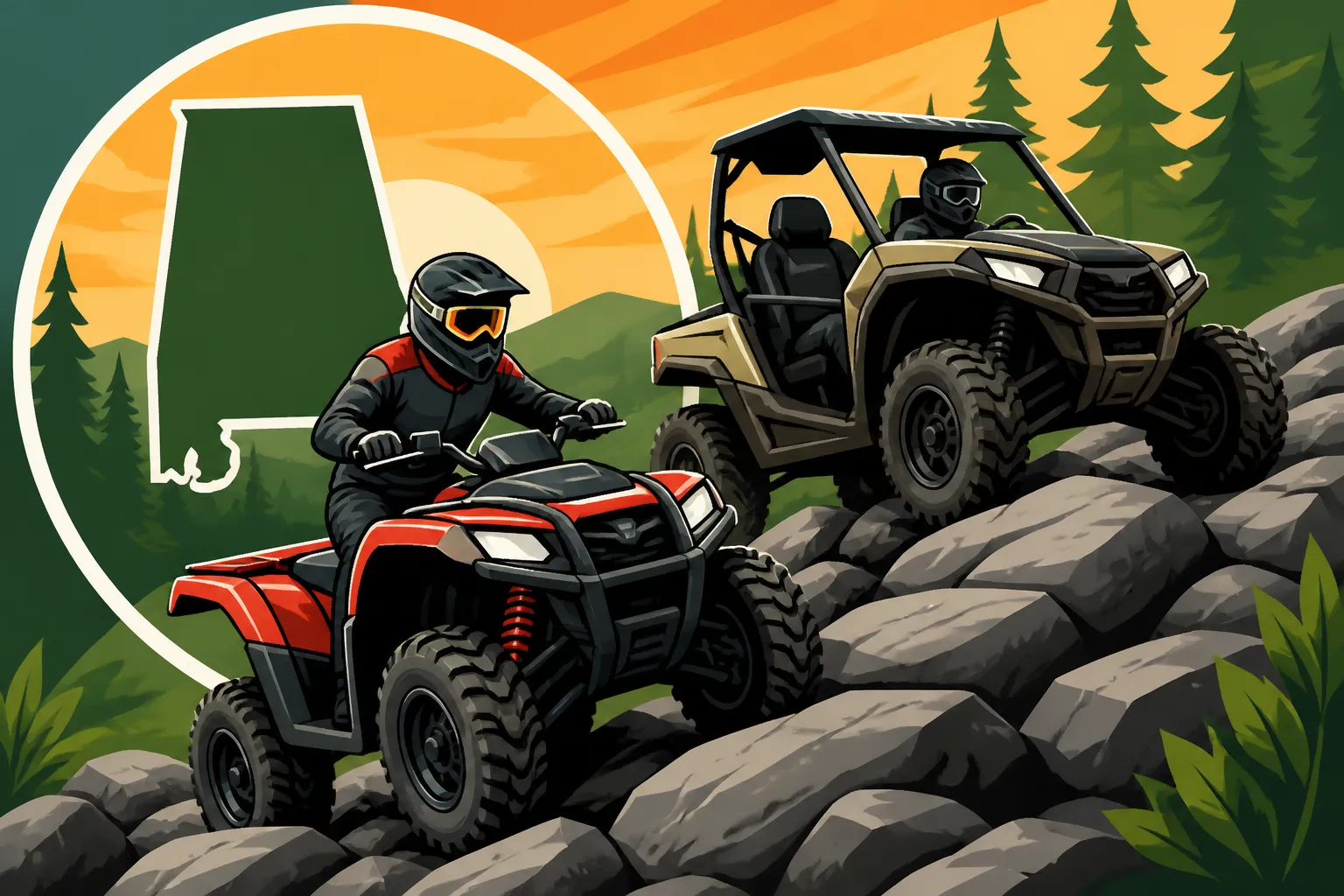
Alabama Parks With Rock Crawling
Finding a place to rock crawl in Alabama can be harder than it sounds: a park may advertise challenging trails without having a dedicated rock garden, and a route that suits a short-wheelbase quad may not suit a wide side-by-side. This guide compares Alabama riding areas, explains what to check before towing, and helps you match your machine and experience to the terrain.
What to look for in an Alabama rock-crawling park
Rock crawling can mean different things at different parks
At one riding area, “rock crawling” may mean a marked obstacle section with exposed rock, steep ledges, and routes around the hardest lines. At another, it may describe naturally rocky portions of a larger trail system. Those are different experiences, especially if you are towing in a modified UTV expecting purpose-built obstacles.
Ask the park what it means by rock crawling before you go. Find out whether obstacles are on designated routes, whether the park has separate lines for different vehicle sizes, and whether a stock machine can bypass the hardest sections. A staff member who knows the terrain can often explain whether the challenge is mainly steepness, loose rock, ledges, tight turns, or a combination.
It also helps to distinguish rock crawling from mud riding. A park may offer both, but a muddy trail is not automatically a rock-crawling route. Mud can conceal holes and sharp edges, while exposed rock calls for deliberate tire placement and careful throttle control. For a broader overview of areas that advertise this type of terrain, see [Alabama Parks With Rock Crawling].
Check that the park allows your exact machine
“ATV,” “UTV,” and “side-by-side” are not interchangeable for every park’s admission rules. Some areas have routes suitable for quads but restrictions for larger machines. Others may allow side-by-sides only on certain trails, or may have limits related to width, passenger capacity, tires, or vehicle type.
Before you load up, give the park the details that matter: machine make and model, approximate width, number of seats, tire setup, and whether it is a four-wheel-drive UTV. If you have a modified machine, mention the modifications. A wide machine with a long wheelbase may fit through the park gate but still be unsuitable for narrow, rocky routes.
The trail system’s map and difficulty labels also deserve a careful look. A route marked “advanced” may be manageable for an experienced driver in a capable UTV but inappropriate for a novice on a smaller quad—or the reverse. [Alabama Trails That Allow Side-by-Sides] is a useful related topic when you are sorting out whether a riding area accommodates your vehicle.
| Riding area | What to investigate for rock crawling | Good questions before you tow |
|---|---|---|
| Hawk Pride Mountain Offroad near Tuscumbia | Whether the park’s current layout includes rock-crawling routes suited to your vehicle | Which obstacles are open, and are there bypasses? |
| Boggs and Boulders near Andalusia | Which sections are rocky obstacles versus mud or general trail riding | Are routes separated by machine size or difficulty? |
| Stony Lonesome OHV Park near Bremen | Whether its current trails include the kind of rocky challenge you want | Which trails are open to your machine and experience level? |
| Minooka Park near Jemison | Whether a specific route offers exposed rock or technical obstacles | Is rock crawling available on an open trail, or only in a designated area? |
Park layouts, access rules, and open routes can change. Treat this table as a starting point for your questions, not a guarantee that a particular obstacle is available on the day you visit.
Alabama riding areas to investigate
Hawk Pride Mountain Offroad near Tuscumbia
Hawk Pride Mountain Offroad, near Tuscumbia in northwest Alabama, is one of the names worth investigating if your main goal is technical off-road terrain. Before making plans, confirm directly which parts of the property are open to your vehicle and whether the park currently identifies particular routes or areas for rock crawling. A name on a list is not enough to establish that every route will be suitable for every ATV or UTV.
For a first visit, ask how the terrain is divided by difficulty and whether staff recommend a particular route for a newcomer. If your group includes both experienced crawlers and riders who prefer easier trails, you will want to know whether people can choose different lines and reunite without leaving the designated route system. It is much easier to plan this at home than to negotiate it when the group is already at a rocky pinch point.
Check practical details as well: admission and riding procedures, operating schedule, parking and trailer space, safety requirements, and whether a waiver is required. Because these details can change, use the park’s own information before leaving. If an online trail map is available, compare it with the park’s latest guidance rather than relying on an old screenshot or an unverified social post.
Boggs and Boulders near Andalusia
Boggs and Boulders, near Andalusia in south Alabama, is another area to ask about when looking for a mix of off-road terrain. Its location makes it a possible option for riders coming from the southern part of the state, but the drive should not be the only deciding factor. Confirm whether the specific rock features you want to ride are open, and whether those sections are intended for your machine type.
A useful call is more specific than “Do you have rock crawling?” Ask whether there are marked rock obstacles, whether the park has different lines for different skill levels, and whether a stock UTV can reasonably use the easier routes. If your machine has oversized tires, a lift, a winch, or other modifications, explain that too. The staff may be able to point out limitations that are not obvious from a general trail description.
Think about the rest of your group, too. A technically difficult section can be fun for a prepared driver and stressful for a passenger who expected a relaxed trail ride. Agree in advance on who will attempt the obstacles, who will use a bypass, and where the group will meet afterward. A park with multiple kinds of riding may be a better fit than a single-purpose route if people in your party have different comfort levels.
Stony Lonesome and Minooka Park
Stony Lonesome OHV Park near Bremen and Minooka Park near Jemison are established Alabama riding destinations to investigate when planning a trip. Do not assume, however, that “challenging trails” means a dedicated rock-crawling course. Ask about the route or obstacle that interests you by name, and confirm whether it is open to your type and width of machine.
For Stony Lonesome, check the current trail map and park guidance before planning around a technical route. The park is a larger riding destination with a range of trail experiences, so it may suit a group that wants to mix trail riding with more difficult sections. The details that matter most are whether the rocky route is open, whether a bypass exists, and whether the trail is restricted by machine type or weather conditions. Read more in [Stony Lonesome OHV Park in Alabama].
Minooka Park is a different kind of planning question. It is a county park in Jemison with riding opportunities, but riders looking specifically for rock crawling should confirm the current obstacle options rather than infer them from the general availability of off-highway trails. Its location may be convenient for a central Alabama day trip, but convenience does not replace a route check. See [Minooka Park Riding in Alabama] for related information about the park.
Match the route to your ATV or UTV
Consider width, wheelbase, ground clearance, and tires
A trail that looks manageable in a video can feel very different in person. Width affects whether a UTV can pass between trees or rocks; wheelbase influences how it approaches ledges and crests; ground clearance affects the risk of hanging up on an obstacle. Tire size and tread matter, but they do not compensate for a poor line or a vehicle that is too large for a narrow route.
Before choosing a route, compare your machine’s approximate width and wheelbase with the park’s restrictions and trail descriptions. A four-seat UTV may be longer and wider than a two-seat model, even within the same product family. Accessories such as doors, mirrors, spare tires, or a roof rack can also change how much clearance you need in tight terrain.
If your group owns different machines, plan around the least suitable vehicle rather than the most capable one. For instance, an experienced driver in a modified two-seat side-by-side may be comfortable with a tight rock section, while a stock four-seat UTV may need to take a bypass. [Alabama Trail Difficulty Ratings] can help frame the conversation, but ask the park how its ratings apply to your machine.
Choose a challenge that fits the driver, not just the machine
A capable machine does not make a new driver experienced. Rock crawling rewards patience, line choice, communication, and controlled inputs. A driver who is still learning may be better off starting with easier trails, observing more experienced riders, and tackling a short obstacle only when there is room to turn around or choose another line.
Talk through basic signals before anyone climbs into a vehicle. The driver should be able to see the spotter, and the spotter should stand where they are not exposed to a tire, a shifting vehicle, or a potential rollover path. If communication is unclear, stop. Continuing because other riders are waiting usually adds pressure without improving the line.
Passengers should know what the ride involves. A rocky route can jolt a vehicle, tilt it at an angle, and require pauses while the driver chooses a path. Children or passengers who are uncomfortable with those movements may be happier on an easier trail. For additional planning around vehicle fit and terrain, see [Alabama North and South Riding Compared] and [Alabama Trail Difficulty Ratings].
Use maps as planning tools, not permission to ride anywhere
A digital map can help you understand the general layout of an area, identify nearby trail systems, and plan a route before you arrive. Tools such as onX Offroad can be useful for that sort of trip planning, especially when you want to compare mapped routes with your group’s experience and vehicle capability. Download or save the information you need before heading into an area where service may be limited.
A map does not establish that a route is open, legal for your vehicle, or suitable for your skill level. Park boundaries and public-land boundaries can be easy to confuse, and a line on a screen should never be treated as authorization to leave an approved trail. Use the park’s own map and posted signs to confirm what is permitted.
Keep a paper or saved copy of the park map as a backup, and share the plan with everyone in the group. If you use onX Offroad to sketch a route, compare it with the park’s official guidance and ask staff about closures or route changes. Local signs and instructions at the entrance take priority over an old saved track.
Plan for conditions, safety, and trail etiquette
Check rain, closures, and changing ground conditions
Weather can change the character of a rock route. Rain may make surfaces slippery, wash loose material into a trail, or turn a water crossing into a different obstacle. Even when exposed rock remains visible, wet tires can lose traction, and an approach that felt controlled in dry conditions may become difficult.
Call or check the park’s official updates before you leave, particularly after a storm or during a wet stretch. Ask whether any routes are closed, whether certain areas are restricted to protect the ground, and whether the park recommends delaying your visit. A closed trail is not an invitation to find a way around a barrier; closures are part of keeping riders and the property safe.
Build flexibility into your day. If the route you planned is closed or beyond your group’s comfort level, be willing to switch to an easier trail rather than trying to force the original plan. [Alabama Trail Closures After Rain] and [Alabama Trail Riding After Heavy Rain] cover related considerations for trip planning.
Bring practical recovery and safety gear
Rocky terrain can place a machine in an awkward position even when nothing has broken. Pack a first-aid kit, drinking water, communication devices, basic tools, and any recovery equipment appropriate to your vehicle and experience. If you carry a winch, know how to use it safely and inspect the equipment before the trip. A winch is not a substitute for choosing a sensible line or having a safe recovery plan.
Protective gear matters on a technical trail. Wear a helmet and other riding gear that suit the machine and conditions, and follow the park’s posted requirements. Secure loose items so they cannot fall onto the trail or interfere with the vehicle. If you are riding with passengers, make sure everyone understands where to sit, how to brace, and when to remain in the vehicle.
Do not attempt a recovery simply because you feel pressure to clear the trail. Stop, assess the machine’s position, and ask for help if you are unsure how to proceed. Keep bystanders well away from a winch line and from the vehicle’s path. A calm pause is usually safer than a rushed pull.
Respect shared trails and the property
A rock-crawling area may be shared by vehicles with very different speeds, sizes, and abilities. Follow posted direction, yield as instructed, and make sure your group does not block a trail while discussing an obstacle. If you stop to spot a driver, place people where they can communicate clearly without standing in a dangerous position.
Stay on designated routes and avoid creating new lines around an obstacle. Riding around a muddy or rocky section can damage vegetation, widen the trail, or create a route that the park has not approved. If a trail is blocked, too difficult, or damaged, turn around where safe and tell park staff rather than cutting a new path.
Good etiquette also means being realistic about noise, litter, and group size. Pack out what you bring in, keep equipment secure, and give other riders room to pass or take their turn. [Alabama Trail Etiquette Locals Expect] offers more guidance for sharing riding areas responsibly.
Before you tow, use this trip checklist
Confirm the details with the park
A quick call or official-page check can prevent a long, frustrating drive with a machine that cannot use the routes you came to ride. Ask about operating days, admission procedures, check-in, machine restrictions, current closures, and whether the park has a specific rock-crawling area. If staff use names for individual routes or obstacle zones, write those names down so you can find them on the map.
Be direct about your vehicle. Give the model or approximate width, number of seats, tire setup, and any major modifications. If you are bringing a group, explain the range of machine types and experience levels. Ask whether all vehicles can ride together or whether the park recommends different routes.
Clarify what “open” means for the day you plan to visit. A park can be operating while a particular trail is closed, or a route can be open but unsuitable after recent rain. For more background on private riding areas, see [Alabama Private Off-Road Parks]. If you are considering a public-land route instead, do not assume the same access rules apply.
Pack for the whole day, not just the obstacle
The drive to a riding area is only one part of the plan. Secure the machine properly, bring the gear required by the park, and make sure your tow vehicle has what it needs for the return trip. Pack water, food, basic tools, a first-aid kit, charged communication devices, and a paper or saved trail map.
Set a meeting point in case your group gets separated. Agree on how you will handle a breakdown, a route closure, or a rider who wants to stop. If you are visiting an unfamiliar park, identify where to check in and ask staff what to do if someone needs assistance on the trails.
Finally, leave room to change plans. If conditions are slick, a route feels too difficult, or your machine is not suited to the obstacle, choose a different trail. The best rock-crawling day is not the one where someone conquers every line; it is the one where the group rides within its limits and gets home safely.
Disclaimer
This article is for general informational purposes only and does not constitute professional advice. Laws, prices and regulations vary by location and change over time. Consult a qualified professional for guidance on your specific situation.