Alabama Excludes Farm Equipment
Many Alabamians who own an ATV or side-by-side often find themselves scratching their heads when it comes to understanding the state's rules, especially when their machine pulls double duty around the farm. It's easy to get confused about whether your trusty farm quad needs to be registered or titled like a recreational one. This guide will clarify Alabama's specific exclusion for farm equipment, helping you navigate the requirements for your off-road machine used for agricultural purposes.
Understanding Alabama's Off-Road Vehicle Definitions
Before we dive into what makes a piece of equipment "farm equipment" in Alabama, it's really important to understand how the state generally defines the off-road vehicles we're talking about. The lines can sometimes feel a bit blurry, but the law tries to draw clear distinctions. Knowing these definitions is your first step to understanding why certain machines are treated differently.
How Alabama Defines an All-Terrain Vehicle (ATV)
In Alabama, an All-Terrain Vehicle, or ATV, typically refers to those three or four-wheeled machines designed for off-highway use. Think about the classic quad: it's built for rough terrain, often has a straddle-style seat, and handlebar steering. The legal definition often specifies things like its width, weight, and engine size. For example, the statute will generally define an ATV as a motorized, off-highway vehicle that is 60 inches wide or less, weighs 1,500 pounds or less, and has non-highway tires. If your machine fits this description, it's an ATV in the eyes of Alabama law, and normally, you'd be looking at registration requirements if you plan to ride it off your private property. You can learn more about [Alabama's ATV and ROV Legal Definitions].
These machines are not intended for paved public roads, and their design reflects that. They're meant for trails, fields, and rugged landscapes, which is why a separate set of rules governs them compared to, say, a car or even a motorcycle. The intent of the manufacturer plays a big role here, as does the equipment itself, particularly the tires.
How Alabama Defines a Recreational Off-Highway Vehicle (ROV/UTV)
Recreational Off-Highway Vehicles (ROVs), more commonly known as Utility Terrain Vehicles (UTVs) or side-by-sides, are also defined within Alabama law. These are generally larger, heavier, and often have bench or bucket seats with a steering wheel, much like a small car. They're designed for a variety of tasks, including hauling and carrying passengers, in off-highway environments. Alabama's definition for ROVs typically includes machines that are 80 inches wide or less, weigh 3,500 pounds or less, and also feature non-highway tires.
Many farmers use UTVs extensively for work, hauling feed, tools, or even livestock, making this definition particularly relevant to them. Just like ATVs, these machines are built for off-road performance, not for highway speeds or public street use. The increased cargo capacity and seating arrangements make them incredibly versatile, but they still fall under the umbrella of off-highway vehicles that, under normal circumstances, would require registration for public land use. Understanding [Alabama ROV Width and Weight Limits] can help clarify if your side-by-side falls into this category.
The Importance of Non-Highway Tires in the Definition
One critical element in both the ATV and ROV definitions in Alabama is the phrase "non-highway tires." This isn't just a technicality; it's a fundamental characteristic that separates these vehicles from street-legal automobiles. Non-highway tires are designed for maximum traction on loose surfaces like dirt, mud, sand, or gravel. They often have aggressive tread patterns, lack Department of Transportation (DOT) approval, and are not built for the speeds, forces, or wear patterns encountered on paved roads.
This tire characteristic is a key indicator that the vehicle is intended for off-road use only. If your machine came from the factory with these types of tires, it's highly likely to be classified as an ATV or ROV under Alabama law, regardless of how you primarily use it. This distinction is crucial because it's one of the first things law enforcement or licensing officials will look at when determining a vehicle's classification. It sets the stage for whether specific exemptions, like the farm equipment exclusion, might apply to your particular machine.
The Specific Farm Equipment Exclusion in Alabama Law
Now that we've covered the general definitions of ATVs and ROVs, let's get to the heart of the matter for many Alabamian landowners and farmers: the farm equipment exclusion. This specific provision in the law offers a much-needed reprieve for those who rely on these machines for their livelihood, ensuring they aren't burdened with unnecessary registration or titling requirements.
Locating the Exclusion in the Statute
Alabama's off-road vehicle statute explicitly carves out an exclusion for farm equipment. You'll typically find this language in the sections defining what constitutes an "off-road vehicle" for the purposes of titling and registration. The law recognizes that certain machines, while they might otherwise fit the description of an ATV or ROV, are primarily used for agricultural purposes and, therefore, should not be subjected to the same administrative burdens. This is a common-sense approach designed to support the state's agricultural industry.
This exclusion is not hidden away in a minor footnote; it's an intentional and clear statement within the legal framework. It acknowledges that a farmer's UTV, used for checking fences, moving irrigation pipes, or herding cattle, serves a fundamentally different purpose than an identical UTV used for recreational trail riding at a state park. The legislative intent behind this exclusion is to prevent unnecessary regulation from impeding agricultural operations. It’s also important to note that [Alabama Excludes Golf Carts From the Chapter] and other similar vehicles that don't quite fit the off-road vehicle definition.
Why This Exclusion Exists
The primary reason for the farm equipment exclusion is to facilitate agricultural operations. Farming is a demanding profession that often requires versatile, agile machinery to navigate diverse terrains and perform various tasks efficiently. Imposing registration and titling requirements on every ATV or UTV used exclusively for farm work would create an undue regulatory burden, adding costs and paperwork without significant public safety benefits, especially when these machines rarely, if ever, leave private agricultural land.
Furthermore, many traditional farm implements, like tractors and combines, have always been exempt from standard vehicle registration and titling when used for agricultural purposes. This exclusion simply extends that same logic to modern off-road vehicles that have become indispensable tools on today's farms. It's about recognizing the practical realities of agricultural life and ensuring that state regulations don't inadvertently hinder productivity or increase operational costs for farmers. The state wants to support its farmers, not complicate their daily tasks with red tape.
What the Exclusion Means for Titling and Registration
For an ATV or UTV that qualifies as "farm equipment" under Alabama law, the exclusion means a few very important things. First and foremost, you generally do not have to register it with the Alabama Law Enforcement Agency (ALEA) for public or private use, as you would a recreational machine. Second, and this is especially relevant with the new titling law coming into effect for model year 2026 and newer machines, you do not have to title it in Alabama, regardless of its model year. The specific wording of the exclusion makes these machines outside the scope of the titling and registration requirements altogether, as long as they meet the "farm equipment" criteria.
This is a significant benefit for farmers, as it saves them the time, effort, and fees associated with these processes. It means less paperwork and more time focused on farming. However, it's critical to understand the conditions under which this exclusion applies, as merely owning a farm doesn't automatically exempt every off-road vehicle you possess. The key lies in the primary use of the machine, which we'll explore next. For many, this exclusion means they don't have to worry about the complexities of [Alabama Public Use ATV Registration Explained] or [Alabama Private Use ATV Registration Explained].
What Qualifies as "Farm Equipment" in Alabama?
This is where the rubber meets the road, or perhaps more aptly, where the tractor tire meets the field. The core of the farm equipment exclusion lies in its definition, and it's not always as straightforward as you might hope. It’s less about the type of machine and more about its primary function and context of use.
Examples of Clearly Exempt Farm Equipment
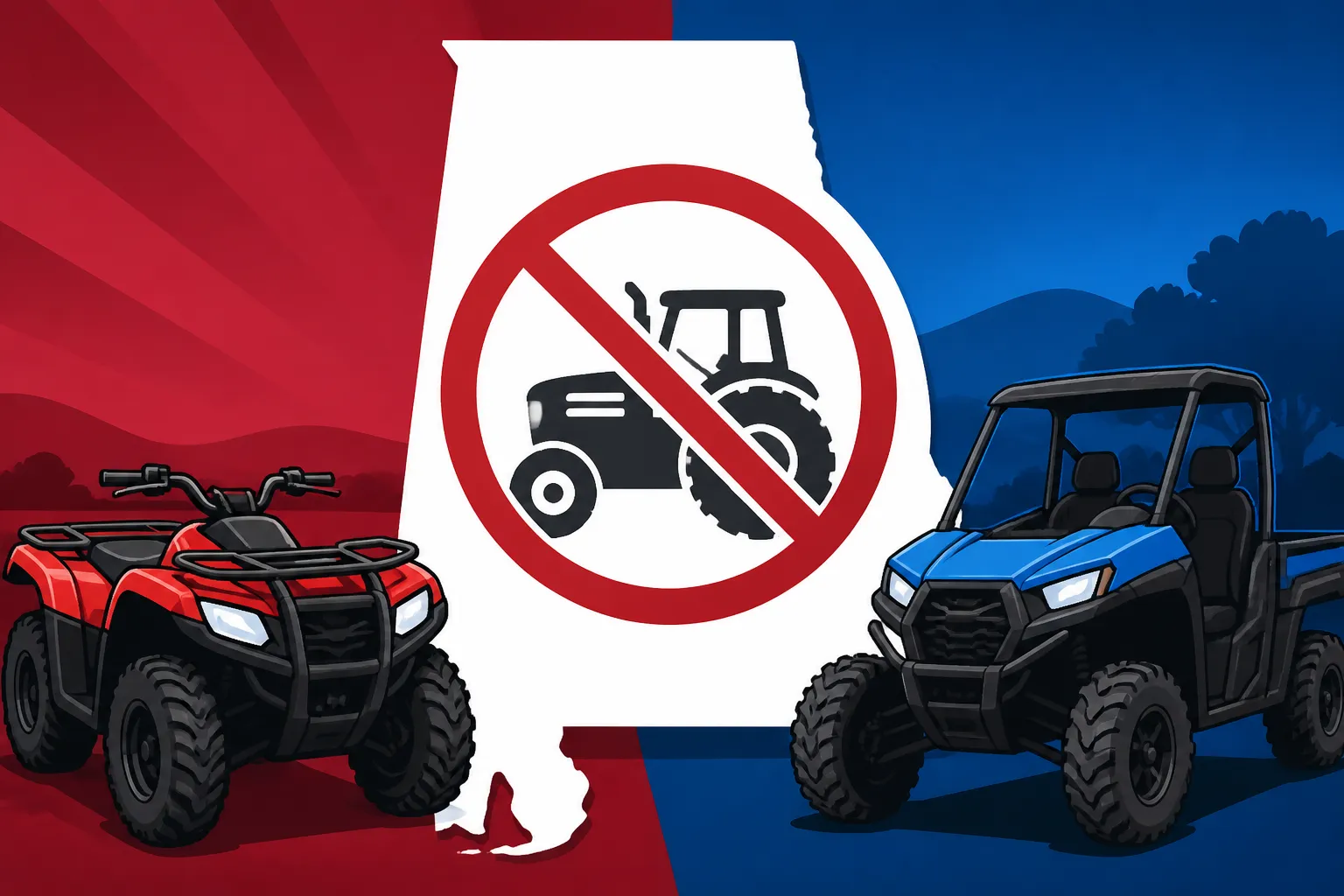
When we talk about "farm equipment," the images that typically come to mind are large, purpose-built machines like tractors, cultivators, combines, and planters. These are unmistakably designed and used exclusively for agricultural operations, from tilling fields to harvesting crops. These machines, by their very nature, are exempt from typical vehicle registration and titling when used in a farming context. You don't see tags on your neighbor's combine for a good reason!
Beyond these giants, many smaller items also clearly fall under the farm equipment umbrella. Think about specialized sprayers pulled by a UTV, seed spreaders, certain types of hay balers, or manure spreaders. If a machine is specifically manufactured and primarily used to perform tasks directly related to the production of agricultural products, including crops, livestock, poultry, and timber, it’s a strong candidate for this exclusion. The intent behind the design and the actual day-to-day use on a working farm solidify its status as farm equipment.
The "Primarily Used" for Farming Test
Here’s the critical nuance: the exclusion for farm equipment often hinges on the concept of being "primarily used" for agricultural purposes. This means that if your ATV or UTV spends the vast majority of its operational time engaged in farm-related activities, it likely qualifies. This could include things like:
- Hauling feed, tools, or supplies around fields or barns.
- Checking on livestock or crops across large tracts of land.
- Plowing small garden plots or food plots for wildlife management directly tied to agricultural output (e.g., growing feed for farm animals).
- Spraying pesticides or herbicides on fields.
- Assisting with fence repairs or other infrastructure maintenance on the farm.
- Transporting materials for timber operations on private land.
If your UTV is used 90% of the time to check on cattle and only 10% of the time to joyride on a Sunday afternoon on your own property, it would almost certainly pass the "primarily used" test. The focus is on the dominant, intended application. This is a common-sense approach but requires you to be honest about how you truly utilize your machine. The ability to prove this "primary use" may become important if ever questioned.
Machines That Blur the Lines (e.g., UTVs with attachments)
This is where things can get a little tricky. Many modern UTVs are incredibly versatile and can be equipped with a wide array of attachments – everything from plows and seeders to winches and snow blades. A UTV, in its base form, might fit the definition of an ROV. However, when you attach a sprayer to the back and use it exclusively for applying herbicides on your row crops, it starts to look a lot like specialized farm equipment. The context of its use has significantly shifted.
The key question remains: what is its primary purpose? If a side-by-side, even a very powerful sport model, is genuinely modified and consistently used for heavy agricultural tasks, it strengthens the argument for it being farm equipment. Conversely, if that same UTV, despite having a few farm attachments, is regularly taken to an OHV park for recreation, or used primarily for hunting and leisure, it becomes much harder to argue it's "farm equipment" for exemption purposes. It's about demonstrating a consistent pattern of agricultural application. This "primary use" is what differentiates a vehicle that needs [Alabama Registration for a Farm Machine] from one that does not.
Practical Implications for Alabama Farmers and Landowners
For farmers and landowners in Alabama, understanding this exclusion has significant practical implications. It affects everything from how you operate your machinery daily to how you might need to interact with local authorities if questions arise. It truly streamlines farm operations, provided you adhere to the spirit and letter of the law.
On-Farm Use Without Registration or Title
The most direct benefit of the farm equipment exclusion is the freedom to use your qualifying ATVs and UTVs on your private agricultural land without needing to worry about state registration or titling. This means no tags, no decals, and no trips to the county office for that particular machine, as long as its use remains confined to your farm and genuinely serves an agricultural purpose. This applies whether you're moving equipment, checking irrigation systems, transporting feed, or supervising livestock.
This exemption eliminates a layer of bureaucracy and cost for working machines that are integral to daily farm life. It acknowledges that private property use for legitimate agricultural purposes should not be encumbered by regulations designed for public recreational use. However, always remember the distinction: "on-farm use" strictly means within the boundaries of your agricultural property, not on public trails or roads unless specific exemptions for road crossing apply.
Crossing Public Roads for Farm Purposes
While the general rule is that farm equipment can be used on private land without registration or title, Alabama law does make provisions for crossing public roads. Farmers often need to move their machinery, including ATVs and UTVs used as farm equipment, from one part of their property to another, which might involve a brief traverse across a public road or even travel a short distance down a public road to an adjacent field. In these scenarios, the farm equipment exemption generally extends to allow such necessary movements.
However, there are usually conditions. These movements must be for legitimate agricultural purposes, such as moving from one field to another, or going to and from a farm repair shop. These aren't invitations for recreational rides on public roadways. Typically, machines must be operated safely, with appropriate lighting if after dark, and yield to other traffic. While these specific rules may vary slightly, the spirit is always about enabling farming operations, not creating a loophole for road riding. Understanding these rules is essential, as [Alabama Farm Use and Road Riding] provides specific guidance on these situations.
Proving Farm Use During an Encounter
What happens if you're on a public road, crossing from one field to another, and an Alabama deputy pulls you over? This is where demonstrating your machine's "farm equipment" status becomes important. You might need to explain that the UTV, for instance, is primarily used to manage your cattle operation, and you're merely moving it to pasture on the other side of the road. Having some form of documentation, even if informal, can be helpful.
This could include:
- A written explanation of your farming operations.
- Proof of land ownership or a lease agreement for agricultural land.
- Photos of the machine actively being used for farm tasks.
- Having farm tools or supplies visibly on the machine at the time.
While there isn't a formal "farm equipment permit" to carry, being able to articulate and provide evidence of your machine's primary agricultural use will go a long way in resolving any questions. It’s about being prepared to explain the context of your operation. For official documents like a bill of sale for farm equipment or a landowner permission form if you're working on leased land, a service like LawDepot can provide templates that help document your arrangements clearly, should you ever need to provide evidence.
When a Farm Machine Needs to Be Registered or Titled
The farm equipment exclusion is a powerful tool for Alabama farmers, but it's not a blanket exemption for all uses. There are specific circumstances where even a machine primarily used for farming might fall outside the exclusion and require registration or even titling. Understanding these edge cases is crucial to stay compliant with state law.
Using a Farm Machine for Recreational Public Land Riding
This is perhaps the most common scenario where a "farm machine" might suddenly need to be registered. If you decide to take your UTV, which you normally use for hauling hay, to a public OHV park like Stony Lonesome or Minooka Park for a weekend of recreational trail riding, it ceases to be "farm equipment" in that context. When you enter designated public riding areas, or any public land where ATV/UTV riding is permitted, your machine is no longer being used for agricultural purposes.
In such cases, your UTV would be treated like any other recreational off-highway vehicle, and it would need to be registered with ALEA. You would typically opt for the "public use" registration tier, and you'd need the appropriate decal displayed on your machine. The moment the primary use shifts from agriculture to recreation on public land, the exemption dissolves, and standard registration rules apply. The same applies if you ride it recreationally on public roads where such riding is explicitly allowed by local ordinance, which is rare but does exist in some very limited contexts. This is a common point of confusion for riders, and understanding [Alabama Public Use Versus Private Use] registration tiers is vital.
Selling a Farm Machine to a Non-Farmer
Another situation arises when a farmer sells their machine, previously used exclusively as farm equipment, to someone who intends to use it recreationally or for purposes not related to agriculture. Since there was no prior titling required for the machine due to its farm exemption, the new owner might face a challenge. For model year 2026 and newer machines, the buyer will likely need to acquire an Alabama title through the county probate office, assuming it is no longer being used as farm equipment. For older machines (model year 2015-2025), if they were exempt as farm equipment, they are not eligible for titling under the new law, but registration would apply if used recreationally on public land.
This highlights the importance of a clear bill of sale, even for machines that were never titled. A comprehensive bill of sale, which you can often find templates for on sites like LawDepot, can serve as proof of ownership and help the new owner navigate their responsibilities. If the machine is purchased by someone for recreational use, they will need to understand the [Alabama ATV Titling Starts With Model Year 2026] rules and potentially [Alabama Public Use ATV Registration Explained].
Lender Requirements for Financing a "Farm UTV"
Finally, if you decide to finance the purchase of an ATV or UTV that you intend to use primarily as farm equipment, you might encounter specific requirements from lenders. While the state may exempt it from titling, a bank or credit union providing a loan will almost certainly want to secure their interest. For model year 2026 and newer machines, they will typically require a certificate of title to record their lien. If the machine is a model year 2026 or newer, even if you plan to use it for farm work, the lender will likely require you to title it so they can formally record their lien.
This is a protective measure for the lender, ensuring that if you default on the loan, they have a legal claim to the asset. In such cases, even if state law might otherwise exempt the machine from titling for your use, the lender's requirements will override that, compelling you to obtain a title. This is a business decision by the financial institution, independent of Alabama's farm equipment statute. It’s always best to discuss this with your lender beforehand to understand their specific demands regarding collateral and lien recording. [How a Lender's Lien Shows on a New Title] is a good resource if you're navigating financing a new machine.
| Feature | Standard ATV/UTV (Recreational) | ATV/UTV as Farm Equipment |
|---|---|---|
| Primary Use | Recreation, hunting, trails | Agricultural tasks (e.g., hauling, spraying) |
| Titling Required | Yes (Model Year 2026+) | No (Exempt under farm use) |
| Registration Req. | Yes (for Public/Private Use tiers) | No (Exempt under farm use) |
| On-Farm Use | Allowed on private land without registration | Allowed on private land without registration |
| Public Road Use | Generally prohibited (unless LSV or local ordinance) | Allowed for agricultural crossings/short distances |
| Sales Process | Often includes title transfer (2026+) & reg. | Bill of sale sufficient; new owner may need title/reg |
| Lien Recording | On title (2026+) | Lenders may still require title for their lien (2026+) |
Disclaimer
This article is for general informational purposes only and does not constitute professional advice. Laws, prices and regulations vary by location and change over time. Consult a qualified professional for guidance on your specific situation.