Alabama Ticket Costs for Road Riding
We all know the feeling, don't we? You've got your trusty ATV or UTV, a beautiful day in Alabama, and you just need to get down the road to a neighbor's house, or maybe a quick hop to the deer stand. The temptation to just fire it up and ride on the pavement can be strong, but the reality is that doing so can lead to some pretty hefty financial headaches. This guide is going to walk you through exactly what kind of ticket costs and other expenses you might face if you're caught riding your off-road machine on Alabama's public roads.
The Harsh Reality of Alabama's Road Rules for Off-Road Vehicles
Let's get one thing straight from the start: Alabama takes its road safety seriously, and that often means drawing a clear line between vehicles designed for highways and those built for the dirt. It's a frustrating distinction for many off-road enthusiasts, but it's a legal one with real consequences.
Why Your Quad Isn't Street Legal
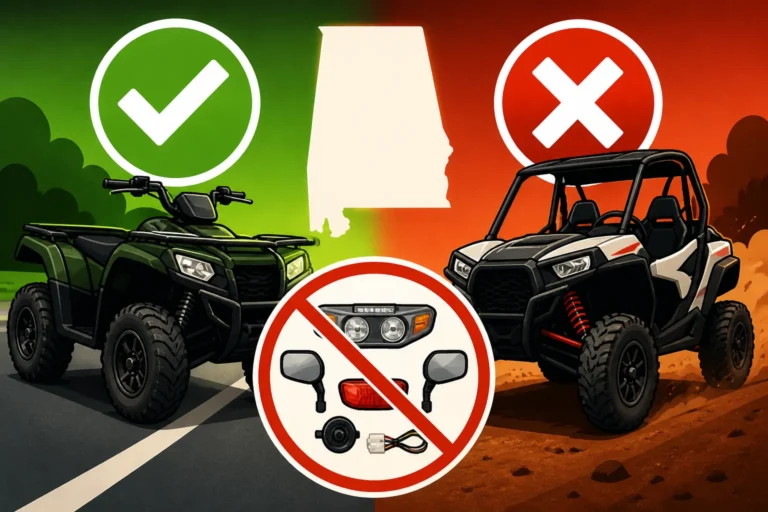
The core issue here boils down to federal regulations. Your ATV or UTV, as awesome as it is on the trails, simply isn't manufactured to meet the same Federal Motor Vehicle Safety Standards (FMVSS) as cars, trucks, or even motorcycles. These standards cover everything from crash-worthiness and emissions to lighting, braking, and tire types. Your quad's knobby tires, for example, are fantastic for grip in mud and over rocks, but they wear quickly and perform poorly on asphalt compared to street tires. Its suspension, designed for absorbing big impacts off-road, isn't optimized for stable, high-speed road travel.
This fundamental difference is why law enforcement in Alabama views your off-road machine as just that – off-road. When you venture onto paved public roads, you're operating a vehicle that simply isn't deemed safe or appropriate for that environment by state law. It doesn't matter if you're only going a quarter-mile; the legal barrier is absolute. You can dive deeper into this by reading about [Alabama's Federal Standard Barrier to Road Use]. These machines are built for adventure on trails, not for cruising down Main Street, which is why aftermarket kits claiming to make your ATV "street legal" often miss the mark on federal compliance. It's a common misconception that simply adding a turn signal kit or a horn will magically transform your off-road vehicle into a highway-ready machine. The reality is far more complex, focusing on structural integrity and crash protection, which no bolt-on kit from even a reputable company like SuperATV can provide for road use. Ultimately, this means your machine falls under the category of [Alabama Machines That Cannot Be Plated].
Understanding the "Public Use" Versus "Private Use" Dichotomy
Now, some of you might be thinking, "But I registered my ATV for public use!" And you're right, Alabama does have a voluntary registration system through the Alabama Law Enforcement Agency (ALEA) that allows you to register your off-road vehicle for either "private use" or "public use." This distinction, however, often causes a lot of confusion, and it's absolutely crucial to understand what "public use" registration actually grants you.
"Public use" registration, while sounding like it would include public roads, primarily means you can legally operate your ATV or UTV on designated public lands and trails, such as those found in state parks or Wildlife Management Areas (WMAs). It does not grant you permission to ride on public roads or highways. Think of it as a permit to play in specific, approved dirt playgrounds, not a license to drive on the street. The voluntary registration system is a great way to show ownership and support trail systems, but it's not a golden ticket for road riding. Many riders find themselves surprised when they receive a citation, believing their "public use" registration protects them. This is a crucial area of misunderstanding, and it's worth clarifying by looking into [Alabama Public Use Versus Private Use] to understand the nuances. Riding on public land on a private tier is definitely not allowed, even if you’re just crossing a small patch of public ground to get to another private parcel.
Local Ordinances and Their Impact
To add another layer of complexity, while state law generally prohibits ATVs and UTVs on public roads, individual cities and counties in Alabama can enact their own ordinances. In some rare cases, these might allow for specific, limited use of certain types of off-road vehicles on very specific local roads, often golf carts in smaller communities. However, these exceptions are typically very narrow and almost never apply to standard ATVs or UTVs.
It's dangerous to assume that because you saw someone riding a golf cart on a specific street in one town, your ATV is also allowed there. Each municipality has its own rules, and what's permissible in one might be strictly prohibited just a few miles down the road. Before you even think about riding on a local street, it is imperative to check the specific ordinances for that city or county. Relying on hearsay or what "everyone else does" is a surefire way to end up with a ticket. Always verify local rules, and remember, even if a local ordinance does allow some form of off-road vehicle on roads, it's typically for very specific, low-speed vehicles that might have unique registration requirements, like a Low-Speed Vehicle (LSV) tag. The best approach is to always check [Alabama City Ordinance Lookups] for where you plan to ride.
Deconstructing the Cost of an Alabama ATV/UTV Road Riding Ticket
So, you've decided to risk it and an officer pulls you over. What happens next? It's not just a slap on the wrist. The financial implications of an ATV or UTV road riding ticket in Alabama can quickly add up, turning that quick trip into a very expensive endeavor.
The Initial Citation: Fines and Court Costs
An ATV or UTV ticket for illegal road riding in Alabama is almost never just a simple fine. It's a combination of several charges that can vary significantly depending on the specific statute violated, the county or municipal jurisdiction, and even the discretion of the issuing officer. You might be cited for:
- Operating an unregistered vehicle: Even though ATV registration is voluntary, if you're operating it on a public road, an officer might interpret this as requiring registration similar to other motor vehicles.
- Operating a vehicle not designed for road use: This is often the primary charge, as your machine doesn't meet FMVSS.
- Reckless endangerment or other moving violations: If you were driving erratically, speeding, or otherwise creating a hazard.
Each of these charges carries a base fine. But here's where it really starts to hurt: court costs, administrative fees, and surcharges are then added on top of the base fine. These can easily double or even triple the initial fine amount. For example, a base fine of, say, $50, could quickly become $200 or more once all the additional fees are tacked on. The exact figures are elusive because they change and vary by county, but the shape of the cost is always a base fine plus a multitude of other charges. This can be a rude awakening for many riders who assume it's just a small fee. Understanding [Alabama Ticket Costs for Road Riding] is key here, and be prepared for [Alabama Court Costs for a Citation] to add a significant chunk to the total.
Potential Secondary Charges and Their Costs
The fun doesn't stop with the primary "illegal road use" ticket. An officer can, and often will, issue additional citations based on other observed violations. These can compound your financial burden significantly:
- No Helmet: While Alabama's general helmet law applies primarily to motorcycles, an officer might interpret the situation differently when an off-road vehicle is illegally on the road, especially if the rider is under 16 or operating unsafely. Always consider wearing a helmet for safety, regardless of the law.
- No Driver's License: If you're riding your ATV/UTV on a public road without a valid driver's license, you could face charges for operating a motor vehicle without a license. This is particularly relevant for younger riders.
- Lack of Insurance: While ATVs generally don't require insurance in Alabama for off-road use, if it's being operated on a public road, an officer might cite you for not having motor vehicle liability insurance. This is a common pitfall and can carry its own significant fines and penalties. It's an area where the lines blur and interpretations can vary, making it a risky proposition. Read more about [Does Alabama Require Insurance on an ATV?] for clarification on this point.
- Failure to Obey Traffic Laws: If you ran a stop sign, failed to yield, or committed any other traffic infraction while on the road, those will be separate tickets with their own fines.
Each of these secondary charges tacks on more money, escalating the total cost of your momentary convenience into a truly expensive mistake. These penalties can add up quickly, making [Alabama Penalties for Illegal Road Riding] a serious consideration.
The Hidden Costs: Impoundment and Legal Fees
Beyond the tickets themselves, there are often hidden costs that can sting even more. If an officer determines your ATV or UTV is being operated illegally on the road, they have the authority to impound your machine.
- Impoundment Fees: This is where things get really expensive. You'll be responsible for towing fees to get your machine to an impound lot, and then daily storage fees for every day it sits there. These fees can rack up incredibly fast, sometimes hundreds of dollars within just a few days. Getting your machine back will require you to pay these charges in full, in addition to resolving any citations. It's a logistical nightmare that quickly drains your wallet. Don't underestimate the impact of [When Police Impound a Quad After a Stop].
- Legal Fees: If the charges are serious, or if you wish to dispute the citation in court, you'll likely need to hire an attorney. Legal representation can be very costly, easily running into the thousands of dollars, depending on the complexity of your case and how far it goes. While it might be worth it to fight a wrongful citation, the cost of an attorney often dwarfs the initial fine amount. Navigating the legal system to [Disputing an ATV Citation in Alabama] can be a complex and expensive process.
Here's a simplified look at how these costs can stack up, keeping in mind specific figures will always vary:
| Cost Category | Potential Expense (Description) |
|---|---|
| Base Fine | For illegal operation of an off-road vehicle on public roads. |
| Court Costs | Mandatory administrative fees levied by the court system. |
| Surcharges | Additional fees that can apply to specific citations. |
| Secondary Fines | For violations like no license, no insurance, helmet, etc. |
| Towing Fees | Cost to transport your impounded machine. |
| Storage Fees | Daily charges for your machine at an impound lot. |
| Legal Fees | Cost of hiring an attorney to dispute charges. |
| Increased Insurance | Potential impact on personal auto insurance rates (if applicable). |
Avoiding the Tickets: Safer Alternatives and Legal Riding
The best way to avoid all these headaches and expenses is simple: don't ride your ATV or UTV on Alabama's public roads. Instead, embrace the fantastic legal riding opportunities available and transport your machine responsibly.
Transporting Your Machine Legally
This is the golden rule: if you want to ride your off-road machine, you need to get it to an approved riding area without operating it on public roads. That means using a trailer. Investing in a good utility trailer, proper ramps, and sturdy tie-downs is far less expensive in the long run than even one ticket, let alone an impoundment. Make sure your trailer is properly registered and your tow vehicle is capable of handling the weight.
When you're loading, secure your machine properly to prevent it from shifting or falling off. Use at least four heavy-duty tie-downs, securing each corner, and make sure they are tight before you hit the road. Companies like SuperATV offer excellent accessories for off-road performance, but remember their purpose is for the trails, not for making your machine road-worthy. You can find convenient places to offload your machine and start your adventure by researching [Alabama Trailheads With Trailer Parking].
Embracing Designated Off-Road Parks and Trails
Alabama is blessed with some incredible riding destinations specifically designed for ATVs and UTVs. Parks like Stony Lonesome OHV Park in Bremen or Minooka Park in Jemison offer miles of diverse trails, from easy scenic routes to challenging mud pits and rock crawling sections. These parks are safe, legal, and provide a much richer riding experience than any paved road ever could.
These designated areas are where your machine truly shines. You can push its limits, explore nature, and enjoy the camaraderie of other off-road enthusiasts without the constant worry of a ticket or a dangerous encounter with road traffic. Make sure you check the park's rules before you go, as some have specific requirements for helmets, spark arrestors, or age limits for riders. Plan your trips to these amazing destinations; it's why you bought the machine, after all! You can find a wealth of information about [Alabama ATV Trails: Where to Ride] and specific details about places like [Stony Lonesome OHV Park in Alabama].
Understanding Limited Road Access Exceptions
While the general rule is "no ATVs/UTVs on public roads," there are a few very specific and limited exceptions outlined in Alabama law. These are crucial to understand, as they are often misinterpreted as broader permissions.
- Crossing a Road: You may generally cross a public road if you do so at approximately a 90-degree angle to the road, after yielding to all oncoming traffic, and only when it is safe to do so. This is for crossing, not riding on the road.
- Farm Use: If you are actively engaged in bona fide agricultural purposes, you might be able to operate a UTV or ATV on a public road for short distances, typically between fields or farm properties. This exception is very narrow and intended for working, not recreational riding. It often requires specific identification or marking as farm equipment. You can learn more by checking [Alabama Farm Use and Road Riding].
- Designated Areas: In very rare instances, a specific local ordinance might designate a very short segment of road as permissible for off-road vehicle use, often to connect two trail systems. These are extremely uncommon and will be clearly marked.
These exceptions are not loopholes for recreational riding. They are specific, limited circumstances, and an officer will scrutinize whether your activity truly falls within their scope. When in doubt, always trailer it. Even knowing [Crossing a Road on an ATV in Alabama] is a specific allowance, it doesn't give you permission to ride down the road.
Disclaimer
This article is for general informational purposes only and does not constitute professional advice. Laws, prices and regulations vary by location and change over time. Consult a qualified professional for guidance on your specific situation.