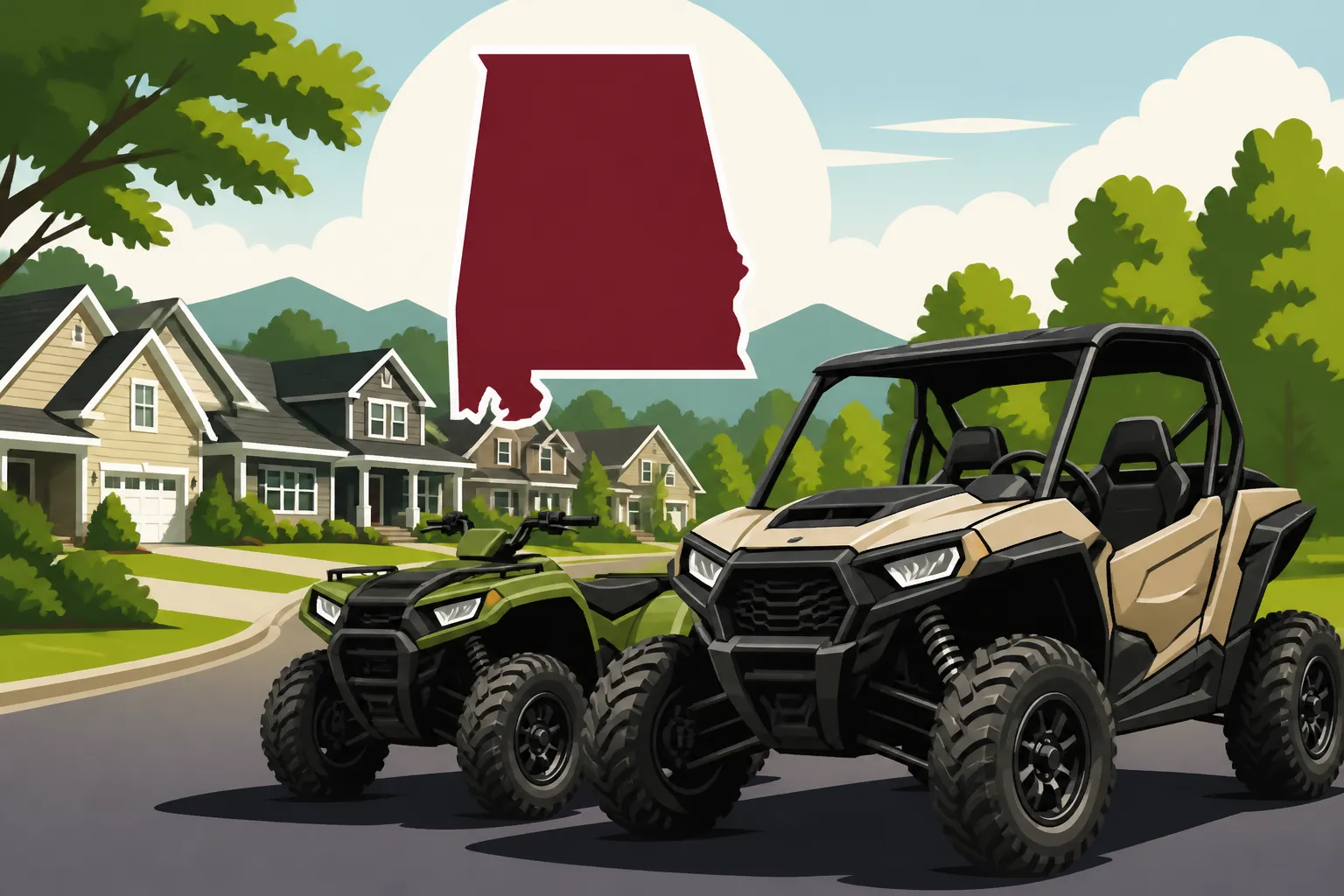
Alabama Subdivision Streets and Quads
It's a common scene in many Alabama communities: you've just finished a long day, and you glance at your trusty quad or side-by-side sitting there, ready for action. You might think about zipping down the street to a neighbor's house, heading to the community pool, or even just driving a short distance to your mailbox without having to fire up the car. But then that nagging question hits you: Can I actually ride my ATV or UTV on these subdivision streets? This guide is here to untangle the often-confusing web of Alabama laws and local ordinances regarding off-road vehicles on residential roads, helping you understand where you can and cannot legally ride.
The State of Alabama's Stance on Off-Road Vehicles on Public Roads
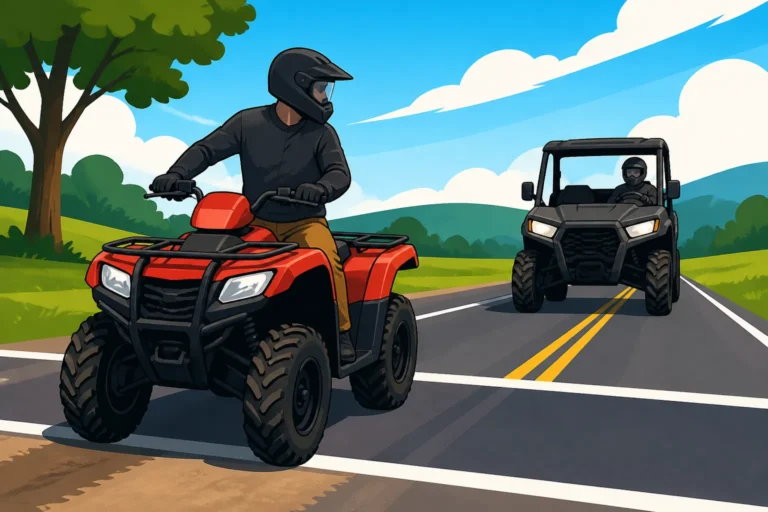
Let's get this out of the way upfront: by and large, Alabama state law does not permit the use of ATVs or UTVs on public roads, and that absolutely includes the streets in your subdivision, even if they feel like private property. This isn't just an arbitrary rule; it's rooted in fundamental safety and federal standards. Your typical ATV or UTV, while incredibly fun and useful off-road, simply isn't designed or certified for highway use.
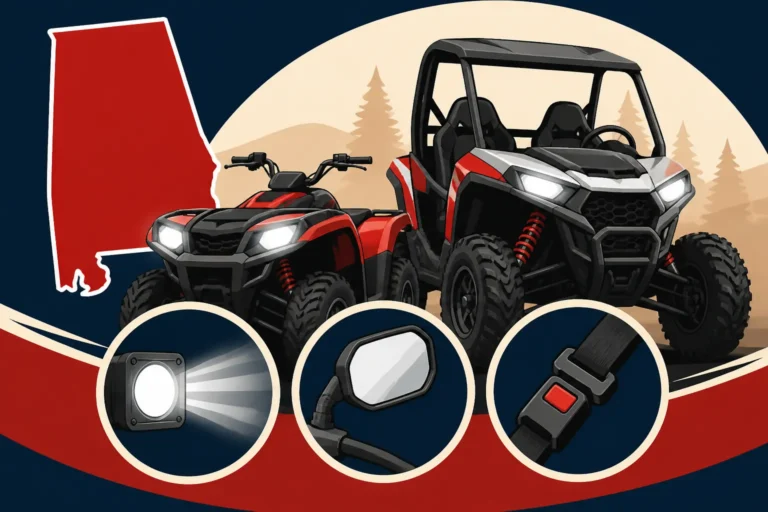
The core issue boils down to federal safety standards. Vehicles intended for road use must meet a very specific set of requirements set by the federal government, known as the Federal Motor Vehicle Safety Standards (FMVSS). These standards cover everything from braking systems, lighting, turn signals, seat belts, and even crashworthiness. Standard ATVs and UTVs are manufactured for off-road purposes and do not come equipped from the factory to meet these stringent requirements. Trying to add a "street legal kit" to an off-road machine rarely, if ever, makes it compliant with these federal standards. It's a critical distinction to understand: just because you add a horn or some blinkers doesn't magically transform an off-road vehicle into a highway-legal one in the eyes of the law. You can read more about [Alabama's Federal Standard Barrier to Road Use] and [Alabama's 49 CFR 571.500 Standard].
The state's primary concern is public safety. Mixing fast, exposed off-road vehicles with cars, trucks, and even pedestrians on paved streets creates significant risks. ATVs and UTVs handle very differently on asphalt compared to dirt. Their suspension, tires, and steering are optimized for uneven terrain, not smooth, high-speed road travel. So, when you think about zipping down your subdivision street, remember that the state is looking at the bigger picture of accident prevention and ensuring that all vehicles sharing the road are built to a common safety benchmark. This general prohibition means that if a sheriff's deputy or a municipal police officer sees you riding your quad down the street, you could be facing a citation.
Understanding Alabama's Core ATV and UTV Definitions
To really grasp why your machine isn't typically welcome on subdivision streets, it helps to understand how Alabama's statutes define these vehicles. The state has specific legal definitions for what constitutes an All-Terrain Vehicle (ATV) and a Recreational Off-Highway Vehicle (ROV), which is where UTVs typically fall. These definitions often highlight characteristics like width, weight, and the intended use of the vehicle – which is almost exclusively off-road.
For instance, an ATV is generally defined as a motorized, off-highway vehicle designed to travel on four low-pressure tires, having a seat designed to be straddled by the operator, and handlebars for steering control. An ROV, often including side-by-sides, is usually a non-highway vehicle, 80 inches or less in width, with a non-straddle seat and a steering wheel. Crucially, both are defined as "non-highway" vehicles. This specific classification immediately places them outside the realm of vehicles legally permitted on public roadways without special exemption. It’s not just a suggestion; it's part of the vehicle's legal identity within Alabama. To delve deeper, check out [Alabama's ATV and ROV Legal Definitions]. This designation as a non-highway vehicle is the fundamental reason why you're encountering these restrictions, even on seemingly quiet residential streets.
Penalties for Illegal Road Riding
Ignorance of the law, as they say, is no excuse. If you're caught riding your ATV or UTV illegally on a subdivision street or any public road in Alabama, you could face consequences. These can range from a warning (if you're lucky and the officer is feeling generous) to a significant fine and even impoundment of your machine. The exact penalties can vary depending on the local jurisdiction and the specific circumstances of the infraction.
A common scenario might involve a local police officer responding to a complaint from a neighbor about noise or perceived reckless driving. In such cases, the officer isn't just going to tell you to go home; they have a duty to enforce state and local traffic laws. Beyond the immediate fine, repeated offenses could lead to more severe penalties. It's not just about the monetary cost; it's also the inconvenience, the time spent in court, and the potential for a mark on your record. It's far better to understand the rules beforehand than to learn them the hard way. Understanding [Alabama Penalties for Illegal Road Riding] is crucial for any off-road enthusiast.
Local Ordinances and Homeowners Association Rules
While state law sets the overarching framework, local municipalities and even private communities often have their own layer of regulations that further restrict or, in very rare and specific cases, permit the use of certain types of vehicles on subdivision streets. This is where things can get a bit more nuanced and frustrating for vehicle owners.
Many cities and towns in Alabama recognize the state's general prohibition on ATVs on public roads and simply reinforce it through their own ordinances. They might have specific language that reiterates that ATVs and UTVs are not permitted on any public street, road, or highway within city limits. These local ordinances are often passed to address community-specific concerns like noise complaints, safety in areas with children, or maintaining the peace in residential zones. If your city has such an ordinance, it overrides any personal desire to use your machine on subdivision streets. You'll want to investigate [Alabama City Ordinance Lookups] to find out for your specific location.
However, some communities, particularly smaller towns or those with a specific recreational focus, might have carve-outs or special provisions for certain types of low-speed vehicles or even golf carts. It's critical to understand that these exceptions are usually very specific and almost never apply to a standard, unmodified ATV or UTV. They are typically for vehicles explicitly designed as golf carts or low-speed vehicles that meet different federal standards entirely.
Homeowners Association Rules and Private Property
Beyond city limits, if you live in a planned community, a gated neighborhood, or an area governed by a Homeowners Association (HOA), you have another set of rules to contend with: the HOA's covenants, conditions, and restrictions (CC&Rs). HOAs have a legal right to set rules for common areas and even individual properties within their jurisdiction, often with the goal of maintaining property values, community aesthetics, and resident safety.
It is highly common for HOAs to specifically prohibit ATVs and UTVs from being ridden on subdivision streets, sidewalks, and common areas. They might cite noise, potential damage to asphalt or landscaping, or safety concerns as reasons. These rules are legally binding for residents and can carry their own set of penalties, which might include fines levied by the HOA, suspension of amenity privileges, or even legal action. Your HOA's rules are typically stricter than city ordinances, so even if a city technically permitted some form of limited use (which is rare for ATVs), your HOA could still say "no." It's essential to check your specific HOA's governing documents. Learn more about [Alabama HOA Rules About Side-by-Sides].
Even if your property itself is private, once you leave your driveway and enter a street that is either publicly owned or part of an HOA's common property, you fall under these regulations. It's a tricky line to navigate, and the best approach is always to check all layers of rules before you ride.
Exceptions, Alternatives, and What Can Actually Be Street Legal
Given the general prohibition, it's natural to wonder if there are any scenarios where you can legally ride something that looks like an off-road vehicle on subdivision streets in Alabama. The answer is yes, but these exceptions are incredibly narrow and usually apply to different classes of vehicles altogether. It's not about making your existing ATV street legal; it's about owning a vehicle that was already designed and certified for street use from the start.
The primary exceptions revolve around genuinely low-speed vehicles (LSVs) and golf carts. These vehicles operate under different legal frameworks. An LSV is a four-wheeled vehicle with a top speed greater than 20 miles per hour but not greater than 25 miles per hour. Critically, to be an LSV, it must also meet specific federal safety standards, including headlamps, tail lamps, stop lamps, turn signal lamps, reflex reflectors, an exterior mirror on the driver's side and an interior mirror or exterior mirror on the passenger's side, a parking brake, a windshield, seat belts, and a vehicle identification number (VIN). These are manufactured as street-legal from the factory. [Alabama Low-Speed Vehicle Rules] explain these criteria in detail.
Golf carts, while often ridden in communities, are usually restricted to specific golf course properties or very limited, designated public roads where a local ordinance explicitly permits their use. They typically have an even lower top speed than LSVs. In many ways, the rules for [Alabama Golf Cart Rules Compared to ATVs] are quite different. It's a huge misconception that if a golf cart can be on the street, then your side-by-side should be too. They are completely different classes of vehicles in the eyes of the law.
Farm Use Exemptions
Another very specific and often misunderstood exception is for vehicles used as farm equipment. Alabama law does provide some allowance for farm equipment to be operated on public roads for agricultural purposes. However, this is not a blanket permission slip to ride your ATV around your subdivision because you occasionally use it to haul a bag of feed. The key here is "bona fide farm purpose."
If your property is legitimately a working farm, and your ATV or UTV is being used for specific, recognized agricultural tasks – such as moving livestock, checking fences, or transporting tools to a field – then you might be permitted to briefly cross or travel a short distance on a public road directly related to those farming activities. This exemption is usually tied to the direct necessity of farming operations and is not intended for recreational use or general transportation on public streets. It's also important that your machine clearly looks like it's in farm service, perhaps with tools or materials being carried, rather than just joyriding. If you're using a utility UTV for heavy lifting or moving materials around a large property, some SuperATV accessories, like heavy-duty cargo boxes or lift kits, might enhance its utility for farm tasks, making it more clearly aligned with a farm equipment role when it might briefly touch a public road for necessary cross-over.
This exemption is often strictly interpreted by law enforcement, and if you're pulling a trailer of kids or simply riding for fun, it's highly unlikely that the "farm use" argument will hold up in court. Always check with your local sheriff's office or municipal police department if you believe your use case falls under this narrow exception.
True "Street Legal" Conversions and the Reality
Many companies sell "street legal kits" for ATVs and UTVs, promising to equip your machine with turn signals, mirrors, horns, and other components. While these additions might make your machine look more like a road-legal vehicle, they almost never make it truly street legal under Alabama law and federal standards. The reason is that an ATV or UTV fundamentally lacks the underlying chassis, braking system, crash protection, and other design elements required to pass the FMVSS standards that all on-road vehicles must meet.
A true street-legal vehicle is built to those standards from the ground up, not modified after the fact. While SuperATV offers fantastic aftermarket parts for off-road performance, even their most robust components for lights, mirrors, or suspension are designed to enhance the off-road experience, not magically transform a vehicle into a DOT-approved, highway-safe machine. Converting an off-road machine to genuinely meet federal LSV or automotive standards is incredibly complex, expensive, and often impossible without essentially rebuilding the entire vehicle. It’s far more practical and safe to purchase a vehicle that is already classified as a [What a Low-Speed Vehicle Standard Requires] rather than trying to convert an ATV or UTV. Trying to fudge the rules with a "kit" could still lead to tickets and impoundment, as your machine still won't meet the legal definition of a street-legal vehicle.
Navigating the Rules: How to Stay Legal and Ride Responsibly
It can feel overwhelming trying to figure out what's allowed and what's not, especially when you see different things happening in different neighborhoods or towns. The key to staying legal and avoiding trouble is proactive research and responsible riding.
The very first step you should always take is to contact your local municipal government – usually the city clerk's office or the police department – and inquire about specific ordinances regarding ATVs, UTVs, golf carts, and low-speed vehicles on public streets within your subdivision. Don't rely on what your neighbor says or what you see others doing; get the information directly from the source. Remember, what's legal in one town or county might be strictly prohibited just a few miles down the road. This is especially true when it comes to [When an Alabama City Writes Its Own ATV Rule].
If you live in an HOA-governed community, review your CC&Rs or contact the HOA management directly. They can provide definitive answers on what's allowed within the community's private roads and common areas. Getting clarity upfront can save you a lot of hassle and potential fines later on.
Responsible Riding on Private Property
For most ATV and UTV owners in Alabama, the joy of riding will be confined to private property or designated off-road parks and trails. And that's perfectly okay! Alabama has fantastic opportunities for off-road enthusiasts. When riding on private land, you still have responsibilities. Always have permission from the landowner. Respect the environment, avoid excessive noise that could disturb neighbors, and always prioritize safety. Wear appropriate gear, never ride impaired, and supervise younger riders diligently. Even if you're not on a public street, riding responsibly helps maintain a positive image for the off-road community.
If you are looking for places to ride your machine legally and safely, consider exploring [Alabama ATV Trails: Where to Ride] or designated areas like [Stony Lonesome OHV Park in Alabama] or [Minooka Park Riding in Alabama]. These venues are designed for off-road use and provide a safe, legal environment for you to enjoy your machine to the fullest. They often have specific rules, waivers, and fees, but they remove all the ambiguity about street legality.
The bottom line is that for the vast majority of ATVs and UTVs in Alabama, subdivision streets are off-limits. Understanding the nuances of state law, federal standards, and local ordinances will help you make informed decisions and keep your off-road adventures fun and legal.
| Vehicle Type | Typical Street Legality in Alabama (Subdivision Streets) | Federal Standard Met | Common Use Case |
|---|---|---|---|
| Standard ATV/UTV | No (Generally prohibited by state law) | None (Off-road only) | Recreational off-road, farm |
| Golf Cart | No (Unless specific local ordinance allows limited use) | None (Low-speed, limited use) | Golf courses, small communities |
| Low-Speed Vehicle (LSV) | Yes (Designed to meet specific federal standards) | FMVSS (Specific LSV category) | Urban/suburban short commutes |
| Farm Equipment (e.g., UTV for farm tasks) | Very Limited (Only for bona fide farm purposes) | N/A | Agricultural work |
Disclaimer
This article is for general informational purposes only and does not constitute professional advice. Laws, prices and regulations vary by location and change over time. Consult a qualified professional for guidance on your specific situation.