Alabama Farm Use and Road Riding
It's a question as old as dirt roads themselves here in Alabama: "Can I just hop on my ATV or UTV and run down the road a piece to get to the back forty, or to check on the cows in the next pasture over?" Many of us rely on these machines daily for farm work, and the idea of trailering them just to move a few hundred yards can feel downright silly. This guide aims to clear up the confusion surrounding Alabama's rules for using your ATV or UTV on public roads when it's genuinely for farm purposes.
The Core Question: Can You Ride a Farm ATV/UTV on Alabama Roads?
This is where things get a little sticky, and it's a common point of frustration for folks who live and work in rural Alabama. You see your neighbors doing it, maybe you've done it yourself, but is it really legal? The short answer often feels like a frustrating, "It depends." Alabama law, like many state laws, tries to balance public safety with the practical needs of its citizens, especially those in agricultural communities. The specific carve-outs for farm use are crucial, but they don't give you a free pass to cruise down the highway whenever you please. It's about understanding the spirit of the law, not just the letter.
Understanding Alabama's Off-Road Vehicle Statute
Alabama's statutes are pretty clear that ATVs and UTVs are primarily designed for off-highway use. The very definition of these machines points to their inherent unsuitability for paved public roads. This isn't just a suggestion; it's the foundation upon which all other rules are built. The state wants to keep highways safe for vehicles designed and built to federal motor vehicle safety standards, and let's be honest, your trusty utility quad wasn't engineered with those standards in mind. It's built for mud, rocks, and hauling feed, not merging into 60 mph traffic. However, the law isn't blind to the realities of rural life. It acknowledges that sometimes, for very specific purposes, these machines need to touch a public road. This is where the farm use exceptions come into play, creating a nuanced legal landscape that can be tricky to navigate without a clear understanding. If you want to dive deeper into the general framework, you can read more about [What Alabama's Off-Road Vehicle Statute Covers].
The General Prohibition and Its Exceptions
Generally speaking, riding an ATV or UTV on a public road in Alabama is a no-go. This includes paved roads, county dirt roads, and even the shoulders of highways. The state's primary concern is safety, both for the ATV/UTV rider and for other motorists. These machines lack many of the safety features found on street-legal vehicles, like airbags, crumple zones, and often even turn signals or proper headlights for highway speeds. However, the law makes specific allowances for certain types of vehicles and uses. One of the most significant exceptions revolves around agricultural activities. These exceptions are not loopholes to be exploited for joyriding; they are strictly defined to allow farmers and those engaged in legitimate agricultural work to perform their duties efficiently. The key is demonstrating that your use of the ATV or UTV on the road is directly and necessarily tied to farming operations. Without this direct connection, you're likely back to facing the general prohibition against road use.
Defining "Farm Equipment" in Alabama
When we talk about "farm equipment" in the context of road use for ATVs and UTVs, it's not just about whether you own a tractor. The legal definition can be a bit more specific than what you might imagine, and it's less about the make and model of your machine and more about its purpose and how it's being used at that specific moment. This distinction is critical because merely owning an ATV if you live on a farm doesn't automatically grant it "farm equipment" status for road-riding purposes. The state isn't just looking at what the machine is, but what it does.
What Qualifies as Farm Equipment
For an ATV or UTV to qualify as "farm equipment" under Alabama law, it typically needs to be used primarily for agricultural purposes. This means tasks directly related to the production of crops, livestock, poultry, or dairy products. Think hauling feed, moving fencing supplies, checking irrigation lines, or driving to a distant pasture to tend to animals. It's about the utility of the machine in the context of a working farm. This designation isn't about getting a special license plate or a unique registration sticker; it's about the activity you're performing. A side-by-side that you use to pull a small utility trailer loaded with hay bales to another field would clearly fall under this umbrella. On the other hand, the same side-by-side used for a leisurely ride down a country lane, even if you just came from feeding cattle, might not be considered farm equipment for that particular journey. Alabama's statutes even go so far as to specifically outline how [Alabama Excludes Farm Equipment] from certain sections of the off-road vehicle chapter, acknowledging its distinct role.
Intent of Use vs. Machine Type
This is perhaps the most crucial distinction. The law places a heavy emphasis on the intent of your ride, not simply the type of machine you're operating. While a massive farm tractor is inherently recognized as farm equipment, an ATV or UTV is a bit more ambiguous because it has recreational uses as well. If you're using your Polaris Ranger to transport a repair kit to a broken fence post on a property that spans both sides of a county road, your intent is clearly agricultural. If you're using the same Ranger to pick up a friend from down the street to go deer hunting on your own property, even though you live on a farm, that specific trip isn't typically considered "farm use" in the eyes of the law for road access. The machine type, be it a utility quad or a side-by-side, takes a backseat to the purpose of its travel on a public roadway. This means you need to be prepared to articulate and demonstrate that your road use is essential for your farming operations if questioned by law enforcement.
Specific Scenarios for Road Use with Farm Machines
It’s easy to get caught up in the general "no road riding" rule and feel like you're stuck, but as we’ve discussed, farm use carves out some specific, very practical exceptions. These aren't just theoretical; they address real-world needs that farmers face every single day. The common thread here is necessity – these machines are being used because they are the most efficient, and sometimes the only, way to accomplish a specific agricultural task that requires briefly traversing public land.
Crossing a Road for Farm Purposes
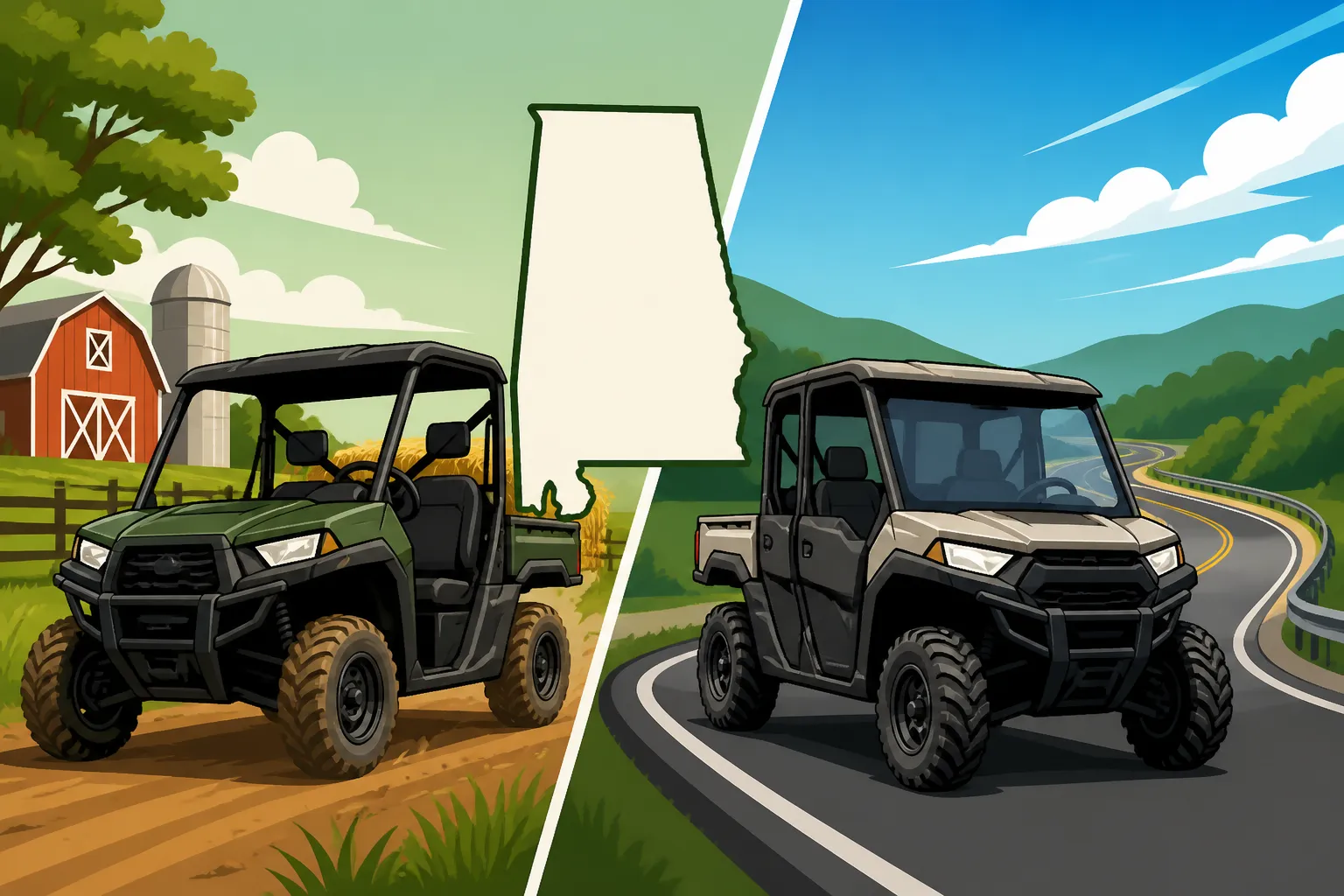
This is perhaps the most widely understood and accepted form of road use for farm machines. Imagine your property is split by a small county road. You’ve got a hayfield on one side and the barn on the other. It would be utterly impractical, not to mention a huge waste of time, to load your quad onto a trailer, drive it across the road, and unload it every single time you need to move equipment or animals from one section of your farm to another. Alabama law generally permits crossing a highway or road for agricultural purposes, provided it’s done safely and as directly as possible. You shouldn't be riding down the middle of the lane for a quarter-mile, but rather crossing at a right angle, yielding to traffic, and minimizing your time on the pavement. Think of it like crossing a street on foot; you look both ways, proceed when clear, and don't linger. This is a common and legitimate reason to momentarily put your tires on asphalt. For more general guidelines on how to handle such maneuvers, refer to [Alabama Rules for Crossing a Highway].
Riding Alongside a Road for Field Access
Another scenario often encountered by farmers is accessing a field or pasture that borders a public road. Perhaps the entrance to your field is a few hundred yards down the road from your driveway, or you need to inspect a fence line that runs parallel to the road. In many instances, the law allows for farm equipment, including ATVs and UTVs used for agricultural purposes, to operate on the shoulder or immediate edge of the roadway for short distances to gain access to or from adjacent property. This isn't permission to travel long distances, but rather to use the necessary margin of the road to reach your intended destination without obstructing traffic. It's about practical access, not convenient travel. Again, safety and minimal disruption are paramount. You’re not trying to be a moving target; you’re trying to efficiently manage your land.
Transporting Tools or Produce on Short Stretches
Consider needing to transport a small sprayer, some hand tools, or a basket of freshly picked produce from one part of your farm to another, where the most direct route involves a brief journey on a public road. An ATV or UTV, especially a utility model with racks or a bed, is often the most practical vehicle for these tasks. The law generally accommodates such movements when they are directly tied to agricultural operations and conducted over short distances. For example, moving a post-hole digger from your barn to a field on the other side of a county road is a legitimate use. However, using your ATV to take a bushel of sweet potatoes to a farmer's market ten miles away, even if you grew them, would likely exceed the scope of "short stretches" and might not be covered by the farm use exception for regular road travel. It's about the direct, immediate needs of the farm, not general transportation. If you're moving something that legitimately requires the capacity of your ATV or UTV over a short distance for farm work, that's one thing. If you're simply using it as a convenient personal vehicle, even for a farm-related errand, you might be pushing the boundaries.
Limitations and Best Practices for Farm Road Use
While farm use provides some wiggle room for ATVs and UTVs on Alabama roads, it's absolutely crucial to understand that these aren't carte blanche permissions. There are very real limitations, and ignoring them can lead to significant trouble. Think of these exceptions as narrow allowances, not broad grants. When you're operating farm equipment, including your quad or side-by-side, on a public way, you're expected to do so with the utmost care and consideration for everyone else on the road. It's about safety first, always.
Speed Limits and Safe Operation
This is a big one. Even if your use of the road is permitted under a farm exception, you are still absolutely bound by the rules of the road that apply to any other vehicle. This means respecting speed limits, which for an ATV or UTV might mean driving significantly below the posted limit to maintain control and stability, especially on pavement. These machines aren't designed for high speeds on hard surfaces, and sudden turns or braking can be incredibly dangerous. You should always operate at a speed that is safe for the conditions, your machine, and the traffic around you. This also means using appropriate hand signals if your machine lacks turn indicators, maintaining a watchful eye for other vehicles, and never assuming other drivers see you. Common sense and defensive driving are your best friends here. Just because you can go 40 mph doesn't mean you should on a public road, especially when riding a machine that handles very differently than a car or truck.
Required Lighting and Safety Gear
Visibility is key, particularly when sharing roads with larger, faster vehicles. While the state might not mandate a full lighting kit for every farm quad that crosses a driveway, it's a matter of personal safety and good practice. If you are operating on any public road, especially during dawn, dusk, or at night, your machine must be adequately lit. This typically means headlights, taillights, and ideally, reflective tape or a slow-moving vehicle (SMV) triangle. Many older ATVs might only have a single headlight or a weak taillight, which simply isn't enough to make you visible. Consider upgrading your lighting, especially if you foresee any need for road use in low-light conditions. Companies like SuperATV offer a wide range of lighting solutions that can significantly enhance your visibility and safety. And let's talk about personal safety gear: a helmet is a non-negotiable item, even if the law doesn't explicitly mandate it for certain farm uses. Eye protection, gloves, and sturdy footwear can prevent serious injury. You can also review [Alabama Rules for Riding After Dark] for more detailed information on visibility requirements.
Avoiding Public Thoroughfares When Possible
This might sound counterintuitive given the topic, but it's a critical best practice. If there's an alternative route on your private property that avoids public roads entirely, even if it's a little longer or bumpier, that's almost always the safest and most legally sound option. The farm use exceptions are there for necessity, not convenience. Law enforcement officers are more likely to be understanding if you can demonstrate that you had no reasonable alternative to using a public road for your farm duties. Always ask yourself: "Is there any other way I can get there without putting my ATV on the road?" If the answer is yes, then that's the path you should probably take. This approach minimizes your risk of a citation and, more importantly, reduces your exposure to traffic hazards. Remember, the goal is to manage your farm efficiently and safely, and sometimes that means a slightly less direct route that keeps you off the pavement.
Distinguishing Farm Use from General Public Use
This is where many riders get into hot water. The line between legitimate farm use and just plain riding an ATV on the road can feel blurry, but in the eyes of the law, it's often quite sharp. Understanding this distinction is vital, not just to avoid penalties, but to comprehend the fundamental purpose of these machines in Alabama. It’s not just about what you’re doing, but also the broader context of why the state regulates road use for off-road vehicles.
Why Your Farm Quad Isn't a Regular Road Vehicle
Let's be blunt: your ATV or UTV, even if it's a heavy-duty utility model, simply isn't built to be a road-legal vehicle in the same way a car or truck is. It doesn't have the same federally mandated safety equipment, like specific braking systems, rearview mirrors, turn signals, or even tires designed for sustained road speeds. The handling characteristics are completely different on pavement compared to dirt. A sudden swerve to avoid a pothole on a highway can easily lead to a rollover or loss of control on an ATV. This inherent design difference is why Alabama, and most other states, have a general prohibition on their road use. The farm use exception isn't about transforming your quad into a street-legal machine; it's about acknowledging that for specific, brief, and necessary agricultural tasks, the practicalities of farming sometimes require limited road access. It doesn't change the fundamental nature of the vehicle. For a broader understanding of what makes a vehicle road-legal, you might want to look into [Alabama's Federal Standard Barrier to Road Use].
The Role of Voluntary Registration
Alabama currently has a voluntary registration system for ATVs and UTVs through the Alabama Law Enforcement Agency (ALEA). You can choose to register your machine for either "public use" or "private use." Many people think that registering their ATV for "public use" automatically makes it legal to ride on public roads. This is a common and dangerous misconception. The public use registration tier allows you to ride on designated public lands and trails where ATVs are permitted, such as state or county OHV parks. It absolutely does not grant permission to ride on public roads and highways that are not specifically marked as multi-use trails open to ATVs. Even if you have that "public use" decal, it won't save you from a ticket if you're cruising down County Road 5. The farm use exception is entirely separate from this registration system. While registering your farm machine might be a good idea for ownership records and theft recovery, it does not magically confer street-legal status. You can find more specific information on this in [Alabama Public Use Versus Private Use] and [Alabama Registration for a Farm Machine]. The registration primarily serves as an ownership record and a way to fund state-managed OHV areas, not as a license to operate on general public roadways.
Potential Penalties and Enforcement for Misuse
Nobody wants to get stopped by a deputy, especially when you're just trying to get some farm work done. But if you misuse the farm equipment exception, you could face consequences that are more than just a minor inconvenience. Law enforcement officers, whether it's the county sheriff or state troopers, are tasked with enforcing traffic laws and ensuring public safety. When an ATV or UTV is on a public road outside of its legal allowances, it can be seen as a hazard, and they will act accordingly.
What Happens If You're Pulled Over
If you're pulled over while riding your ATV or UTV on a public road without a legitimate farm use reason, or if you're abusing the exception (e.g., riding long distances, at excessive speeds, or for recreational purposes), you'll likely face a citation. This isn't just a friendly warning; it's a traffic ticket. Penalties can vary depending on the county, the specific officer, and the circumstances, but you could be looking at fines, court costs, and potentially even your machine being impounded. Officers often have discretion, but if they perceive you're being reckless or intentionally flouting the law, that discretion might not be in your favor. They'll want to know why you're on the road and what specific agricultural task you're performing. Having a clear, concise, and truthful explanation is important. If you can't provide one, or if your explanation doesn't align with what they observe, you're in a tough spot. Remember that officers are also looking out for safety; if your machine isn't visible, or you're riding in a way that endangers others, they will take that seriously. For insights into what a stop might entail, consider [Alabama Rules Riders Get Wrong].
Understanding Local Ordinances and Sheriff Discretion
It's also crucial to remember that while Alabama has state laws regarding ATV and UTV use, individual counties and municipalities can (and often do) enact their own local ordinances. What might be tolerated or explicitly allowed in one very rural county might be strictly prohibited in a more populated area or a specific town. Always check with your local sheriff's office or city hall about any unique local rules that might apply in your area. Additionally, while there are clear statutes, officers do exercise discretion. A deputy seeing you briefly cross a deserted road at dawn to check fence lines on adjacent property might just give a nod. The same deputy seeing you tearing down the highway at noon, loaded with coolers and fishing poles, will likely issue a citation. The key is demonstrating legitimate, safe, and necessary farm use. Don't rely solely on what your neighbor says or what you think the rule is. A quick call to your local law enforcement agency can save you a lot of headache and expense down the road. Local attitudes and enforcement can vary widely, so being informed about your specific area is a huge advantage. You can learn more about general penalties by checking out [Alabama Penalties for Illegal Road Riding] and [Alabama Ticket Costs for Road Riding].
| Feature | Farm Use Road Riding (Allowed under specific conditions) | General Road Riding (Generally Prohibited) |
|---|---|---|
| Purpose | Directly related to agricultural operations | Recreation, commuting, non-farm errands |
| Duration | Brief, short distances, crossing for access | Extended travel, cruising, sightseeing |
| Location | County roads, shoulders, crossing state highways | Any public road, highway, or city street |
| Required Gear | Recommended: Helmet, eye protection, SMV triangle | Recommended: Helmet, eye protection |
| Lighting | Adequate for visibility (especially dawn/dusk/night) | Adequate for visibility |
| Registration | Not a factor for road legality (voluntary for ownership) | Not a factor for road legality |
| Risk of Ticket | Low if legitimate, safe, and brief | High, usually results in a citation |
| Legality Basis | Specific agricultural exemptions in state law | General prohibition on off-road vehicles |
| Typical Machines | Utility ATVs, side-by-sides, farm tractors | Any ATV or UTV |
Equipping Your Machine for Farm Road Safety
Even when your ATV or UTV is being used strictly for legitimate farm purposes on public roads, safety should be your absolute top priority. These machines are robust and incredibly useful, but they aren’t inherently designed for mixed-traffic environments. Because of this, it falls to us as riders and operators to make sure our machines are as visible and safe as possible when they touch public asphalt or gravel.
Essential Accessories for Visibility
One of the biggest risks when operating an ATV or UTV on a public road is visibility. Cars and trucks are larger, faster, and drivers often aren't expecting to see a smaller, lower-profile off-road machine in their lane or on the shoulder. Therefore, anything you can do to make your machine stand out is a wise investment. This includes, but isn't limited to:
- Slow-Moving Vehicle (SMV) Triangle: This bright orange triangle is universally recognized as indicating a vehicle moving slower than normal traffic. It's a must-have for any farm equipment on a public road.
- Bright LED Lighting: While your machine might have factory headlights and taillights, consider upgrading to brighter LED versions. Many utility machines only have a single, dim taillight. Adding a second, brighter taillight, or even an additional brake light, can make a huge difference. SuperATV, for instance, offers a variety of LED light bars and pods that can be mounted to provide enhanced forward and rearward illumination.
- Reflective Tape: Apply high-visibility reflective tape to the front, sides, and rear of your machine. This catches headlights from other vehicles and significantly increases your profile, especially in low light conditions.
- Warning Flags/Whips: A bright orange flag on a whip antenna can extend above your machine, making you visible over hills or from behind larger vehicles, which is especially helpful for lower-profile ATVs.
- Turn Signals: While not legally required for farm equipment, adding aftermarket LED turn signals can communicate your intentions clearly to other drivers, greatly enhancing safety.
Even if the law doesn't require every single one of these, equipping your machine with them demonstrates responsible operation and could very well save you from an accident. For more on ensuring your machine is seen, you can explore [Alabama Lighting on a Machine at Night].
Maintenance for Reliable Farm and Road Use
Beyond visibility, the mechanical soundness of your machine is paramount. A breakdown on a busy county road is not only inconvenient but dangerous. Regular maintenance, already crucial for farm equipment, becomes even more important when that equipment is interacting with public traffic.
- Brakes: Ensure your brakes are in excellent working order. ATVs and UTVs need reliable stopping power, especially if you need to quickly react to unexpected traffic or road conditions.
- Tires: While off-road tires are great for the field, they can wear quickly and handle differently on pavement. Ensure your tires have adequate tread and are properly inflated. Over-inflated tires for road use can reduce traction, while under-inflated tires can lead to instability and excessive heat buildup. Check for any cuts, cracks, or bulges.
- Steering and Suspension: Worn-out tie rods, ball joints, or suspension components can make your machine unpredictable, especially on hard surfaces. Regularly inspect these components for play or damage. A machine that wanders on a dirt path is one thing; on a paved road with oncoming traffic, it's a disaster waiting to happen.
- Fluid Levels: Keep all fluids – oil, coolant, brake fluid – at proper levels. Overheating or a loss of essential fluids can lead to a sudden breakdown, stranding you in a vulnerable position.
- Horn: Many ATVs don't come with a horn, but a UTV might. If your machine lacks one, consider adding an aftermarket horn. It can be a vital safety device for alerting other drivers to your presence, even if it's not a legal requirement for farm machines.
By taking these proactive steps, you're not just adhering to vague safety guidelines; you're significantly reducing your risk and ensuring your ATV or UTV remains a reliable tool for your farm operations, whether it's in the field or briefly on the road.
Disclaimer
This article is for general informational purposes only and does not constitute professional advice. Laws, prices and regulations vary by location and change over time. Consult a qualified professional for guidance on your specific situation.