Alabama Golf Cart Rules Compared to ATVs
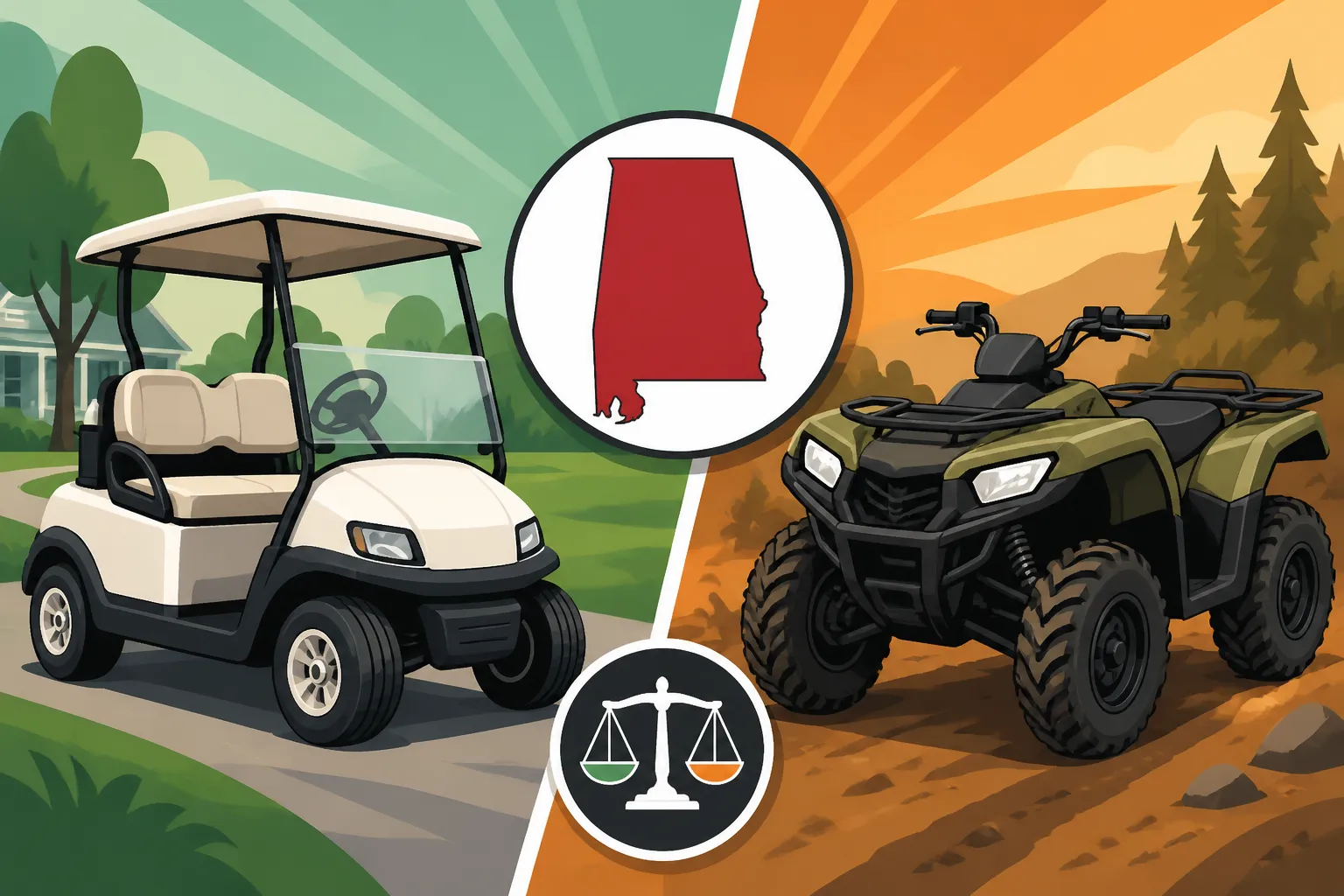
It's incredibly common to see folks scratching their heads, wondering why their neighbor can zip around town in a golf cart while their perfectly capable ATV is stuck on the trailer when it comes to public roads. The confusion is real, and it stems from some very distinct legal definitions and rules in Alabama. This comprehensive guide is here to untangle that knot, laying out the precise differences between Alabama's golf cart rules and ATV regulations, especially when it comes to hitting the open road.
The Core Definitions: What Exactly is an ATV, UTV, and Golf Cart in Alabama?
Before we can even begin to talk about where you can and can't ride, it's absolutely crucial to understand how Alabama's laws classify these machines. What might look similar at first glance—four wheels, an engine, off-road tires—is often viewed through entirely different lenses by the state statutes. This isn't just semantics; it directly impacts where you can operate them, if they need to be titled or registered, and what kind of equipment they need.
Alabama's ATV and ROV Legal Definitions
When the state of Alabama talks about an All-Terrain Vehicle (ATV), it's generally referring to a motorized, off-highway vehicle designed to travel on four or more low-pressure tires, intended for use by a single operator (though some are designed for a passenger). The legal definition often includes specific width and weight limits. For a traditional ATV, we're talking about machines that are typically 60 inches wide or less and weigh no more than 1,500 pounds dry. They're built for digging into dirt, climbing hills, and navigating rough terrain, not cruising down Main Street. The defining characteristic is usually their non-highway tires and suspension built for off-road demands.
Then there are Recreational Off-Highway Vehicles (ROVs), which many of us commonly refer to as UTVs or side-by-sides. These are generally larger, often with multiple seating positions, a steering wheel, and roll-over protection. Alabama's definition for an ROV usually expands the width limit, often allowing up to 80 inches, and increases the dry weight limit significantly, sometimes up to 3,500 pounds. While there can be some conflicting figures in the various sections of the law regarding ROV weight, the core idea is that these are robust machines designed for utility or sport off-road use. Both ATVs and ROVs fall under the same general chapter of Alabama law regarding off-road vehicles, meaning they share many of the same restrictions when it comes to public road use. For a deeper dive into these classifications, you might find [Alabama ATV and ROV Legal Definitions] helpful.
How Alabama Excludes Golf Carts From the Chapter
Here's where the path diverges significantly. The Alabama law that defines and regulates ATVs and ROVs specifically states that it excludes golf carts. This exclusion is a game-changer. It means that golf carts are not subject to the same titling, registration, or blanket road-use prohibitions that apply to ATVs and ROVs at the state level. It's not that golf carts are unregulated; it's that they fall under a different set of rules entirely, often determined at a more local level.
This distinction is key to understanding why you might see a golf cart legally cruising through a residential neighborhood in one town, while an ATV is absolutely forbidden. The state legislature carved out golf carts as their own category, recognizing their different design, intended use, and lower speed capabilities. This explicit exclusion means you cannot look at the ATV statutes and assume those rules apply to your golf cart, and vice-versa. To learn more about this specific exclusion, check out [Alabama Excludes Golf Carts From the Chapter].
Understanding Alabama's Stance on Street Legality for ATVs and UTVs
This is perhaps the biggest point of confusion and frustration for ATV and UTV owners in Alabama. The desire to simply ride your machine from your property to a nearby trail or even just to a neighbor's house down a county road is strong, but the state's laws make this almost universally impossible for standard off-road vehicles. It boils down to a fundamental difference in how these machines are manufactured and what federal standards they are designed to meet.
Alabama's Federal Standard Barrier to Road Use
The primary hurdle for making an ATV or UTV street legal in Alabama is the requirement to comply with Federal Motor Vehicle Safety Standard (FMVSS) 500. This is a rigorous set of safety regulations that all vehicles intended for public road use must meet during their manufacturing process. These standards cover everything from lighting, braking systems, and tires, to crash-worthiness, emissions, and occupant restraints. Standard ATVs and UTVs are simply not built to these specifications. They lack features like DOT-approved headlights and tail lights, proper turn signals, windshields, specific seatbelt types, and many other components that are mandatory for highway vehicles.
Think about it: your typical sport quad is designed for agile, high-performance off-road maneuvers, often at speed, in uncontrolled environments. It's not engineered for collision protection or road visibility in the same way a car or even a motorcycle is. This fundamental design difference is why [Alabama's Federal Standard Barrier to Road Use] is such a formidable wall. The state law explicitly references this federal standard, effectively prohibiting any machine that doesn't meet it from being driven on public roads. This is also why [Why a Standard Quad Can Never Pass the Standard] is a truth many riders find hard to accept.
Why a Street Legal Kit Will Not Make It Legal
This is another common misconception that can lead to costly tickets and frustration. Many aftermarket companies sell "street legal kits" that include things like turn signals, mirrors, horns, and sometimes even DOT-approved tires. While these accessories might make your machine look more road-ready, they absolutely do not change its legal status in Alabama. The critical component is not just having the parts, but having the vehicle manufactured to meet FMVSS 500 from the factory.
An aftermarket kit cannot magically transform an off-road-only vehicle into a federally compliant on-road vehicle. The certification comes from the manufacturer, not from bolt-on additions. Law enforcement officers are well aware of this distinction. Attempting to ride your ATV or UTV on public roads with just a "street legal kit" will likely result in a citation for illegal operation of an off-road vehicle on a highway. It's an expensive lesson many riders learn the hard way. For more details, explore [Alabama Street Legal Kits and the Law].
Alabama Low-Speed Vehicle Rules and the Exception
While standard ATVs and UTVs can't be street legal, there is a narrow exception for a category of vehicles known as Low-Speed Vehicles (LSVs). These are machines that are designed and manufactured to meet specific federal safety standards for low-speed operation. They look somewhat like golf carts, but they are built to a higher safety standard, often featuring headlights, tail lights, turn signals, stop lights, reflective devices, an exterior mirror mounted on the driver's side and either an interior mirror or exterior mirror mounted on the passenger's side, a parking brake, and seat belts. Crucially, LSVs are limited to a top speed of 20 to 25 miles per hour.
An LSV is designed for road use, but only on roads where the posted speed limit is 35 mph or less. They must be titled, registered, and insured just like any other motor vehicle. The key here is that an LSV is purpose-built by a manufacturer to these standards, not a modified ATV or UTV. If you're considering a vehicle that looks like an open-air UTV but is advertised as street legal, it's almost certainly an LSV, and it will have a Vehicle Identification Number (VIN) that reflects its compliance. Understanding [What a Low-Speed Vehicle Standard Requires] will clarify these distinctions further. This is the one path for an ATV/UTV-like machine to gain road access, but it requires a very specific type of vehicle from the outset.
Alabama Golf Cart Rules: A Different Set of Standards
Now that we've firmly established why your standard ATV or UTV is generally unwelcome on Alabama roads, let's turn our attention to golf carts. Because they are explicitly excluded from the ATV/ROV statute, they operate under a completely different framework, one that gives much more power to local municipalities.
When a Town Registers Golf Carts for Street Use
Unlike ATVs, which are largely prohibited statewide from public roads, golf cart legality on public streets in Alabama is often a matter of local ordinance. This means that one town might allow golf carts on certain roads, while a neighboring town might completely forbid them. It creates a patchwork of rules across the state, which can be confusing but also offers flexibility. Many cities and towns in Alabama have recognized the utility and appeal of golf carts for local transportation, especially in residential areas, master-planned communities, or areas with low-speed limits.
These local ordinances typically define the specific roads where golf carts are allowed (often secondary roads, residential streets, or those with speed limits of 25 mph or less), the hours of operation, and any required equipment. Some municipalities may even have their own local registration or permitting process. It's absolutely crucial for golf cart owners to check with their specific city or county clerk's office before operating a golf cart on public roads, even if they've seen others doing it. What's legal in Fairhope might be illegal in Cullman. To better understand this localized approach, research [Alabama Cities With Cart Ordinances] for examples.
Key Equipment Differences for Street-Legal Golf Carts
While golf carts aren't typically held to the stringent FMVSS 500 standards required for an LSV or a standard motor vehicle, many local ordinances that permit their use on streets do require certain safety equipment. This often includes:
- Headlights and Taillights: For visibility, especially if operating near dawn or dusk.
- Turn Signals: To indicate intended turns, much like a regular car.
- Brake Lights: To show when the driver is slowing or stopping.
- Horn: For alerting pedestrians or other drivers.
- Rearview Mirrors: At least one, but often two (one on each side) to monitor traffic behind.
- Seatbelts: In some ordinances, especially if the cart is capable of higher speeds or carries multiple passengers.
- Reflectors: To enhance side visibility.
These requirements aim to make golf carts more visible and predictable to other traffic, acknowledging that while they are low-speed, they are still sharing public space. It’s important to note that these requirements are set by the local municipality, not the state, and can therefore vary.
Speed and Operation Limits for Golf Carts
Even when permitted on public roads by a local ordinance, golf carts typically come with strict speed and operational limits. Most commonly, golf carts are restricted to roads with a posted speed limit of 25 mph or less, and the cart itself may have a maximum operating speed, often around 20-25 mph. They are generally prohibited on state highways, major arterial roads, and any road where the speed limit exceeds the local allowance.
Furthermore, there might be restrictions on the number of passengers, age requirements for operators (often requiring a valid driver's license), and limitations on operating hours (e.g., not allowed after dark unless specific lighting is present). These limitations underscore the golf cart's role as a low-speed, neighborhood-friendly mode of transport, not a replacement for a conventional car or an off-road beast. The intent is to allow for convenient, short-distance travel within a defined, low-traffic environment.
Comparing Public and Private Land Use for Both Vehicle Types
The distinction between private property and public land is perhaps the most critical factor when considering where you can legally ride an ATV, UTV, or golf cart in Alabama. The rules change dramatically the moment you cross from one type of land to the other, influencing everything from equipment requirements to the need for registration.
Riding on Private Property: Few Restrictions for Either
This is where things are generally simplest and most permissive. If you own the land, or have explicit permission from the landowner, you have a great deal of freedom regarding both ATVs/UTVs and golf carts. On private property, state-level regulations concerning street legality, titling (for older machines), and registration generally don't apply to how you operate the machine. You can ride your ATV, UTV, or golf cart pretty much as you please, within the bounds of general safety and nuisance laws.
This means no need for turn signals, no worries about federal standards, and no concerns about local speed limits unless the landowner sets them. Of course, safety should always be paramount. Wearing helmets, riding sober, and operating within your skill limits are always wise, regardless of the legal requirements. But as far as state enforcement goes, private land is largely a free-riding zone. For more on this, you might explore [Alabama Private Use on Your Own Property].
Designated Public Use Areas for ATVs/UTVs
While public roads are largely off-limits, Alabama does offer dedicated public lands and facilities where ATVs and UTVs are not just allowed, but encouraged. These include state-managed OHV parks like Stony Lonesome OHV Park, portions of national forests, and specific Wildlife Management Areas (WMAs) with designated trails. These areas are specifically designed and maintained for off-road vehicle use, often featuring a variety of terrain and difficulty levels.
To ride on these public lands, you generally need to voluntarily register your ATV or UTV with the Alabama Law Enforcement Agency (ALEA) under the "public use" category. This registration provides a decal that signals your compliance and helps fund the maintenance of these public riding areas. Without this registration, you could face fines or be denied access. It’s a voluntary system, but if you plan on exploring Alabama's fantastic public trails, it's a necessary step. [Alabama Public Use ATV Registration Explained] delves into this process in detail. Having this registration not only keeps you legal but also contributes to the resource that makes public riding possible, so it's a win-win. To understand the benefits, read [What Registering Gets You Before Riding Public Land].
Where Golf Carts Can and Cannot Go on Public Land
For golf carts, the situation on public land is quite different from ATVs and UTVs. Generally, golf carts are not permitted on designated OHV trails in state parks, national forests, or WMAs. These trails are typically designed for the rugged capabilities of ATVs and UTVs and often have terrain unsuitable for a golf cart. Trying to navigate a golf cart through mud bogs or over rocky climbs meant for a sport quad would likely result in damage and getting stuck.
However, golf carts are commonly allowed in other public areas, such as campgrounds within state parks or national forests, provided they are used for transportation within the campground and not taken onto off-road trails. Again, any operation on public land, even in a campground, would still be subject to local rules and park regulations. So, while your ATV is welcome on the designated trails at Stony Lonesome, your golf cart is usually restricted to the paved campground roads, if allowed at all. This highlights their different intended roles: ATVs for adventure, golf carts for convenience in specific, controlled low-speed environments.
Titling, Registration, and Insurance: Diverging Paths
The processes for establishing ownership, recording your machine with the state, and protecting your investment vary wildly between ATVs/UTVs and golf carts in Alabama. This is another area where the legal frameworks are entirely separate, leading to distinct requirements and considerations for owners.
Alabama ATV Titling Starts With Model Year 2026
A significant change is coming to ATV and UTV ownership in Alabama. Beginning with model year 2026, all new ATVs and UTVs sold in the state will be required to be titled. This means that if you purchase a brand-new 2026 model year quad or side-by-side, you'll go through a titling process similar to what you would for a car or truck. The title will serve as official proof of ownership, complete with lienholder information if the machine is financed. This new law aims to address issues like theft and to provide a clear chain of ownership for these valuable assets.
For anyone buying a 2026 or newer machine, be prepared for this process. It will involve working with your county probate office or a designated title agent. However, if your machine is an older model year, prior to 2026, it generally will not be subject to titling requirements. [Alabama ATV Titling Starts With Model Year 2026] outlines the specifics of this new law. It's an important step for the state in modernizing how it tracks off-road vehicles. For those with existing machines, you might be curious [Why Older Alabama ATVs Cannot Be Titled].
Alabama's Voluntary ATV Registration Through ALEA
Even before the titling law kicks in for new machines, Alabama has had a system for registering ATVs and UTVs through the Alabama Law Enforcement Agency (ALEA). This registration is entirely voluntary for private use, meaning if you only ever ride on your own land or with permission on private property, you are not legally obligated to register your machine. However, as mentioned earlier, if you plan to ride on any public land (like OHV parks or designated WMA trails), this voluntary registration becomes a de facto requirement.
The registration is good for three years and involves a relatively modest fee. When you register, you choose between a "public use" or "private use" designation, with the public use option granting access to those state-sanctioned riding areas. The main purpose of this registration is to help fund the maintenance and development of public OHV recreation facilities and to identify machines when they are used on public lands. It does not confer street legality. You can delve into the nuances of [Alabama Public Use Versus Private Use] to understand which tier is right for you.
Alabama Golf Carts Are Not Titled or Registered at the State Level
In stark contrast to ATVs and UTVs, golf carts in Alabama are typically not titled or registered at the state level. The Department of Revenue or ALEA does not issue titles or registrations for golf carts, even if they are modified to meet local street-legal requirements. This means you won't find a statewide database of golf cart owners or a centralized system for tracking them.
However, this doesn't mean they are completely untracked. As discussed, if a municipality allows golf carts on its public streets, that city or county might implement its own local permitting or registration system. This local permit would then be your official documentation for operating the golf cart on those specific municipal roads. So, while the state might not be involved, your local government very well could be, reinforcing the idea that golf cart rules are hyper-local.
Insurance Considerations for Each
When it comes to insurance, both types of vehicles benefit from coverage, though the mandates differ. For ATVs and UTVs, Alabama generally does not require insurance for off-road use on private land. However, it is highly recommended. A good ATV/UTV policy can cover liability if you accidentally injure someone or damage property, provide comprehensive coverage against theft or fire, and cover collision damage to your own machine. If you finance your ATV or UTV, your lender will almost certainly require you to carry full coverage insurance. If you're wondering, [Does Alabama Require Insurance on an ATV?] breaks down the state's stance.
For golf carts, state law also doesn't mandate insurance if they're used exclusively on private property. However, if a golf cart is operated on public streets, even under a local ordinance, many municipalities (and common sense) will dictate that you should carry at least liability insurance. This protects you in case of an accident involving another vehicle, pedestrian, or property. Some policies designed for automobiles might even have endorsements that extend coverage to golf carts. Given their increasing popularity and presence on local roads, having appropriate insurance for your golf cart is a smart move, protecting your assets and peace of mind.
Penalties and Enforcement for Misuse
Understanding the consequences of misusing these vehicles is just as important as knowing the rules themselves. Alabama law enforcement takes the illegal operation of ATVs, UTVs, and even golf carts seriously, and the penalties can range from simple citations to more severe consequences like impoundment.
Alabama Penalties for Illegal Road Riding
Operating an ATV or UTV on public roads in Alabama, when not a legally registered Low-Speed Vehicle, carries significant penalties. You're likely looking at a citation for operating an unregistered or non-street-legal vehicle on a highway, which can come with substantial fines and court costs. Beyond the financial hit, law enforcement has the authority to impound your machine. Imagine having your valuable ATV towed away, incurring impound fees on top of your fine—it's a scenario no rider wants to face.
Furthermore, if you're involved in an accident while illegally riding on a public road, the legal ramifications can be much more severe. Your insurance might deny coverage, leaving you personally liable for damages and injuries. This can quickly escalate into a very expensive and stressful situation. The state's stance is clear: ATVs and UTVs are off-road machines, and riding them on pavement is generally illegal. Familiarize yourself with [Alabama Penalties for Illegal Road Riding] to fully grasp the risks involved. It's simply not worth the gamble.
Enforcement for Golf Cart Violations
While golf carts might have more leeway on local streets, they are not immune to enforcement. When a city or town has an ordinance allowing golf carts on specific roads, that ordinance will also stipulate the rules of operation. Violating these rules can lead to citations from local law enforcement. For example, if you operate a golf cart on a road not designated for them, exceed the speed limit, operate without required safety equipment (like lights after dark), or allow an underage driver, you could face fines.
Since golf cart regulations are typically local, the penalties will also be set by the municipality. These might be similar to minor traffic infractions, but they are still official violations that can result in financial penalties. Local police or sheriff's deputies will enforce these ordinances. While generally less severe than the penalties for illegal ATV road use, golf cart violations still underscore the importance of understanding and adhering to the specific rules of the area you're riding in.
Practical Takeaways for Alabama Riders
Navigating the landscape of ATV, UTV, and golf cart rules in Alabama can feel like a maze, but armed with the right information, you can ensure your rides are both enjoyable and legal. The key is to remember the fundamental differences in how the state views these machines and to respect the intent behind the laws.
Always Verify Local Ordinances for Golf Carts
Because golf carts operate under a patchwork of local rules rather than a single statewide mandate for road use, the single most important piece of advice for golf cart owners is to always check with your specific city or county government. What's permissible in a coastal community may be strictly forbidden in an inland rural town. Don't rely on what your friend in another county says, or what you saw someone else doing.
A quick call to the city clerk's office, the mayor's office, or even the local police department (for non-emergency questions, of course!) can save you a lot of headache and potential fines. Ask about designated roads, required equipment, hours of operation, and any local permits. Some municipalities even publish their ordinances online. Consulting [Alabama City Ordinance Lookups] can be a good starting point for your research. Taking the time to verify ensures you're playing by the rules that specifically apply to your location.
When in Doubt, Keep ATVs/UTVs Off the Pavement
For standard ATVs and UTVs, the overwhelming legal presumption in Alabama is that they are not street legal. Unless your machine is a purpose-built, federally compliant Low-Speed Vehicle, or you are operating it as farm equipment in a very specific context (which has its own narrow set of rules), it should not be on public roads. Trying to skirt these laws by adding aftermarket lights or hoping a deputy won't notice is a risky gamble.
Instead, embrace the incredible off-road opportunities Alabama offers. Load your ATV or UTV onto a trailer and head to one of the state's many fantastic OHV parks or designated trails. These are the environments where your machine is truly meant to shine, and where you can ride legally and safely without the constant worry of a citation. For a comprehensive answer to the core question, consider [Are ATVs Street Legal in Alabama?]. Focus on enjoying your off-road machine in the places it was designed for.
SuperATV as a Resource
When it comes to outfitting your ATV or UTV for its intended off-road purpose, you'll find a wealth of resources available. Companies like SuperATV offer an enormous range of parts and accessories, from lift kits and heavy-duty axles to winches and protective skid plates, all designed to enhance your machine's performance and durability on the trails. While these products are fantastic for improving your off-road experience, remember that they are built with off-road use in mind and do not magically make your vehicle street legal in Alabama. Always ensure any modifications comply with regulations for the specific riding areas you plan to visit, and prioritize safety and responsible riding practices above all else.
| Feature/Requirement | Standard ATV/UTV (Off-Road) | Golf Cart (Local Street Legal) | Low-Speed Vehicle (Street Legal) |
|---|---|---|---|
| Primary Use | Off-road recreation, utility, farm work | Short-distance transport, residential | Limited speed road transport |
| State Street Legal | Generally NO | Varies by local ordinance | YES (with specific limitations) |
| Titling (AL) | Required for 2026+ Model Years | Generally NO (state level) | YES |
| Registration (AL) | Voluntary (required for public land use) | Generally NO (state level), local permits possible | YES |
| Federal Standard | Does NOT meet FMVSS 500 | Does NOT meet FMVSS 500 (usually) | MUST meet FMVSS 500 |
| Speed Limit | N/A (off-road), Illegal on most roads | Capped by local ordinance (e.g., 20-25 mph) | 20-25 mph top speed |
| Required Equipment | Basic safety (lights, brakes) for operation | Varies by local ordinance (lights, mirrors, etc.) | Lights, signals, mirrors, seatbelts, windshield, VIN |
| Insurance | Recommended, often required by lender | Recommended, sometimes local mandate | Required |
| Public Land Access | Designated OHV parks, WMA trails | Campgrounds (internal), some local parks | Public roads (speed limit <35mph) |
Disclaimer
This article is for general informational purposes only and does not constitute professional advice. Laws, prices and regulations vary by location and change over time. Consult a qualified professional for guidance on your specific situation.