Machines Excluded From the Chapter
It's incredibly frustrating when you're trying to understand the rules for your off-road machine in Alabama, only to find that the very definition of what you own seems to shift depending on who you ask or which page you read. You just want to know if your specific vehicle falls under the state's ATV and UTV laws for titling and registration, but it's not always straightforward. This guide will cut through the confusion and help you understand which machines are expressly excluded from Alabama's specific off-road vehicle chapter, saving you the headache of looking up rules that don't even apply to you.
Understanding Alabama's Core Definitions for Exclusion
The key to figuring out if your machine is excluded from Alabama's ATV and ROV (Recreational Off-Highway Vehicle, often called a side-by-side) chapter lies in the specific legal definitions. If your vehicle doesn't fit neatly into the state's description of an ATV or ROV, then those particular titling and registration rules simply won't apply to it. It sounds simple, but the details matter significantly.
The Importance of Width and Weight Limits
Alabama's law defines ATVs and ROVs with very particular physical characteristics, especially regarding their width and dry weight. For an ATV, the statute typically specifies a width limit, generally around 50 inches, and a dry weight limit, often around 1,500 pounds. ROVs, or side-by-sides, are usually given a bit more leeway, with a width limit of up to 80 inches and a dry weight of up to 3,500 pounds.
If your machine exceeds these stated dimensions or weight limits, it's generally not classified as an ATV or ROV under this specific chapter. Think about those enormous custom-built off-road buggies or heavily modified jeeps often seen tearing up trails – while they are certainly off-road vehicles, they don't fit these narrow definitions. This means they are excluded from the ATV/ROV titling and registration requirements, though they might fall under other, broader vehicle regulations. It's crucial to check your owner's manual for your machine's exact specifications when trying to decipher if it fits within these parameters. For a deep dive into these numbers, you can check out [Alabama ATV and ROV Legal Definitions].
"Non-Highway Tires" as a Key Characteristic
Another critical component of Alabama's definition for ATVs and ROVs is the requirement for "non-highway tires." This phrase might seem self-explanatory, but it’s a legal distinction that clearly separates these off-road machines from vehicles intended for street use. Non-highway tires are specifically designed for traction on dirt, mud, sand, and rough terrain, featuring aggressive treads and often lacking the DOT (Department of Transportation) certification found on street-legal tires.
If your machine is equipped with tires that are street-legal or designed for highway use, it immediately signals that it's likely not an ATV or ROV in the eyes of this particular statute. This distinction helps prevent confusion with other types of vehicles that might travel off-road but are primarily manufactured for on-road purposes, like traditional cars or trucks. This specific tire type is a foundational element of how the state categorizes these vehicles for the purpose of the ATV/ROV chapter.
Farm Equipment Exclusion
Alabama law often includes specific carve-outs for farm equipment, and the off-road vehicle chapter is no exception. Machines used exclusively for agricultural purposes on private land or for specific farm-related tasks are generally excluded from the titling and registration requirements for ATVs and ROVs. This makes a lot of sense, right? A farmer using a utility quad to check fences or haul feed across their own property isn't exactly the same as someone riding recreationally on public trails.
However, the "exclusively for agricultural purposes" part is key. If that same utility quad is then taken to an OHV park for a weekend ride, or used for non-farm tasks on public land, its status might change. The exclusion is usually tied to the use of the machine, not just its design. This is why a side-by-side designed with farm features might still require registration if it's also used for recreation. It’s always best to be absolutely clear about the primary purpose of your machine. We delve deeper into this specific exemption in [Alabama Excludes Farm Equipment].
Golf Carts and Low-Speed Vehicles Are Different
It’s incredibly common for people to lump all small, open-air, low-speed vehicles into the "ATV" category, but Alabama law clearly distinguishes between them. Understanding these differences is vital to avoid unnecessary registration efforts or, worse, unintended legal trouble.
Why a Golf Cart Is Not an ATV in Alabama
Despite appearances, a golf cart is not legally considered an ATV in Alabama, and this is an explicit exclusion within the relevant statutes. While both can be used off-road (often to the detriment of golf course greens!), their design, intended purpose, and regulatory frameworks are distinctly different. Golf carts are primarily designed for transporting people and light equipment on golf courses or within planned communities, typically at lower speeds. They generally don't have the robust suspension, ground clearance, or engine power of a true ATV.
Because golf carts are explicitly excluded, they do not fall under the ATV/ROV titling or registration rules. Instead, they often operate under separate local ordinances in specific towns or counties that might permit them on certain public roads. This can be a huge source of confusion, as what's allowed in one municipality might be strictly prohibited in another, but it never makes a golf cart an ATV under state law. You can read more about this distinction in [Why a Golf Cart Is Not an ATV in Alabama].
Low-Speed Vehicles LSVs and Their Own Rules
Further complicating the picture are Low-Speed Vehicles, or LSVs. These are distinct from both golf carts and ATVs. An LSV is typically a street-legal vehicle, often resembling a beefed-up golf cart or a small, electric utility vehicle, that must meet specific federal motor vehicle safety standards (FMVSS). These standards include requirements for headlights, taillights, turn signals, seat belts, mirrors, and a VIN (Vehicle Identification Number) that allows them to be titled and registered for use on public roads with speed limits typically 35 mph or less.
ATVs and ROVs, by their very nature, cannot meet these FMVSS standards. Their design for off-road performance means they lack the necessary safety features for highway use. Therefore, LSVs are titled and registered as on-road vehicles, following a completely different set of regulations than the off-road vehicle chapter. Trying to convert an ATV into an LSV with an aftermarket "street legal kit" typically doesn't work, as the core vehicle structure and original manufacturing certifications are what truly define an LSV. We discuss these requirements in more detail in [What a Low-Speed Vehicle Standard Requires].
Other Specific Exclusions and Considerations
Beyond the main categories, there are a few other types of machines or uses that often lead to questions about their inclusion in Alabama’s ATV/ROV chapter. Clarity here can save you a lot of headache.
Military, Emergency, and Government Vehicles
Vehicles used by governmental entities, whether federal, state, or local, typically operate under their own specific regulations and are often exempt from general titling and registration laws that apply to private citizens. This includes machines used by the military, law enforcement, fire departments, or other emergency services. Imagine a UTV being used by a game warden in a Wildlife Management Area, or a county utility vehicle for maintaining power lines. These machines serve specific public functions and are usually procured, tracked, and managed through different governmental processes.
The intent behind these exemptions is to ensure that essential public services can utilize the necessary equipment without being bogged down by the same administrative requirements placed on privately owned recreational vehicles. So, if you see an official-looking ATV or side-by-side operating in a public area, it's likely part of an official fleet and not subject to the same rules as your personal quad.
Lawn and Garden Equipment
This might seem obvious to some, but it's worth stating: standard lawn and garden equipment, such as riding lawnmowers, zero-turn mowers, or garden tractors, are unequivocally not considered ATVs or ROVs under Alabama law. Even if you use your riding mower to traverse a bumpy, unpaved acre, its primary design and intended purpose are for landscaping and maintenance, not recreational off-road riding. These machines typically lack the robust suspension, specialized off-road tires, and safety features associated with ATVs and ROVs.
Trying to register a riding lawnmower as an ATV would be like trying to register a bicycle as a motorcycle – it simply doesn't fit the legal definition. While some larger garden tractors might have four wheels and an engine, their classification remains distinctly separate. This exclusion ensures that everyday household and property maintenance tools aren't caught up in regulations meant for recreational or utility off-road vehicles. For more on this, check out [Why a Lawn Tractor Does Not Count as an ATV].
Machines That Exceed the Core Definitions
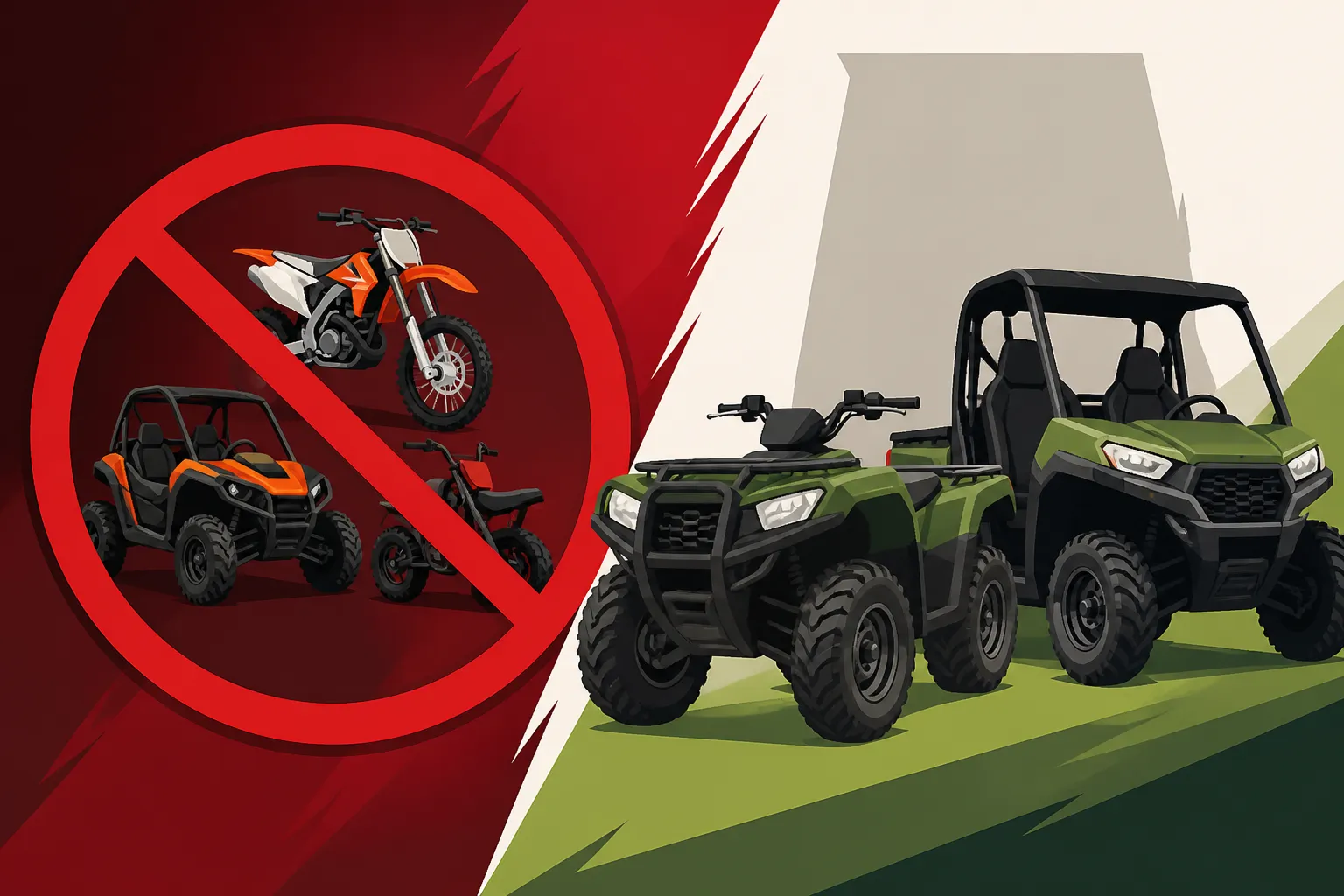
Sometimes, you encounter a truly unique off-road machine – perhaps a custom-built rock crawler, a highly modified UTV, or an amphibious vehicle. If these machines significantly exceed the defined width and weight limits for ATVs or ROVs, or if they don't meet other core definitional criteria (like having non-highway tires), then they are simply not covered by Alabama's specific off-road vehicle chapter.
This doesn't necessarily mean they are illegal, nor does it mean they are street legal. It just means that the particular rules for ATV/ROV titling and registration don't apply. These types of vehicles might exist in a legal grey area or fall under broader, less specific vehicle statutes, or they might be restricted entirely to private property. Owners of such unique machines would need to consult general vehicle laws or even local ordinances to determine their legal status and permitted uses. The key takeaway is that if it doesn't fit the specific legal box for an ATV or ROV, this chapter isn't for it.
What These Exclusions Mean for Owners
Understanding these exclusions is more than just academic; it has real-world implications for how you own, manage, and use your vehicle in Alabama. It helps you avoid missteps and ensures you're looking at the correct rulebook.
Different Rules for Different Machines
The most important takeaway is that being excluded from Alabama's ATV and ROV titling and registration chapter doesn't mean a machine is unregulated; it simply means it operates under a different set of rules. For instance, golf carts might be governed by municipal ordinances for street use, or they might be restricted entirely to private property. Low-speed vehicles, on the other hand, are titled and registered much like a traditional car, subject to on-road vehicle laws.
For farm equipment, its use is often the defining factor, allowing it to operate without specific off-road registration when performing agricultural tasks. This means you can't just assume a general lack of regulation. Instead, you need to identify the correct category for your machine and then research the laws that specifically apply to that category. This targeted approach will prevent you from trying to comply with rules that aren't relevant to your vehicle.
Ownership and Proof for Excluded Machines
Even if your machine isn't titled or registered under Alabama's ATV/ROV chapter because it's excluded, you absolutely still need clear proof of ownership. Whether it's a golf cart, a piece of farm equipment, or a custom-built off-road rig, having documents that prove you are the rightful owner is critical for a variety of reasons. This proof can come in the form of a bill of sale, the original manufacturer's certificate of origin (MCO or MSO), or a previous registration document from another state.
A robust bill of sale, for instance, protects both the buyer and the seller in a private transaction, clearly documenting the transfer of ownership, the machine's details (like its serial number), and the purchase price. Tools like those offered by LawDepot can help you draft professional and legally sound bills of sale or other ownership documents, even for machines that fall outside the typical titling categories. This documentation is vital for insurance purposes, proving your property rights, or recovering your machine if it's ever stolen. Without it, even an excluded machine can become a real headache to prove you actually own. It's always best to have your paperwork in order, regardless of what's excluded from specific state chapters.
Here's a quick reference for common machines and their typical exclusion status from Alabama's ATV/ROV Chapter:
| Machine Type | Primary Characteristics | Excluded from ATV/ROV Chapter? | Why It's Excluded | Primary Governing Rules/Considerations |
|---|---|---|---|---|
| Golf Cart | Designed for golf courses, lower speeds | Yes | Explicitly excluded by statute. | Local municipal ordinances, private property rules. |
| Low-Speed Vehicle (LSV) | Street-legal, meets FMVSS, registered | Yes | Titled/registered as an on-road vehicle; meets different standards. | Alabama DMV for street-legal vehicles, local road use laws. |
| Farm Equipment | Used exclusively for agriculture | Yes | Specific agricultural use exemption. | Private property, agricultural operations laws. |
| Lawn Tractor/Mower | Designed for landscaping/maintenance | Yes | Primary design/intent not off-road recreation. | General property laws, manufacturer guidelines. |
| Custom Off-Road Buggy | Exceeds ATV/ROV width/weight/tire limits | Yes | Does not fit the specific legal definitions for ATVs/ROVs. | General vehicle laws, private property, specific OHV park rules (if allowed). |
| Military/Emergency ATV/ROV | Operated by government agencies | Yes | Governmental/official use exemptions. | Agency-specific regulations. |
Disclaimer
This article is for general informational purposes only and does not constitute professional advice. Laws, prices and regulations vary by location and change over time. Consult a qualified professional for guidance on your specific situation.