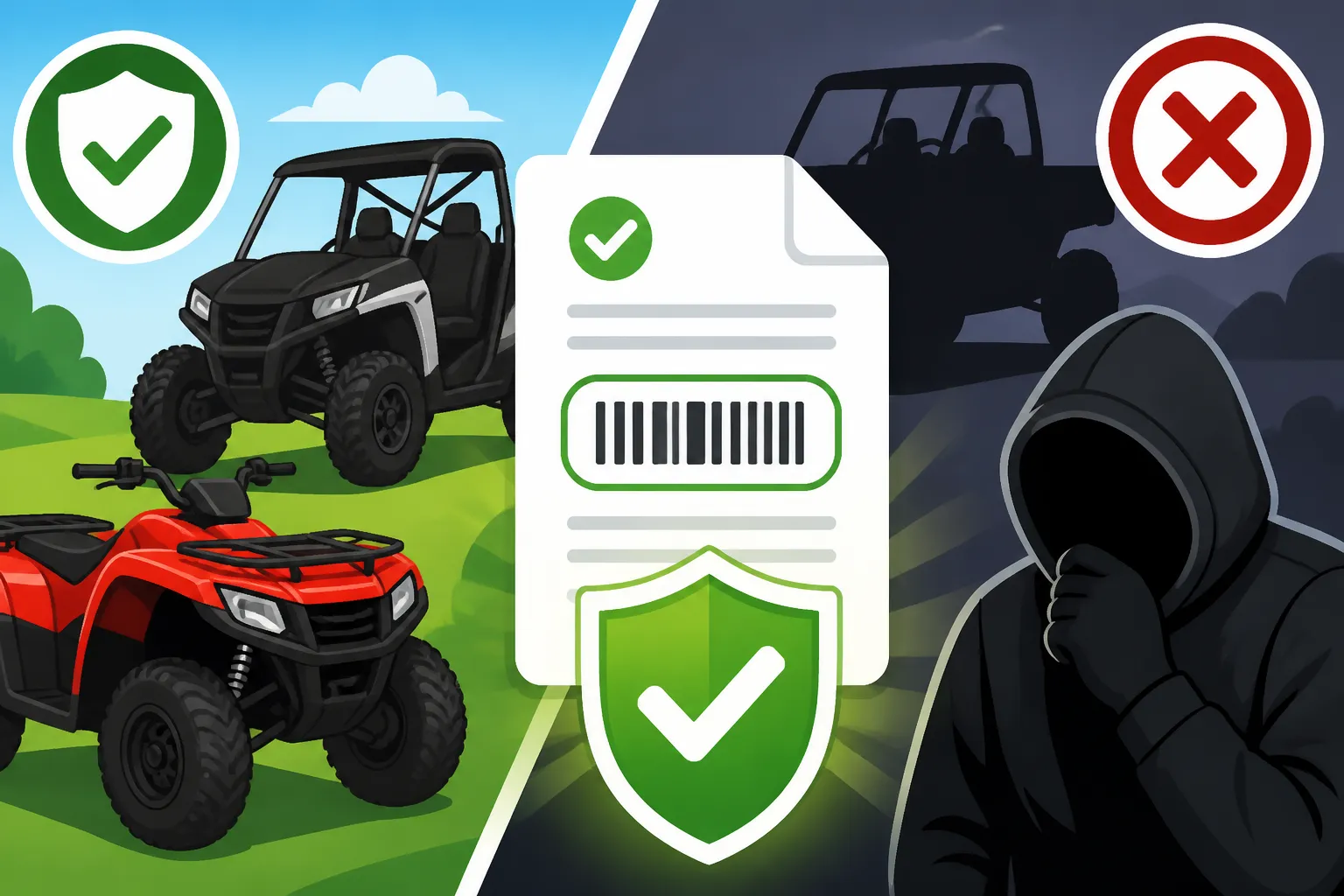
Why a Bill of Sale Must Carry the Serial Number
We've all been there: you've found the perfect ATV or side-by-side, maybe a screaming deal from a private seller, and you're ready to hit the trails or get to work on the farm. But before you shake hands and hand over the cash, there's one piece of paperwork that's absolutely critical, yet often overlooked or poorly executed: the bill of sale. And within that bill of sale, one tiny detail holds monumental importance for every Alabama off-road enthusiast: the machine's serial number. Without it, you could be opening yourself up to a world of frustration, legal headaches, and ownership disputes that no amount of fun riding can make up for. This guide will walk you through exactly why that serial number is non-negotiable on your Alabama ATV or UTV bill of sale.
The Absolute Necessity of the Serial Number on Your Bill of Sale
Imagine buying a car without a Vehicle Identification Number (VIN) on the paperwork. Unthinkable, right? Well, for ATVs and UTVs in Alabama, the serial number (often called the VIN for these machines) plays precisely the same role. It's not just a formality; it's the anchor that connects a specific machine to its legal owner, and without it on your bill of sale, you're essentially buying or selling a ghost. Many folks, especially in private sales where there isn't a dealer handling all the nuances, might scribble a quick receipt that just lists the make, model, and price. That’s a recipe for disaster.
Why It's More Than Just a Number
That string of alphanumeric characters stamped onto the frame of your ATV or side-by-side is its unique identifier, its fingerprint. It tells the world exactly which machine you are talking about. Think about it: how many red Honda Ranchers from 2018 do you think are out there? Hundreds, thousands even. Without a serial number, any one of them could be your machine, or none of them could be. This becomes especially problematic when you consider potential theft. If your machine is stolen and recovered, how do you definitively prove it's yours if your purchase paperwork doesn't specify its unique identifier? Police rely on that serial number to match recovered property to its rightful owner. The absence of this critical detail on your bill of sale leaves a massive gap in your proof of ownership, turning what should be a straightforward recovery into a bureaucratic nightmare.
Connecting the Machine to the Paperwork
The serial number on your bill of sale is the indisputable link between the physical ATV or UTV and the legal transaction. It’s what transforms a generic receipt into a legally binding document specifically for that machine. When you fill out paperwork for [Alabama Registration Paperwork Explained], the very first thing the Alabama Law Enforcement Agency (ALEA) will ask for is that serial number. They need to ensure that the machine you are attempting to register is indeed the machine that was legally transferred to you. Without the serial number on your bill of sale, you're essentially presenting them with a document that proves you bought an ATV, but not necessarily this ATV. This critical disconnect can halt your registration process dead in its tracks, leaving you with a machine you can't legally ride on designated public lands.
Future Implications for Registration and Titling (2026 and Beyond)
While current Alabama law already requires the serial number for proper registration, the stakes are about to get even higher. Starting with machines manufactured as Model Year 2026, Alabama will begin mandatory titling for ATVs and UTVs. This new law, outlined in [Alabama ATV Titling Starts With Model Year 2026], means that these newer machines will require a formal title, much like a car or truck, to prove ownership. Guess what's absolutely central to any title application? You guessed it: the serial number. If your bill of sale for a 2026 model year machine (or newer) doesn't clearly state that serial number, you'll face immense difficulty, if not outright impossibility, in getting that crucial title. The state's [Alabama Title Applications From January 2026] will demand this precision, and a vague bill of sale simply won't cut it. This upcoming change only reinforces why accurate and complete paperwork, starting with the bill of sale, is paramount.
Protecting Yourself as a Buyer and Seller in Alabama
A well-executed bill of sale, complete with the serial number, isn't just about meeting state requirements; it's about safeguarding your interests, whether you're handing over cash or receiving it. Both parties benefit immensely from the clarity and legal protection it provides.
For the Buyer: Your Proof of Ownership and Peace of Mind
As a buyer, a detailed bill of sale with the serial number is your primary document for [Proving You Own an Untitled Machine], especially for older machines that may not have been titled historically. This document is your shield against potential disputes about ownership, claims from third parties, or even issues with law enforcement if the machine's history is ever questioned. Imagine buying a machine, riding it for a year, and then discovering it was reported stolen years ago. If your bill of sale clearly lists the serial number, and you checked that number against stolen vehicle databases before the purchase, you have a strong defense. If it's missing, you might find yourself losing the machine and out of luck. It gives you the confidence to know that you are the rightful and verifiable owner, a peace of mind that's truly invaluable. When it comes time to register your machine with ALEA, having the serial number clearly on your bill of sale streamlines the process, making it much easier to get that registration decal and hit the trails without hassle.
For the Seller: Documenting the Transfer and Limiting Liability
Many sellers mistakenly think their responsibility ends when the money changes hands. However, a comprehensive bill of sale with the serial number is just as important for you. It serves as undeniable proof that you sold that specific machine on that specific date to that specific person. This record can protect you from various post-sale issues. For example, if the buyer is involved in an accident or commits a trespass with the machine a week after you sell it, a proper bill of sale can prove you are no longer the owner, helping to shield you from any liability or legal entanglement. It prevents the awkward (and potentially costly) situation where you might still be associated with the machine in official records because the transfer wasn't properly documented. Without it, you have little defense if the buyer claims you didn't sell them the machine, or if they try to return it later claiming some undisclosed defect.
Avoiding Common Pitfalls in Private Sales
Private sales, while often offering great deals, are ripe for potential problems if not handled meticulously. When you're dealing directly with another individual, the responsibility for thorough documentation falls entirely on you. One of the biggest pitfalls is discovering, after the fact, that the machine you purchased was previously stolen. This nightmare scenario can be mitigated if you make it a habit to check the serial number on the machine against your bill of sale before completing the transaction, and then checking that number against known stolen vehicle databases. Reputable sources like LawDepot offer professional bill of sale templates that ensure all the necessary fields, including a prominent spot for the serial number, are included. These templates can guide both buyers and sellers through the process, preventing common omissions that lead to big problems down the road. Another common issue is disputes over included accessories or the machine's condition. While the serial number won't solve all these issues, it ensures there's no ambiguity about which machine was sold, narrowing the scope of any disagreement to other terms. Without a clear serial number, it's easier for someone to claim they bought a different machine or that the one they received wasn't the one you advertised. [Buying From a Private Seller in Alabama] emphasizes the need for careful documentation, and the serial number is at the heart of that.
Legal and Administrative Consequences of a Missing Serial Number
The repercussions of a bill of sale lacking a serial number extend far beyond mere inconvenience. They can lead to significant legal, financial, and administrative hurdles that will quickly dampen the joy of your new off-road machine.
Struggles with ALEA Registration
For any ATV or UTV that you plan to ride on Alabama's public trails or designated areas, voluntary registration with ALEA is required. This process is generally straightforward, but it absolutely hinges on accurate information, with the serial number being a cornerstone. When you submit your application, ALEA's system cross-references the details you provide. If your bill of sale, which serves as your proof of ownership, does not contain the serial number, you'll likely find your application rejected or significantly delayed. [Alabama Serial Numbers on the Application] are specifically requested for a reason – it ensures proper identification and record-keeping. The state needs to know exactly what machine is being registered. Without this identifier clearly documented on your proof of purchase, the state has no definitive way to link you to the specific machine, making the registration process impossible until you can rectify the documentation. This could mean tracking down a previous owner who may no longer be cooperative, a frustrating and time-consuming endeavor.
Titling Hurdles from 2026 Onward
As we approach 2026, the implications for newer machines become even more severe. With mandatory titling coming into effect for Model Year 2026 and newer ATVs and UTVs, the serial number on your purchase documentation will be paramount. When you apply for a title at your county office, as described in [How to Title an ATV in Alabama], the bill of sale is a foundational document. It acts as the bridge between the previous owner (or the dealer) and you, verifying the legitimate transfer of ownership. If that bill of sale is missing the serial number, the titling clerk will have no way to process your application, as they cannot legally title a machine without its unique identifier. This means you could purchase a brand-new machine, only to find yourself unable to secure the legal title required to operate it, severely impacting its resale value and your ability to prove ownership unequivocally. It creates a limbo state where you physically possess the machine, but your legal claim to it is tenuous at best.
Theft Recovery and Insurance Claims
Unfortunately, theft is a reality for many ATV and UTV owners. If your machine is stolen, the first thing law enforcement will ask for is its serial number. This unique identifier is entered into national databases, making it possible for authorities to identify and return your machine if it's recovered, even in another state. Without the serial number documented on your bill of sale, providing this crucial information to the police can be incredibly difficult, slowing down the recovery process or making it impossible to prove the machine is yours if it's found. Similarly, when filing an insurance claim, your provider will absolutely require the serial number to process the claim. They need to verify the specific machine covered by your policy was the one stolen or damaged. Trying to file an insurance claim for [Insuring a Machine With No Title] becomes a complicated dance of proving ownership without the most direct piece of evidence, potentially leading to denied claims or protracted investigations. A complete bill of sale listing the serial number smooths this process considerably, allowing you to focus on replacing your machine rather than battling bureaucracy.
Disputes and Legal Challenges
In the unfortunate event of a legal dispute over ownership, a poorly drafted bill of sale can leave you highly vulnerable. Whether it's a disagreement with a previous owner, a claim from a lienholder, or a challenge from a family member after a death, the serial number on the bill of sale provides the irrefutable evidence needed to settle such conflicts. Without it, your claim to ownership could be difficult to prove in a court of law, potentially leading to the loss of your machine or significant legal expenses. Imagine trying to explain to a judge that you bought "a red quad" without any further identifying marks on the purchase document. It simply won't hold up. This is where using a robust template, like those found on LawDepot, can be a lifesaver, ensuring that all necessary legal details are included for your protection.
Crafting a Complete and Valid Bill of Sale
Understanding why the serial number is so important is the first step. The next is knowing how to create a bill of sale that includes it, along with all the other critical details, to ensure you're fully protected.
Key Elements Beyond the Serial Number
While the serial number is undeniably crucial, a complete and valid bill of sale needs more. Think of it as painting a full picture of the transaction. Here’s what else you absolutely must include:
- Date of Sale: This establishes exactly when ownership transferred.
- Full Names and Addresses of Buyer(s) and Seller(s): This clearly identifies all parties involved. Make sure these match government-issued IDs.
- Detailed Machine Description: Beyond make and model, include year, color, and any distinguishing features or accessories. The more detail, the better.
- Purchase Price: Clearly state the agreed-upon amount.
- Method of Payment: Note how payment was made (cash, check, bank transfer).
- Condition of the Machine: A brief statement about its condition ("as-is," "good running condition," etc.) can prevent future disputes.
- Signatures of Both Parties: This is crucial for legal enforceability. Consider having it notarized for extra peace of mind, though it's not always legally required for a simple bill of sale.
These details, combined with the serial number, create a robust legal record. [Alabama Bill of Sale Requirements] will confirm that these elements are standard for a reason: they leave no room for ambiguity.
Verification Steps Before Finalizing the Sale
Before any money changes hands or signatures are applied, both buyer and seller should take verification seriously. As a buyer, you must physically locate the serial number on the ATV or UTV itself. It's usually stamped into the frame, often near the steering column, on a frame rail, or on the engine case. Compare this number exactly to what's written on the bill of sale. If there's a discrepancy, stop the sale until it's rectified. Don't assume it's just a typo. An incorrect serial number makes the bill of sale virtually worthless for proving ownership of that specific machine. As a seller, double-check that you've accurately transcribed the serial number from the machine to the document. [Checking a Serial at an Alabama Sale] is not just a suggestion; it's a vital step to prevent future problems. It’s also wise for buyers to run the serial number through an online stolen vehicle database (many police departments or state agencies offer this, or third-party services) to ensure they aren't inadvertently purchasing hot property.
Using Templates for Accuracy
Trying to create a bill of sale from scratch can be daunting, and it's easy to overlook essential information. This is where using a professionally designed template comes in handy. Platforms like LawDepot offer customizable bill of sale templates specifically designed to be legally sound and comprehensive. These templates ensure that all the critical fields, including dedicated spaces for the serial number, buyer and seller information, sale terms, and disclaimers, are present. They guide you through the process, minimizing the chance of errors or omissions that could cause issues later. While a simple handwritten note might feel sufficient, a structured template provides far greater protection and peace of mind for both parties.
What to Do If You Don't Have a Serial Number
What if you're in a tough spot and already have an ATV or UTV without a bill of sale that lists the serial number, or perhaps no bill of sale at all? It's a challenging situation, but not always insurmountable, particularly for older machines. For registration purposes, ALEA often accepts alternative forms of proof of ownership, such as a sworn affidavit of ownership, a title from another state, or a notarized statement from a previous owner, especially if the machine is older and a clear chain of custody is difficult to establish. [Alabama Registration Without a Bill of Sale] outlines some of these possibilities. For machines bought years ago at a farm sale, proving ownership may require a declaration from the seller (if they can be found) or other corroborating evidence. The key is to be proactive in gathering as much documentation as possible, even if it's not a perfect bill of sale. However, for newer machines (Model Year 2026 and beyond), lacking a properly documented serial number on your purchase papers will make getting a title exceptionally difficult, potentially requiring a court order or other complex legal remedies. The best advice remains: always ensure that critical serial number is on your bill of sale from day one.
Here’s a quick overview of what makes a bill of sale effective:
| Feature | Good Bill of Sale | Problematic Bill of Sale | Implications for Owner |
|---|---|---|---|
| Serial Number | Clearly stated, matches machine's physical number. | Missing or incorrect serial number. | Positive: Clear proof of ownership, easy registration/titling, aids theft recovery. Negative: Ownership disputes, registration/titling rejection, difficult theft recovery, insurance claim issues. |
| Buyer/Seller Info | Full names, addresses, contact. | Vague names, missing addresses. | Positive: Clear parties, legal recourse if needed. Negative: Difficulty tracking parties, liability issues. |
| Date of Sale | Specific date of transaction. | No date or unclear date. | Positive: Establishes ownership transfer timeline. Negative: Ambiguity for liability or taxing periods. |
| Machine Description | Make, model, year, color, distinguishing features. | Just "quad" or "side-by-side". | Positive: Identifies specific machine. Negative: Difficult to prove which machine was sold/bought. |
| Purchase Price | Clearly stated amount. | Vague ("for a sum"), or not listed. | Positive: Financial record, tax basis. Negative: Disputes over value, tax assessment issues. |
| Signatures | Both buyer and seller sign. | Only one party signs, or no signatures. | Positive: Legal enforceability. Negative: Document may not be legally binding. |
| "As-Is" Clause (if applicable) | Clearly states machine is sold "as-is." | No mention of condition. | Positive: Limits seller liability for future issues. Negative: Seller may be liable for hidden defects. |
Disclaimer
This article is for general informational purposes only and does not constitute professional advice. Laws, prices and regulations vary by location and change over time. Consult a qualified professional for guidance on your specific situation.