Alabama Registration Compared to Mississippi
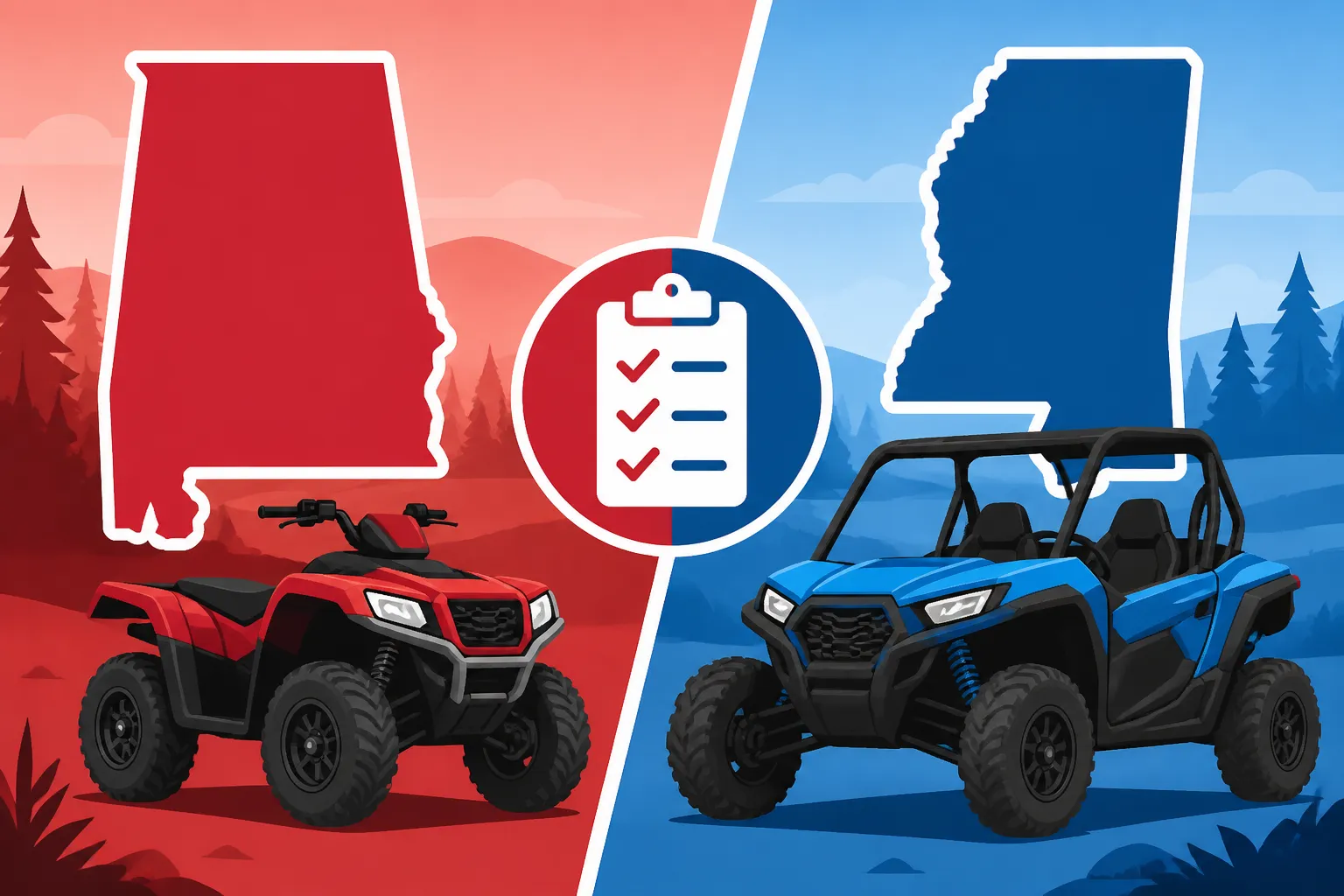
It's incredibly frustrating when you're trying to do the right thing and understand the laws for your ATV or UTV, only to find that what applies in one state doesn't quite line up with its neighbor. Many riders who live near the Alabama-Mississippi border, or even just travel between the two for riding opportunities, often scratch their heads trying to figure out the differences in registration requirements. This guide is here to untangle that confusion, laying out exactly how Alabama's off-road vehicle registration process differs from Mississippi's, so you can ride with confidence, no matter which side of the line you're on.
Alabama's Approach to ATV and UTV Registration
Alabama has taken a unique path when it comes to ATV and UTV registration, one that often catches people by surprise because it's not what they might expect from vehicle laws. Unlike cars or trucks, the state views off-road machines through a slightly different lens, especially regarding their use on public versus private lands. Understanding this distinction is key to navigating the system here.
Voluntary Registration and Its Tiers
For the vast majority of ATV and UTV owners in Alabama, registering their machine is a completely voluntary choice. This isn't a mandate for everyone; it's an option that provides specific benefits. The Alabama Law Enforcement Agency (ALEA), specifically its Marine Patrol Division, oversees this process, which can seem a bit odd for a dirt machine, but it's how the state has organized it. They offer two distinct tiers of registration, and your choice depends entirely on how and where you plan to ride.
The "Private Use" tier is the less expensive option, designed for folks who primarily keep their riding to private property, like their own land, a hunting lease, or private riding parks. It serves as an official record of ownership and helps with theft recovery, but it doesn't grant widespread access to public lands. Then there's the "Public Use" tier, which costs a bit more. This tier is for riders who intend to use their ATVs or UTVs on designated public trails, wildlife management areas (WMAs), or other state-managed riding areas. Choosing the Public Use option signals your intent to operate on these lands and helps fund their maintenance and management. Both of these registrations are valid for three years, which is a nice long stretch compared to annual renewals you might find elsewhere. [Alabama Registrations Run Three Years] is a good read if you want to dive deeper into why this period was chosen.
What Alabama's Registration Actually Provides
It's crucial to understand that an Alabama ATV or UTV registration is not the same as a license plate for street use. Alabama does not consider these machines street legal in the traditional sense, and getting a registration sticker will not allow you to cruise down public roads. What you receive from ALEA after registering is a small, adhesive decal that you affix to your machine, typically in a visible spot. This decal, along with the registration card, serves as official proof that your machine is recognized by the state for off-road use.
The primary benefits of this registration, particularly for the Private Use tier, revolve around establishing clear ownership. If your machine is ever stolen, having it registered with the state gives law enforcement a much better chance of recovering it and proving it belongs to you. It also streamlines the process if you ever need to transfer ownership later on, as there's a clear state record. For those in the Public Use tier, this decal is your ticket to legally access those designated public riding areas. It signals that you've contributed to the system that maintains those trails. Without it, you could face fines or be turned away from public lands. [Why Alabama Issues an Ownership Record, Not a Plate] explains this concept in more detail.
The New Titling Law in Alabama Model Year 2026
Here's where things get a little more complex, especially when comparing to past practices. Starting with model year 2026, Alabama is implementing a new titling law for ATVs and UTVs. This is a significant change because, historically, these machines have gone untitled. From January 1, 2026, any new ATV or UTV with a model year of 2026 or later will require a title. This means if you buy a brand-new side-by-side or quad, you'll go through a titling process similar to a car, handled by your county probate office.
It's important to differentiate this new titling requirement from the existing, voluntary registration process. For machines model year 2025 and older, the new titling law simply doesn't apply. These older machines will continue to operate under the old rules: voluntary registration with ALEA, but no title from the state. The title and registration functions are even split between two different state agencies, which can definitely add to the confusion for owners. The titling is handled by the county probate offices and processed through the ALVIN system, while registration remains with ALEA. This new titling system aims to enhance ownership security and streamline transactions for newer machines, but it creates a dual system for the time being. [Alabama ATV Titling Starts With Model Year 2026] goes into depth on what this means for future owners.
Mississippi's Framework for Off-Road Vehicle Registration
Just a short drive across the state line, Mississippi presents a somewhat different picture when it comes to regulating ATVs and UTVs. While some of the underlying concerns are similar – like public land access and ownership proof – the practical application and legal framework are structured differently, reflecting a different approach by the state legislature.
Mandatory Registration for Public Land Access
In Mississippi, the registration of off-road vehicles (ORVs), which includes ATVs and UTVs, isn't entirely voluntary in the same way it is in Alabama. If you plan to ride your ATV or UTV on any land designated for public use, such as state forests, wildlife management areas (WMAs), or state park trails managed by the Mississippi Department of Wildlife, Fisheries, and Parks (MDWFP), then registration becomes mandatory. This is a clear "if you want to ride here, you must register" rule. If you strictly keep your machine on private property that you own or have explicit permission to use, then state registration might not be required, but most riders eventually find themselves wanting to explore public options.
The registration process typically involves applying through the MDWFP. You'll receive a decal or sticker that you must display on your machine as proof of registration. This system helps the MDWFP manage and maintain the trails, and it ensures that users of public lands are contributing to their upkeep. It’s not just a suggestion; it's a legal requirement to operate on those lands. This contrasts sharply with Alabama's Public Use tier, which is an option for public land access, not a blanket mandate for all ORV owners.
The Role of Title in Mississippi
One of the biggest differences between Alabama and Mississippi (at least for pre-2026 Alabama machines) lies in the concept of a state-issued title. For many years, Mississippi has generally not required or issued official state titles for ATVs and UTVs. This means that if you buy a new machine in Mississippi, you'll receive a Manufacturer's Certificate of Origin (MCO) or Manufacturer's Statement of Origin (MSO) from the dealer. This document, along with a bill of sale, is your primary proof of ownership.
For machines bought privately, a well-documented bill of sale becomes paramount. Without a state title, transferring ownership relies heavily on these private documents. This can create challenges when it comes to proving ownership, especially if documents are lost or poorly kept. While a bill of sale signed by both parties is legally binding, it doesn't carry the same weight or centralized record-keeping as a state-issued title, which Alabama is now moving towards for newer machines. This lack of a title system means that security interests (like liens from a lender) are also recorded differently, usually through a UCC filing rather than being noted directly on a title document. If you're buying a used machine in Mississippi, always insist on a clear bill of sale and ideally, the original MCO/MSO if available. [Alabama Bill of Sale Requirements] highlights some key elements that should always be present in such a document, regardless of state.
Road Use and Street Legalization in Mississippi
Like Alabama, Mississippi generally does not allow ATVs or UTVs to be operated on public roads and highways. These machines are fundamentally designed for off-road use, and state law reflects that. There are exceptions, primarily for agricultural purposes or crossing a highway at a designated intersection, but cruising city streets or county roads is largely prohibited for standard off-road vehicles.
Some cities and counties in Mississippi have local ordinances that permit the use of UTVs or golf carts on certain secondary roads, usually with speed restrictions and specific equipment requirements (like lights, mirrors, and turn signals). However, these are highly localized and do not equate to a statewide "street legal" status for all UTVs, much less ATVs. You would need to check with each individual municipality. True street-legal conversions for ATVs, to meet federal motor vehicle safety standards (FMVSS), are practically impossible due to the inherent design of most quads. For UTVs, purpose-built "low-speed vehicles" (LSVs) can be street legal, but these are distinct from most off-road UTVs. [Can You Drive an ATV on the Road in Alabama?] addresses similar questions for Alabama riders.
Key Differences in Requirements and Process
When you lay out the two systems side-by-side, the distinctions in how Alabama and Mississippi handle off-road vehicles become quite clear. It's not just about what's required, but also how you go about meeting those requirements, and which agencies you'll be interacting with along the way.
Application Process and Required Documents
In Alabama, if you choose to register your ATV or UTV, you'll be dealing with ALEA's Marine Patrol Division. The application process typically involves filling out a form, providing proof of ownership (like a bill of sale or Manufacturer's Certificate of Origin), and the machine's serial number. Many dealers in Alabama are set up to handle the registration paperwork for you when you purchase a new machine, which is a convenient service. If you're buying privately, you'll need a solid bill of sale detailing the machine, purchase price, seller and buyer information, and the all-important serial number. [Alabama Registration Paperwork Explained] breaks down what you'll need.
Mississippi's registration process, if you're riding on public lands, goes through the MDWFP. You'll typically need to provide an application, proof of ownership (such as an MCO/MSO for new, or a bill of sale for used machines), and possibly details about where you intend to ride. While dealers might assist, many private purchases and registrations for public land access might require you to directly interact with the MDWFP. Given the lack of a state title for many machines in Mississippi, a comprehensive bill of sale is even more vital as your primary proof of ownership. Resources like LawDepot can be incredibly helpful for drafting a legally sound bill of sale when you're dealing with a private transaction, ensuring all necessary details are covered in either state.
Costs and Fees
The cost structure for off-road vehicle recognition also varies between the two states. In Alabama, the registration fee for an ATV or UTV is a single charge that covers a three-year period. There's also a small "issuance fee" added on top of the registration fee when you apply. The total cost is relatively modest, especially considering it covers three years. The Public Use tier is a little more expensive than the Private Use tier, reflecting the increased access and administrative costs associated with maintaining public riding areas. [Alabama Registration Costs Over Three Years] provides a good overview of what to expect for Alabama.
Mississippi's ORV registration fees are typically collected by the MDWFP. While I can't give specific figures, their system is often structured as an annual or possibly multi-year fee that directly supports their public land and wildlife management efforts. Because Mississippi doesn't have a titling requirement for these machines, you won't encounter separate state titling fees like those coming to Alabama for 2026 model year machines. The overall cost might feel different due to the length of the registration period and the specific purpose for which the fees are collected.
Proof of Ownership and Transfer
This is perhaps one of the most significant practical differences. In Alabama, even with voluntary registration, the state's upcoming titling law for 2026 and newer machines provides a clear, official record of ownership. For older, untitled machines, the ALEA registration acts as a state-recognized ownership record, often supplementary to a bill of sale. When you sell a registered machine in Alabama, you'll transfer the registration. For a titled machine (2026+), you'll transfer the title, much like a car.
In Mississippi, without a statewide titling system for most ATVs and UTVs, the burden of proving ownership falls more squarely on documentation like the MCO/MSO and the bill of sale. When transferring ownership in Mississippi, the process primarily involves providing the new owner with the original MCO/MSO (if applicable) and a signed, detailed bill of sale. There's no state title to sign over. This makes it absolutely critical for both buyers and sellers in Mississippi to keep meticulous records and ensure their bill of sale is comprehensive and unambiguous. Using a service like LawDepot for a professional bill of sale can provide peace of mind in these situations, ensuring all legal bases are covered and minimizing potential disputes down the road. [Proving Ownership of a Quad Bought at a Farm Sale] is a relevant resource for ensuring proper documentation, especially in private sales.
Practical Implications for Cross-State Riders
Many riders in the Alabama-Mississippi border region, and even those from further afield, often find themselves wanting to explore trails in both states. This introduces a whole new layer of questions about how each state's laws apply when you're just visiting.
Riding in the "Other" State
A common question is whether your Alabama-registered ATV can be ridden in Mississippi, or if a Mississippi-registered ORV is welcome on Alabama trails. Generally, both states do extend some level of reciprocity for out-of-state registered vehicles, but it's not a blanket pass.
If you have an Alabama Public Use registration decal, it's generally accepted in other states that require off-road vehicle registration for public land access. Similarly, if your ORV is properly registered with the MDWFP for public use in Mississippi, it should typically be recognized by Alabama's public land managers if you intend to ride on their designated trails. However, this is where the voluntary nature of Alabama's registration comes into play. If your Alabama machine only has the Private Use registration, or no registration at all, you might find yourself in a grey area when trying to access Mississippi's public lands which require registration. Always verify with the specific park or land management agency in the state you're visiting. Local rules can override general reciprocity, and it's always better to be safe than sorry. [Alabama Rules for a Visiting Mississippi Rider] touches on specifics for cross-border visits.
Moving from One State to Another
If you're making a permanent move and bringing your ATV or UTV with you, the rules change from visitor status to new resident. If you move from Mississippi to Alabama, and your machine is model year 2026 or newer, you will eventually need to apply for an Alabama title for it once the law goes into effect. Regardless of the model year, if you want to ride on Alabama's public lands, you'll need to obtain an Alabama Public Use registration through ALEA. Your Mississippi registration won't cut it for permanent residency here, nor will it serve as an Alabama title.
Conversely, if you move from Alabama to Mississippi, you won't need to apply for a state title for your ATV or UTV, even if it's a 2026 model that was titled in Alabama. Mississippi generally doesn't have that requirement. However, if you plan to ride on Mississippi's public lands, you'll need to apply for registration through the MDWFP. Your Alabama registration will not transfer or fulfill Mississippi's public land requirements for new residents. In both scenarios, retaining your original MCO/MSO and a solid bill of sale will be critical for proving ownership in your new home state. [Alabama Registration for a New Resident] details what's needed if you're settling in Alabama.
Here's a quick summary of the key differences:
| Feature | Alabama (Pre-2026 Models) | Alabama (2026+ Models) | Mississippi |
|---|---|---|---|
| Registration | Voluntary (Private or Public Use tiers) | Voluntary (Private or Public Use tiers) | Mandatory for public land use, otherwise voluntary |
| Registration Agency | ALEA Marine Patrol Division | ALEA Marine Patrol Division | MS Dept. of Wildlife, Fisheries, and Parks (MDWFP) |
| Registration Period | Three years | Three years | Typically annual or multi-year |
| Titling | No state title issued | Mandatory state title issued (by county) | No state title issued |
| Titling Agency | N/A | County Probate Office | N/A |
| Proof of Ownership | Bill of sale, MCO/MSO, ALEA registration | Bill of sale, MCO/MSO, State Title | Bill of sale, MCO/MSO |
| Primary Road Use | Generally not allowed | Generally not allowed | Generally not allowed |
| Reciprocity for Visitors | Generally accepted with valid out-of-state public-use registration | Generally accepted with valid out-of-state public-use registration | Generally accepted with valid out-of-state public-use registration |
Navigating the world of ATV and UTV laws can definitely feel like a maze, especially when you're dealing with state lines. While Alabama and Mississippi are neighbors, their approaches to off-road vehicle registration and titling have some distinct differences. Alabama offers voluntary registration with a clear shift towards mandatory titling for newer machines, while Mississippi relies more on mandatory registration for public land access and traditional ownership documents like a bill of sale. Always do your homework, whether it's before a quick trip across the border or a permanent move, to ensure your machine is properly documented and legal for the trails you plan to conquer.
Disclaimer
This article is for general informational purposes only and does not constitute professional advice. Laws, prices and regulations vary by location and change over time. Consult a qualified professional for guidance on your specific situation.