Alabama Registration Compared to Georgia
Navigating the world of ATV and UTV registration can feel like a maze, especially when you live near a state line or enjoy riding in neighboring states. What's perfectly acceptable for your quad or side-by-side in Alabama might raise an eyebrow (or worse, a citation) just a few miles down the road in Georgia. This guide is here to untangle the differences between Alabama's and Georgia's ATV and UTV registration requirements, helping you understand what you need to do to ride legally wherever your trails may take you.
Understanding Alabama's Approach to Off-Road Vehicle Registration
Let's start with our home state. Alabama has a pretty specific way of handling ATVs and UTVs, and it's important to grasp the nuances, especially with some recent changes on the horizon. For a long time, Alabama focused almost entirely on registration for off-road machines, with no statewide titling requirement for most older models.
Voluntary Versus Mandatory Registration in Alabama
One of the biggest distinctions in Alabama is whether your machine's registration is voluntary or mandatory. Generally speaking, if you're riding exclusively on private land that you own or have permission to use, registration is entirely voluntary. Many folks choose to register anyway for the proof of ownership and the decal, but it's not a legal requirement for private-land use. This gives a lot of flexibility for landowners, farmers, and hunting clubs who keep their machines entirely within their own property boundaries.
However, the moment you decide to take your ATV or UTV to any public lands in Alabama—think state parks, designated riding areas, or wildlife management areas (WMAs) where off-road vehicles are permitted—registration becomes mandatory. The state wants to ensure that machines on public property are accounted for and that owners are contributing to the upkeep and regulation of these areas. This public use tier often has a slightly higher fee because it unlocks access to these shared resources. It's a key distinction to remember, as many riders find themselves needing public land access for recreation. [Alabama Public Use ATV Registration Explained] delves deeper into these requirements.
The Role of ALEA and the Three-Year Term
In Alabama, the registration of your ATV or UTV is handled by the Alabama Law Enforcement Agency (ALEA). They are the central authority for issuing the decals and processing the paperwork that gets your machine officially registered. You'll submit your application, proof of ownership (like a bill of sale), and fees directly to them. This centralized system means consistency across all counties in terms of the process.
A very rider-friendly aspect of Alabama's registration is its three-year term. Unlike annual renewals you might see for other vehicles, your ATV or UTV registration in Alabama is valid for a full three years from the date of issuance. This means less frequent trips to the mailbox or online portal, and fewer administrative headaches. When your three years are up, you'll simply go through a renewal process to keep your registration current. [Alabama Registrations Run Three Years] explains more about this benefit.
Alabama's Upcoming Titling Requirements
Now, here's where Alabama is evolving. Historically, Alabama did not title most ATVs and UTVs. This meant proving ownership primarily relied on a bill of sale and your registration. However, a new law means that starting with model year 2026 machines, ATVs and UTVs will be subject to a titling requirement. This brings Alabama more in line with how other states handle vehicle ownership, adding another layer of security and proof of ownership.
This change means that if you purchase a brand-new ATV or UTV that is a 2026 model year or newer, you will need to apply for a title for it, typically through your county probate or license office. Older machines, those from model year 2025 and earlier, will not require a title under this new law. This phased approach aims to ease the transition for existing owners while establishing a clear system for future purchases. It's a big shift, and [Alabama ATV Titling Starts With Model Year 2026] and [Alabama Title Applications From January 2026] provide essential details.
Navigating Georgia's Off-Road Vehicle Regulations
Crossing the state line into Georgia, you'll find a different set of rules for ATVs and UTVs. Georgia's approach has some similarities but also distinct differences that are crucial for riders to understand, especially concerning registration and titling.
Georgia's Definition and Titling Mandate
In Georgia, Off-Road Vehicles (ORVs) are generally defined and regulated, and the state does require titles for most ATVs and UTVs. This is a significant divergence from Alabama's historical non-titling status for these machines. If you buy an ATV or UTV in Georgia, whether new or used, the process will typically involve applying for a title through the Georgia Department of Revenue's Motor Vehicle Division, usually handled at your county tag office.
This titling mandate provides a clear chain of ownership, which is often seen as a benefit for preventing theft and facilitating sales. It means that when you purchase a machine in Georgia, getting that title transferred into your name is a critical step, much like buying a car. Without a title, proving legal ownership can become a significant hurdle.
Registration for Off-Road Use in Georgia
While Georgia requires titles for ATVs and UTVs, the concept of a specific "off-road registration" sticker or plate for exclusive off-highway use is often less emphasized than in Alabama. Instead, the titling process is the primary method of recording ownership and identifying the machine.
For riding on private land, much like Alabama, specific state registration for the sole purpose of private off-road use is generally not required beyond the titling process itself. However, if you plan to operate your ATV or UTV on any public lands, trails, or designated recreation areas within Georgia, you will need to check with the specific land management agency (e.g., U.S. Forest Service, Georgia Department of Natural Resources) for their particular permit or access requirements. These often focus on land access permits rather than a general state registration for the vehicle itself.
Road Use and Exceptions in Georgia
Both Alabama and Georgia generally restrict ATVs and UTVs from being driven on public roads. However, both states have specific, narrow exceptions, often related to agricultural use, crossing roads, or very specific local ordinances. In Georgia, some counties and municipalities have created ordinances allowing limited use of UTVs or golf carts on certain secondary roads, but these are highly localized and do not apply statewide.
For instance, if you're using an ATV for bona fide agricultural purposes in Georgia, there might be provisions for limited road travel between fields. However, this is not a blanket allowance for recreational road riding. It's always crucial to check local laws and never assume an ATV or UTV is street legal unless explicitly stated by a local ordinance and the machine meets specific low-speed vehicle (LSV) requirements, which most ATVs and UTVs do not. [Alabama ATV Road Rules Explained] provides our state's perspective, which shares many similarities in caution.
Key Differences in ATV/UTV Registration and Titling
Let's break down the core distinctions between Alabama and Georgia to make things crystal clear. Understanding these points is crucial, especially if you buy a machine in one state and plan to use it in another, or if you simply ride near the border.
Titling: A Fundamental Divergence
The most significant difference lies in the titling requirements.
- Alabama: Historically, no statewide title for ATVs and UTVs. Ownership was primarily proven by a bill of sale and registration. However, starting with model year 2026, new ATVs and UTVs will require a title. This means current owners of older machines (2025 model year and earlier) are unaffected by the titling law. [Why Pre-2026 Owners Do Nothing] is a good resource for existing Alabama owners.
- Georgia: Generally, ATVs and UTVs do require a title. This has been the standard practice for a long time, providing a clear ownership document from the county tag office.
This difference has practical implications. If you buy a used ATV in Georgia, expect a title to be part of the transaction. If you buy a used one in Alabama (pre-2026 model), you'll likely only receive a bill of sale and perhaps an existing registration record. When selling, having the correct paperwork, like a well-drafted bill of sale (which a service like LawDepot can help you create), is paramount in both states, but the presence of a title significantly changes the transfer process.
Registration: Mandatory vs. Voluntary for Off-Road Use
While both states want to keep track of machines, their primary mechanisms and mandatory nature differ.
- Alabama: The state offers a voluntary registration for private land use, but it becomes mandatory if you want to ride on any designated public lands or trails. This public use registration includes a decal and contributes to public land management.
- Georgia: Titling is the primary means of identification. There isn't a broad, mandatory "off-road registration" program akin to Alabama's public use tier. Instead, public land access often relies on specific permits issued by the managing agency (e.g., U.S. Forest Service pass, WMA permit), which are separate from vehicle registration.
This means if you're an Alabama resident planning to ride Georgia's national forest trails, you'll need to research Georgia's specific permit requirements for those trails, rather than looking for a general state ATV registration.
Agencies Involved and Term Lengths
The administrative aspects also vary, impacting how and where you interact with state authorities.
- Alabama: ATV/UTV registration is handled by ALEA, and it runs for a convenient three-year term. Titling (for 2026+ models) will be handled by county probate or license offices.
- Georgia: Titling and any associated vehicle records are typically managed by the Georgia Department of Revenue's Motor Vehicle Division through your local county tag office, similar to how cars are handled. Registration terms usually align with vehicle registrations, often on an annual basis, though for off-road vehicles not street legal, the emphasis remains on the title.
Costs and Fees
While I can't provide specific dollar amounts (as they can change), I can describe the shape of the costs.
- Alabama: Registration involves a fee for the three-year term, plus an issuance fee and any processing charges. For 2026+ models, there will be a separate title fee, plus county processing charges. These costs are generally straightforward and publicly published by ALEA and county offices. [Alabama Registration Cost] and [Alabama ATV Title Cost] provide more detail.
- Georgia: The primary cost for an ATV or UTV will be the title fee itself, plus any applicable sales tax, which varies by county. There might also be a small ad valorem tax in some areas. If you need specific land access permits, those will be additional fees.
The total cost of ownership will include sales tax, whether you're in Alabama or Georgia. A service like LawDepot can help you ensure your bill of sale accurately reflects the purchase price, which is vital for calculating sales tax. [Alabama ATV Sales Tax Rate] gives insight into our state's rates.
Practical Implications for Riders and Owners
Understanding these differences isn't just academic; it has real-world consequences for how you buy, own, and ride your off-road machine.
Buying and Selling Across State Lines
If you're buying an ATV or UTV from a private seller in Georgia and bringing it to Alabama (or vice versa), be prepared for the different paperwork.
- Bringing a Georgia machine to Alabama (2026+ model year): If it's a 2026 model year or newer, Alabama will require you to title it. The Georgia title will be crucial for this. If it's older than 2026, Alabama still won't require a title from you, but you'll still need a solid bill of sale and can register it voluntarily or for public use. [Alabama Title for a Machine Bought Out of State] provides details.
- Bringing an Alabama machine to Georgia: Georgia will likely require you to title the machine. If your Alabama machine (pre-2026 model) doesn't have a title, you'll need a robust bill of sale and potentially other proofs of ownership to satisfy Georgia's titling requirements. This is where a comprehensive bill of sale, perhaps drafted with the help of a tool like LawDepot, becomes absolutely essential.
Always get a proper bill of sale that includes the machine's VIN/serial number, seller's and buyer's information, and the sale price. [Alabama Bill of Sale Requirements] outlines what our state expects.
Riding Near the Border or on Vacation
For those who live close to the Alabama-Georgia line, or who enjoy taking their machines on vacation, knowing the local rules is paramount.
- Alabama-registered machine in Georgia: Your Alabama registration decal might not be recognized as a substitute for Georgia's land access permits. Always check the rules for the specific public land you plan to ride in Georgia.
- Georgia-titled machine in Alabama: You can register your Georgia-titled machine in Alabama for public use if you wish, getting an Alabama decal for access to our public trails. The Georgia title will serve as your proof of ownership. [What Visiting Riders Need to Ride Legally in Alabama] is a great reference for out-of-state visitors.
Remember, even if your machine is legally titled or registered in your home state, the rules of the state you are riding in take precedence regarding operation, safety gear (like helmets), and permissible riding areas.
The Importance of Proof of Ownership
Regardless of the state, having clear proof of ownership is vital. In Alabama, especially for older machines, this means a detailed bill of sale and a valid registration certificate. In Georgia, it primarily means the state-issued title. For either state, if your machine is ever stolen or involved in an accident, official paperwork will be your best friend.
Without a title (for a state like Georgia) or robust alternative proof (for older Alabama machines), dealing with insurance claims, selling the machine, or even proving it's yours if found after theft can turn into a nightmare. Services like LawDepot can assist in creating legally sound documents like a bill of sale or even a notarized affidavit if you're trying to establish ownership without a traditional title in specific circumstances.
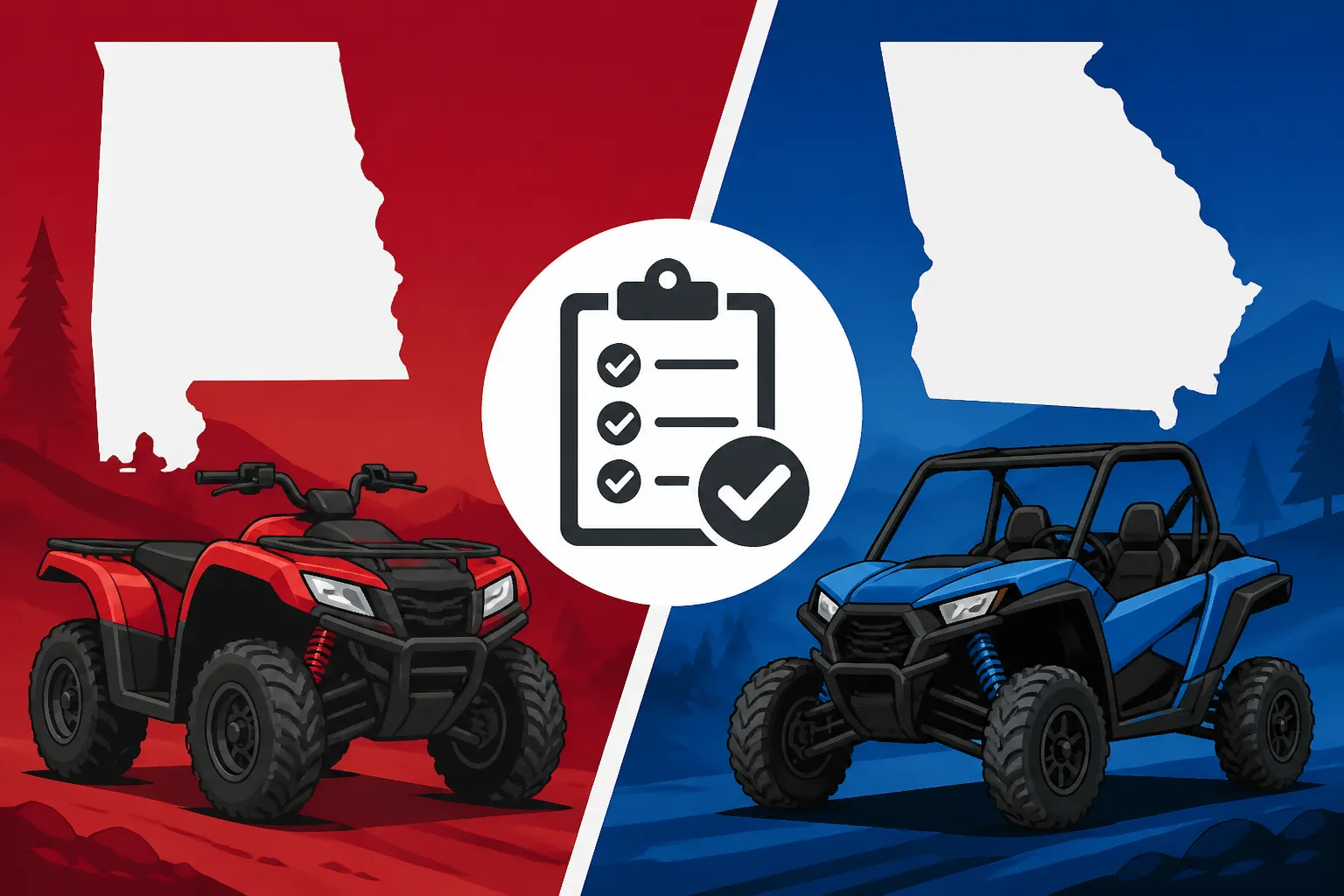
Here’s a quick comparison of the key differences:
| Feature | Alabama (Pre-2026 Model Year) | Alabama (2026+ Model Year) | Georgia |
|---|---|---|---|
| Titling Required | No | Yes | Yes |
| Registration Mandatory | Only for public land use (voluntary for private use) | Only for public land use (voluntary for private use) | Generally no state-wide off-road specific registration; titling is key. |
| Registration Term | Three years (ALEA) | Three years (ALEA) | N/A (titling is primary, annual renewals if street legal) |
| Primary Agency | ALEA (registration), County Offices (titling from 2026) | ALEA (registration), County Offices (titling from 2026) | County Tag Offices (DOR) |
| Proof of Ownership | Bill of sale, registration (title for 2026+ models) | Title, bill of sale, registration | Title |
| Road Use | Generally restricted (few exceptions) | Generally restricted (few exceptions) | Generally restricted (few exceptions) |
| Common Frustration | Lack of title for older machines, proving ownership | Adapting to new titling process for new machines | Lack of off-road specific registration for trails |
As you can see, while both states aim to manage off-road vehicles, their chosen methods create distinct processes for owners and riders. Always double-check the latest rules directly with the relevant state agencies or local authorities before you ride. The last thing any of us wants is to have a fun day on the trails turn into a legal hassle!
Disclaimer
This article is for general informational purposes only and does not constitute professional advice. Laws, prices and regulations vary by location and change over time. Consult a qualified professional for guidance on your specific situation.