Speed Limits Inside an Alabama OHV Park
A posted speed limit is only part of riding safely at an Alabama OHV park. Limits and enforcement can differ by park, trail, and conditions, so guessing from another park’s rules can put you in a difficult spot. Here’s how to find the rule that applies, choose a sensible pace when no number is posted, and avoid treating a park trail like an open road.
How speed limits work inside Alabama OHV parks
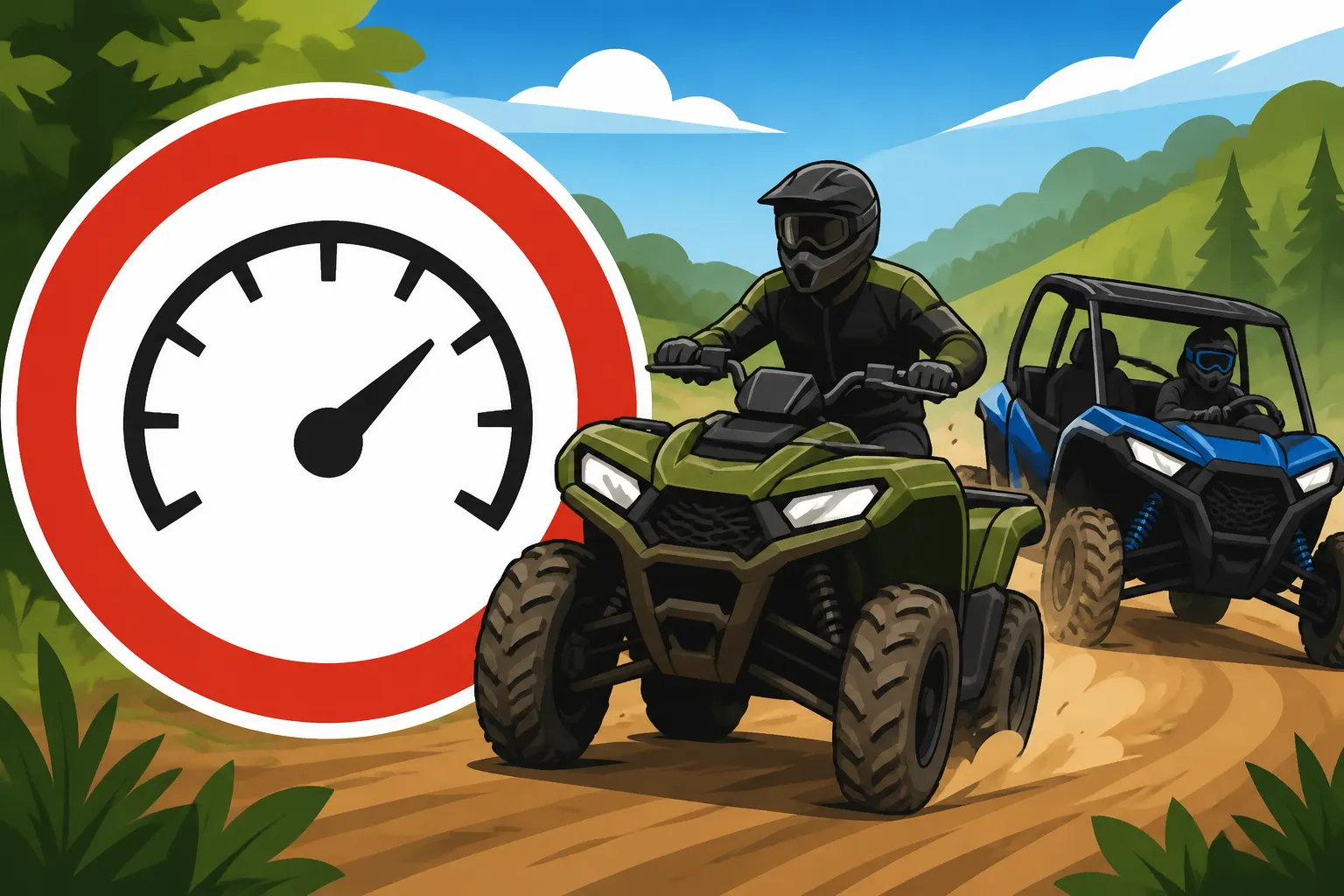
There is no single speed number that riders should assume applies at every Alabama OHV park. A park may post a general limit, set different limits in particular areas, or use signs to control speed near entrances, staging areas, campgrounds, and other busy spots. The park’s current signs and instructions from its staff are the practical starting point.
A posted maximum is not a target. It tells you the highest speed allowed under the conditions covered by the rule. If the trail is crowded, slick, rough, narrow, or difficult to see around, a lower speed may be necessary even when you are below the posted limit.
Park policies can also differ from general advice about riding on private property or public land. A privately operated facility may set conditions for admission and use, and riders are expected to follow the rules communicated by the operator. Before heading out, check the park’s current information and review Alabama Private Park Waivers and Rules. A waiver or posted rule may address speed, trail direction, passing, vehicle types, and conduct around other visitors.
Do not rely on a number remembered from a previous visit. Operators can change signs, routes, and procedures, and a limit at one property does not automatically apply at another. If you plan to ride at a particular location, ask the park directly whether it has a general speed limit and whether particular areas have separate restrictions. [Questions Worth Asking a Park Office] can help you make that call useful.
| Situation | What to do |
|---|---|
| A speed-limit sign is posted | Follow the posted limit, then slow further if conditions or traffic require it. |
| A trail has no visible speed sign | Do not assume there is no rule; check the park’s instructions and ride at a pace that lets you stop safely. |
| Staff gives a speed instruction | Follow it, even if it is more restrictive than a sign you saw elsewhere. |
| A route is crowded or visibility is limited | Reduce speed enough to respond to people, machines, obstacles, and turns. |
| You are unsure which rule applies | Stop in a safe place and ask park staff before continuing. |
The table is a practical approach, not a substitute for a park’s official rules. If a sign and a verbal instruction seem to conflict, pause somewhere safe and ask staff to clarify rather than choosing whichever rule is more convenient.
Choosing a safe pace on a trail
A speed limit sets an upper boundary; it does not tell you what speed is safe on every section. Trail conditions can change within a short distance. A straight, open section may offer a clear view ahead, while a blind corner, muddy dip, steep descent, or narrow crossing may leave little room to react. Ride slowly enough to stay in control and stop within the distance you can see.
That principle matters especially when trails are shared by different types of visitors or machines. Other riders may travel more slowly, stop suddenly, or need extra room to negotiate an obstacle. A person walking near a staging area may be difficult to see behind parked vehicles or vegetation. Give other visitors room and avoid passing where the route is too narrow to do it predictably.
Several conditions call for an immediate reduction in speed:
- Blind turns and rises: You cannot know whether someone or an obstacle is just beyond the point where the trail disappears from view.
- Loose or slippery ground: Wet soil, mud, loose gravel, and other changing surfaces can affect steering and braking.
- Steep sections: A downhill slope can make it harder to slow or change direction; an uphill climb can conceal traffic beyond the crest.
- Ruts and embedded obstacles: A wheel can catch or deflect, particularly when a rider approaches too quickly or at a poor angle.
- Dust and poor visibility: Dust raised by another machine can hide trail features and following riders. Leave enough space for it to settle or clear.
- Busy intersections and staging areas: People may be entering, leaving, loading machines, or deciding which trail to take.
- Wet conditions after rain: A familiar route may be more slippery, rutted, or difficult to read than it was on a dry day.
Trail ratings can help you choose routes that suit your ability and machine, but a difficulty rating is not a speed recommendation. Review Alabama Trail Difficulty Ratings before choosing a route, and be willing to turn back if the conditions are beyond your comfort or skill level. If heavy rain has affected the property, check Alabama Trail Closures After Rain and follow any closure instructions. A closed or damaged route is not a place to test whether it remains passable.
Machine type matters, too. A side-by-side, a quad, and a dirt bike may respond differently to bumps, turns, and braking. So do tires, passenger load, cargo, and the rider’s experience. Adjust your pace to the machine you are operating and the people who are with you. A machine’s ability to accelerate quickly does not mean the trail is safe to ride quickly.
On a group ride, the fastest rider should not set the pace for everyone else. Keep a speed that allows the group to remain orderly, and use planned stopping points rather than pressuring less-experienced riders to keep up. If riders become separated, regroup safely instead of speeding to catch one another. Families should also review Alabama Park Rules for Passengers and [Alabama Park Rules for Helmets] before riding, because speed is only one part of managing risk with passengers and young riders.
Signs, park rules, and what can happen if you ignore them
Park speed rules may appear on entrance signs, trail markers, maps, waivers, or other park instructions. Read the information before unloading and pay attention as you move through the property. Signs can apply to a particular zone rather than the entire trail system, so do not assume that a limit you saw at the entrance applies everywhere—or that it stops applying just because you have left the entrance area.
If the property has an orientation, check-in, or required waiver, use that opportunity to ask about speed limits and any places where riders should slow down. A useful question is whether there is one general limit or separate limits for specific routes and areas. Also ask where the park posts updates and what to do if a marker is missing, blocked, or difficult to read.
The consequences of ignoring a park’s speed rules depend on the operator’s policies and circumstances. Staff may give an instruction, restrict access, or take other action under the conditions of entry. Do not assume that a public-road ticketing rule is the only consequence that matters. A park is managing access to its property, and its rules may be part of the conditions you accepted when entering.
Riding too fast can create problems even when no one issues a warning. A collision can injure riders or visitors, damage machines, and disrupt the day for everyone on the trail. It can also lead to a loss of access under the park’s policies. Staying below a posted limit is not enough if the way you ride is still unsafe for the conditions.
If you see another rider moving too quickly, avoid confronting them while either of you is operating a machine. Move to a safe place and notify staff if you are concerned about an immediate hazard or repeated rule violations. If you are the rider being asked to slow down, do so promptly and ask for clarification only after stopping safely. Arguing from a moving machine or trying to prove a point by continuing at speed makes the situation worse.
A waiver does not mean that every rule is optional, and signing one is not a reason to ride carelessly. Review Alabama Private Park Waivers and Rules alongside the park’s signs and current instructions. If you visit a different location, do not assume its policies match those of a park you already know. Alabama Private Off-Road Parks is a useful starting point for comparing riding options, but confirm the selected park’s rules directly before you go.
Check the rules before unloading
A quick check before the ride can prevent confusion later. Park websites and social pages may provide useful information, but operational details can change. When speed rules are not clearly stated online, contact the park rather than relying on an old post, a map shared by another rider, or an assumption based on a different property.
Use this sequence:
- Confirm the property is open and suitable for your machine. Check operating information and any restrictions on vehicle types or trails. Alabama ATV Trails: Where to Ride can help you identify places to consider.
- Ask about speed limits and zones. Find out whether the park posts a general maximum, separate limits, or special slow-speed areas. Ask where the current rules are displayed.
- Read all instructions at arrival. Check signs, maps, entry materials, and any required orientation before riding.
- Choose a route for the group. Consider machine capability, rider experience, passengers, and trail conditions rather than choosing only by distance or difficulty.
- Agree on group behavior. Set expectations about spacing, passing, stopping, and regrouping. Do not let the fastest rider pull the group into an unsafe pace.
- Reassess as conditions change. Slow down for traffic, dust, rain, poor visibility, obstacles, and fatigue. Stop if the route or rule is unclear.
- Follow staff directions. If the park changes access or tells riders to slow down or leave a route, comply before asking questions.
It is also worth preparing for the parts of a ride that affect speed decisions. A tired rider may react more slowly; a poorly secured load can shift; and a machine with a mechanical problem may not steer or brake as expected. Check the vehicle before starting, carry appropriate protective gear, and take breaks when concentration drops. If someone in the group is new to the machine or the terrain, choose easier routes and build confidence gradually.
Keep enough distance from the machine ahead to account for dust, sudden braking, and trail obstacles. On a shared route, pass only when it is allowed and there is a clear, safe place to do so. Never assume that a horn, engine noise, or a quick glance will warn someone in time. Safe passing depends on visibility, room, and predictable behavior—not simply on having more speed.
If your plans include a public trail, forest route, or another property after the OHV park, check those rules separately. Park permission does not automatically grant permission to ride elsewhere, and speed rules may not be the same across different types of land. For a park visit, the simplest approach is to know the current posted limit, ride below it whenever conditions call for caution, and ask staff whenever the rule is uncertain.
Disclaimer
This article is for general informational purposes only and does not constitute professional advice. Laws, prices and regulations vary by location and change over time. Consult a qualified professional for guidance on your specific situation.