Alabama Insurance Proof at a Park
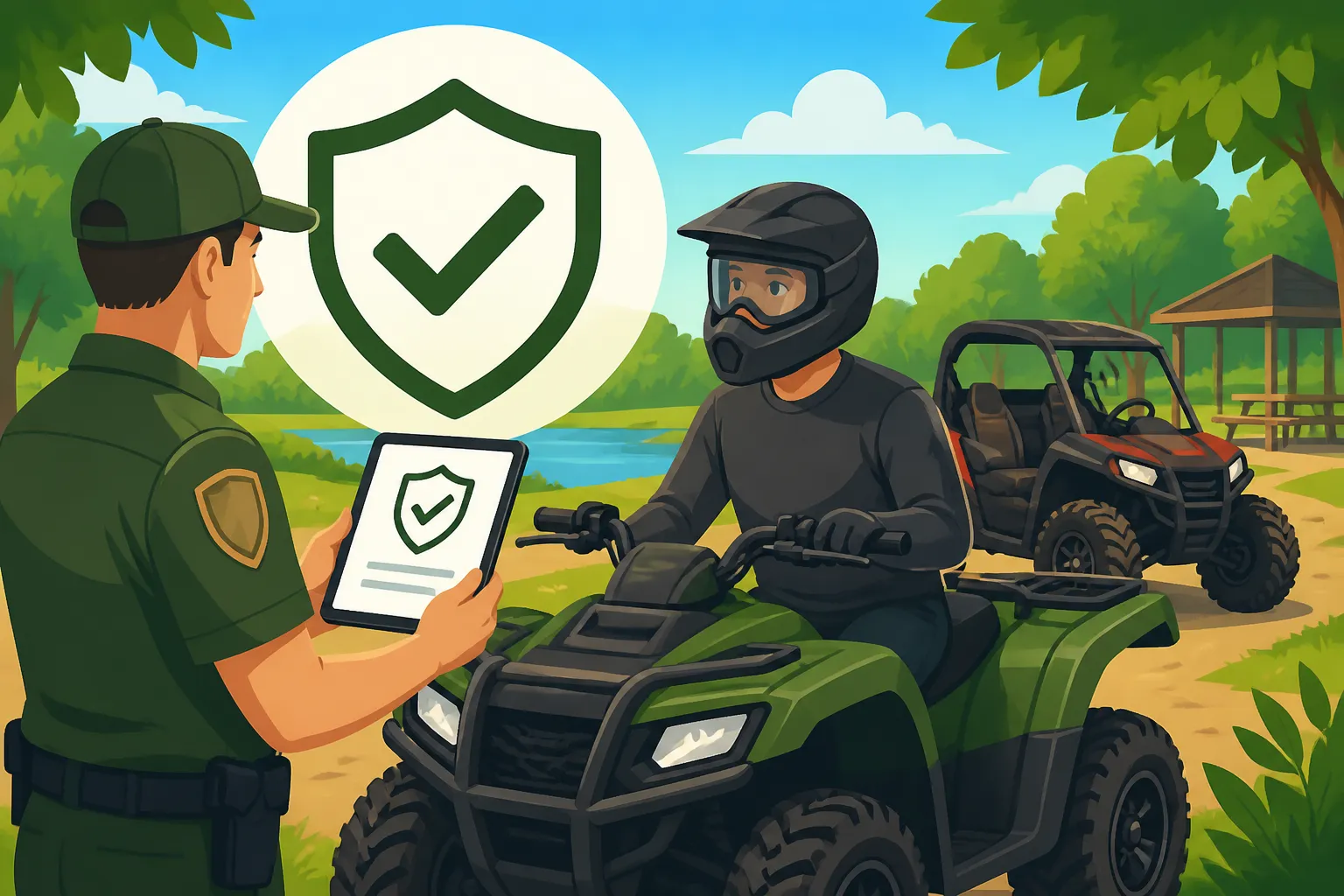
A park gate can be an awkward place to discover that your insurance card does not answer the question staff are asking. In Alabama, requirements can differ between private riding parks, public recreation areas and managed public land. Before loading your ATV or UTV, find out whether insurance is required, what kind of proof counts, and whether the policy covers the machine and rider you plan to bring.
Why insurance rules can differ from park to park
There is no single insurance document that guarantees entry to every place where you might ride in Alabama. A private off-road park can set its own admission rules, while public land managers may have separate permits and access conditions. A venue may require proof of coverage, recommend it without requiring it, or focus on a signed waiver instead. Those are different things, so check the specific location rather than relying on another park’s rules.
A waiver is not an insurance policy. It may explain risks, require a rider or guardian to accept certain terms, or set conditions for using the property. Insurance, by contrast, is a contract that may help pay for covered losses, subject to its terms, limits and exclusions. Completing a waiver does not create coverage, and showing an insurance card does not replace a waiver or permit.
| Riding location | What to confirm before leaving | What insurance proof may mean |
|---|---|---|
| Private riding park | Entry rules, waiver, machine and rider requirements | The park may ask for proof of specific coverage or may not require it |
| County or other public recreation area | Current site rules, access restrictions and any posted conditions | Do not assume that a park pass or permit includes personal insurance |
| Wildlife Management Area | Permit and area rules, open routes and dates | Insurance does not replace required access permissions |
| National forest or other federal land | Which routes are open and what permits or restrictions apply | Check the managing agency’s rules; a private park’s policy is not a substitute |
| Organized ride or event | Organizer’s entry terms, waiver and any event-specific documents | The organizer may have its own proof requirements for participants |
If you are headed to a private facility, read its current rules and contact the park if they do not clearly answer your question. The site’s admission page, waiver, registration instructions or rules sheet may describe insurance conditions. For more on how facility requirements can vary, see Alabama Private Park Insurance Rules and Alabama Private Park Waiver Forms.
Public access has a different logic. A permit or authorization may be needed to ride in a particular area, and permitted riding may be limited to designated routes or certain dates. Insurance proof does not grant access by itself. Review Alabama Public Land Rules Compared to Private and, for wildlife areas, Alabama WMA Rules Vary by Area. If you plan to ride in a national forest, confirm the route and current access conditions with the relevant land manager; Alabama National Forest Riding Permits explains why checking those rules matters.
Do not treat another rider’s experience as confirmation. A park can revise admission conditions, and the rules for a special event may differ from ordinary day-use rules. If a website and a posted rule appear to conflict, call the park office before you tow there and ask which requirement applies to your visit.
What to ask before you haul your machine
A useful call or email is specific. Saying “Do I need insurance?” may not be enough if staff mean liability coverage, proof for each machine, or a document in a particular format. Explain what you are bringing and ask what they want to see at check-in.
Ask the park:
- Is insurance required for regular day entry, or only for an event, rental, guided ride or other activity?
- What type of coverage must the policy show?
- Does the policy need to identify the ATV or UTV by make, model or serial number?
- Must the rider be named on the policy, or is coverage based on the machine and its authorized operators?
- Is proof required for every machine in a group?
- Will staff accept a digital insurance card, or should you bring printed proof?
- Does a passenger, a minor riding under supervision, or a guest operating your machine need separate documentation?
- Are there additional rules for a rented or borrowed machine?
- Is proof needed when you make a reservation, or only when you arrive?
- What document should an event organizer or business provide if the entry is commercial or organized?
If the answer is that insurance is not required, consider asking whether the park recommends a particular kind of personal coverage anyway. A no-proof-at-the-gate rule does not mean there is no financial risk if someone is hurt or property is damaged. It also does not mean a policy you already have will cover the ride.
If a park says coverage is mandatory, ask it to describe the requirement in writing. Avoid guessing at a limit or assuming that a standard insurance card satisfies the rule. The park’s wording may distinguish liability coverage from coverage for damage to your own machine, or require a certificate for an organized event. If the rule is unclear, share it with your insurer and ask whether the policy meets that exact condition.
Keep a record of the answer: the date, the staff member or office you contacted, and the wording of the requirement. This is especially helpful when several riders are coordinating a trip or when a venue’s online information is brief. For a group visit, ask whether each rider must check in individually and whether one organizer’s paperwork can cover the group. Do not assume it can.
Which documents are useful to bring
The right proof depends on the park’s stated rule, but it is sensible to have more than a tiny insurance card image available. A card may show that a policy exists without spelling out the covered machine, operators, exclusions or limits. If staff need to verify a specific condition, a declarations page or other insurer-issued document may be more useful. Ask the park and your insurer which document is appropriate instead of handing over unrelated paperwork.
Before your trip, check that the information on the document matches the machine and trip:
- The named insured is correct, and the person bringing the machine is authorized under the policy.
- The policy is active for the dates you will ride.
- The listed vehicle or covered class includes the ATV or UTV you plan to use.
- The serial number or other identifying information matches, if the document includes it or the park requests it.
- Any required coverage type is visible in the document the park accepts.
- The policy’s use conditions do not conflict with riding at a recreational park or participating in an event.
The policy language matters. A machine insured for one use may not automatically be covered in every setting. Riding on a private course, joining an organized event, lending a machine to another person, or carrying passengers can raise questions about exclusions and who is covered. Do not rely on the vehicle’s brand, the fact that it is registered, or the word “recreational” on a card as proof that a particular loss is covered.
Ask your insurer directly about the situation you have planned. Describe the venue as an off-road riding park if that is what it is, and explain whether you will ride, lend the machine, carry a passenger or take part in an organized event. If the park has a written requirement, give the wording to the insurer. Get clarification in writing when a verbal answer leaves uncertainty.
A registration record is also not insurance proof. Alabama’s registration paperwork and a private insurance policy serve different purposes. If you need to understand what state registration does and does not establish, see Alabama Registration Paperwork Explained. Likewise, a bill of sale or ownership record does not show that a policy is active.
Keep your documents available without exposing more personal information than needed. Bring the proof the park requests, not a full packet of financial or account records unless there is a clear reason. A secure folder or waterproof document pouch can protect paper copies from rain and mud; Amazon is one place people look for basic document-storage options. For phone copies, save the documents for offline access and use a screen lock. Cell service may be unreliable near trailheads, and an image stored only in email might not load when you need it.
Avoid common insurance and check-in mix-ups
Assuming a general vehicle policy covers an ATV or UTV. Policies vary, and coverage for a road vehicle does not automatically settle whether an off-highway machine is covered. Ask the insurer about the exact machine and riding location.
Confusing a waiver with proof of coverage. A waiver may be required even when insurance is not. It may also be required in addition to insurance. Read the park’s entry instructions and be ready to complete each separate requirement. Alabama Private Park Waivers and Rules offers more context on facility-specific conditions.
Showing an expired or incomplete card. Check the effective dates before the trip. If a park asks for information the card does not display, bring the additional insurer-issued document the park accepts.
Assuming the policy covers every rider. The person who owns the machine may not be the only person operating it. Confirm how the policy treats other household members, guests, employees or minors, and follow the park’s own age and supervision rules.
Thinking insurance makes a restricted route legal. Proof of coverage does not override a closed trail, a landowner’s restriction, a permit condition or a posted park rule. Check the access requirements separately, including Alabama Permit Questions Riders Ask.
Waiting until the gate to resolve a disagreement. If a staff member says the document is not acceptable, ask which specific requirement it fails to meet. A calm explanation may resolve a misunderstanding, but the park can enforce its entry rules. If you cannot meet the requirement, do not assume you can ride while you sort it out; ask whether the park can clarify the rule or whether you should reschedule.
A simple pre-trip routine helps: check the venue’s current rules, contact the office about any unclear insurance language, confirm the policy with your insurer, and save the accepted proof in both printed and offline digital form. Keep permits, waivers and insurance documents separate so you can show the right item when asked. That preparation will not eliminate every coverage question, but it can prevent a preventable gate delay and help you understand what protection you actually have.
Disclaimer
This article is for general informational purposes only and does not constitute professional advice. Laws, prices and regulations vary by location and change over time. Consult a qualified professional for guidance on your specific situation.