Signing the Waiver Every Riding Park Requires
A park waiver can look like routine check-in paperwork, but signing it may affect what you can later claim if someone is hurt or property is damaged. Alabama riders also need to separate a private park’s waiver from permits, registration, and land-access rules. Here’s what to check before signing, especially when children, passengers, or out-of-state machines are involved.
Why riding parks ask you to sign a waiver
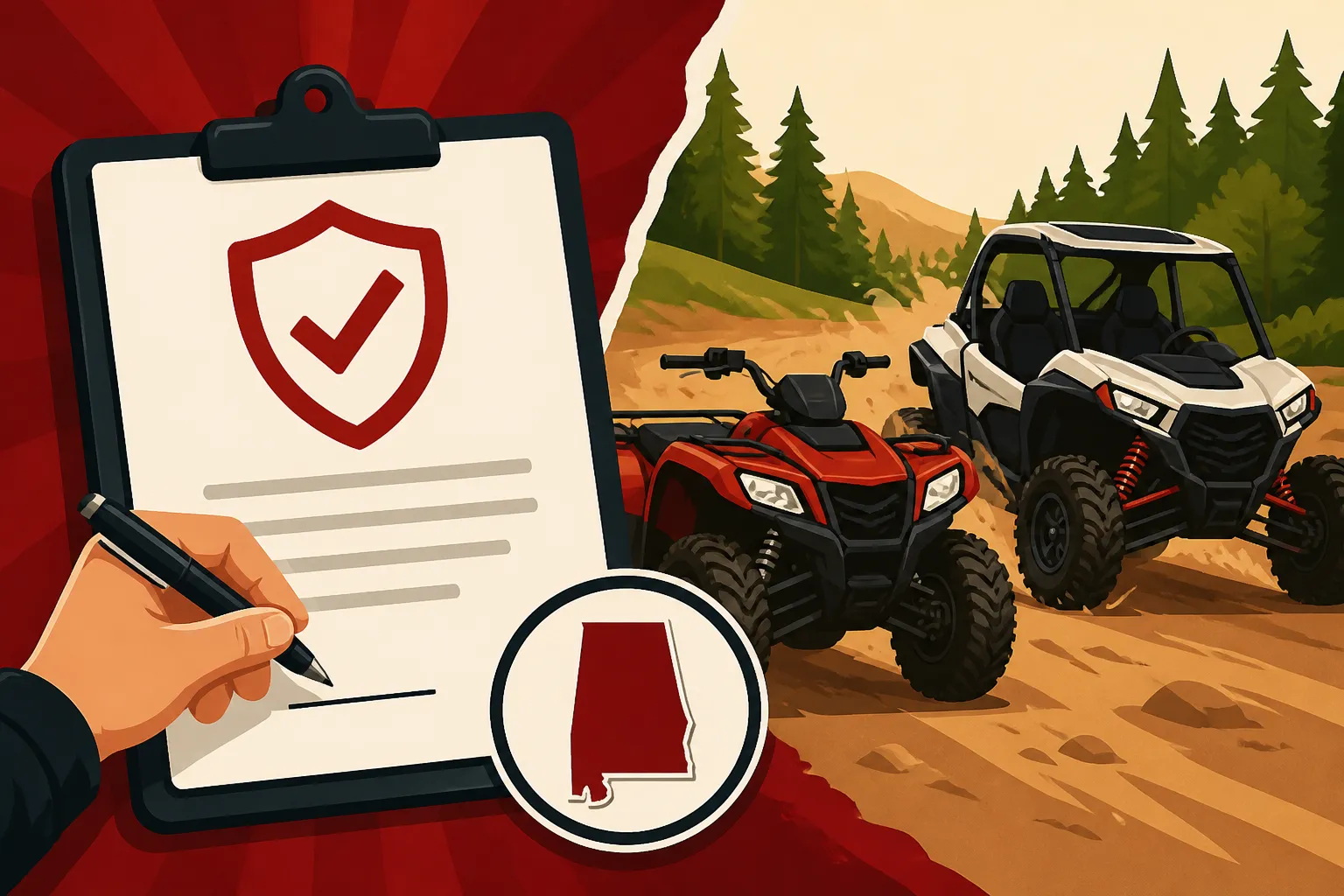
A waiver is a document a riding park may require before letting a rider enter or take part in an activity. It usually describes risks associated with off-road riding and asks the participant to accept some responsibility for those risks. Some forms also address claims, medical treatment, property damage, photographs, or the responsibilities of a parent or guardian.
Private off-road parks set their own admission conditions, subject to applicable law. A waiver is one of those conditions; it is not the same thing as a state permit or registration. A park might require a signed form before issuing an entry pass, allowing a machine onto its trails, or admitting a minor. The exact process depends on that park’s current rules.
That distinction matters in Alabama. A signed waiver does not, by itself, authorize riding on public land, a wildlife management area, a national forest road, or someone else’s property. Nor does it automatically satisfy a park’s other requirements for helmets, passengers, machine size, insurance, or age. Check the park’s separate entry rules, and review Alabama Private Park Waivers and Rules alongside Alabama Park Admission Fees when planning a visit.
A waiver is not a permit or permission to ride anywhere
The form generally applies to the relationship between the park and the people named in it. It does not replace any permit, license, permission, or other condition that applies to a particular riding area. For example, a private park’s form does not grant permission to cross land beyond the park’s boundary. A public-land permit, where required, does not necessarily meet a private park’s admission requirements either.
Before treating any document as proof that you can ride, identify who issued it and what it covers:
| Document or requirement | What it generally addresses | What it does not automatically provide |
|---|---|---|
| Private park waiver | Acknowledgment of risk and terms between a participant and the park | Permission to ride outside the park or a guarantee that every claim is waived |
| Park admission or wristband | Entry under that park’s current conditions | Public-land access or vehicle registration |
| Public-land permit | Access subject to the land manager’s rules | Admission to a private park |
| Landowner permission | Authorization to use the land within the permission’s scope | Permission to use nearby land or public roads |
| Vehicle registration or ownership record | A vehicle-related record under applicable rules | A trail pass or authorization to ride wherever you choose |
For public-land rules, consult the authority responsible for the specific area rather than relying on the waiver. Alabama WMA Rules Vary by Area explains why an area’s posted conditions matter, while Alabama National Forest Riding Permits covers a separate access question. A waiver from a private park should not be assumed to cover either setting.
Why forms differ from park to park
There is no single form every Alabama riding park must use. One park may use a short electronic release; another may provide a longer document with separate sections for adults, minors, passengers, or organized groups. A form may be signed once per visit, once per season, or at another interval set by the park. Do not assume a waiver from a previous visit—or from a different park—will be accepted.
The form may also be only one part of check-in. A park can have separate policies covering age limits, helmets, machine types, passenger seats, alcohol, pets, campsite behavior, or trail closures. Read those rules independently. A signed waiver is not evidence that you have met every condition of entry.
What to read before you sign
Do not treat the signature line as the whole document. Read the waiver and any linked or attached park rules before signing, and ask for clarification if a term is unclear. A staff member may be able to explain the park’s process, but a verbal explanation is not necessarily a change to the written form. If an answer matters to your decision, ask whether the park can provide it in writing.
Identify who is covered
Check whose name the form asks for and who the release applies to. A form for one adult may not include a spouse, child, passenger, or riding companion. Group leaders should not assume they can sign on behalf of everyone in the group. Each participant may need to complete a separate form, or a parent or guardian may need to complete a separate section for a minor.
Look for the legal name of the park or operator, the date or visit covered, and any description of the activity. If the name on the form does not match the park you booked, or the form seems to cover a different event, pause and ask staff to explain before accepting the terms.
Understand the risks described
Off-road riding involves risks that can include uneven ground, steep or slippery terrain, collisions, changing trail conditions, mechanical problems, and the actions of other riders. A waiver may list examples of risks and state that the rider accepts some or all of them. Read what the park actually says rather than relying on a general idea of what a waiver normally means.
Check whether the document discusses risks from park conditions, other participants, the participant’s own decisions, or the use of a particular machine. Note whether it describes medical response or emergency transport. A waiver is not a safety briefing, and reading it does not replace asking about trail difficulty, closures, or conditions.
Look for release, indemnity, and responsibility language
Some forms include terms that go beyond acknowledging risk. They may ask a participant to release certain claims, promise to reimburse or protect the park against some claims, accept responsibility for property damage, or agree to use the site under its posted rules. The wording and legal effect can depend on the form and the circumstances.
If the form includes a promise to pay or protect the park against claims involving someone else, do not assume it is just another way of saying “I understand riding is risky.” Ask what the term means in the context of your visit. If the potential consequences are significant or the language is unclear, consider getting advice from a qualified attorney before signing.
Check how the form handles information and photos
A waiver or check-in system may request contact details, emergency contacts, or information about participants. It might also include consent related to photographs or video. See whether those permissions are optional or bundled into the waiver, and ask how the park uses the information if that matters to you.
Do not enter inaccurate information simply to complete check-in. If a name, date, machine description, or emergency contact is wrong, ask staff to correct it. Keep a copy or confirmation of the form if the park provides one, and save any rules or booking messages that explain what was agreed.
Children, passengers, and groups need extra attention
A parent or guardian should read the form carefully before signing for a child. The adult’s signature may acknowledge risks for the child, confirm that the child has permission to ride, or accept particular responsibilities. The precise terms vary, so do not assume that signing an adult’s form automatically covers a minor.
Confirm who has authority to sign
Parks commonly set their own procedures for minors, including who may sign and whether a parent or guardian must be present. A relative, family friend, coach, or group leader should not assume they can complete a child’s waiver unless the park confirms that its policy allows it.
Before traveling, ask the park what it requires for a minor who is arriving with another adult. Check whether the child must be present at check-in, whether a form needs to be completed in advance, and what identification or other information the park expects. These are park-specific logistics, not questions the adult should try to settle by interpreting another park’s form.
A waiver also does not establish that a child is allowed on every machine or trail. Minimum ages, supervision rules, passenger restrictions, and equipment requirements can be separate conditions. Review Alabama Park Rules for Minors and [Alabama Private Park Minimum Ages], then confirm the specific park’s current rules before the trip.
A passenger may need separate permission
A person riding as a passenger may be treated as a participant who needs to understand and sign the park’s waiver. Do not assume the driver’s form covers everyone aboard. Ask whether each passenger must complete a form and whether a parent or guardian must sign for a passenger who is a minor.
The machine itself matters too. A park may limit passengers to seats intended for them or set additional conditions for carrying children. A signed waiver cannot make an unsuitable seat safe or override a park’s passenger policy. Check Alabama Park Rules for Passengers and ask the park about the specific machine and planned passenger.
Group organizers should not sign for the whole party by assumption
A club, family group, or event organizer may coordinate check-in, but that does not automatically give the organizer authority to sign a waiver for each attendee. Ask the park whether the group will use individual forms, a group process, or another arrangement. Make sure every participant knows the park’s requirements before arriving so a missing signature does not disrupt the ride.
For an organized event, get the park’s instructions in writing where possible. Confirm who is responsible for collecting forms, whether minors have a separate procedure, and whether the waiver must be completed before the event date. Alabama Permits for a Group Trip may help distinguish group access requirements from the private park’s own paperwork.
What signing does and does not mean
A waiver is not a magic shield for either side. Its effect depends on the wording, applicable law, and circumstances. A signed form does not necessarily mean that a rider has surrendered every possible claim, and it does not guarantee that a park will be responsible for every injury or loss. Avoid relying on broad statements such as “nothing can be claimed” or “the waiver is unenforceable” without legal advice specific to the situation.
A signature usually shows that the person signed or accepted the document. It does not prove that the person understood every term, that each term is valid, or that the park has met every responsibility it may have. If there is a serious dispute or injury, the actual form and the relevant facts matter.
Signing does not replace safe decisions
The form does not make a trail suitable for your experience level or machine. It does not tell you whether a route is open, whether recent rain has changed the surface, or whether a machine can safely manage a particular section. Ask the park about current trail conditions and difficulty, respect closures, and ride within your ability.
Likewise, accepting risk does not mean you should ignore a hazard or a park instruction. If you see a blocked trail, damaged structure, unsafe condition, or a rule you do not understand, contact staff and avoid the area until you have a clear answer. Read the park’s operating rules along with the waiver; Alabama Private Park Helmet Rules and Alabama Private Park Insurance Rules address separate requirements that may apply at check-in.
A waiver does not create insurance coverage
A waiver is not an insurance policy. It does not provide medical, liability, collision, or property-damage coverage simply because the rider signed it. If you are relying on insurance, review your actual policy and ask the insurer whether the planned use is covered. Do not infer coverage from the park’s waiver, admission pass, or a staff member’s general comments.
The same distinction applies to a park’s own insurance. A park’s coverage does not automatically mean an individual rider or passenger is protected against every loss. If coverage is important, ask the park what it requires or provides, then confirm the answer with the insurer or a qualified professional.
A waiver does not necessarily decide responsibility for damage
A form may discuss damage to park property or responsibility for a participant’s conduct. If you are unsure what happens after a collision, damage to a gate, or damage to another rider’s machine, ask the park how it handles such incidents. Do not assume the form sets a fixed amount or that your personal policy will pay.
If something happens, follow the park’s reporting procedure and preserve relevant records. Note the date, location, people involved, and any instructions from staff. For a serious injury or substantial property damage, consider getting legal and insurance advice before making statements about responsibility or signing additional documents.
A practical checklist for check-in day
A few minutes of preparation can prevent confusion at the gate. Complete the form only after reviewing the park’s current instructions, and allow time for questions rather than rushing through a screen or paper form.
- Confirm the park’s current waiver process. Ask whether every rider and passenger needs a separate form, whether forms can be completed before arrival, and whether the park requires them again for a later visit.
- Ask about minors before traveling. Confirm who must sign, whether the parent or guardian needs to be present, and whether the park has a separate age or supervision policy.
- Check that the form matches the visit. Verify the participant names, park or operator, date, and activities covered. Ask staff to correct errors before accepting the form.
- Read every section, including linked rules. Pay attention to risk acknowledgment, release language, indemnity, property damage, emergency response, and photo or information permissions.
- Keep park policies separate in your mind. Verify admission, helmet, passenger, machine, insurance, and trail rules independently. For trip logistics, Alabama Riding Areas That Take Reservations can be useful, but a reservation is not permission to disregard the park’s entry conditions.
- Bring any required confirmation. If the park sends a completed waiver or booking confirmation, keep it accessible. Ask whether staff can retrieve an electronic form if your phone has no service.
- Ask before signing if a term is unclear. A staff explanation can clarify the park’s process, but if the legal effect is important, seek qualified legal advice rather than treating an informal explanation as a legal interpretation.
- Do not assume a waiver transfers between parks. Complete the form required by the park you are visiting, even if you have signed a similar form elsewhere.
- Have a plan if conditions change. Ask how the park handles closures or weather-related changes and review Alabama Park Refund Policies for the park’s own terms. A waiver and a refund policy answer different questions.
Out-of-state riders should take the same approach. A waiver is a park’s condition of entry, not a substitute for checking whether the machine and rider meet the rules that apply at the destination. Review Alabama Visitors From Out of State for the separate questions visitors should settle before riding.
If you decide not to sign because a term is unacceptable or unclear, ask whether the park offers another option. The park may decline admission under its rules; do not sign a form you do not understand just to avoid losing time or a booking. If the form involves substantial financial responsibility or a serious legal concern, getting professional advice before the visit is safer than trying to resolve it at the entrance.
Frequently Asked Questions
Does every Alabama ATV or UTV park require a waiver?
Many private riding parks make a signed waiver part of entry, but requirements and procedures vary. Confirm directly with the park you plan to visit, including whether passengers and minors need separate forms.
Does a signed park waiver let me ride on public land?
No. A private park waiver does not grant public-land access or replace a permit or land manager’s rules. Check the requirements for the specific area where you intend to ride.
Can one adult sign a waiver for an entire group?
Do not assume so. Ask the park whether each participant must sign and what procedure applies to minors. The park’s written requirements determine its check-in process.
Should I sign if I do not understand a clause?
Ask the park to clarify its process, and do not rely on a casual explanation to determine a clause’s legal effect. If the term could create significant responsibility, consider asking a qualified attorney before signing.
Disclaimer
This article is for general informational purposes only and does not constitute professional advice. Laws, prices and regulations vary by location and change over time. Consult a qualified professional for guidance on your specific situation.