When Your Machine Is Too Wide for Stony Lonesome
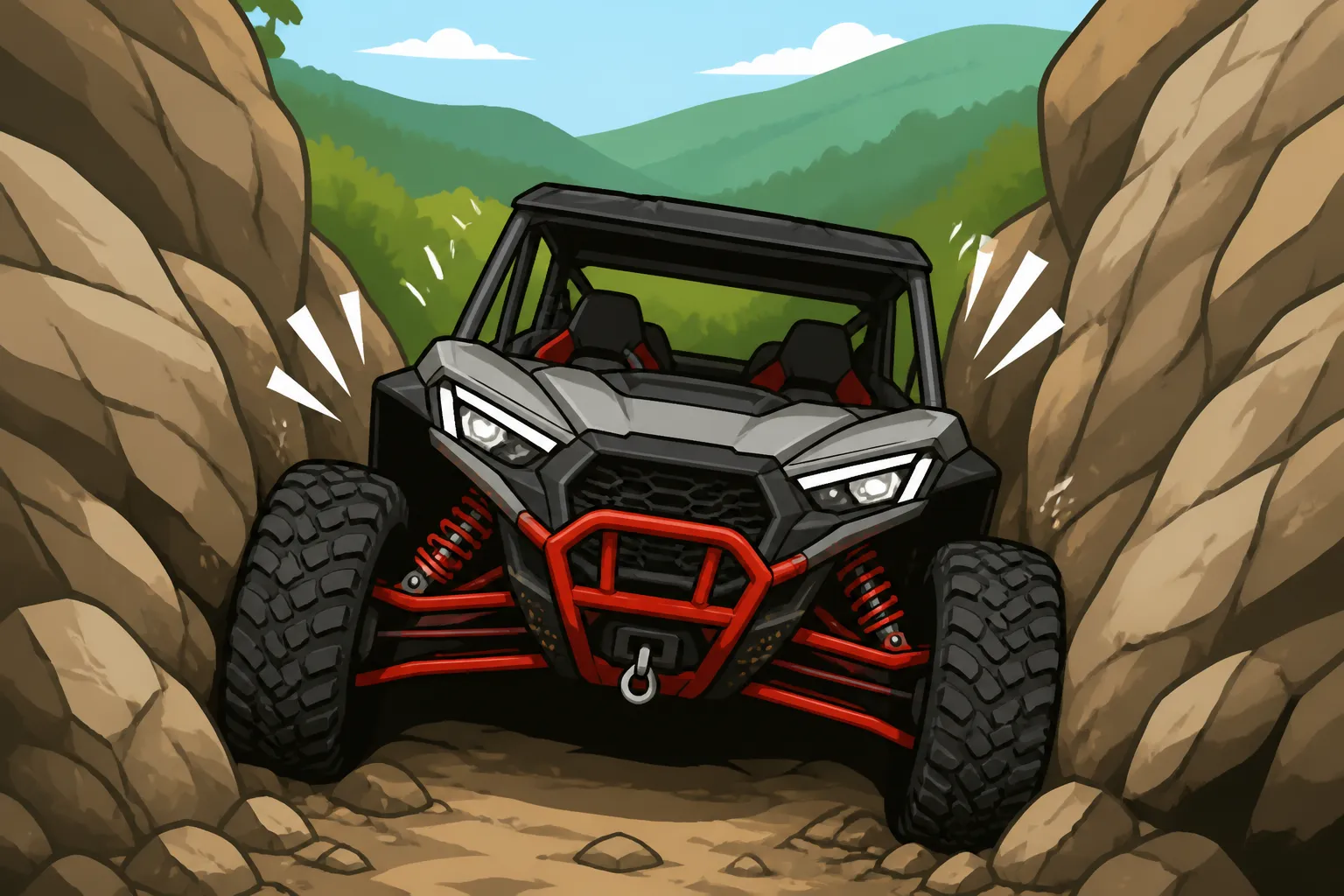
A side-by-side can meet Alabama’s legal definition and still be too wide for a particular trail or obstacle. If you’re planning a ride at Stony Lonesome, the useful question isn’t only what the law allows; it’s whether your machine and its accessories suit the park’s current routes. Measure before you haul, then confirm trail access and any vehicle limits directly with the park.
Legal width and trail width are different questions
Alabama’s vehicle definitions use width limits to distinguish types of off-highway machines. The state’s ATV definition generally uses a maximum width of 60 inches, while the ROV definition generally uses a maximum width of 80 inches. These figures describe legal categories; they do not promise that a machine will fit every trail, gate, bridge, or wooded passage at an off-highway park.
That distinction matters at Stony Lonesome. A machine that falls within the state’s definition may still be awkward or unsafe on a narrow section of trail. A machine wider than a definition’s limit may not fit that category at all, but that alone does not tell you whether the park will admit it or which routes, if any, it can use. For the state definitions and their limits, see Alabama ATV Width and Weight Limits and Alabama ROV Width and Weight Limits. The quick comparisons 60 Inches and 1,500 Pounds and 80 Inches for a Side-by-Side can also help clarify which definition may apply.
Park access is a separate decision. A trail system can include routes with different surfaces, obstacles, and clearances, and conditions can change. Do not assume that a machine’s classification, registration, or ability to ride another park settles the question for Stony Lonesome. Confirm the park’s current rules and fit requirements before making the trip.
| Question | What it tells you | What it does not tell you |
|---|---|---|
| Does the machine meet Alabama’s ATV or ROV definition? | Which state vehicle definition may apply | Whether it fits every trail at Stony Lonesome |
| What is the machine’s actual width? | How much clearance it needs at its widest point | Whether the park currently permits it |
| Is the machine within the park’s current vehicle rules? | Whether admission or certain riding areas may be allowed | Whether every trail will be suitable |
| Are trails open and passable on the planned day? | Whether a route may be usable under current conditions | Whether the machine can safely clear every obstacle |
A state width limit is not a trail-width guarantee. Keep the legal question and the practical fit question separate, and get an answer to each before you load the machine.
Measure the machine you will actually bring
A manufacturer’s published width is a useful starting point, but it may not reflect the machine as it sits on your trailer. Tires, wheels, fender flares, mirrors, track systems, racks, and other add-ons can change the widest point. Even a modest change can matter when a route passes between trees or through a tight entrance.
Measure the machine in its riding configuration. A basic tape measure, which you can find at a hardware store or on Amazon, is enough for a straightforward measurement. If the vehicle has a feature that folds or retracts, record both the normal riding width and the width with that feature positioned as intended for a narrow passage. Do not count a mirror as safely out of the way just because it can be pushed inward temporarily; ask the park whether that configuration is acceptable.
A careful measurement process helps avoid relying on estimates:
- Park on level ground with the tires set straight and the machine in the condition you plan to ride.
- Identify the widest fixed points from side to side. Check tires, wheels, fenders, flares, racks, and accessories rather than measuring only the body.
- Measure across those points at their widest distance. Keep the tape level and measure from the outermost point on one side to the outermost point on the other.
- Record the measurement, the machine’s make and model, and any accessories that affect width.
- If the machine has adjustable or removable parts, describe those parts clearly when asking the park about admission and trail access.
Measure the width of a side-by-side with its mirrors in the position you intend to use on the trail. Also consider whether a winch mount, aftermarket bumper, or other protruding part is wider than the tires. For a quad, check the tires and any hand guards or racks that extend beyond the bodywork. These details are easy to miss when you rely on a brochure or a seller’s estimate.
The number alone is not a complete fit assessment. A machine that is narrower than a trail’s tightest opening may still need room to turn, avoid an obstacle, or pass another rider. A wide wheelbase, long body, or limited turning radius can make a route challenging even if the vehicle’s outer edges fit through a gap. The operator also needs room to maneuver without forcing the machine against trees or damaging trail edges.
If you are unsure how to measure an unusual setup, take clear photos of the front and rear, note the widest accessories, and ask the park what measurement method it uses. Do not modify a measurement by leaving out equipment that will be on the machine when you ride.
Confirm Stony Lonesome’s current rules before you tow
Do not assume there is one published maximum width that applies to every route or every day. Park rules, route access, and trail conditions can change. Contact Stony Lonesome before the trip and give staff the machine’s actual width, type, and relevant modifications. Ask specific questions rather than simply asking whether the park allows UTVs or ATVs.
Useful questions include:
- Is there a current maximum vehicle width for admission?
- Does the park use a different limit for a particular trail, obstacle, or riding area?
- Does the stated width include mirrors, tires, fenders, or aftermarket accessories?
- Are there routes that staff recommend avoiding for this machine?
- Are there alternate routes or bypasses around narrow sections?
- Have any closures, storm damage, or temporary restrictions changed access?
- Are there other vehicle requirements that could affect this machine?
If the park gives you a width limit, ask what it means in practice. A number measured across the tires may differ from one measured across mirrors or accessories. If staff describe a route as narrow but do not give a measurement, explain your machine’s width and configuration and ask whether they consider it appropriate. Keep a note of the answer, especially if you are coordinating a group with machines of different sizes.
Confirm again close to your ride date if weather or maintenance could affect the trails. A route that was passable during a previous visit may be affected by fallen trees, erosion, standing water, or repairs. Conditions after heavy rain can be especially different from what a trail map suggests; Alabama Trail Closures After Rain covers why it is worth checking before heading out. A map is helpful for planning, but it cannot guarantee that a particular machine will clear a feature on the day you arrive. See Alabama Trail Map Downloads for general planning context, and check directly with the park for current information.
When asking about access, distinguish admission from route suitability. A park may allow a vehicle into the property without recommending that it use every trail. If a route is not suitable, ask whether there is a reasonable alternative rather than treating access at the gate as permission to attempt every obstacle.
Make a safer plan if your machine is close to the limit
If your measured width is close to a limit the park gave you, do not count on a few inches of flexibility. Measurement differences, tire bulge, uneven ground, and obstacles can reduce clearance. Ask the park whether your exact machine is suitable before towing it there. If staff cannot confirm that it will fit the routes you want to ride, consider choosing another machine or another riding area rather than testing the clearance on the trail.
Before departure, check that removable accessories are secured and that anything you take off is allowed to be removed for riding. A loose mirror or rack component can create a hazard, and taking equipment off may affect the machine’s safe operation or violate a park rule. Do not remove safety equipment or make a change that leaves the machine unstable.
At the park, follow posted directions and staff instructions. If you encounter a gap that looks too tight, stop in a safe place and assess the situation. Do not force the machine through, climb over trail banks, or make a new path around an obstacle. Those choices can injure riders, damage property, and harm the trail. If a route becomes impassable, turn around only where it is safe and permitted, and ask staff for guidance.
For group rides, compare the widest machine in the group with the park’s current guidance. A route that works for narrow quads may not be a good choice for a wide side-by-side, even when both vehicle types are admitted. Agree on a route before setting out, keep the group together where appropriate, and make sure every rider understands that posted closures and trail directions take priority. Alabama Trail Difficulty Ratings and Alabama Trail Etiquette Locals Expect offer useful context for planning a ride that matches both the machine and the group.
The practical rule is straightforward: measure the machine as configured, verify the park’s current requirements, and choose routes that leave room to maneuver. Alabama’s vehicle-width definitions can help identify the legal category of a machine, but they cannot tell you whether that machine will fit a specific trail at Stony Lonesome. A short call before the trip can prevent a long tow with no suitable route to ride.
Disclaimer
This article is for general informational purposes only and does not constitute professional advice. Laws, prices and regulations vary by location and change over time. Consult a qualified professional for guidance on your specific situation.