Do You Need to Register an ATV in Alabama?
The question of whether you need to register your ATV or UTV in Alabama can feel like navigating a maze, especially with all the different rules about where you can ride and what kind of machine you have. It's a common point of confusion for new and experienced riders alike, and getting it wrong can certainly put a damper on your next adventure or even lead to a frustrating encounter. This guide will cut through the uncertainty, explaining exactly when and why registration matters in Alabama, and what steps you'll need to take to keep your machine legal for the trails you want to explore.
The Short Answer: Is Registration Required in Alabama?
Let's get right to it because I know you're looking for a clear answer. Unlike motor vehicles that absolutely must have a plate to touch a public road, the requirement for registering your ATV or UTV in Alabama isn't a simple yes or no. It really hinges on two main things: where you plan to ride your machine, and what kind of machine it is according to the state's definitions.
For most off-road enthusiasts, especially those planning to stick to private property or designated off-road parks, the state-level registration through the Alabama Law Enforcement Agency (ALEA) is technically voluntary. That's right, you don't have to do it just to own the machine. However, the moment you decide to venture onto public lands or designated public trails, that voluntary registration suddenly becomes a necessary step. It’s a bit of a nuanced situation, and it's easy to misunderstand, leading many riders to scratch their heads.
When Registration Becomes Mandatory (Public vs. Private Use)
The biggest trigger for mandatory registration in Alabama is your intent to ride on public land. This isn't just about vast national forests or state parks, but also includes county-managed OHV parks or other areas designated for public off-road vehicle use. If you envision yourself tackling the trails at places like Stony Lonesome OHV Park or Minooka Park, then yes, you absolutely need to register your machine with ALEA. These public access points often require proof of valid registration before you can even unload your machine from your trailer. They need a way to track the machines on their property, and the state registration decal is that key.
Think of it this way: the state isn't necessarily concerned with what you do on your own 100 acres, but when you venture out into shared spaces, there's a need for a system to identify and regulate the machines. This helps with everything from funding for trail maintenance to tracking in case of theft. Without that registration, you could be turned away at the gate, which is the last thing you want after a long drive to the trails. It's about being a responsible user of public resources. You can read more about [Alabama Public Use ATV Registration Explained].
Understanding Alabama's Voluntary System
Even when not strictly mandatory for private land use, the state's voluntary registration system still offers benefits that many riders find worthwhile. When we talk about "voluntary," we're talking about machines used exclusively on private property, like your hunting lease, your farm, or your own backyard trails. If your quad or side-by-side never leaves your property (or another private property with permission), the state isn't going to come knocking demanding to see your registration. However, registering voluntarily still provides an official state record linking you to your machine.
For instance, if your ATV is stolen from your barn, having it registered with ALEA provides an official record of ownership that can be incredibly helpful for law enforcement in recovering it. It creates a paper trail, even if it's not a title in the traditional sense. It also helps in situations where you might need to prove ownership for insurance purposes or when crossing state lines (though Alabama's registration is unique). While it might seem like an extra step for a machine that stays put, many owners appreciate the added layer of security and official recognition it provides.
Delving Deeper: Alabama's Dual-Agency Approach to Off-Road Machines
Alabama has a somewhat unique approach to off-road vehicles, splitting responsibilities between two state agencies: the Alabama Law Enforcement Agency (ALEA) handles the registration process, which is essentially an ownership record and a permit to ride public lands. Meanwhile, the Department of Revenue (DOR) is set to manage the titling process, which is a whole different beast. This dual-agency system can certainly add a layer of complexity for owners trying to figure out their obligations. It’s not as straightforward as just going to one place for everything, like you might for a car.
The Role of ALEA in Registration
ALEA is the agency you'll interact with for getting your ATV or UTV registered in Alabama. Their system focuses on recording your ownership for off-highway vehicles (OHVs) and issuing the decals that prove you've met the public use requirements. This isn't about getting a license plate; it's purely about documentation and identification for off-road use. They manage a database of registered machines, and when you pay your fee, you receive a small decal that you're meant to display on your machine. This decal is your proof that you've gone through the proper channels to ride on designated public lands.
It's important to remember that this ALEA registration doesn't confer any street-legal status to your ATV or UTV. Alabama's laws are very clear about where these machines can and cannot operate, and registration through ALEA doesn't change that. It's strictly for off-road purposes. The registration process itself is designed to be relatively simple, often requiring a bill of sale and proof of identity. You can learn more about [Alabama's Voluntary ATV Registration Through ALEA] and [Alabama Registration Paperwork Explained].
The Upcoming Titling Requirements from DOR
Now, here's where things are going to change significantly starting in January 2026. The Alabama Department of Revenue (DOR) will begin issuing actual titles for ATVs and UTVs. This is a massive shift because a title is a legal document proving ownership, much like a car title. This change aims to reduce theft, make transactions more transparent, and provide a clearer record of ownership, especially for financing and resale. This new titling law will apply to all ATVs and UTVs that are model year 2026 and newer.
This means if you buy a brand-new ATV in 2026, you'll go through a titling process with the DOR in addition to considering ALEA registration for public use. It's a critical distinction: registration (ALEA) is about using the machine, while titling (DOR) is about owning the machine. For machines older than model year 2026, they will generally remain untitled, and the ALEA registration will continue to serve as the primary official record of ownership for those older machines. This could certainly create some confusion, with some machines titled and others only registered. You can read more about [Alabama Title Applications From January 2026].
Navigating the Different Tiers: Public vs. Private Use Registration
One of the most important distinctions in Alabama's ATV and UTV registration system is the difference between "public use" and "private use." This isn't just a label; it dictates where you can legally ride and the fee structure you'll encounter. Understanding these tiers is crucial to ensuring you're compliant with state regulations, especially if your riding habits vary. Many owners initially assume one category, only to realize later that their actual use falls into the other, leading to potential issues.
What "Public Use" Really Means for Your Riding
The "public use" registration tier is for anyone who plans to ride their ATV or UTV on any land not exclusively owned by them or a private entity with direct permission. This includes, but isn't limited to, state-operated OHV parks, county riding areas, and any other designated public trails. If you're going to a place where you pay an admission fee to ride, chances are you need a public use registration. This tier supports the maintenance and administration of these public riding areas.
When you obtain a public use registration, you're essentially getting a permit to legally access these shared spaces. It demonstrates that you've contributed to the system that keeps these trails open and safe. Without it, you might be denied entry, or worse, face fines if caught riding in designated public areas without the proper decal. This is often the default choice for enthusiasts who enjoy exploring a variety of trails across the state. It's all about playing by the rules when you're on communal ground. You can get more details on [Alabama Public Use ATV Registration Explained].
The "Private Use" Option and Its Limitations
Conversely, the "private use" registration tier is designed for machines that will exclusively be ridden on private property. This could be your own farm, a hunting club's leased land, or land owned by friends or family where you have direct permission to ride. The key word here is "exclusively." If your machine ever leaves that private property to be ridden on public trails, even just once, then the private use registration isn't appropriate. This tier comes with a lower fee, reflecting the reduced administrative burden on the state, as these machines are not expected to be using public resources.
However, the major limitation is that this registration does not authorize you to ride on public land or designated public trails. Attempting to enter an OHV park with a private use decal will likely result in being turned away. It's vital to be honest with yourself about where you intend to ride. If there's any chance you'll want to hit the public trails, opting for the public use registration from the start will save you a headache. It's a cost-saving measure, but only if your riding is truly confined to private land. More information is available on [Alabama Private Use ATV Registration Explained].
Choosing the Right Tier for Your Riding Habits
Deciding between public and private use registration boils down to a clear-eyed assessment of your riding plans. It’s not just about what you might do, but what you will do. If you have any intention of visiting an official ATV park, a WMA (Wildlife Management Area) that permits OHVs, or any trail system managed by a government entity, then the public use registration is your necessary path. It offers flexibility and ensures compliance wherever you choose to ride within the state's public framework.
On the other hand, if your ATV or UTV is solely a tool for farm work, deer camp transport on private leases, or backyard fun, and you are 100% certain it will never touch a public trail, then the private use registration is a perfectly valid and more economical choice. Just be absolutely sure about your commitment to private land use. Changing your mind later means going through the process again and paying the difference. Many riders find it simpler to choose the public use option for the broader access it provides, even if they only occasionally ride public trails. It is worth looking into [Choosing the Cheaper Tier] for more context.
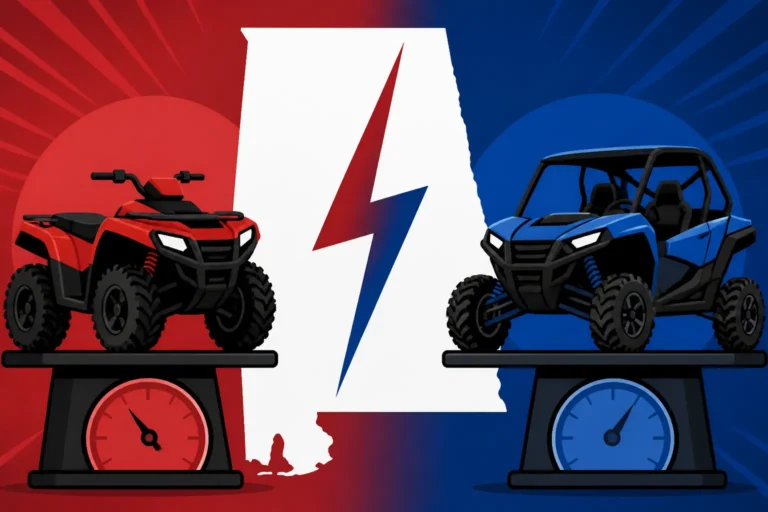
Here's a quick comparison to help you visualize the differences:
| Feature | Public Use Registration | Private Use Registration |
|---|---|---|
| Where You Can Ride | Public lands, designated OHV parks, private property | Exclusively on private property (with permission) |
| Cost | Higher (supports public trail maintenance) | Lower (for limited, private use) |
| Primary Purpose | Permit to use public off-road resources, ownership record | Ownership record, limited to private property use |
| Required For | Accessing places like Stony Lonesome, Minooka Park | Not required for any specific activity, but beneficial |
| Decal | Issued, must be displayed | Issued, must be displayed |
| Flexibility | High – can ride almost anywhere legally permitted | Low – restricted to private property |
| Official Recognition | Provides official state record and proof of compliance | Provides official state record |
The Process: How to Register Your ATV or UTV in Alabama
Once you’ve decided which registration tier is right for you, the actual process of getting your ATV or UTV registered with ALEA is fairly straightforward. It doesn't require nearly as much red tape as registering a car, but there are specific documents and steps you need to follow to ensure everything goes smoothly. Don't let the simplicity fool you; missing a key piece of information can send you back to square one, which no one enjoys.
Essential Paperwork and Information You'll Need
Gathering your documents beforehand is crucial. You'll typically need to provide proof of ownership, which usually comes in the form of a bill of sale. This document is paramount because it establishes the chain of ownership and proves that the machine legally belongs to you. Make sure the bill of sale clearly lists your name, the seller's name, the purchase date, and most importantly, the Vehicle Identification Number (VIN) or serial number of the ATV or UTV. A generic handwritten note might not cut it; sometimes, a more formalized document, perhaps even one created using a service like LawDepot, can make the process smoother, especially for private sales.
You'll also need personal identification, such as your driver's license or state ID. This confirms your identity as the applicant. If you purchased the machine from a dealer, they might provide a certificate of origin or other dealer paperwork, which will also be required. The application itself will ask for basic information about your machine, like its make, model, year, and serial number. Double-checking these details against your machine's physical markings and your bill of sale will prevent discrepancies that could delay your registration.
Where and How to Submit Your Application
Unlike vehicle tags that you might get at your local county probate office, ATV and UTV registrations are handled directly by ALEA. This means you'll typically mail your application and supporting documents to their office in Montgomery. While it might feel a bit old-school in this digital age, it's the established method. The ALEA website usually provides the necessary forms, which you can download and print. It's critical to fill out these forms completely and legibly to avoid processing delays.
After you've filled out the application and gathered your bill of sale and ID, you'll mail everything to the address provided on the ALEA form. Don't forget to include payment for the registration fee. [Why Your Registration Paperwork Goes to Montgomery] explains more about this centralized process. Once processed, ALEA will mail you a registration card and the all-important decal, which you must affix to your machine as proof of registration.
Understanding the Costs and Renewal Cycle
The cost of ATV/UTV registration in Alabama is relatively modest, especially compared to vehicle registration fees. As I mentioned before, the "private use" tier is less expensive than the "public use" tier. While I can't give you exact dollar figures, know that these fees are typically updated periodically, so it's always best to check the official ALEA website for the most current costs. These fees go towards the administrative costs of the program and, for public use registrations, contribute to trail maintenance and other related programs.
One important thing to remember is that Alabama registrations for off-road vehicles run for three years, not annually like some other types of registrations. This is a nice convenience, meaning you don't have to worry about renewing it every single year. When the three-year period is nearing its end, you'll need to go through the renewal process again to keep your registration current. This cycle is a bit different from what many people are used to, but it simplifies things in the long run. You can find more information about [Alabama Registrations Run Three Years].
Disclaimer
This article is for general informational purposes only and does not constitute professional advice. Laws, prices and regulations vary by location and change over time. Consult a qualified professional for guidance on your specific situation.