Alabama Has No Mandatory ATV Safety Course
Alabama does not generally require ATV and UTV riders to complete a state-mandated safety course before riding, but that does not mean every trail, park, or public-land area has the same rules. This guide explains what the statewide rule means, when a course is still a smart choice, and how to check for separate age, permit, and riding-area requirements before you unload.
What Alabama’s No-Course Rule Means
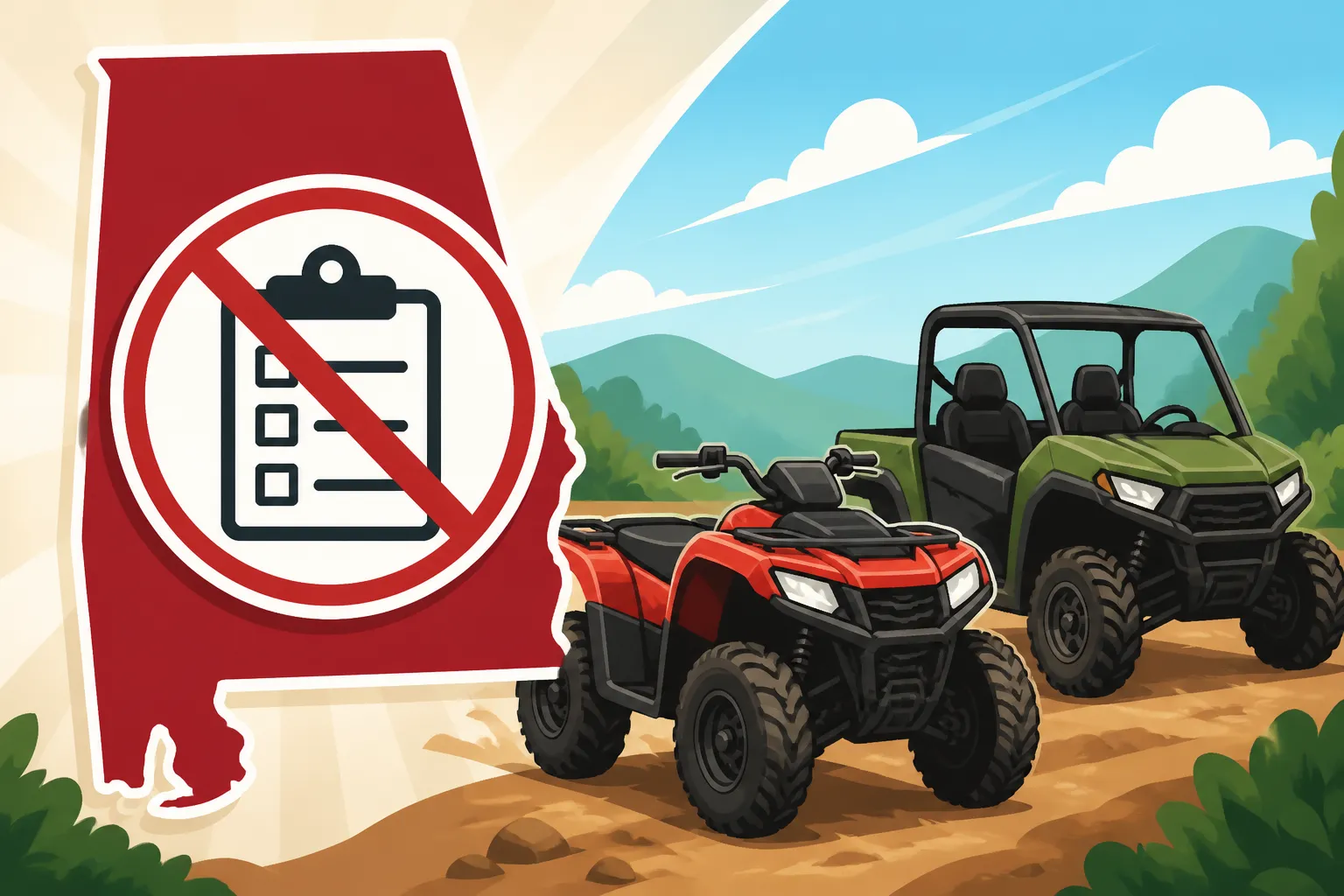
No statewide course prerequisite
Alabama does not generally require riders to complete an ATV safety course as a statewide condition of owning or operating an off-highway machine. In practical terms, a rider should not assume that the state requires a course certificate just to ride on private property or to visit a riding area.
That answer is narrower than it may sound. “No mandatory course” does not mean “no rules,” and it does not promise that every location will let every rider in without conditions. A private park, landowner, event organizer, or public-land manager may set its own requirements for access. Those rules can address age, helmets, waivers, permits, machine type, passengers, or where a vehicle may travel.
It also helps to separate a safety course from other paperwork. A permit, registration document, landowner’s permission, or signed waiver is not the same thing as a course certificate. Each serves a different purpose, and one should not be treated as a substitute for another.
State law and site rules are different layers
Imagine a family planning a Saturday ride near Cullman. The parents learn that Alabama does not generally require a course, then assume that is the only rule they need to check. At the gate, they may still encounter park-specific requirements for minors, protective gear, waivers, or permitted vehicles. The state course rule does not erase those conditions.
The same distinction matters for public land. A rider may be free of a statewide course mandate yet still need to meet the rules that apply to a particular tract, route, season, or permit. For a Wildlife Management Area, start with the area’s access rules rather than assuming the general course answer settles the question. See [Alabama WMA Riding Rules for Quads] and Three Things You Need Before Riding a WMA.
Think of the course question as one checkbox among several, not as an all-purpose riding authorization. Before leaving home, identify the exact place you plan to ride and check the requirements from the agency, park, event, or property owner responsible for that place. If a rule is unclear, ask the office that manages access and keep its answer with your trip notes.
Why a Voluntary Course Can Still Be Worth Taking
A course helps build habits before the trail gets stressful
A safety course can give a new rider a structured way to learn basic control, braking, turning, terrain awareness, and riding judgment. Those skills are easier to practice in a controlled setting than during a crowded ride when someone is waiting behind you or a passenger is asking whether the machine can make it up a muddy incline.
That difference matters in Alabama conditions. Red clay can become slick after rain, wooded paths may hide roots and ruts, and a familiar-looking trail can change quickly with weather or traffic. A rider who understands how to slow down, choose a line, and leave room to stop is better prepared than someone relying on confidence alone.
Training is especially useful when the machine is new to you, even if you have ridden a different type before. Moving from a small sport quad to a heavier utility ATV or a side-by-side changes how the machine responds. A course can help you avoid treating experience on one vehicle as proof that every machine handles the same way.
What training can and cannot do
A course can teach useful skills and make safety conversations more concrete. It cannot guarantee that a rider will avoid a crash, make an unsafe route appropriate, or override the rules of a park or public-land area. Completing training is a starting point for better decisions, not permission to ignore conditions.
A certificate also does not automatically replace a permit, an access pass, a waiver, proof of ownership, or a landowner’s consent. If a park asks for a waiver, the rider must follow that process even if they have completed a course. If an area requires an access permit, the course certificate does not take its place.
It is worth asking what a specific course covers before enrolling. Some options may focus on basic operation, while others may be designed for particular ages, vehicles, or experience levels. The practical question is not just “Will I get a certificate?” but “Will this training help me make better choices on the kind of terrain and machine I actually ride?” For an overview, see What an ATV Rider Course Teaches.
How to Find and Choose a Course
Compare the course with the rider and machine
Start by identifying who needs the training and what they ride. A first-time adult on a utility quad may need a different introduction from a teenager learning on a youth-sized machine. A side-by-side operator may need to focus on vehicle dimensions, passenger communication, seat belts, and how the machine behaves on slopes rather than assume quad practice transfers perfectly.
Then check the course provider’s own description. Look for the intended age group, vehicle types, learning format, practical exercises, completion documentation, and any conditions for participation. Confirm whether the course is classroom-based, online, hands-on, or a combination. An online module can be convenient for basic learning, but it cannot provide the same supervised practice as actually operating a machine.
For a starting point, review Alabama Safety Course Options and Alabama Online Safety Courses. Compare what each option teaches instead of choosing only by convenience. If you are considering an online course for a young rider, check that the format fits the child’s age and attention span, and plan supervised practice afterward.
Ask useful questions before registering
Before signing up, ask who teaches the course and what experience or qualifications the instructors have. Find out whether participants use their own machines or whether equipment is provided, what clothing and protective equipment they need, and whether there are prerequisites. These details can prevent a frustrating arrival when a rider discovers that the course is not designed for their machine or experience level.
Ask what documentation the participant receives after completion and whether a particular park, event, club, or land manager accepts it for any purpose. Do not rely on a general statement that a course is “recognized” without knowing what that means for your planned ride. A certificate could be useful for personal records but still not satisfy a separate site-specific rule.
Finally, make sure the instruction fits the actual riding situation. Someone who rides a small family property may benefit from basic control and supervision practices. Someone planning a public-land trip may also need to study route restrictions, permits, seasonal access, and where riding is allowed. Training and access research work best together rather than as alternatives.
Young Riders Need More Than a Certificate
Match the machine to the child
A child’s readiness is not determined by age alone. Size, judgment, attention, coordination, experience, and the ability to follow instructions all matter. A young rider who can reach the controls may still be unable to manage a machine’s weight, acceleration, or braking demands in a stressful moment.
The machine should be appropriate for the rider, not merely available in the garage. Before riding, a parent can check that the child can comfortably reach and operate the controls, understand how to stop, and explain what to do if the machine feels unstable. A youth-sized vehicle does not automatically make an activity safe, but using a machine that is clearly too large can make control harder from the start.
A course can help a child learn basic skills, but it cannot replace active adult supervision. Children may understand a rule in a quiet practice area and forget it when friends are nearby or the trail looks exciting. Keep early rides short, choose manageable terrain, and build skills gradually. For more on the wider considerations, see [Alabama Rules for Young Riders].
Make supervision specific and consistent
“Keep an eye on them” is too vague to be a useful riding plan. Decide who is responsible for watching the young rider, where that adult will be, what the stop signal is, and what happens if the child loses sight of the group. A parent riding far ahead may not be able to intervene when a child reaches a difficult turn or an unexpected obstacle.
Set clear boundaries before the engine starts. Explain which routes are off limits, how far the child may ride from the adult, when to stop, and why the group will not race or follow another rider blindly. Practice the signal and stopping routine in a quiet area before entering a busier trail.
Protective equipment and clothing should fit the child and stay in place during movement. A helmet that slides around or protective eyewear that keeps fogging can distract a young rider and may not serve its intended purpose. If you need to compare basic gear options, Amazon may be one place to look at product descriptions and sizing information; confirm fit and suitability rather than relying on a product listing alone.
Check Park and Public-Land Requirements Separately
Private parks can set their own conditions
Private riding parks are not all governed by one identical admission checklist. A park may have rules about minimum ages, supervision, helmets, passengers, vehicle types, sound, waivers, or operating areas. Requirements can differ between locations, so a rider should check the rules for the specific park rather than assume that a course certificate answers every question.
Before making the drive, read the park’s current posted rules or contact its office. Ask whether there are requirements for minors, whether a parent must sign paperwork, what protective equipment is expected, and whether any particular machine is excluded. If you are planning a group ride, check whether every rider must complete the same check-in process.
A waiver is a separate requirement from training. Signing one does not demonstrate that a rider has completed instruction, and a course certificate does not eliminate a waiver requirement. Learn how those documents fit into a park visit by reviewing Alabama Private Park Waiver Forms and Alabama Park Rules for Minors.
Public land and permits require their own homework
Public-land access can involve rules that have nothing to do with whether a rider has taken a course. A tract may have designated routes, seasonal limits, permit steps, check-in procedures, or restrictions on the kind of machine allowed. Access rules can also differ from one area to another, so a permit or experience on one tract should not be assumed to carry over to another.
For a Wildlife Management Area, check the applicable area information before riding. Confirm that the tract allows the kind of riding you intend to do, that you have the required permit or documentation, and that you understand any route or season restrictions. A hunting-related permit does not automatically mean every road or trail is open to recreational riding.
A simple pre-trip table can keep the separate questions straight:
| Requirement | What it answers | What to check |
|---|---|---|
| Safety course | Has the rider received relevant instruction? | Course provider, rider age, machine type, and course content |
| Park waiver | Has the rider completed the park’s required paperwork? | The specific park’s rules and check-in process |
| Public-land permit | Is the rider authorized under the area’s access system? | The exact tract, dates, routes, and permit conditions |
| Landowner permission | Has the owner allowed access? | Written permission, boundaries, and permitted activities |
| Protective equipment | Is the rider prepared for the conditions and site rules? | Fit, condition, weather, and posted requirements |
Keep each document or confirmation organized before departure. A phone screenshot can be helpful, but do not assume a weak signal will be available at a remote trailhead. Where appropriate, carry a printed copy or save the relevant information offline.
Build a Safety Plan Before the First Ride
Prepare the machine and basic gear
A safety plan starts with the machine. Before riding, check the tires, brakes, throttle, steering, lights if needed, fuel level, and any obvious leaks or loose parts. A machine that sat in a shed all winter may look ready but still have a low tire, a sticky control, or a worn component that becomes a problem once you are away from the trailer.
Choose protective gear for the rider, terrain, weather, and riding-area rules. A properly fitting helmet and eye protection are common starting points, but the right choices depend on the situation and any rules that apply at the location. Check condition and fit before the ride rather than discovering a cracked visor or loose strap at the staging area.
If you are shopping for replacement gear or basic maintenance items, Amazon can help you compare descriptions and compatibility information, but verify that an item fits the rider and machine. Keep receipts and product details with your ownership and maintenance records when useful. For the machine itself, prioritize the manufacturer’s operating guidance over assumptions based on a similar-looking model.
Plan the route and group behavior
Choose a route that matches the least experienced rider in the group. A loop that feels easy to an experienced adult may be tiring or intimidating for a beginner or child. Agree on a pace, stopping points, and a regrouping plan before anyone rides out. Make it clear that no one should feel pressured to follow a faster rider onto a difficult section.
Check weather and trail conditions before leaving. Rain can change traction on clay, and a route that was manageable on a dry day may become slippery or rutted. If conditions are worse than expected, turn around or choose a safer route. Reaching the end of a trail is never more important than having a group that can ride back under control.
Tell someone who is not riding where you plan to go and when you expect to return. Carry a charged phone where service is available, but do not rely on cell coverage in remote areas. Pack water, a basic first-aid kit, and any needed medication. If your group rides in areas with poor reception, agree on what to do if riders become separated.
Common Misunderstandings About ATV Safety Courses
A certificate is not a universal access pass
One frequent misunderstanding is that taking a course automatically makes a rider eligible to use any trail or public-land area. It does not. A course can help develop riding skills, but it does not grant land access or replace a permit, waiver, registration document, or permission from a property owner.
Another common mistake is assuming that because Alabama does not generally mandate a course, no riding area can require one. Statewide rules and site-specific conditions are different. A private facility or organized event may establish its own participation requirements. If a course is listed in the rules, contact the organizer to clarify what documentation is accepted before you arrive.
The reverse assumption can also cause confusion: seeing a course requirement at one facility does not mean every Alabama rider must take that course statewide. Check where the requirement comes from and whom it applies to. [No State Course Requirement] is the key distinction, while local access rules still need to be checked separately.
Familiarity is not the same as competence
A rider may have years of experience and still have gaps in basic safety habits. Perhaps they learned informally, ride only on flat land, or have never practiced stopping on a slope. A voluntary course can reveal those gaps without making the rider feel that experience counts for nothing.
Likewise, a new rider may complete a course and still need extensive practice. A certificate does not prove readiness for steep, muddy, crowded, or unfamiliar terrain. Confidence should grow through controlled practice, not through a document alone.
Training is most useful when paired with honest self-assessment. Ask what situations make you nervous, what controls you have not practiced, and whether you understand the limits of your machine. If a hill, crossing, or obstacle seems beyond your ability, choosing another route is a sound riding decision, not a failure.
A Practical Pre-Ride Checklist
Before you leave home
First, identify the exact place you are going and confirm that ATV or UTV riding is allowed there. Check whether the location has limits on machine type, age, passengers, operating hours, or route use. If it is public land, determine what permits and access conditions apply. If it is private property, make sure permission is clear and covers the activity you plan to do.
Next, decide whether a voluntary course would be useful for any rider in the group. Consider experience, machine changes, youth riders, and the complexity of the terrain. A course is especially worth considering when a rider has never received structured instruction or is moving to a larger or differently designed machine. Look through A Voluntary Safety Course Worth Taking in Alabama when weighing that decision.
Gather the documents and supplies you may need: site rules, permits, waivers, identification if requested, emergency contacts, water, protective gear, and basic repair items. Make sure every rider knows who is responsible for checking in, where the group will meet, and what to do if someone becomes separated.
At the trailhead and during the ride
At the trailhead, pause long enough to review the posted rules and assess conditions. A long tow or a carefully planned weekend can make people eager to start immediately, but that is exactly when a missing permit, unsuitable route, or overlooked safety rule is easiest to miss. Adjust the plan before riding rather than trying to resolve uncertainty on the trail.
Use a brief group check before departure. Confirm that everyone has a properly fitting helmet and other required gear, that machines are in working order, and that less experienced riders understand the route and signals. Pair beginners with patient riders, not with the fastest person in the group.
During the ride, keep a pace that allows everyone to maintain control and leave room between machines. Stop when someone is tired, uncomfortable, or unsure. Do not treat a course, a permit, or a successful ride last weekend as proof that today’s conditions are safe. Weather, terrain, fatigue, and group mix all change the decision.
Disclaimer
This article is for general informational purposes only and does not constitute professional advice. Laws, prices and regulations vary by location and change over time. Consult a qualified professional for guidance on your specific situation.