Alabama Parks Shared With Horses
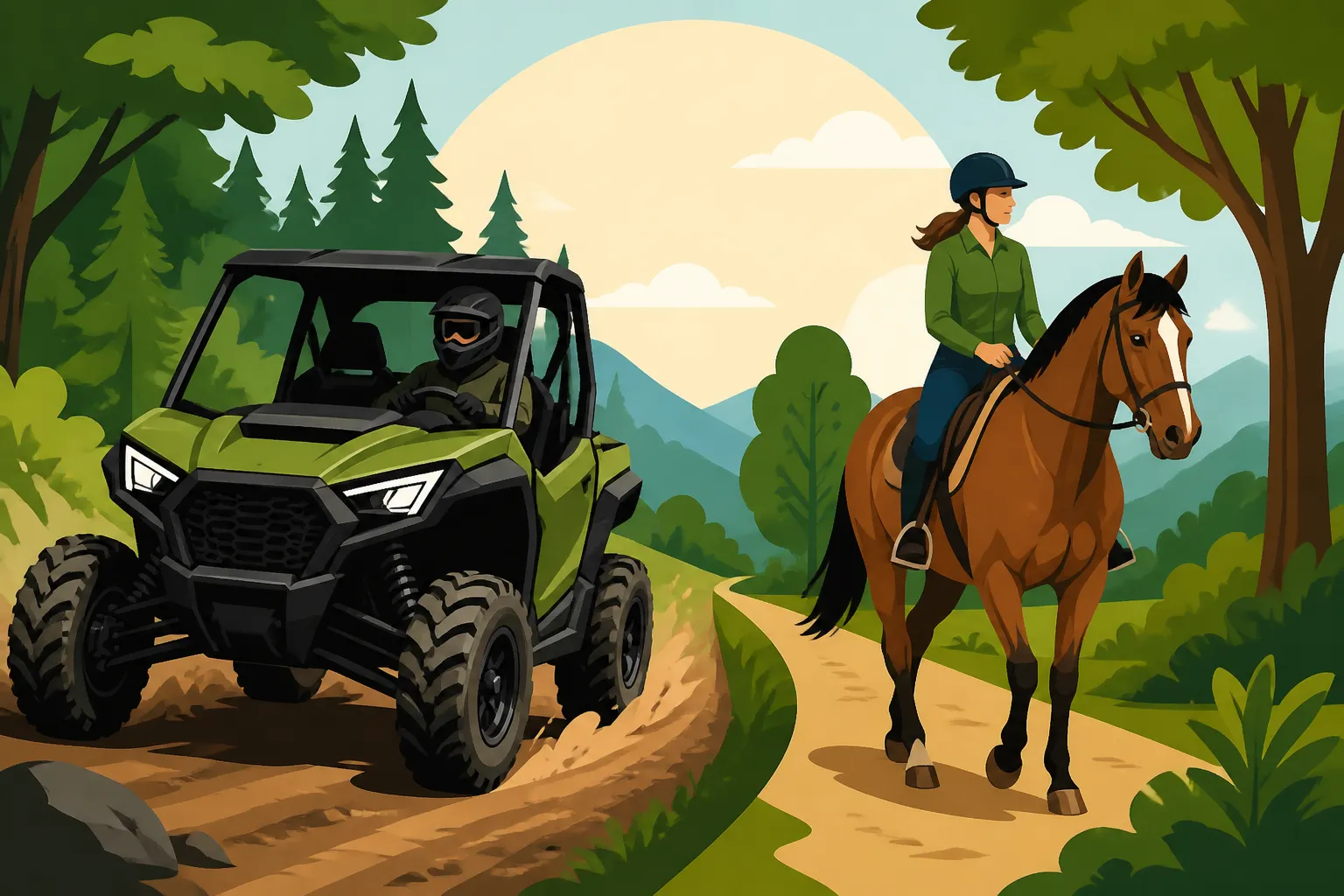
A ride can go sideways quickly when an ATV rounds a blind bend and meets a horse and rider on the same narrow trail. Shared-use routes call for more than ordinary trail etiquette: you need to know where each activity is allowed, how to approach horses safely, and what to do when the trail is too tight to pass. This guide covers those decisions for Alabama riding areas.
What shared trails mean in Alabama
Shared ground does not always mean shared trails
A park may welcome both off-highway vehicles and horses without allowing them on the same routes. One activity might have its own trail network, or different users might be directed to specific sections. The distinction matters: seeing horse trailers in the parking area does not tell you that horses and ATVs can use the same trail.
Before unloading, check the park’s current map, posted signs, and rules. Look for routes marked by user type, seasonal restrictions, one-way directions, and any closures. If a map uses colors or symbols you do not understand, ask staff before riding rather than guessing at the trailhead.
Minooka Park in Chilton County is one Alabama riding area people may consider when looking for a mix of outdoor activities. Its acreage and amenities can make it useful to understand what the park offers, but don’t assume every route is open to every user. Check the park’s current information and on-site instructions before planning a horse-and-ATV outing. [Minooka Park's 420 Acres in Alabama] offers a related starting point for learning about the park.
Confirm access before you tow
A little checking at home can prevent a frustrating drive with a trailer. Confirm whether the park is operating, which areas are open to motorized riding, whether horses are permitted, and whether any routes are shared. Rules and operating schedules can change, and conditions after heavy rain may affect access even when a park is open.
Use official park maps and direct park guidance as your primary sources. Apps such as onX Offroad can help you prepare by reviewing your route and identifying areas to investigate, but a map app should not override a park’s posted rules or indicate permission where none has been granted. If the map and signs seem to conflict, stop and ask park staff.
Keep the address, entrance instructions, and a backup plan handy. Some riding areas have multiple access points, and a route that looks close on a screen may not connect to the entrance you need. Planning the visit around verified access is especially helpful if you’re meeting horse riders who need a safe place to unload and prepare.
How to approach horses on an ATV or UTV
Slow down early and give the horse room
Horses can react suddenly to engine noise, movement, or an approaching vehicle they cannot see clearly. The safest response is to reduce speed well before reaching the horse, avoid revving the engine, and give the rider time to notice you. If you can see a horse ahead but the rider has not seen you, wait at a safe distance rather than closing in.
On a narrow trail, don’t assume there is enough room to pass just because your ATV or UTV fits. A horse may step sideways, and the rider may need space to turn or guide the animal to a safer spot. Keep your vehicle under control, stay on the established trail, and follow any instructions from the rider or park staff.
A courteous greeting can help, but avoid calling out loudly or making a sudden gesture. Calmly ask whether it is safe to pass and wait for the rider’s direction. If the rider asks you to stop, turn off the engine, or back away, follow those instructions. The horse’s handler is best placed to judge what the animal can manage in that moment.
Pass only when the rider says it is safe
Passing on a shared trail is not a contest to see who can squeeze through first. Wait until the horse and rider have reached a location with enough room and stable footing for the maneuver. Avoid passing on a steep slope, beside a drop-off, at a blind corner, or where loose soil could make either vehicle or horse slip.
When the rider gives the go-ahead, move slowly and smoothly. Keep a generous gap, avoid sudden acceleration, and don’t drive close behind the horse after passing. If you’re in a group, let the rider know how many vehicles are coming so they aren’t surprised by a long line of machines.
The same courtesy applies when you meet a horse from the opposite direction. Don’t crowd the trail while deciding who should move. If the route is too narrow or the ground is unstable, wait where you are and communicate calmly. If there is no safe way to pass, follow the park’s instructions for turning around or yielding.
Plan the ride around trail layout and conditions
Read the route before setting off
Trail maps are most useful when you look at them before the group starts moving. Identify intersections, loops, narrow sections, access roads, and any marked routes for horses or motorized vehicles. Agree on a meeting point in case riders separate, and make sure everyone understands the route’s difficulty and direction.
A mapping app can provide helpful context while you plan, but don’t treat a colored line as proof that an ATV route is open or shared with horses. Check the park’s map and posted notices, then use onX Offroad or another navigation tool as a supplement for following your planned route. If you lose cell service, an offline map or paper copy can help you stay oriented, but it still doesn’t replace local rules.
Before the ride, talk through the group’s pace and what to do at blind corners. The first rider can call out hazards to the group, but everyone should leave enough space to stop without creating a pileup. On a shared route, an alert group is safer than a fast one. [Alabama Trail Difficulty Ratings] and [Alabama Trail Conditions Before You Tow] are useful related topics to review when preparing.
Treat mud, dust, and poor visibility as safety issues
Alabama clay can become slick after rain, while dry trail surfaces can create dust that makes it hard to see what is ahead. Both conditions matter around horses. Mud can reduce control and make passing risky; dust can obscure a horse, rider, or approaching machine around a curve.
If the trail is wet, slow down and avoid spinning tires or cutting around puddles into the vegetation. If dust is hanging in the air, leave more space between vehicles and reduce speed where visibility is limited. Stop in a safe place if you cannot see far enough ahead to react.
Weather can also change access. A route that was rideable on a dry morning may be damaged or closed after a storm, and a closed trail may be intended to protect the surface as well as visitors. Check for current notices before leaving home and again at the entrance. [Alabama Trail Closures After Rain] covers another part of planning around changing conditions.
| Trail situation | Safer response | Avoid |
|---|---|---|
| Horse ahead on a wide trail | Slow down, keep distance, ask before passing | Accelerating toward the horse |
| Horse ahead on a narrow trail | Stop at a safe distance and wait for direction | Squeezing past without permission |
| Blind corner or crest | Reduce speed and be ready to stop | Assuming the trail is clear |
| Muddy or unstable ground | Give everyone extra room and use a controlled pace | Spinning tires or passing on a slope |
| Dusty section | Increase following distance and lower speed | Riding close enough to lose sight |
| Unclear signs or route markings | Stop and ask park staff | Guessing which users are allowed |
Prepare your group and machine for shared use
Set expectations before anyone starts the engine
A shared-use ride goes more smoothly when everyone knows the basic plan. Before starting, explain that the group will slow down around horses, wait for riders to approve a pass, and stop at blind intersections if visibility is limited. New riders may not realize how quickly an engine can startle an animal, especially if they are focused on keeping up.
Choose a lead rider who is comfortable managing pace and a sweep rider who can make sure nobody gets left behind. Keep the group compact enough to communicate, but not so close that one sudden stop causes a collision. If the group is large, consider breaking it into smaller units where park rules allow.
Parents should explain these expectations in simple, practical terms to young riders. “Don’t startle the horse” is less useful than “slow down, stay back, and wait until the rider tells us to pass.” A child riding a smaller machine may be less visible to a horse rider, so adults should supervise closely and keep the child within reach.
Check equipment and carry essentials
A pre-ride check is useful on any trail, but shared routes make predictable control especially important. Check brakes, throttle response, tires, lights, and steering before entering the trail. Secure loose cargo so it won’t fall or make unexpected noise, and make sure passengers know to remain seated and hold on as the machine moves slowly past other users.
Carry water, a basic first-aid kit, a charged phone, and a way to navigate if cell service is weak. If you rely on a digital map, download or save the information you need before reaching a dead zone. A paper park map can serve as a backup, particularly when the group is unfamiliar with the area.
Let someone outside the ride know where you’re going and when you expect to return. That step is easy to overlook when a day trip feels familiar, but it helps if a machine breaks down or the group takes a wrong turn. For more practical planning advice, see [Alabama Trail Etiquette Locals Expect] and [Alabama ATV Trails: Where to Ride].
Choose a park and ride with respect
Read the posted rules, even if you have visited before
A familiar park can still have a changed route, temporary closure, or different operating schedule. Check signs at the entrance and along the trail. Pay attention to rules about permitted vehicles, direction of travel, speed, noise, horses, and whether particular areas are closed to motorized use.
If the park has a waiver or separate visitor rules, read them before riding. A waiver may be only one part of the requirements; it does not necessarily explain where each user can travel. [Alabama Private Park Waivers and Rules] is a relevant guide to the broader role park rules play in a visit.
When something is unclear, ask a staff member or contact the park before you unload. This can feel like a small inconvenience when friends are waiting, but it is better than discovering halfway down a trail that your group entered an area where motorized riding is not allowed. [Alabama Parks Shared With Horses] is another related topic for understanding the considerations involved in shared recreation areas.
Leave the trail usable for the next person
Respectful riding includes more than yielding to horses. Stay on designated routes, don’t cut around closed gates, pack out litter, and avoid creating ruts that make the trail harder for other users. If you see damage, a fallen limb, or a confusing sign, report it to park staff instead of making your own route around the problem.
Horse riders also need room to enjoy the trail without feeling pressured by a line of machines behind them. Be patient when the trail is busy, keep noise under control, and don’t treat a slow pass as an inconvenience to be solved by driving closer. A calm encounter helps keep shared access pleasant for everyone.
Before you leave, check that your group has all its gear and belongings, and use designated areas for loading and unloading. If you are planning another visit, check park updates and seasonal hours rather than relying on memory. [Minooka Park's Seasonal Hours in Alabama] is a related topic to consider when scheduling a trip to that area.
Disclaimer
This article is for general informational purposes only and does not constitute professional advice. Laws, prices and regulations vary by location and change over time. Consult a qualified professional for guidance on your specific situation.