Riding in a Town That Never Wrote a Rule
A town’s silence about ATVs can feel like a green light—especially when neighbors ride the same streets without being stopped. But no local ordinance does not automatically make a quad or side-by-side legal on public roads in Alabama. This guide explains what that silence means, what to verify before riding, and how to avoid mistaking a local gap for permission.
What a Town’s Silence Does and Does Not Mean
No local rule is not the same as legal road access
If a town has never adopted a specific ATV ordinance, that may mean there is no additional town rule addressing certain kinds of riding. It does not cancel state vehicle laws, make a regular ATV street-legal, or give riders permission to use roads controlled by another agency. A machine still has to meet the requirements that apply to it, and the road owner may have rules of its own.
This is the key distinction: a local rule might restrict or permit some activity within the town’s authority, while state law determines whether a vehicle can be operated on a public road in the first place. A standard quad or UTV is not automatically approved for street use just because a council never discussed it. For a fuller overview of the baseline issue, see [Can You Drive an ATV on the Road in Alabama?] and [Alabama's Federal Standard Barrier to Road Use].
It is also easy to confuse “I’ve seen people do it” with “it is permitted.” A neighbor may be using a private lane, may have a vehicle that qualifies under a different classification, or may simply be taking a risk. A deputy’s lack of response during one ride is not a standing legal approval for everyone else.
The road’s location matters
A road that runs through town is not necessarily owned or controlled by the town. It could be a state highway, a county-maintained road, a privately owned road, or a street within a municipality. The rules and the agency responsible for questions can change depending on that distinction. A town’s lack of an ATV ordinance cannot settle what applies on a road outside its control.
Before riding, identify the exact road and who maintains it. If you are unsure, ask the town clerk or police department whether the road is municipal, then contact the appropriate county or state office if it is not. Do not rely on road signs—or the absence of a sign—as your only source of permission.
A private subdivision road can raise a different set of questions from a public street. It may be privately maintained but open to regular traffic, or it may be restricted by an HOA or property owner. Permission from one person does not necessarily settle every issue, especially if the route connects to a public road. The same caution applies to hunting leases, timber roads, and farm lanes: get clear permission from the landowner or manager rather than assuming access. [Alabama Trespass Law for Riders] explains why permission matters even when a route looks like an ordinary road.
How to Check Before You Ride
Ask the right offices specific questions
A vague question such as “Are ATVs allowed here?” can lead to a vague answer. It is more useful to explain what you want to do: name the road, describe the machine, say whether you plan to travel on a public street or private road, and ask whether the vehicle can legally operate there. If you have a side-by-side rather than a quad, say so; those terms can be treated differently in rules and vehicle classifications.
Start with the town clerk or municipal police department for local ordinances and town streets. If the road is maintained by the county, ask the county road department or appropriate county office. For a state route, ask the relevant state transportation office. You can also ask a local law enforcement agency how it handles the question, but treat an informal conversation as guidance—not as a substitute for confirming the applicable law. [Alabama City Ordinance Lookups] and [Calling an Alabama Sheriff Before You Ride] offer practical ways to approach those conversations.
Write down the name of the office, the road you asked about, and the answer you received. If someone says a particular road is open to a particular vehicle, ask whether that means all public roads in town or only that route, and whether restrictions apply by time, speed, or vehicle type. A specific, documented answer is much more helpful than relying on a general impression.
Use this checklist to sort out the situation
| What to check | Why it matters | Useful next step |
|---|---|---|
| Who owns or maintains the road | Town, county, state, and private roads may have different rules | Identify the road authority before riding |
| Whether the town has an ordinance | A local rule may add restrictions, but its absence does not override state law | Ask the clerk or police department about the specific road |
| What kind of machine you have | An ATV, UTV, golf cart, and low-speed vehicle may not share the same legal status | Describe the machine accurately and check its classification |
| Whether the vehicle meets road-use requirements | Equipment alone may not establish that a vehicle is legally approved for road use | Confirm the vehicle’s legal classification and required paperwork |
| Whether the route crosses another road or property | A permitted route can still lead onto a road or land where riding is not allowed | Confirm every part of the route, not just the starting point |
| Whether permission is written | Verbal permission can be hard to remember or clarify later | Keep written permission for private property when appropriate |
This process can feel like more work than simply taking the short ride you had in mind. Still, it is much easier to ask before heading out than to discover at a roadside stop that you were relying on a town’s silence as permission. For additional context about local rules, see [Alabama Local Ordinances on ATV Riding].
Why a Regular ATV and a Road-Legal Vehicle Are Different
Equipment does not change a vehicle’s legal classification
Adding headlights, turn signals, mirrors, a horn, or a windshield may make a machine more visible or convenient. But having some road-style equipment does not, by itself, make an off-road ATV legal on public streets. The vehicle’s classification and applicable safety requirements matter, not just the list of parts installed on it.
A useful comparison is a vehicle built and certified to meet the requirements for a low-speed vehicle versus an off-road machine modified after purchase. A machine that was designed and certified for road use is not automatically equivalent to an ATV with extra equipment attached. The road-use requirements can involve more than accessories, so check the legal classification rather than judging by appearance. See [Alabama Low-Speed Vehicle Rules] and [Alabama's 49 CFR 571.500 Standard] for more on that distinction.
Aftermarket parts can be useful for off-road visibility, passenger comfort, or trail safety. But a kit or accessory from a supplier such as SuperATV should not be treated as proof that an ATV meets every legal requirement for public-road use. Ask whether the vehicle itself qualifies, and verify that the answer applies to the road you plan to use.
A plate or registration record is not blanket permission
Owners sometimes see a registration decal, paperwork, or a plate-like attachment and assume it settles the street-use question. It may not. A registration or ownership record can serve a particular administrative purpose without authorizing a vehicle to travel on every public road. Confirm what a document means and what use it covers before relying on it.
This is especially important when buying a used machine. A seller may say it is “street legal” because it has lights, a mirror, or a tag from somewhere else. Ask what exact vehicle classification appears on its paperwork, where it was registered, and whether that status applies in Alabama. If the seller cannot explain the basis for the claim, pause before counting on the machine for public-road travel. [Alabama Rules for a Machine With a Tag] can help clarify why a tag does not automatically answer every road-use question.
A dealer or aftermarket shop may be able to explain what equipment has been installed, but installation is not the same as legal approval. If you are considering modifications, ask what they do and do not establish. The name of a kit—or the confidence of the seller—cannot replace confirmation from the authority responsible for the vehicle classification and the road.
Safer Options When Public-Road Use Is Unclear
Keep the ride on property where you have permission
When you cannot confirm that a public street is open to your machine, the safest practical choice is to avoid riding on it. Use private property only with permission, and plan a route that does not quietly spill onto a public road, sidewalk, or someone else’s land. A trail that ends at a county road may create a different legal problem from a trail that stays within the permitted property.
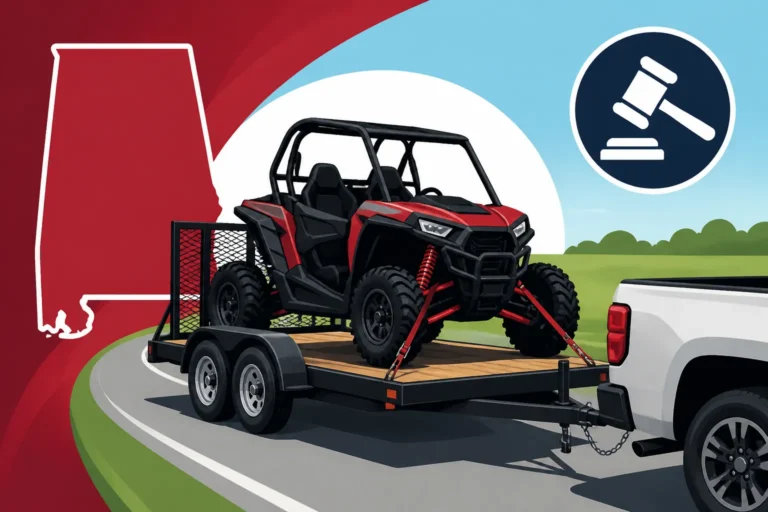
If you need to move the ATV between properties or to an off-road riding area, hauling it on a trailer is often a more dependable option than riding it on the shoulder or through town. For designated riding locations, check the park’s rules and entry requirements before leaving home. A local riding area may require its own waiver or have limits on vehicle size, passengers, or equipment.
If your proposed route includes a road crossing, do not assume that crossing rules make it legal to ride along the road. Crossing a road and traveling down it are separate questions. Confirm whether a crossing is allowed at that specific location and what conditions apply. [Alabama Rules for Crossing a Highway] covers the issue in more detail.
Prepare a simple verification routine
Before each unfamiliar ride, use a short routine rather than relying on habit:
- Map the route. Mark every public road, private lane, trail entrance, and crossing.
- Identify each road authority. Check whether a road is town-, county-, state-, or privately controlled.
- Confirm the vehicle’s status. Use the machine’s paperwork and classification, not just its appearance or added accessories.
- Ask about the exact route. Explain the vehicle type and where you intend to ride.
- Get private-property permission. Confirm that permission covers the full route and the day you plan to ride.
- Save the answer. Keep useful written guidance or permission with your riding information, while remembering that it does not replace legal requirements.
Even if you have taken the same route many times, check again after a move, a machine purchase, a road construction change, or a change in property ownership. A town that has not adopted an ATV-specific rule may still have other rules that affect your route, and the road authority may change from one block to the next.
Some riders add mirrors, lights, or other accessories to improve visibility when moving around private property or loading areas. SuperATV and other aftermarket suppliers may offer equipment for off-road machines, but that equipment should not be confused with authorization to use public streets. When road legality is uncertain, confirm first and choose a trailer or permitted private route rather than testing the interpretation in traffic.
Disclaimer
This article is for general informational purposes only and does not constitute professional advice. Laws, prices and regulations vary by location and change over time. Consult a qualified professional for guidance on your specific situation.