Shoes Required on a Motorcycle
There's a common misconception, especially among new riders in Alabama, that if the state mandates helmets for motorcycles, it must also have rules about other protective gear, like proper shoes. It’s easy to get frustrated when you're trying to figure out what's legally required versus what's just smart practice, and the law isn't always as clear as you'd hope. This guide is here to untangle the legalities around footwear for motorcycle riders in Alabama, explain the distinctions, and offer some real-world advice to keep you safe and comfortable on two wheels, or four.
Alabama's General Approach to Motorcycle Riding Gear
When you hit the open road on a motorcycle in Alabama, or even just cruise down a country lane, there's often a lot of talk about what gear you should wear. But when it comes to what the law actually requires, the list is surprisingly short for many items. This can be a source of confusion for riders who prioritize safety but also want to stay on the right side of the law. Understanding the state's approach to riding gear starts with its most definitive mandate: the helmet law.
The Core Motorcycle Helmet Law
Let's cut right to it: Alabama absolutely, unequivocally requires helmets for all motorcycle riders and passengers. This isn't a suggestion; it's a legal mandate that's been on the books for quite some time, and it's enforced. The state legislature, driven by safety concerns and accident statistics, made a clear decision that protecting a rider's head is paramount. This law aims to reduce serious injuries and fatalities in the event of a crash, and it applies regardless of age or experience. You'll find deputies and state troopers don't hesitate to issue citations for helmet violations, and for good reason – the consequences of riding without one can be devastating.
It's important to note that this helmet law specifically targets motorcycles. For those of us who also enjoy the thrill of an ATV or UTV, the helmet requirements can sometimes differ or be less explicitly stated in public use statutes. While many private riding parks, like Stony Lonesome OHV Park in Alabama, will require helmets for all riders regardless of machine, state law doesn't extend the motorcycle helmet mandate to off-road vehicles in the same universal way. This distinction often creates a grey area, but for motorcycles, it's black and white: wear a helmet. [Does Alabama's Motorcycle Helmet Law Cover ATV Riders?] covers this distinction more.
What the Law Says About Other Gear (or Doesn't)
This is where the waters get a bit murky and the frustration often sets in for riders seeking definitive answers. Beyond the helmet, Alabama state law is largely silent on other specific pieces of protective gear for motorcycle riders. You won't find a statute that dictates you must wear a leather jacket, gloves, or specific eye protection (though eye protection is highly recommended for safety and comfort, especially against road debris). This lack of specific mandates can lead to a false sense of security or, conversely, over-caution where it's not legally necessary.
For example, while common sense dictates wearing gloves to protect your hands and improve grip, or a sturdy jacket to shield against abrasions, the state of Alabama does not have a law that requires these items. This is a common point of discussion among riders: where does personal responsibility end and state mandate begin? The underlying philosophy seems to be that while the state will intervene for critical safety items like helmets, it leaves other gear choices to the individual rider's discretion and judgment. However, this doesn't mean these other gear items aren't crucial for your safety and comfort, especially if you ever have an unplanned encounter with the pavement or a tree.
Is Footwear Legally Required for Motorcycle Riders in Alabama?
After understanding Alabama's approach to general riding gear, let's zoom in on the specific question of footwear. Many riders understandably assume that if helmets are mandatory, then something as fundamental as shoes would also be covered by law, especially given the exposed nature of motorcycle riding. However, this isn't necessarily the case, and the reality might surprise you.
The Absence of a Specific Footwear Statute
Here's the straightforward answer: As of now, Alabama state law does not have a specific statute that dictates what type of footwear a motorcycle rider must wear. This means there's no legal requirement for you to wear boots, closed-toe shoes, or any particular style of shoe when operating a motorcycle on public roads in Alabama. You could, theoretically, ride in flip-flops, sandals, or even barefoot without violating a specific state footwear law for motorcycles. This often comes as a shock to riders, especially those from states with stricter uniform traffic codes.
The absence of such a law highlights the state's selective approach to rider safety mandates. While critical components like head protection are deemed essential for legal enforcement, other protective measures are left to the rider's discretion. This doesn't mean it's a good idea to ride in inadequate footwear, but it's crucial to distinguish between legal requirements and recommended safety practices. An Alabama deputy might pull you over for speeding, but they won't ticket you for wearing sneakers instead of riding boots, assuming your riding isn't otherwise reckless. [Alabama Penalties for Illegal Road Riding] are usually focused on the machine's legality or dangerous operation, not specific clothing.
What About Local Ordinances or Private Land Rules?
While state law might be silent, it's always wise to consider local regulations and private property rules. For instance, cities and counties in Alabama do have the authority to enact their own ordinances, which can sometimes be more restrictive than state law. However, it is exceptionally rare to find a local ordinance in Alabama that specifically mandates footwear for motorcycle riders on public streets. Most local rules related to vehicles focus on things like noise, parking, or where certain vehicles can operate, not individual rider attire. [Alabama City Ordinance Lookups] might yield results for ATV or golf cart use, but rarely for motorcycle footwear.
The bigger consideration for footwear requirements often comes into play on private land or at organized riding events and parks. If you're planning to ride your dirt bike or ATV at an off-road park like Minooka Park Riding in Alabama, it's highly probable that their rules will include a requirement for closed-toe shoes or sturdy boots. This is for liability reasons as much as safety. Many tracks and trails simply won't let you ride if you show up in open-toed footwear because the risk of injury from debris, hot engine parts, or an accidental foot plant is too high. Similarly, any organized group ride or charity event might set its own safety standards for participants, which could include mandatory footwear. Always check the rules of the specific venue or event before you go. [Alabama Private Park Helmet Rules] often go hand-in-hand with footwear rules.
Why Good Footwear Matters, Even Without a Law
The fact that Alabama doesn't have a specific law mandating footwear for motorcycle riders doesn't mean you should disregard it. In fact, choosing the right footwear is one of the most critical decisions a rider can make for their personal safety, comfort, and control. Just like you might invest in quality parts for your ATV or UTV from a company like SuperATV to protect your machine, investing in quality gear for yourself is equally, if not more, important. The road, or the trail, can be an unforgiving place, and your feet are vulnerable.
Safety Benefits of Appropriate Footwear
Think about what your feet encounter when you're riding. On a motorcycle, they're exposed to engine heat, exhaust pipes, road debris kicked up by other vehicles, and the occasional stone or bug. In the event of a sudden stop or a minor tip-over, your feet are often the first point of contact with the ground. Sturdy, over-the-ankle boots provide a critical layer of protection against these everyday hazards and more serious impacts. They can prevent scrapes, burns, and even broken bones. Imagine catching your foot between your bike and the pavement – a thin canvas sneaker offers virtually no resistance, while a reinforced leather boot could make a significant difference.
For off-road riding on an ATV or UTV, the stakes are arguably even higher. You're dealing with uneven terrain, mud, rocks, roots, and potential water crossings. Your feet are constantly shifting, bracing, and interacting with the footpegs or floorboards. Proper boots protect against impacts from flying debris, branches, and the machine itself. They also offer much-needed ankle support, reducing the risk of sprains or twists when you put a foot down on uneven ground. [Alabama Riding Season Considerations] like mud or dust also highlight the need for durable and protective footwear.
Comfort and Control on the Ride
Beyond protection, good footwear significantly enhances your comfort and control while riding. Try to imagine shifting gears or engaging the rear brake on a motorcycle with flimsy sandals – it's not only uncomfortable but potentially dangerous due to a lack of tactile feedback and stability. Riding boots are designed with soles that offer excellent grip on footpegs and floorboards, even when wet, and provide the rigidity needed to operate controls precisely.
On a long ride, weather conditions can change quickly. Waterproof boots keep your feet dry in an unexpected rain shower, while breathable materials can help manage heat on hot Alabama summer days. Conversely, a good pair of boots will provide insulation in cooler weather. This comfort reduces fatigue, allowing you to focus more on the road or trail ahead rather than distracting discomfort. For those long days riding at a park or exploring [Alabama ATV Trails: Where to Ride], comfort becomes paramount.
Protecting Your Feet in a Crash or Fall
This is perhaps the most compelling reason to wear appropriate footwear. While no one ever plans to crash, accidents happen. When a motorcycle goes down, your feet and ankles are incredibly vulnerable. They can be crushed, twisted, scraped, or burned. The human foot and ankle contain numerous small bones, ligaments, and tendons that are easily injured. A sturdy pair of riding boots, especially those with reinforced ankle support and impact protection, can mean the difference between a minor bruise and a life-altering injury.
Consider the potential for road rash, a common injury where skin is scraped away by friction with the pavement. Even a low-speed slide can cause severe damage to exposed feet and ankles. Boots act as a sacrificial layer, absorbing much of the abrasion and impact. Furthermore, they help keep your feet on the pegs or floorboards during unexpected bumps or evasive maneuvers, preventing them from dragging or getting caught under the machine. While insurance coverage is vital, preventing injury in the first place is always the best approach. [Insuring an Untitled Machine in Alabama] is a great step, but personal protective gear is another.
Footwear Recommendations for Alabama Riders
So, if the law doesn't tell you exactly what to wear, how do you choose? It comes down to prioritizing safety, comfort, and control. Whether you're on a motorcycle or an ATV, the principles are quite similar: protect your feet from impacts, abrasions, and the elements, while ensuring you maintain full control of your machine.
Key Features to Look For in Riding Boots
When you're looking for riding boots, whether for a motorcycle or an off-road machine, keep these features in mind:
- Ankle Coverage and Support: This is paramount. Look for boots that extend at least over the ankle bone. Many excellent riding boots go much higher, providing even greater support and protection. Good ankle support helps prevent twists and sprains.
- Sturdy Materials: Leather is a classic for a reason – it's durable, abrasion-resistant, and offers good protection. Synthetic materials designed for riding can also be excellent, often offering lighter weight or better waterproofing. Avoid thin fabrics or mesh that offer minimal protection.
- Reinforced Toe and Heel: These areas are particularly vulnerable to impact. Boots with reinforced toe boxes and heel counters provide crucial protection against crushing injuries.
- Non-Slip Soles: A good, grippy sole is essential for maintaining traction on footpegs, the ground, and for confident stops. Look for oil-resistant and slip-resistant materials.
- Secure Fasteners: Laces, zippers, buckles, or a combination thereof should secure the boot snugly to your foot without being overly restrictive. You don't want your boot slipping off or catching on controls.
- Weather Protection: Consider waterproofing if you ride in all conditions. Even if you're fair-weather only, Alabama's unpredictable pop-up showers can leave you soaked without it. Some boots also offer insulation for cooler weather.
What to Avoid While Riding
Just as important as knowing what to look for is knowing what to avoid. For your safety, steer clear of these types of footwear when riding:
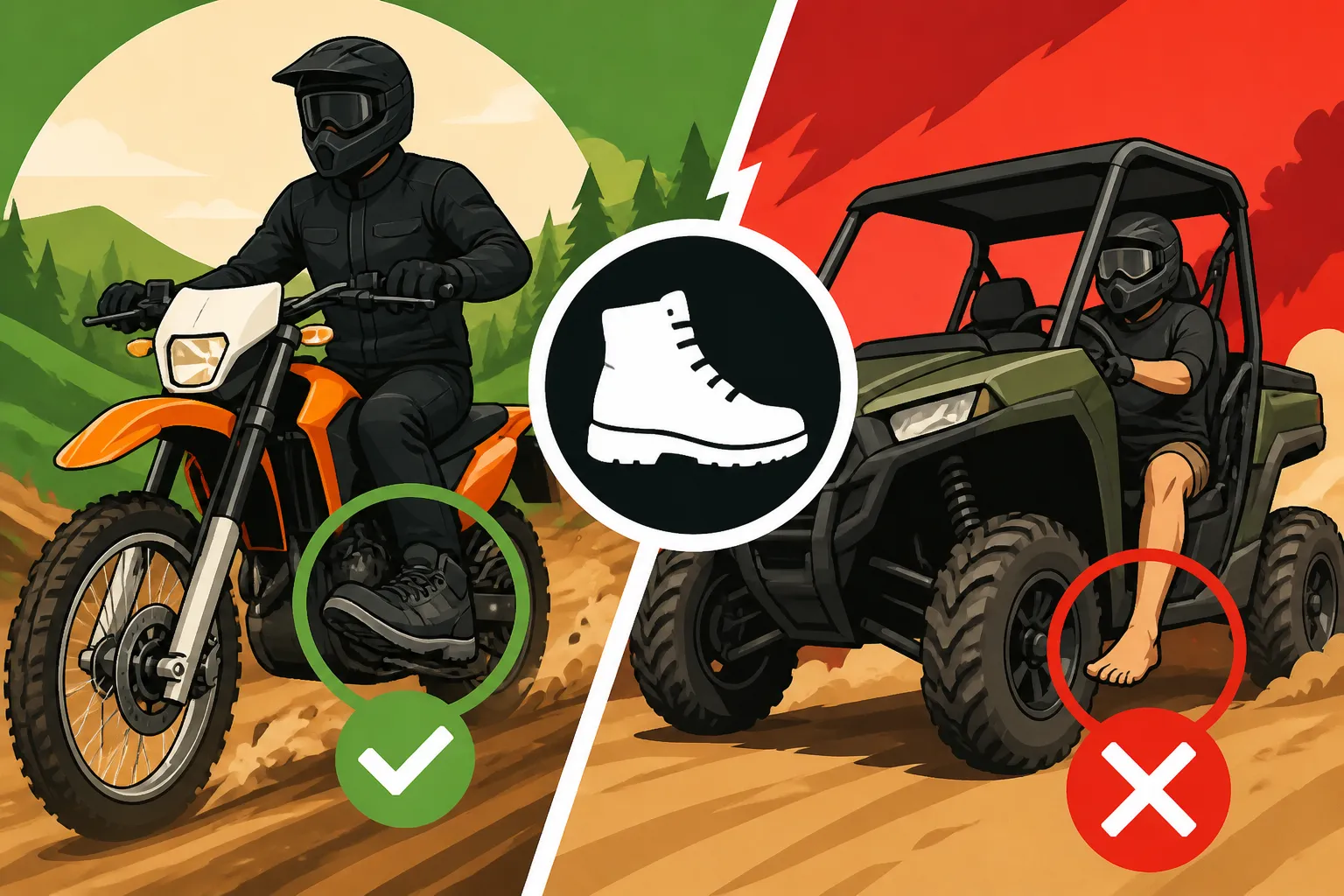
- Open-Toed Shoes: Sandals, flip-flops, and clogs offer zero protection. Your toes are completely exposed to impacts, scrapes, burns from hot engine parts, and debris. Plus, they can easily slip off.
- Loose-Fitting Shoes: Any shoe that isn't snug on your foot can come off unexpectedly, get caught on controls, or become a dangerous distraction. This includes certain types of slip-ons.
- Shoes with Poor Grip: Smooth-soled shoes, fashion sneakers with minimal tread, or worn-out footwear can lead to slips when you put your foot down at a stop or try to brace yourself on uneven ground.
- High Heels: While perhaps fashionable, high heels are incredibly impractical and dangerous for riding. They offer no stability, can catch on controls, and make it difficult to balance the machine.
Relating to ATV/UTV Riding
The advice for motorcycle footwear applies directly to ATV and UTV riding, perhaps even more so given the nature of off-road environments. When you're tackling [Alabama Trails That Allow Side-by-Sides] or navigating deep ruts, your feet are exposed to different but equally dangerous threats. Kicking up rocks, sloshing through mud, or having to put a foot down suddenly to prevent a roll are all scenarios where sturdy boots are indispensable. Just as you'd ensure your machine is equipped with heavy-duty accessories, perhaps from a reputable brand like SuperATV, to withstand the rigors of the trail, your personal gear, especially your boots, needs to be up to the task.
Even if your UTV has floorboards, a solid boot offers ankle support against jostling, protection from mud and water, and critical leverage for foot controls. For ATV riders, who are more physically engaged with their machines, proper boots are almost as important as a helmet. They provide the necessary grip on footpegs and protection for those moments when you might need to "dab" a foot down to regain balance. Think of your boots as an extension of your machine's safety features, just as vital as your roll cage or seatbelts.
Here's a quick comparison of common footwear types and their suitability for riding:
| Footwear Type | Legal in Alabama (Motorcycle) | Protection Level | Control/Grip | Comfort/Weather (General) | Off-Road ATV/UTV Suitability |
|---|---|---|---|---|---|
| Flip-flops/Sandals | Yes | None | Very Poor | Low | Very Poor (Dangerous) |
| Canvas Sneakers | Yes | Low (Abrasions) | Moderate | Moderate | Low (Minimal Protection) |
| Regular Work Boots | Yes | Moderate | Good | Moderate-Good | Good (Basic Protection) |
| Hiking Boots | Yes | Good | Good | Good | Good (Better Ankle Support) |
| Dedicated Riding Boots | Yes | Excellent | Excellent | Excellent (Specific Design) | Excellent (Optimal Protection) |
Disclaimer
This article is for general informational purposes only and does not constitute professional advice. Laws, prices and regulations vary by location and change over time. Consult a qualified professional for guidance on your specific situation.