Alabama Rules for a Visiting Florida Rider
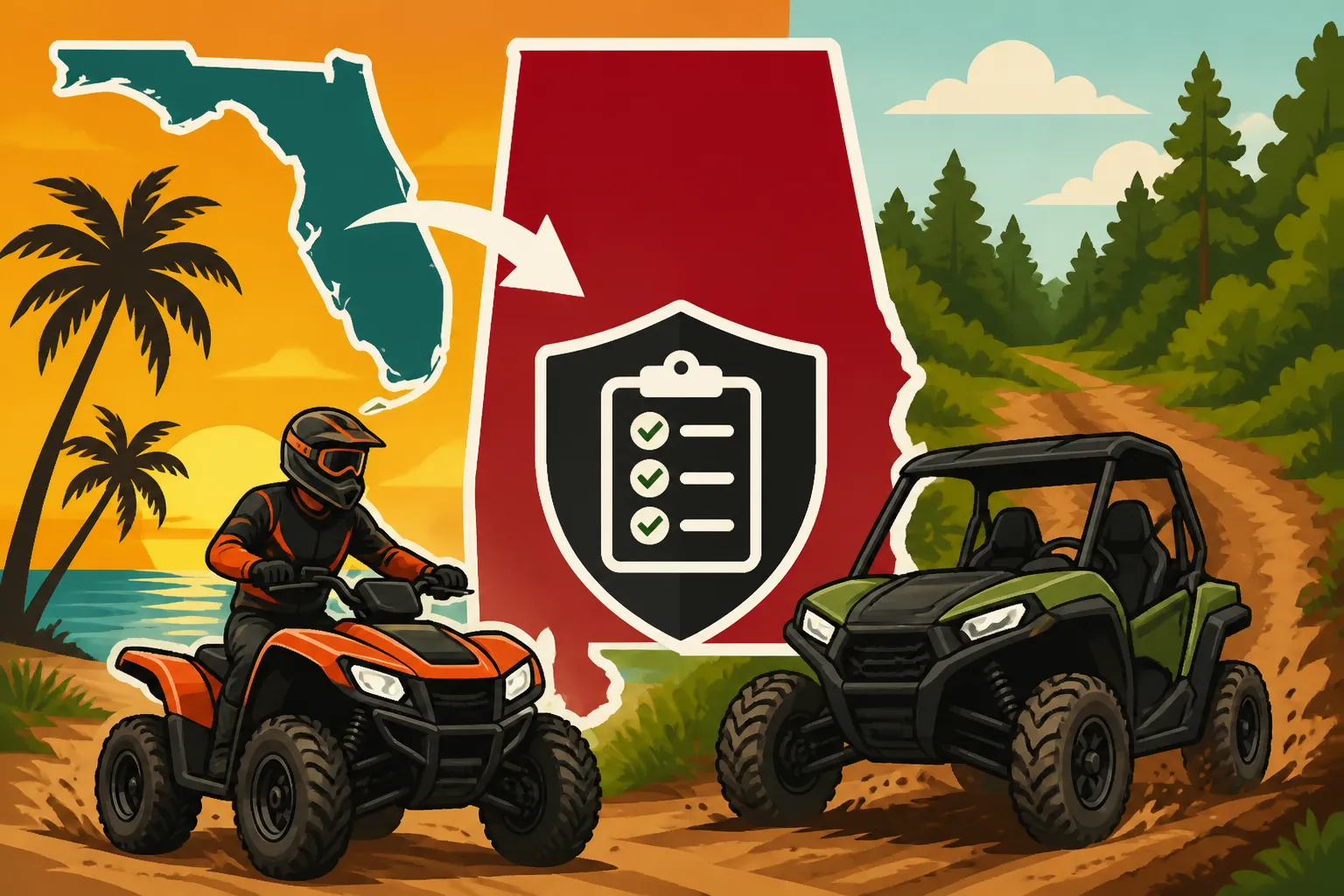
You've packed up your quad or side-by-side, driven north on I-65 from the Sunshine State, and you're ready to hit some new trails in Alabama. But before you unload that machine, it's crucial to understand that Alabama's off-road vehicle laws can be quite different from what you're used to in Florida. This guide is here to unravel those differences, highlight common pitfalls for visiting riders, and equip you with the knowledge to enjoy Alabama's diverse terrain without running into unexpected trouble.
Navigating Alabama's Core ATV & UTV Regulations for Out-of-State Riders
When you cross state lines, you're not just entering a new landscape; you're entering a new legal framework for off-road vehicles. What might be perfectly acceptable in Florida could lead to a citation or impoundment in Alabama. It's a common frustration for riders who just want to enjoy their hobby, but understanding these foundational rules is your first step to a hassle-free trip.
Registration Realities for Visiting Riders
One of the first things Florida riders often wonder about is registration. In Alabama, ATV and UTV registration is actually voluntary, administered by the Alabama Law Enforcement Agency (ALEA). This is a big departure from states where registration is mandatory for almost any use. However, "voluntary" doesn't mean "unnecessary," especially if you plan to ride on certain public lands or designated trail systems. Even for visitors, having your machine properly registered back home is generally recognized, but Alabama's voluntary system has its own nuances.
If you're just passing through or riding on private land with permission, your home state's registration (if required there) is usually sufficient. However, if you intend to frequent Alabama's public trail systems that require an Alabama Public Use registration decal, you might find yourself in a gray area. Some state-run parks or designated riding areas might prefer or even require an Alabama registration, even for out-of-state machines. It's always best to check with the specific park or land management agency before you tow your rig hundreds of miles. While you might not need to title your machine in Alabama, understanding [Do You Need to Register an ATV in Alabama?] is key to avoiding issues.
The Alabama registration system aims to help fund off-road trail development and maintenance within the state. It provides a unique decal that designates your machine for either "Public Use" or "Private Use," each with a different fee structure. For most visiting riders primarily looking for public trail access, the Public Use registration is the one to consider. Even if you ultimately decide against getting an Alabama registration, it's vital to have proof of ownership from your home state readily available when you ride. [What Visiting Riders Need to Ride Legally in Alabama] covers this more broadly.
Titling: What Florida Owners Need to Know
Alabama's approach to ATV and UTV titling has recently undergone significant changes. For machines with a model year of 2026 or newer, Alabama will require a title. For older machines (model year 2025 and earlier), titles are generally not required and often not issued by the state. This is a point of frequent confusion, as many states, including Florida, might already title all ATVs and UTVs regardless of age.
As a visiting Florida rider, you likely already have a title for your machine if Florida requires it. This title from your home state serves as your primary proof of ownership. You will not be expected or required to obtain an Alabama title for your machine, regardless of its model year, simply because you are visiting. Your Florida title is valid evidence of ownership within Alabama.
The new Alabama titling law is primarily designed for resident owners to ensure proper ownership records within the state, especially for new sales or transfers. While it won't directly affect your ability to visit and ride, understanding that Alabama has a different titling landscape can help you comprehend why a local rider might have different paperwork than you. Just keep your original title and registration from Florida handy when you travel. Alabama law will recognize that you legally own your machine based on your home state's documentation.
Understanding Alabama's Strict Road Use Laws
This is where many out-of-state riders, particularly those from Florida, often run into the most trouble. Florida has various local ordinances and specific state rules that allow for golf cart or even some ATV/UTV use on certain public roads. Alabama, however, has a much stricter stance on off-road vehicles on public streets and highways. Do not assume your "street legal kit" from Florida will make your machine legal on Alabama roads.
The Reality of "Street Legal" in Alabama
Let's be blunt: generally speaking, ATVs and UTVs are not street legal in Alabama. The state's statutes are quite clear that to be operated on public roads, a vehicle must be manufactured to meet federal motor vehicle safety standards (FMVSS). Standard ATVs and UTVs, as sold by manufacturers like Polaris, Can-Am, or Honda, are not designed or certified to meet these standards. Adding aftermarket lights, turn signals, mirrors, or even a windshield (often sourced from companies like SuperATV, which offers fantastic accessories for off-road use) does not magically transform an off-road vehicle into a street-legal one in Alabama.
The intent of these aftermarket parts, even from reputable brands, is typically to enhance safety and functionality for off-road riding, not to convert the machine for public road use. This is a critical distinction. Many Florida riders, accustomed to more permissive local laws, install these kits thinking they are compliant everywhere. In Alabama, an officer will likely view your modified ATV or UTV as an illegal vehicle on the road, regardless of the accessories you've added. [Are ATVs Street Legal in Alabama?] details these restrictions.
The only real exception is for vehicles built and certified by the manufacturer as "Low-Speed Vehicles" (LSVs) that meet specific federal standards and are then registered and tagged for road use. These are typically golf cart-like vehicles, not traditional ATVs or UTVs. Trying to operate a standard ATV or UTV, even with all the bells and whistles, on an Alabama public road can result in significant fines, potential impoundment, and an unexpected end to your trip. [Alabama Penalties for Illegal Road Riding] are not to be taken lightly.
Crossing Roads and Designated Routes
While operating an ATV or UTV on a public road is generally prohibited, Alabama law does allow for crossing public roads in specific circumstances. Typically, this is permitted when traveling from one off-road section to another, but it must be done quickly, safely, and at a right angle to the road. You cannot ride down the shoulder, or travel any significant distance on the paved surface. This is a privilege, not a right, and it comes with strict limitations.
Furthermore, there are very specific and limited cases where certain county roads or designated sections within specific jurisdictions might allow ATV or UTV use. However, these are rare, highly localized, and often require specific signage, speed limits, and adherence to local ordinances. As a visitor, you should never assume a road is open to ATVs unless you see clear, official signage explicitly permitting it, or you've personally confirmed with local law enforcement or land managers. [Alabama Rules for Riding a County Road] further explains these nuances.
It's a good practice to consult local ordinances directly if you plan to ride near a town or county road. Checking with the county sheriff's office or city hall before you go is always a wise move. Trying to "wing it" based on what you think might be allowed can easily lead to a bad day. The general rule of thumb for visitors is to assume roads are off-limits unless explicitly proven otherwise, and even then, understand the precise conditions.
Public Land, Private Land, and Trail Park Specifics
Knowing where you can legally ride is just as important as knowing how your machine is classified. Alabama offers a variety of riding opportunities, but each comes with its own set of rules and permissions.
Riding in Alabama's Public Areas
Alabama has several fantastic public riding areas, including state-operated OHV parks and some designated trails within national forests or Wildlife Management Areas (WMAs). However, each of these public lands operates under its own specific rules, which can vary wildly. Some may require an Alabama Public Use registration decal, even if your Florida registration is current. Others might require a day-use permit or a WMA license in addition to your off-road vehicle registration.
National Forests in Alabama, such as the Talladega or Bankhead, often restrict ATVs and UTVs to designated roads or trails only. This means you can't simply blaze your own path. Maps indicating these designated routes are crucial and should be obtained from the local Forest Service office before your ride. Remember, what's permitted on one section of federal land might be prohibited on another. [Alabama ATV Trails: Where to Ride] provides a good starting point for finding these locations.
The key takeaway for public land is: never assume. Always contact the specific land management agency (e.g., state park, Forest Service district office, WMA office) before you head out. Inquire about their specific requirements for out-of-state riders, any necessary permits, and the designated riding areas. This proactive step can save you immense frustration and potential penalties for trespassing or violating local rules. [Alabama Trespass Law for Riders] also applies to public lands where you might wander off designated paths.
Private Parks: Your Safest Bet for Trail Riding
For many visiting riders, especially those unfamiliar with Alabama's nuances, private OHV parks are often the easiest and safest option. These parks, like Stony Lonesome OHV Park or Minooka Park, offer dedicated trail systems designed for ATVs and UTVs, with clear rules and established facilities. They typically charge an admission fee, and you'll always be required to sign a waiver before riding.
Private parks set their own rules regarding helmets, passenger limits, minimum age requirements for riders, and often even equipment like spark arrestors. They will usually have these rules clearly posted on their websites or at the entrance. Because you're paying to access a controlled environment, there's less ambiguity about where you can ride and what's expected of you. Many of these parks are well-maintained and cater to riders of all skill levels, from beginners to seasoned enthusiasts.
While you'll still need to ensure your machine is in good working order and you have appropriate safety gear, private parks significantly reduce the legal complexities associated with public land or road use. They are designed for off-road recreation, and their staff are usually well-versed in handling out-of-state visitors. [Alabama Private Park Waivers and Rules] is a good resource to check before you visit any private park.
Essential Preparations Before You Ride
A successful trip to Alabama involves more than just loading your machine. It requires understanding the environment, packing the right gear, and knowing what documentation to keep handy.
Gear, Safety, and Local Expectations
Even if Florida's helmet laws for ATVs are different or non-existent in certain scenarios, you should always wear an appropriate DOT-approved helmet when riding in Alabama. While Alabama's helmet laws specifically refer to motorcycles, private parks often mandate helmet use for all riders, and it's simply good common sense. Eye protection, gloves, long pants, and sturdy boots are also highly recommended to protect against debris, falls, and the elements. Alabama's red clay, especially after a rain, can be notoriously slick and can stain gear quickly, so be prepared for a messy adventure!
Beyond personal safety gear, consider outfitting your machine for the local conditions. A winch can be a lifesaver on Alabama's steeper, clay-filled climbs. Skid plates are always a good idea for rocky sections. And if you're riding through water crossings, ensuring your machine's air intake and exhaust are protected is smart. Manufacturers and aftermarket suppliers like SuperATV offer robust protection and recovery gear that can make a huge difference in challenging terrain. Remember to check [Alabama Spark Arrestor Requirements], as many parks and public lands require them to prevent wildfires.
What to Carry With You
As a visiting rider, proving who you are and that you own your machine is paramount. Here's a quick checklist of what you should always have with you when riding in Alabama:
| Document/Item | Why It's Important |
|---|---|
| Valid Driver's License/ID | To prove your identity to law enforcement or park officials. |
| Florida Title/Registration | Official proof of ownership and registration from your home state. Keep the originals in a secure, dry place, and carry good quality copies with you on the trail (perhaps laminated). |
| Proof of Insurance | Although Alabama does not mandate insurance for ATVs on private property, many riding parks require it, and it's essential for liability if an accident occurs. Your home state's policy should cover you. |
| Written Landowner Permission | If riding on private land that isn't a dedicated park, always have written permission from the landowner. This protects you from [Alabama Trespass Law for Riders]. |
| Park/Area Permits | Any required day passes, WMA permits, or national forest permits for the specific area you are riding. |
| Basic Tool Kit | Essential for minor trailside repairs (tire plug kit, air pump, basic wrenches). |
| First Aid Kit | Accidents happen. Be prepared for minor injuries. |
| Plenty of Water/Hydration | Alabama summers are hot and humid. Dehydration is a serious risk. |
| Map & GPS Device | Cell service can be spotty in remote areas. Don't rely solely on your phone. |
| Communication Device | A fully charged cell phone is a start, but a satellite communicator can be invaluable in areas without service. |
By taking the time to understand Alabama's specific rules, preparing your machine and yourself, and carrying the correct documentation, you'll be well on your way to a memorable and legal off-road adventure. Florida might be known for its beaches, but Alabama's trails offer a different kind of beauty and challenge that's absolutely worth exploring, as long as you do it responsibly.
Disclaimer
This article is for general informational purposes only and does not constitute professional advice. Laws, prices and regulations vary by location and change over time. Consult a qualified professional for guidance on your specific situation.