Alabama LSV Requirements Explained
It's a common dream for many Alabama ATV and UTV owners: being able to hop on your machine and legally cruise down the road to a neighbor's house, the fishing hole, or even a local store. But the reality is, most off-road vehicles simply aren't designed or legally permitted for public road use. This guide is here to untangle the often-confusing world of Alabama's Low-Speed Vehicle (LSV) requirements, clarify what truly makes a vehicle street-legal, and explain why your trusty quad probably doesn't fit the bill.
The Frustration of Wanting to Ride Your Off-Road Machine on Alabama Roads
I get it. You’ve got a perfectly good ATV or UTV, and it seems like such a waste to always have to trailer it everywhere. Maybe you just need to cross a short stretch of pavement to get to another section of your property, or perhaps there's a cool little country store just a mile down the road from your hunting camp. The thought of being able to legally drive your side-by-side on those paved or gravel roads is incredibly appealing. Many folks look at their robust machines, equipped with headlights, taillights, and often turn signals from the factory, and think, "What's the big deal? Why can't I just put a license plate on this thing?"
The big deal, unfortunately, comes down to a fundamental difference in how the law defines and regulates vehicles built for off-road fun versus those built for public roads. Alabama, like many states, relies on federal standards to determine what's truly "street legal." This is where the term "Low-Speed Vehicle" comes into play, and it's often where the confusion begins for ATV and UTV owners. You might see golf carts zipping around small towns with plates, or hear rumors of some side-by-sides being legal, and naturally wonder if your machine can join them. But the path to road legality is far more complex than simply adding a few aftermarket lights or a horn. [Are ATVs Street Legal in Alabama?] is a question we get all the time, and the answer, for most machines, is a resounding "no."
What Exactly is an Alabama Low-Speed Vehicle (LSV)?
Alright, let's cut through the noise and talk about what an LSV actually is in the eyes of Alabama law. A Low-Speed Vehicle isn't just any golf cart or a modified side-by-side. It's a specific class of motor vehicle defined by federal and state regulations that's designed for operation at low speeds on public roads. The key here is "designed for," meaning it must meet specific Federal Motor Vehicle Safety Standards (FMVSS) right from the factory. This isn't something you can usually achieve with an aftermarket kit.
Alabama's rules for these vehicles closely align with the federal standard known as [Alabama's 49 CFR 571.500 Standard]. This standard dictates a whole host of safety requirements that apply to these low-speed vehicles, making them fundamentally different from your average ATV or UTV. Think of it this way: a car is built to car standards, a motorcycle to motorcycle standards, and an LSV to LSV standards. Your quad or side-by-side is built to off-road recreational vehicle standards. These aren't interchangeable.
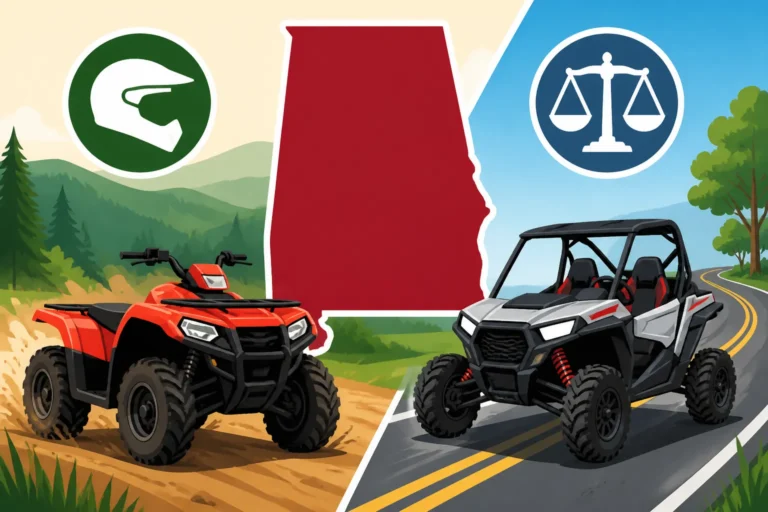
Here’s a look at the core differences between a typical off-road machine and what Alabama considers a street-legal Low-Speed Vehicle:
| Feature | Typical ATV/UTV (Off-Road Only) | Low-Speed Vehicle (LSV) |
|---|---|---|
| Primary Use | Off-road recreation, utility, farm work | Public street travel at low speeds |
| Federal Standard | No specific FMVSS for public roads | Must meet FMVSS 571.500 |
| Manufacturer Intent | Sold as an off-road vehicle | Manufactured and sold as an LSV |
| Maximum Speed | Varies (often 40+ mph) | 20-25 mph |
| Minimum Speed | N/A | 20 mph (on level ground) |
| Headlights | Often present, but not FMVSS compliant | FMVSS compliant |
| Tail & Stop Lights | Often present, but not FMVSS compliant | FMVSS compliant |
| Turn Signals | Often optional/aftermarket | Required, FMVSS compliant |
| Windshield | Often optional/aftermarket | Required (AS-1 or AS-4 grade safety) |
| Occupant Restraints | Seat belts in UTVs, none in ATVs | Required, FMVSS compliant seat belts |
| Mirrors | Often optional/aftermarket | Required (driver side, passenger side, or interior) |
| Horn | Often optional/aftermarket | Required |
| Vehicle Identification Number (VIN) | Off-road specific VIN | Road-legal VIN, indicating LSV status |
| Registration/Tag | [Alabama's Voluntary ATV Registration Through ALEA] for off-road use only | Mandatory state registration and license plate |
As you can see, the requirements for an LSV are quite stringent, and they mostly revolve around fundamental safety features that are part of the vehicle's original design and manufacturing process. This is the crucial distinction. [Alabama's Federal Standard Barrier to Road Use] means that if a machine isn't built to those specs from the factory, it can't simply be converted. Even if you install a complete kit from a company like SuperATV, adding lights, mirrors, and a horn, your machine still won't meet the underlying federal manufacturing standards required to be classified as an LSV. It might look the part, but the legal framework isn't interested in appearances; it's interested in certified safety.
Key Requirements for an LSV to be Street Legal in Alabama
If you're looking to acquire a machine that is street legal as an LSV in Alabama, here’s what you need to understand. We’re talking about vehicles that come from the factory already stamped with the necessary certifications. This isn't about modifying an existing off-road vehicle; it's about buying a vehicle specifically manufactured and classified as a Low-Speed Vehicle.
The core of Alabama's LSV requirements lies in meeting the federal safety standard FMVSS 571.500. This means the vehicle must be manufactured with:
- Headlamps: These aren't just any lights; they must meet specific illumination and safety standards.
- Tail Lamps and Stop Lamps: Again, federally compliant, ensuring visibility and signaling when braking.
- Turn Signal Lamps: Essential for road safety, indicating your intended direction of travel.
- Red Reflex Reflectors: These provide passive safety, especially from the rear.
- An Exterior Mirror: At least one mirror mounted on the driver's side, or an interior mirror if the vehicle has a windshield. Most often, you'll see a driver's side and passenger side mirror for optimal visibility.
- A Parking Brake: To keep the vehicle stationary when parked.
- A Windshield: Made of safety glass, usually AS-1 or AS-4 grade, just like regular cars. This is often where [Why a Standard Quad Can Never Pass the Standard] comes into play – most ATVs and UTVs simply aren't designed to integrate a road-grade windshield properly.
- A Vehicle Identification Number (VIN): This VIN must be one that signifies the vehicle was manufactured as an LSV.
- A Horn: A simple, working horn is required.
- Seat Belts: All designated seating positions must have federally compliant safety belts.
Beyond the equipment, there are operational rules. An LSV in Alabama is generally restricted to roads where the posted speed limit is 35 miles per hour or less. They cannot be operated on highways or interstates. The vehicle itself must be capable of a speed of at least 20 miles per hour but not more than 25 miles per hour on a paved level surface. If you see a side-by-side speeding past that limit on a public road, it's either operating illegally or it's not an LSV at all.
For owners of genuine LSVs, standard vehicle requirements like [Alabama Title Applications From January 2026] (if model year 2026 or newer), mandatory state registration, and displaying a license plate apply, just like any other car. [Alabama Low-Speed Vehicle Rules] are distinct and must be followed carefully to avoid penalties.
The Reality: Why Converting Your ATV/UTV to an LSV is (Almost) Impossible
Now, let's tackle the elephant in the room: converting your existing ATV or UTV into a street-legal LSV. I see a lot of folks pouring money into "street legal kits" with the hope of making their machines compliant. You might get a kit from a company like SuperATV that includes a horn, turn signals, mirrors, and a DOT-approved windshield. These are fantastic accessories for improving safety and functionality off-road, and even for compliance in some very specific, limited local ordinances that allow them on certain roads.
However, despite these additions, your ATV or UTV will almost certainly not qualify as an LSV under Alabama state law or federal regulations. The reason is simple and frustrating: the federal standard (FMVSS 571.500) applies to how the vehicle is manufactured, not just what accessories are bolted onto it afterward.
Think about it this way: you can put racing stripes, a spoiler, and a loud exhaust on a sedan, but it doesn't make it a race car. The fundamental chassis, engine, and safety systems of a true race car are built differently from the ground up. The same principle applies here. Your ATV or UTV has a VIN that identifies it as an off-road vehicle, not a low-speed vehicle designed to meet public road safety standards. This VIN is a critical component of its legal identity. [Why a Street Legal Kit Will Not Make It Legal] is a painful truth for many who have spent a lot of money only to find they still can't legally ride on the street.
The certification process to become a federally compliant LSV is rigorous and conducted by the manufacturer before the vehicle even leaves the factory floor. They attest that the vehicle meets all applicable safety standards. An individual owner cannot simply "certify" their modified off-road vehicle.
So, what's the realistic takeaway? If your goal is to legally operate a low-speed vehicle on public roads in Alabama, your best bet is to purchase a vehicle that was manufactured as an LSV from the start. These are purpose-built vehicles that often resemble a beefed-up golf cart or a compact utility vehicle, but crucially, they come with a VIN and manufacturer's statement of origin that designates them as a Low-Speed Vehicle compliant with FMVSS 571.500. [Buying a Machine Built as a Low-Speed Vehicle] is the only truly reliable pathway to legitimate street legality in this category. For everything else, your awesome off-road machine is generally best kept on private property or designated [Alabama Public Use Designated Areas].
Disclaimer
This article is for general informational purposes only and does not constitute professional advice. Laws, prices and regulations vary by location and change over time. Consult a qualified professional for guidance on your specific situation.