Alabama Riding as Farm Equipment
For many folks across our beautiful state, an ATV or UTV isn't just about hitting the trails on the weekend; it's a vital piece of equipment that makes daily farm life possible. But when those crucial farm tasks require you to leave your private property and touch a public road, a whole new layer of questions and anxieties pops up. It’s easy to feel like you’re constantly guessing, trying to figure out if your honest efforts to manage your land could land you in hot water. This guide is all about cutting through that confusion, clarifying Alabama's rules around using your off-road machine as farm equipment, and helping you understand exactly what you can and can't do on those public roads and rights-of-way.
The Allure of Using Your ATV/UTV for Farm Work in Alabama
There’s no denying the incredible utility that ATVs and UTVs bring to agricultural operations across Alabama. From the sprawling fields of the Black Belt to the smaller homesteads in the Appalachian foothills, these machines have become indispensable tools. They offer a unique blend of power, maneuverability, and efficiency that traditional farm tractors sometimes can’t match for certain tasks.
The Practicality and Efficiency of Off-Road Machines on the Farm
Think about the sheer versatility. You can haul feed and supplies, check fences, transport tools, spray small plots, or even move livestock with the right attachments. A modern side-by-side, especially one from a brand like SuperATV with its robust accessory options, can pull small trailers, carry multiple passengers (like farmhands or family), and navigate tight spaces that a tractor simply couldn’t. This isn't just about convenience; it’s about significant time savings and reducing physical labor, which directly impacts a farm's productivity and the well-being of its operators. For many, a UTV has replaced an old pickup truck for farm chores, offering better fuel efficiency and less wear and tear on a road-going vehicle. It's truly become the workhorse of choice for countless Alabama farmers.
The Temptation to Bridge the Gap Between Field and Road
The natural progression, once you’ve integrated your ATV or UTV so deeply into your farm's workflow, is the desire to use it for short hops between fields, or to get to a mailbox across a county road. Why crank up the truck for a quarter-mile drive when your UTV is already loaded with tools and ready to go? This is where the lines get blurry. It feels like common sense that a machine being used for legitimate farm work should have some leeway on public roads, especially if it’s just for a brief crossing or a short stint on the shoulder. This temptation is completely understandable, born out of efficiency and necessity. However, what feels logical on the farm isn't always what the law explicitly permits, and that discrepancy is a source of real frustration for many hardworking Alabamians.
Alabama's Legal Definition of "Farm Equipment" for ATVs and UTVs
Alabama law, like many states, tries to accommodate agricultural operations, recognizing their unique needs. However, the specific wording often creates a grey area, especially when it comes to machines like ATVs and UTVs that can also be used recreationally. Understanding the exact language is crucial to avoid unintended legal issues.
What the Statute Actually Says About Exclusions
When you dig into Alabama’s off-road vehicle statute, you’ll find that it [Alabama Excludes Farm Equipment] from certain definitions and regulations that apply to recreational ATVs and UTVs. This exclusion is often the source of hope for farmers. The law generally exempts "farm equipment" from the requirement of registration with ALEA (Alabama Law Enforcement Agency). But here's the critical nuance: the exemption is usually for equipment designed and used primarily for agricultural purposes, such as tractors, combines, and other implements of husbandry. The question then becomes, is your ATV or UTV, which might be identical to your neighbor's recreational machine, truly considered "farm equipment" in the eyes of the law, simply because you're using it to spread feed or check crops? The distinction often comes down to its primary design and the nature of its road use.
The Critical Distinction of "Incidental" Road Use
The term "incidental" is key when discussing [Alabama Farm Use and Road Riding]. Generally, farm equipment is permitted to travel on public roads incidentally to its primary agricultural purpose. This means a tractor can drive a short distance down a county road to get from one field to another, or to reach a barn. The road use is a necessary, minor part of a larger farm operation. The same logic can extend to an ATV or UTV, but it's not a blanket pass.
For example, if you own adjacent parcels of land separated by a county road, and you need to move your UTV, loaded with tools, from one field to the next, that's a strong case for incidental farm use. However, if you’re driving your ATV into the nearest town to pick up a bag of dog food or grab some lunch at the local diner, even if you just finished spraying a field, that's generally not considered incidental farm use. The purpose of the trip changes, moving from directly agricultural to personal convenience or commercial transport, which typically falls outside the exemption. It's about the intent and necessity of the road travel in relation to the farm work. A quick trip to adjust irrigation on the back forty, requiring a short county road crossing, is one thing; using the ATV as a daily driver for errands is quite another.
Navigating Public Roads with Your Farm ATV/UTV in Alabama
Understanding that "farm equipment" exemption is a bit of a tightrope walk. While the law aims to help farmers, it also has to ensure public safety on shared roadways. This means there are very specific limits to when and how your ATV or UTV, even when performing farm duties, can touch public asphalt or gravel.
Permissible Crossings and Short Distance Travel
When the state allows [Alabama Rules for Farm Machines on Roads], it's almost always in the context of brief, necessary movements. You might be allowed to cross a paved state highway at a right angle to get from one side of your property to the other. Or perhaps drive a very short distance on a low-traffic [Alabama Rules for Riding a County Road] to access another field just down the way. These are usually limited to instances where there's no practical alternative, and the travel is the shortest possible distance required to continue farm work. Think about it: a farmer might have fields on both sides of a country road, and moving an implement from one to the other is essential. The key is minimal intrusion on public traffic and direct connection to an active agricultural task. This isn't permission for joyriding between farm properties or taking the scenic route.
The Limitations of the "Farm Use" Exemption on Public Roads
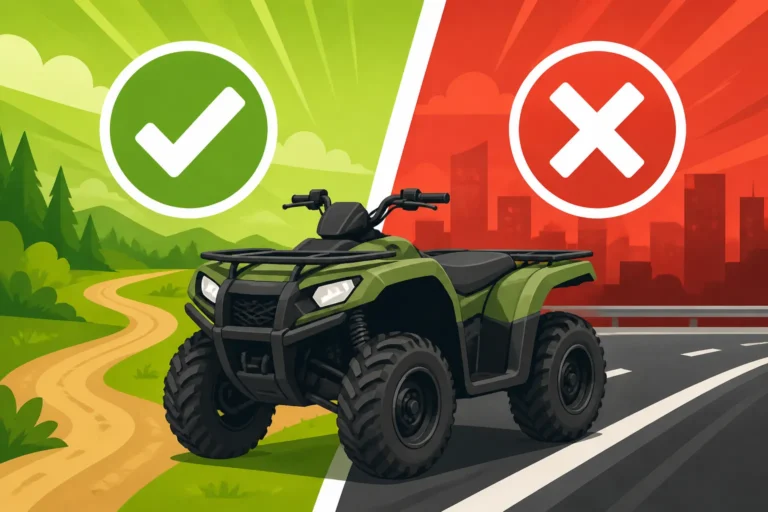
It's absolutely crucial to grasp that the "farm use" exemption does not magically make your ATV or UTV street legal for general road use. This is a common and dangerous misconception. While you might be exempt from certain registration requirements, you're not exempt from safety considerations or from regulations designed for road vehicles. The exemption rarely extends to longer distances or to situations where the primary purpose isn't direct agricultural movement. For instance, traveling several miles on a paved road to reach a different, distant farm property or to transport produce to a market is almost certainly going to be outside the scope of the farm equipment exemption. In these scenarios, you're expected to use a road-legal vehicle and a trailer, just like anyone else would for transporting cargo over public roadways. [Alabama Penalties for Illegal Road Riding] can be stiff, including fines and even impoundment, so it’s not something to take lightly.
Equipment Requirements for Road Use, Even for Farm Tasks
Even for those brief, permissible movements on public roads, your ATV or UTV isn't entirely off the hook when it comes to equipment. While it might not need turn signals or a horn like a car, there are still basic expectations for visibility and safety, especially when sharing the road with other vehicles. Many state laws, and even local ordinances, may require things like an orange reflective triangle (SMV sign) for slow-moving vehicles, functional taillights, and sometimes even headlights, especially if there's any chance of low-light operation. Imagine crossing a road at dusk; having proper lighting is not just a good idea, it's a critical safety measure. Equipping your UTV with a light bar or additional work lights from a company like SuperATV might be beneficial for farm tasks, but you also need to ensure your standard lighting is fully operational for any road interaction. Always consider what makes you visible to others, because even a brief interaction with traffic needs to be safe.
Common Misconceptions and Costly Mistakes for Alabama Farmers
The desire to efficiently use your ATV or UTV for farm work is completely valid, but a few common misunderstandings can lead to significant headaches, fines, or worse, accidents. It's easy to assume the law is on your side when you're genuinely working the land, but reality can be quite different.
Assuming Total Exemption for Farm-Related Travel
This is perhaps the biggest pitfall. Many farmers operate under the assumption that if their ATV or UTV is being used for anything related to the farm, it's automatically exempt from all road rules and requirements. This isn't the case in Alabama, and it's a dangerous oversimplification. The "farm equipment" designation is narrow and conditional. It generally applies to implements of husbandry that are incidental to agricultural operations on a public road, not as a primary mode of transportation. If you're driving your side-by-side a mile down a paved highway to get to a gas station for fuel, even if that fuel is for your tractor, it's highly unlikely that a law enforcement officer will view that as "incidental farm use."
The moment your machine's primary function shifts from direct field work or quick property transitions to general transport, even for farm-related supplies, you risk stepping outside the protection of the exemption. You could find yourself facing citations for [Alabama Penalties for Illegal Road Riding], operating an unregistered vehicle, or even lacking appropriate insurance. The consequence could be a ruined day, a hefty fine, and the hassle of retrieving an impounded machine.
The Risk of Operating an Unregistered or Uninsured Machine
Another significant mistake is believing that because your farm ATV or UTV is exempt from titling (for older machines) or registration (under specific farm use conditions), it's also exempt from insurance requirements or general liability. This is a very risky gamble. While Alabama’s ATV/UTV registration is voluntary for private use, and specific farm equipment exemptions exist, liability for accidents doesn't disappear. If you're involved in a collision on a public road, even while making a perfectly legitimate incidental farm crossing, you are still liable for any damage or injury you cause.
If your machine isn't covered by an [Does Alabama Require Insurance on an ATV?] policy, or your farm liability policy doesn't extend to road use, you could be personally responsible for significant financial costs. Imagine clipping a car's bumper while making a quick crossing, or worse, causing an injury. The legal and financial ramifications could be devastating without proper insurance. Even if your machine falls under the "farm equipment" umbrella for registration, you absolutely need to talk to your insurance agent about adequate liability coverage for any potential public road exposure. Ignoring this could be one of the most expensive mistakes a farmer makes.
Practical Strategies for Legally Using Your ATV/UTV as Farm Equipment
Given the complexities, proactively adopting smart strategies can make a world of difference in avoiding legal entanglements and ensuring your farm operations run smoothly and safely. It's about being informed and taking preventative steps.
Understanding Local Ordinances and County Road Rules
While state law provides a framework, local ordinances can add another layer of rules, particularly regarding [Alabama Do Alabama County Roads Have Their Own ATV Rules?]. What's permissible on one rural county road might be restricted on another, or within city limits that you might briefly traverse to get to a distant pasture. Many counties and towns in Alabama have their own specific regulations about off-road vehicles on public rights-of-way.
Before you rely on your ATV or UTV for even incidental farm travel on public roads, make it a point to contact your local sheriff's department or the county commission office. Ask them directly about their interpretation and enforcement of farm equipment exemptions for ATVs and UTVs on county roads. Don't rely on hearsay or what a neighbor "heard." Getting clarification straight from the source can prevent a lot of headaches later. They can often provide insights into designated crossing points, time-of-day restrictions, or specific equipment requirements they enforce. This due diligence is a small investment of time that can save you significant trouble.
Ensuring Proper Identification and Safety Measures
Even when operating under the farm equipment exemption, making your presence known and ensuring your machine is safe are paramount. This isn't just about avoiding a ticket; it's about preventing accidents. Always display an orange [Alabama Rules for Farm Machines on Roads] slow-moving vehicle triangle prominently on the rear of your ATV or UTV when on any public road, regardless of how short the distance. This universally recognized symbol warns other drivers that your vehicle is traveling significantly slower than typical road traffic.
Beyond the SMV sign, make sure all lights are working: headlights, taillights, and any additional amber or red flashing lights that can enhance visibility. Consider adding reflective tape to the sides and rear of your machine, especially if you anticipate operating near dawn, dusk, or in foggy conditions. Wear bright, visible clothing. While Alabama may not mandate helmets for all ATV riding, wearing one, especially when interacting with public roads, is a wise safety choice. It's also a good practice to carry [Alabama Proof of Ownership Without a Title] for your machine, like a bill of sale, especially if you're not titling it, as it can help clarify ownership if you're stopped. For farmers, having a clear sign or sticker indicating "Farm Use" on the machine might also help articulate your purpose to law enforcement, although it doesn't grant legal immunity.
| Feature / Scenario | Tractor (Clearly Farm Equipment) | ATV/UTV (Used for Farm Work) |
|---|---|---|
| Primary Design | Specifically for agriculture | Primarily recreational, adaptable for farm |
| Road Travel | Incidental, short distances between fields/barns | Highly restricted, truly incidental & minimal |
| Registration Exemption | Generally exempt | May be exempt for true incidental farm use, but voluntary general registration available |
| Titling Exemption | Generally exempt | [Why Pre-2026 Owners Do Nothing], but [Alabama ATV Titling Starts With Model Year 2026] for new machines |
| Insurance | Covered by farm liability policy (confirm scope) | Critical to have specific ATV/UTV liability covering road exposure |
| SMV Sign Required | Yes | Strongly recommended/often required |
| General Road Use | Not street legal, limited to incidental movement | Not street legal, very limited to incidental movement |
| Errands in Town | Not permissible as farm equipment | Not permissible as farm equipment |
| Carrying Proof | Not usually required (obvious farm equipment) | Recommended (Bill of Sale, farm exemption documentation) |
Beyond Farm Use: When Your ATV/UTV Needs Full Registration or Titling
It’s easy to think of your ATV or UTV solely through the lens of farm work, especially if that's its primary role. However, Alabama law draws a clear distinction between bona fide agricultural use and other types of operation, and understanding this divide is crucial for staying on the right side of the law.
Recreational Use Versus Agricultural Necessity
The moment your ATV or UTV leaves the strict confines of agricultural necessity, its status changes. If you’re taking your UTV out with friends to hit the trails at Stony Lonesome OHV Park, or simply riding around your property for fun, that's recreational use. Even if you use the same machine for hauling feed during the week, its weekend warrior status means it's now subject to different regulations. For these types of uses, you might consider [Alabama Public Use ATV Registration Explained] or [Alabama Private Use ATV Registration Explained] through ALEA, depending on where you intend to ride. This voluntary registration, while not making your machine street legal, provides a legal record and often comes with an identifying decal. The point is, don't assume your "farm machine" card is always valid; the context of your ride dictates the rules. Using the same machine for hunting on a WMA, for example, would fall under specific [Alabama WMA Riding Rules for Quads] that are separate from farm exemptions.
The New Titling Requirements for Post-2026 Machines
Here's a significant change coming to Alabama that every ATV and UTV owner, including farmers, needs to be aware of: [Alabama's 2024 Titling Law] is ushering in new requirements. Starting with model year 2026, all new ATVs and UTVs sold in Alabama will require a title. This means if you buy a brand new side-by-side in 2026 or later to use on your farm, it will need to be titled through your county's probate office. This process is distinct from registration and aims to provide clear proof of ownership, aid in theft recovery, and streamline lienholder processes.
For older machines (model year 2025 and earlier), nothing changes immediately – [Why Older Alabama ATVs Cannot Be Titled] under the new law. However, for any new acquisition for your farm, you'll need to factor in the [Alabama ATV Title Cost] and the process of getting a title. While the titling requirement doesn't inherently make the machine street legal, it does establish a formal chain of ownership that hasn't existed for off-road vehicles in Alabama before. This is a big shift, and it's something farmers acquiring new equipment will need to navigate alongside their existing understanding of farm use exemptions. Make sure you understand [Alabama ATV Title Requirements for 2026] if you plan on buying new.
Disclaimer
This article is for general informational purposes only and does not constitute professional advice. Laws, prices and regulations vary by location and change over time. Consult a qualified professional for guidance on your specific situation.