Crossing a Road on an ATV in Alabama
One of the most common headaches for any ATV or UTV owner in Alabama is figuring out how to get their machine from point A to point B when there’s a public road in the way. It’s a frustrating scenario many of us face, especially when our favorite riding spot or hunting lease is split by a county road or a short stretch of pavement. This comprehensive guide is here to untangle the confusion surrounding Alabama's rules for crossing public roads on your off-road vehicle, offering clear, actionable advice to keep you safe and legal.
The Core Question: Can You Even Cross an Alabama Road on Your ATV?
It’s a question that echoes across riding groups, hunting camps, and backyard mechanic sessions all over Alabama: "Can I even take my quad across that road?" The answer, like so many things involving laws and our machines, isn't a simple yes or no. It's usually "yes, but under very strict conditions." The core problem many riders face is misunderstanding the fundamental difference between riding on a road and crossing a road. This distinction is absolutely critical to staying within the bounds of Alabama law.
Understanding Alabama's General Prohibition
Let's get this out of the way first: for the vast majority of us and our machines, ATVs and UTVs are simply not street legal in Alabama. This isn't just a suggestion; it's a legal reality rooted in deep federal standards that dictate what makes a vehicle safe for public road use. Your trusty quad or side-by-side, built for navigating mud, rocks, and tight trails, doesn't meet the stringent safety requirements for things like crashworthiness, braking performance, or emissions that cars and trucks must meet. Attempting to modify an ATV or UTV with turn signals and a horn, while perhaps well-intentioned, generally won't transform it into a street-legal vehicle because it still won't meet the underlying [Alabama's Federal Standard Barrier to Road Use].
The dangers of operating an off-road vehicle on pavement are very real and not to be underestimated. These machines have high centers of gravity, knobby tires designed for traction in dirt (not grip on asphalt), and often lack the sophisticated suspension and braking systems needed for sudden stops or evasive maneuvers at road speeds. Imagine hitting a patch of wet pavement on your quad's knobby tires – it’s a recipe for disaster. This general prohibition protects not just other motorists, but also the riders themselves from the inherent risks. We often hear stories from riders who were simply trying to get to the store or connect two trails by riding a short distance on a county road, only to be pulled over by law enforcement. The officer isn't trying to ruin your day; they're enforcing a law designed for safety. This distinction between the off-road environment your machine thrives in and the public road network is paramount.
The Specific Exception for Crossing
Thankfully, Alabama law does carve out a very specific and narrow exception for crossing public roads. This isn’t a loophole that allows you to sneak a few extra yards of pavement riding; it’s a practical allowance for owners who need to move their machines from one piece of private property to another, or from one trail section to an adjacent one, where a public road forms a necessary barrier. The spirit of the law recognizes that sometimes, getting to your destination requires traversing a small strip of public pavement. Without this exception, many of us would find our access severely limited, forced to load our machines onto trailers for even the shortest hops.
The key here is crossing. This exception is not an invitation to ride along the road, even for a short distance. It’s for a direct, perpendicular movement across the roadway. Think of a farmer who has fields on both sides of a less-trafficked county road. To move his utility side-by-side, loaded with fencing supplies, from one field to the other, he needs to cross the road. Alabama law anticipates this kind of legitimate, necessary movement and provides a legal pathway, albeit one fraught with specific requirements. This exception exists out of necessity, not convenience, and understanding its limitations is critical to avoid legal trouble.
What "Crossing" Truly Means in Alabama
The term "crossing" might seem straightforward, but in the eyes of Alabama law enforcement and the statutes, it carries a very specific and strict interpretation. It’s not just about getting to the other side; it’s how you get to the other side that makes all the difference. Failing to adhere to this precise definition can quickly turn a legal maneuver into an illegal one, leading to citations and headaches.
Distinguishing a "Crossing" from "Riding On"
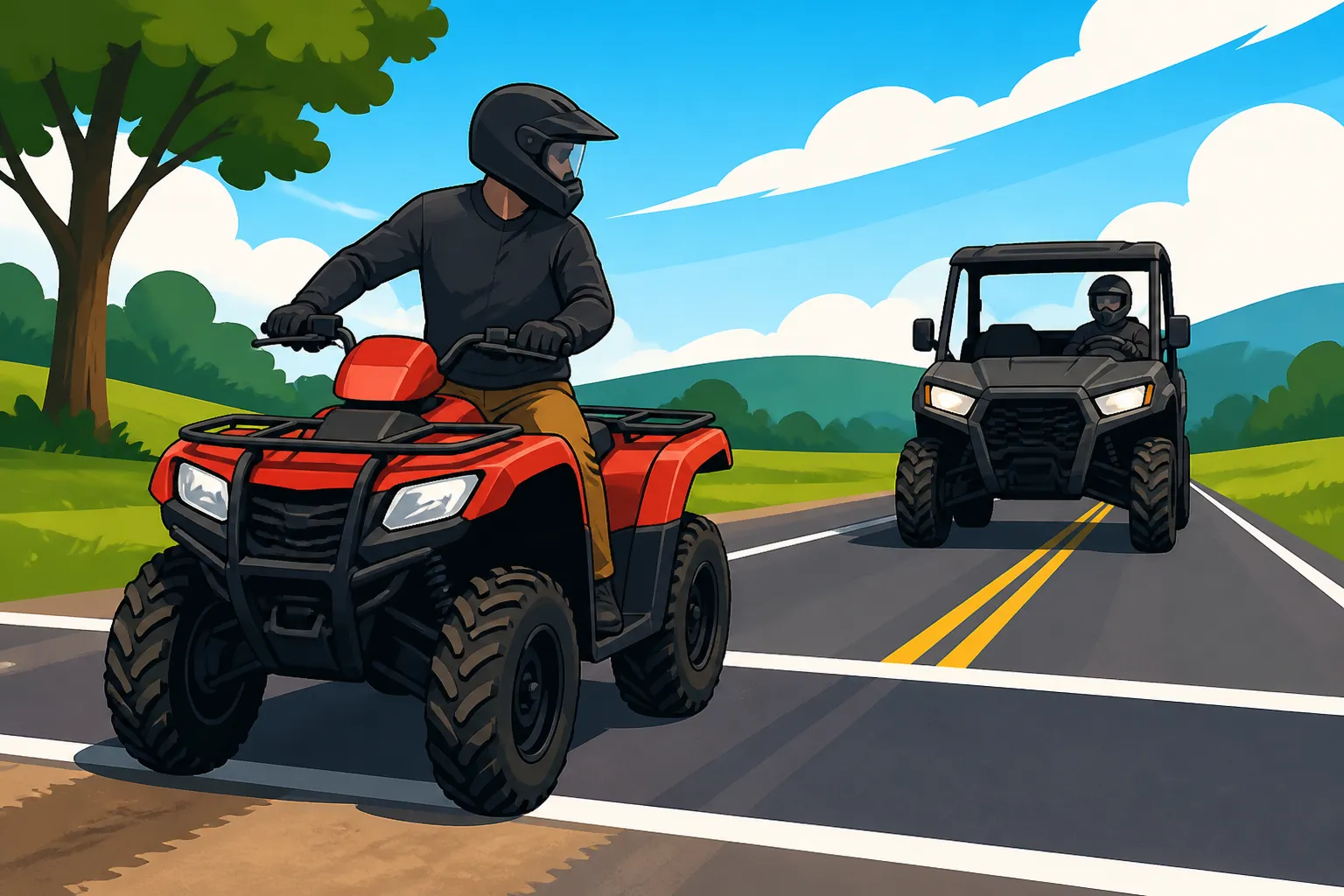
This is perhaps the most crucial distinction to grasp. A legal "crossing" in Alabama is defined as traversing a public roadway at approximately a 90-degree angle to the flow of traffic, taking the absolute shortest and most direct path from one side to the other. Imagine a straight line painted across the road from shoulder to shoulder; your ATV should follow that line as closely as possible. The moment you deviate from this direct line – turning slightly, riding parallel to the road for even a few feet, or extending your path unnecessarily – you transition from a legal crossing to illegal "riding on" the road.
The temptation to ride "just a little bit" on the shoulder or to follow the curve of the road to a better access point is strong, but it’s a trap that can lead to a ticket. For example, consider a rider who has private land on both sides of a winding county road. The rider sees a gate fifty yards down the road and decides to drive along the shoulder to reach it. That 50-yard ride, while brief, is not a legal crossing. It's operating an off-road vehicle on a public road, which is generally prohibited. This kind of scenario is a frequent cause of citations, as officers are trained to look for any deviation from the strict perpendicular path. The intent behind the law is to minimize the time an off-road vehicle spends interacting with street traffic, reducing the risk of accidents.
The "Quickest and Most Direct" Path
Further refining the definition of a legal crossing is the requirement for it to be the "quickest and most direct" path. This phrase leaves very little room for interpretation or personal judgment about what might be "convenient." It means if there's a more direct way to get across, you should take it. This applies to both the angle of your approach and the overall speed of your traverse. You shouldn't be dawdling, pulling a wheelie, or doing anything that prolongs your presence on the roadway.
Imagine you're trying to cross a two-lane highway to get from your hunting camp to a distant deer stand. If the most direct path across the highway puts you at an intersection, that's where you should cross. You wouldn't be permitted to ride a quarter-mile down the highway to a less busy spot simply because you perceive it as "safer" or "easier." That extended travel on the road negates the "quickest and most direct" clause. A common mistake we see involves riders slowing down excessively during a crossing to wave at a friend or check their phone. While it might seem harmless, any action that extends the crossing time or deviates from the direct path can be interpreted as a violation. The law prioritizes getting your off-road machine off the public road as swiftly and safely as possible, minimizing its exposure to conventional traffic. For more detailed insights into what constitutes proper road use, you can explore resources like [Alabama ATV Road Rules Explained].
Conditions and Requirements for a Legal Crossing
Even when you've identified a spot that truly requires a direct crossing, there are still crucial conditions and requirements you absolutely must meet to stay on the right side of Alabama law. These aren’t optional suggestions; they are mandates designed to ensure the safety of everyone on the road, including you, the rider. Neglecting any of these can easily turn a legally permissible crossing into a costly violation.
Speed and Safety Precautions
When performing an ATV or UTV road crossing in Alabama, speed is a critical factor. While the law doesn't often specify an exact numerical speed limit for a crossing, the overarching principle is "reasonable and prudent." This means you should cross at a speed that is fast enough to minimize your time on the roadway but slow enough to maintain full control of your machine and react to any sudden changes in traffic or road conditions. You shouldn't be flooring it across a highway, nor should you be crawling at a snail's pace, which could impede traffic and increase your exposure time.
More importantly, safety precautions are paramount. You must yield to all vehicular traffic on the public road. This isn't a suggestion; it's a non-negotiable requirement. Before you even think about entering the roadway, you must come to a complete stop, look both ways thoroughly (left, right, then left again), and ensure there is a sufficiently large gap in traffic to complete your crossing safely without causing other vehicles to slow down, swerve, or take evasive action. Failing to yield the right-of-way is not only illegal but incredibly dangerous. Imagine pulling out in front of a pickup truck traveling at highway speeds; the consequences could be catastrophic. Riders should also be acutely aware of their surroundings, including blind spots, driveways, and any potential hazards that might appear suddenly. Training yourself to always perform these checks, even on seemingly quiet roads, can be a life-saver.
Visibility and Equipment Considerations
While Alabama law doesn't typically require street-legal accessories for a mere road crossing (as opposed to full street-legal conversion), adequate visibility, especially during dawn, dusk, or adverse weather, is a matter of common sense and safety. At a minimum, your ATV or UTV should have functioning headlights and taillights if there's any chance you'll be crossing in low-light conditions. These lights are essential for making you visible to approaching motorists who might not expect an off-road vehicle to be in the roadway.
Many riders, understanding the inherent risks, choose to go above and beyond the minimum, even for a quick crossing. Aftermarket lighting solutions, such as brighter LED headlights, additional floodlights, or even whip lights, can significantly enhance your visibility to other drivers. Components like reflective tape on your machine or riding gear can also make a substantial difference. While Alabama law specifies core requirements for operating these machines, many riders choose to enhance visibility with aftermarket LED light bars or whip lights, available from reputable brands like SuperATV, to ensure they are seen clearly by other motorists, especially when performing a road crossing. Ensuring your machine is well-maintained and all its safety equipment (like brakes) is in perfect working order before attempting any road crossing is also crucial. Consider a scenario where a rider attempts to cross a busy road at dusk, with only dim, factory headlights. An oncoming car, perhaps momentarily distracted, might not see the ATV until it's too late. Investing in better visibility is an investment in your own safety and the safety of others.
Types of Roads and Jurisdictions
The type of road you're looking to cross in Alabama can significantly impact the rules and the level of risk involved. Not all public roads are created equal, and knowing the difference between a quiet county road and a bustling state highway is vital. Furthermore, local municipalities often have the authority to add their own layers of regulations, making local research an absolute necessity.
County Roads vs. State Highways
Generally speaking, the base Alabama state law regarding ATV/UTV road crossings applies uniformly across different types of public roads, whether they are county roads, state routes, or U.S. highways. However, the practical implications and the risk factor vary dramatically. Crossing a rarely-traveled dirt county road with minimal traffic is inherently different from attempting to cross a multi-lane state highway where vehicles are traveling at high speeds. While the legal text might not differentiate, law enforcement's interpretation and your safety absolutely should.
On state highways and U.S. routes, traffic volumes are typically much higher, and speeds are considerably faster. The time window you have to safely complete a crossing is significantly shorter, and the margin for error is almost nonexistent. Troopers on these roads are also often more vigilant about enforcing traffic laws. You might find a deputy on a rural county road to be more understanding of a quick, safe crossing between two pieces of private land than a state trooper on a busy highway. We've heard countless stories of riders who felt safe crossing a quiet county road dozens of times, only to encounter trouble when attempting the same on a slightly busier thoroughfare. Always err on the side of extreme caution on any major paved road, and consider if there's a truly safer, albeit longer, alternative like trailering your machine. For more details on what rules apply to different road types, refer to [Alabama Rules for Crossing a Highway].
City and Town Ordinances
Here’s where things can get particularly complicated for Alabama riders: local control. While the state provides a general framework, individual cities, towns, and sometimes even counties have the authority to enact their own ordinances regarding the operation of ATVs and UTVs on public roads within their jurisdictional limits. This means that a crossing that might be permissible in an unincorporated rural area could be strictly prohibited in a nearby small town. These local laws can be more restrictive than state law, and they often carry their own set of penalties.
Before attempting any road crossing within city or town limits, it is absolutely imperative to check with the local municipality. This usually involves contacting the city clerk's office, the local police department, or the county sheriff's office. Many towns are increasingly sensitive to noise complaints, safety concerns, and traffic issues related to off-road vehicles. What one town permits, another might completely ban. For example, some smaller Alabama towns might have ordinances allowing golf carts on certain streets but explicitly prohibit ATVs or UTVs from crossing any of their public roads. Ignorance of a local ordinance is not a valid defense. Riders caught violating these local rules often face immediate citations, impoundment of their machine, and hefty fines. Always take the time to do your homework; a quick phone call can save you a lot of grief. Exploring [Alabama Local Ordinances on ATV Riding] can provide more guidance on how to research these specific rules.
Penalties and Consequences of Illegal Road Use
The allure of taking a shortcut or just "making it work" by riding your ATV or UTV on a public road, even for a short distance, can be incredibly tempting. However, the penalties and consequences for illegal road use in Alabama are significant and can extend far beyond a simple traffic ticket. Understanding the full scope of these repercussions is crucial for making responsible decisions.
Citations and Fines
The most immediate consequence of illegally riding an ATV or UTV on a public road in Alabama is receiving a citation. These aren't typically minor warnings; they are often treated as serious traffic violations. The fines associated with such offenses can vary, but they are generally not cheap. You could be looking at hundreds of dollars, especially when you factor in court costs and administrative fees that often accompany the base fine.
Beyond the monetary aspect, depending on how the citation is written, it could potentially result in points being added to your driving record, similar to other moving violations. While an ATV is not a registered road vehicle, actions taken with it on a public road can still impact your standard driver's license. This could lead to increased insurance premiums for your car or truck, or even the risk of license suspension if you accumulate too many points. Imagine trying to explain to your auto insurance provider why your rates suddenly jumped because of an ATV incident. The financial hit can be substantial, and it's a stark reminder that these aren't toys when they interact with the public infrastructure. For a deeper dive into the financial repercussions, consider reading [Alabama Penalties for Illegal Road Riding].
Machine Impoundment and Liability
In more severe or repeat instances of illegal road use, law enforcement in Alabama has the authority to impound your ATV or UTV. This means your machine can be seized on the spot and towed to an impound lot. Getting it back is rarely a simple process. You’ll be responsible for towing fees, daily storage fees, and potentially other administrative charges, which can quickly add up to hundreds, if not thousands, of dollars. These costs accrue every day your machine sits in impound, creating a significant financial burden.
Even more serious is the aspect of liability. If you are operating your ATV or UTV illegally on a public road and are involved in an accident, your liability exposure skyrockets. Should you cause property damage or, tragically, injure another person, you could be held personally responsible for all damages, medical bills, lost wages, and legal fees. Most standard off-road insurance policies explicitly exclude coverage for accidents that occur during illegal road use. This means you could be facing devastating financial ruin. Imagine causing an accident with a family car while riding your quad illegally; you could lose everything. This potential for overwhelming personal liability is why adherence to the law is not just about avoiding a ticket, but about protecting your financial future and the well-being of others.
Insurance Implications
This leads directly into a critical point: insurance. Many ATV and UTV owners purchase insurance for their machines, and that’s a smart move for protecting against theft, damage, or liability during off-road use. However, it's crucial to understand the limitations of these policies. Almost without exception, standard off-road vehicle insurance policies will contain clauses that invalidate coverage if the machine is being operated illegally on a public road at the time of an accident.
This means if you decide to ride down a paved road to get to a new trail, and you have an accident, your insurance company can and likely will deny your claim. They won't cover the damage to your machine, nor will they cover any liability claims against you for damage to other vehicles or injuries to other people. This leaves you completely exposed, personally responsible for all costs. For more information on what insurance typically covers, consider reading [Does Alabama Require Insurance on an ATV?]. While some specialized policies might exist for very specific, street-legal UTVs (which is a whole different category), your average sport or utility ATV is not covered for public road activity. This is a terrifying prospect for many riders who assume their insurance "covers everything." Always review your policy details carefully and, if in doubt, call your insurance agent to clarify what is and isn't covered, especially concerning public road interactions. It’s far better to know the limits of your coverage before an incident occurs. You might also be interested in [Can You Insure an Alabama ATV for Road Use?] to understand the specific challenges involved.
Practical Advice for Responsible Crossings
Navigating the complexities of road crossings in Alabama requires more than just knowing the law; it demands a proactive approach to safety and smart planning. For those unavoidable moments when a road must be crossed, responsible riders take extra steps to minimize risk for themselves and others.
Planning Your Route and Scouting
One of the best pieces of advice for any rider in Alabama is to plan your route well in advance, especially if it involves crossing a public road. Don't just arrive at a barrier and spontaneously decide to cross. Instead, identify all potential crossing points before you even load your machine onto a trailer or leave your property. What seems like a clear spot on a map might be a blind curve or have overgrown shoulders in reality.
The best strategy is to scout these crossing points in a street-legal vehicle first. Drive the road, observe traffic patterns, identify sightlines, and look for any hidden dips, culverts, or obstructions that could make a crossing more hazardous. Note the busiest times of day and plan your crossing for off-peak hours if possible. If you frequently cross the same road, commit to memory the safest spots and approaches. For instance, if you have two gates on opposite sides of a county road, but one gate lines up directly across from a clear stretch of road with good visibility, while the other is near a blind hill, always choose the safer option, even if it adds a few extra yards to your off-road travel. This preparation is a foundational element of safe and legal riding. You might find valuable advice related to anticipating conditions in [Alabama Rules for Riding a County Road].
Rider Awareness and Defensive Maneuvers
When it comes time to execute a road crossing, your personal awareness and ability to ride defensively are your best assets. Even if you've done all your planning, conditions can change in an instant. Before you even approach the edge of the pavement, slow down, be prepared to stop, and scan your surroundings. Listen for approaching vehicles you might not yet see.
When at the edge of the road, execute the standard defensive driving technique: look left, then right, then left again, ensuring the path is absolutely clear in both directions. Make eye contact with any approaching drivers if possible, signaling your intention to cross. Do not assume they see you or will yield. Once you commit to crossing, do so decisively and without hesitation, but maintain a speed that allows for full control. Avoid any sudden movements, swerving, or stopping mid-road unless absolutely necessary to avoid an imminent collision. While Alabama law does not require turn signals for an ATV crossing, using clear hand signals to indicate your intention to cross (if it can be done safely without losing control of the machine) can aid communication with other drivers. The goal is to be predictable, visible, and to get off the public roadway as quickly and safely as possible.
Future Considerations: Titling and Registration
With new laws coming into effect in Alabama, many riders are wondering how titling and registration will impact their ability to cross roads. It's a valid concern, but it's important to clarify that these new procedures primarily deal with ownership records and off-road identification, not public road access.
How Voluntary Registration and Future Titling Impact Road Use
As many Alabama riders know, we've had a voluntary registration system through ALEA for off-road vehicles. More recently, Alabama has enacted legislation for mandatory titling of ATVs and UTVs starting with model year 2026. This means if you buy a brand-new 2026 model year ATV or UTV, it will need to be titled. If you purchase an older machine, generally model year 2015 or newer, it will be eligible for an ownership record or a title as well.
However, it is absolutely crucial to understand that neither your voluntary ALEA registration nor the upcoming mandatory titling system grants you any new rights to operate your ATV or UTV on public roads, beyond the very specific and narrow crossing exception discussed earlier. These processes are designed to establish clear ownership, aid in theft recovery, and provide a means of identification for off-road use, particularly on public lands that require it. A title or registration decal simply proves you own the machine and have complied with relevant off-road identification laws; it does not make your ATV or UTV street legal. Thinking your registered or titled machine can suddenly be ridden down a public street is a common and dangerous misconception. For clarity on these new requirements, you might want to review [Alabama ATV Titling Starts With Model Year 2026] and [Alabama's Voluntary ATV Registration Through ALEA].
The Federal Standard Barrier to Road Legality
To truly be street legal in Alabama, a vehicle must meet specific Federal Motor Vehicle Safety Standards (FMVSS), as outlined in federal code (49 CFR Part 571.500). This is the fundamental barrier that almost all standard ATVs and UTVs simply cannot overcome, regardless of how many mirrors, turn signals, or horns you bolt onto them. These standards cover everything from crashworthiness, braking systems, emissions, occupant protection, and much more, designed for vehicles operating in traffic alongside cars and trucks.
A typical ATV or UTV, even one with a "street legal kit" from a company like SuperATV (which sells many fantastic aftermarket accessories for off-road performance and safety, but not legally transformational kits for state-wide public road use of non-compliant machines), is not manufactured to meet these stringent federal standards. These machines are purpose-built for off-road environments. There are some specific classes of vehicles, like Low-Speed Vehicles (LSVs), that are designed and manufactured from the ground up to meet a specific set of federal standards for limited street use (typically under 25 mph). However, these are fundamentally different vehicles from your standard off-road ATV or UTV. If a machine does not have a federal certification label from the manufacturer stating it complies with FMVSS for highway use, then it cannot be legally licensed and operated on public roads in Alabama. This distinction is critical and often misunderstood. For more on this, you can explore [Alabama's 49 CFR 571.500 Standard] and [Why a Street Legal Kit Will Not Make It Legal].
Understanding this distinction is not about being a spoilsport; it's about staying within the bounds of the law and, most importantly, ensuring your safety and the safety of others. While an aftermarket light bar from SuperATV can drastically improve visibility during an approved off-road crossing, it doesn't change the fundamental legal classification of your ATV as an off-road machine, nor does it override federal safety standards for highway use.
Crossing vs. Riding On Public Roads
To summarize the critical distinctions, here’s a quick overview of what is generally allowed versus what is strictly prohibited when it comes to ATVs and UTVs on Alabama's public roads.
| Feature | Legal Crossing (Specific Exception) | Illegal Riding On (General Prohibition) |
|---|---|---|
| Purpose | Transition from one private/off-road area to another. | Convenience, travel, connecting trails by riding parallel to traffic. |
| Path | Quickest and most direct, approximately 90-degree angle. | Riding along the shoulder, driving parallel, extended travel on pavement. |
| Duration | Minimal time spent on the roadway. | Any extended period on the road, even if short distance. |
| Yielding | MUST yield to all public road traffic. | Often disregards right-of-way, assumes roads are clear. |
| Equipment | Basic operational lights (if applicable to conditions) for safety. | May add aftermarket "street legal" accessories, but fundamental legal status unchanged. |
| Consequences | Adherence avoids issues. | Fines, impoundment, liability, insurance denial. |
This table highlights why the precise definition of "crossing" is so vital. It’s not a gray area; it's a clear line that, when crossed, can lead to serious legal and financial repercussions. For more comprehensive information, make sure to read [Are ATVs Street Legal in Alabama?] and [Alabama ATV Road Rules Explained].
Disclaimer
This article is for general informational purposes only and does not constitute professional advice. Laws, prices and regulations vary by location and change over time. Consult a qualified professional for guidance on your specific situation.