Why a Golf Cart Is Not an ATV in Alabama
It's a common sight on back roads, at lake houses, or cruising through a subdivision: the humble golf cart. Many folks in Alabama see these versatile machines and naturally wonder if they fall under the same umbrella as their beloved ATV or side-by-side. This confusion often leads to real frustration when trying to understand rules for registration, titling, and, most importantly, where you can legally ride. This guide is here to untangle the nuances, clearly laying out why, in Alabama, a golf cart is distinctly not an ATV, and what that means for you as an owner.
The Core Definitions: What Alabama Calls an ATV and What It Calls a Golf Cart
Understanding the rules starts with understanding the language the state uses. When it comes to off-road vehicles and golf carts, Alabama has very specific definitions that create distinct categories, each with its own set of regulations and allowances.
The Official ATV and ROV Statute in Alabama
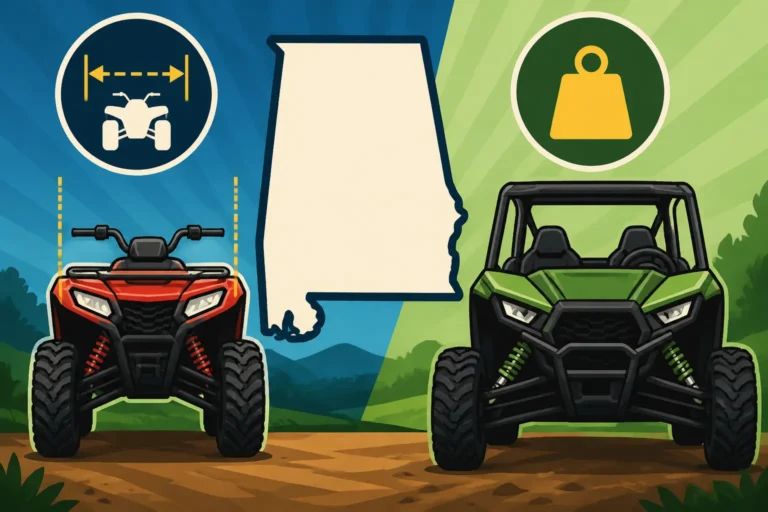
When we talk about ATVs (All-Terrain Vehicles) and ROVs (Recreational Off-Highway Vehicles), which includes most side-by-sides, Alabama's laws paint a clear picture. The state statute defines these machines by several key characteristics that set them apart. For an ATV, we're typically looking at a motorized off-highway vehicle designed to travel on four or more low-pressure tires, intended for use on unpaved surfaces, and having a width of 60 inches or less and a dry weight of 1,500 pounds or less. For side-by-sides (ROVs), the definition expands slightly to allow for widths of up to 80 inches and dry weights up to 3,500 pounds. Both types are generally designed with handlebars for ATVs or a steering wheel for ROVs, and often have specific seating arrangements for the operator and, sometimes, a passenger. These are robust machines, built for tackling rough terrain, pulling utility loads, or providing thrilling recreation. You can dive deeper into these specifics in [Alabama's ATV and ROV Legal Definitions]. This distinct set of criteria ensures that there's no mistaking a purpose-built off-road machine for something else.
Alabama's Explicit Exclusion of Golf Carts
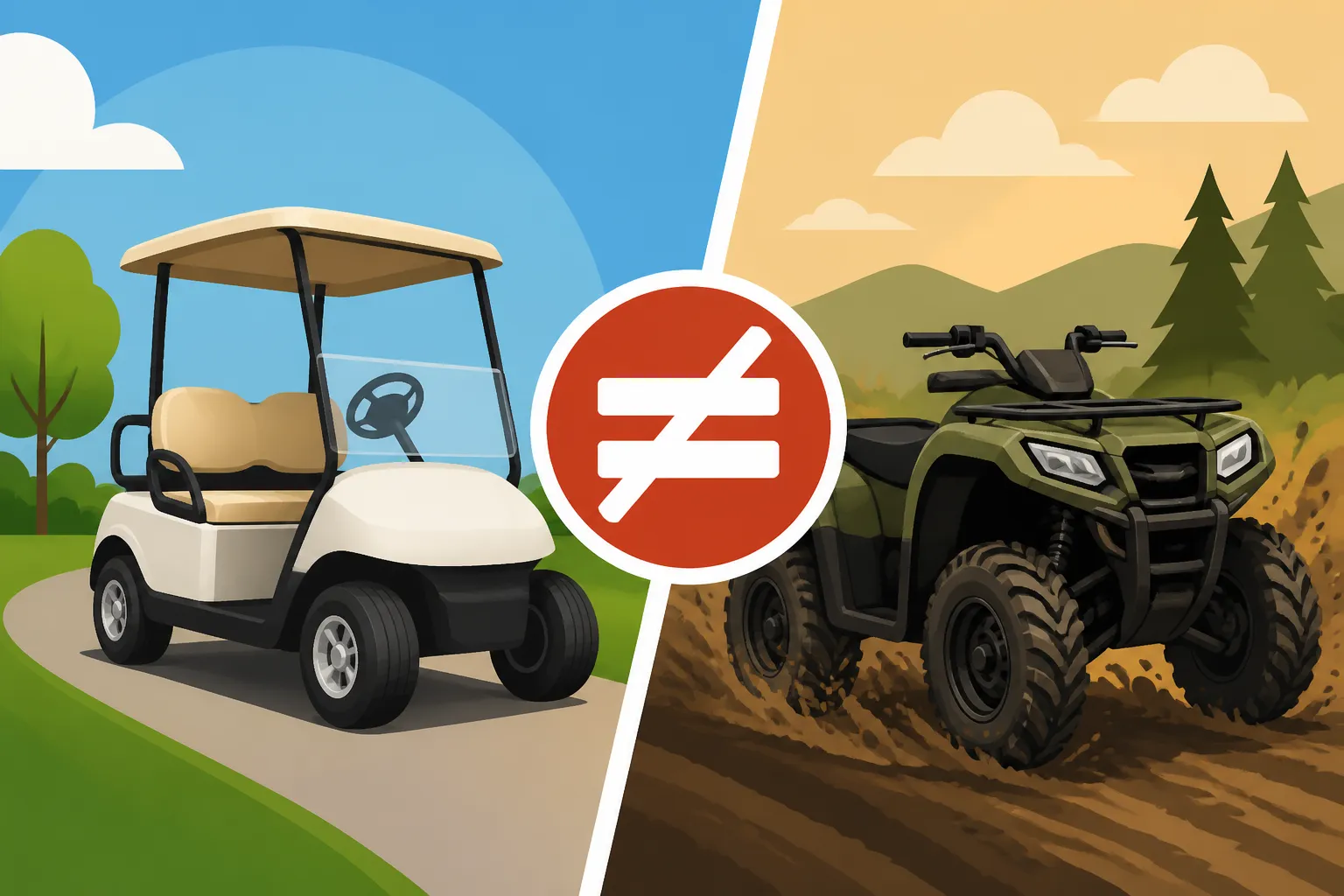
Here's where the rubber meets the road, or rather, where the turf meets the trail. Alabama law explicitly states that golf carts are not considered ATVs or ROVs under the chapter that governs off-road vehicle registration and titling. This isn't just an oversight or an implied difference; it's a clear legislative carve-out. The reasoning behind this exclusion is rooted in the design and intended use of a golf cart. They are primarily built for transporting golfers and their equipment around a golf course, operating at low speeds, and are generally not equipped with the same robust suspension, engine power, or protective features as an ATV or side-by-side. Their tires are typically designed for turf, not the aggressive traction needed for mud, rocks, or steep inclines. This distinction is crucial because it means that golf carts aren't subject to the same registration, titling, or equipment requirements that apply to ATVs and ROVs. So, if you've ever wondered Why a Golf Cart Is Not an ATV in Alabama, it comes down to these specific legal definitions and exclusions.
Why the Distinction Matters: Registration, Titling, and Road Use
The moment Alabama draws a line between golf carts and ATVs, a cascade of different rules and expectations begins. This divergence impacts everything from how you prove ownership to where you can actually take your machine. It’s not just semantics; it’s about compliance and avoiding potential legal headaches.
Different Paths for Registration and Titling
When it comes to official paperwork, ATVs and golf carts in Alabama couldn't be more different. For ATVs and ROVs, the state has a voluntary registration system managed by the Alabama Law Enforcement Agency (ALEA). This allows owners to register their machines for either public or private land use, and provides official decals. While this registration has been voluntary, a significant change is coming: starting with model year 2026, newly purchased ATVs and ROVs will be required to be titled through the Department of Revenue. This means a formal title document, much like a car, will be issued for newer machines, providing clear proof of ownership and a chain of custody. You can learn more about this by checking out [Alabama ATV Titling Starts With Model Year 2026] and [Alabama Voluntary ATV Registration Through ALEA].
Now, for golf carts, the situation is entirely different. Alabama does not have a statewide registration or titling requirement for golf carts. This means you won't be heading to ALEA for a golf cart decal, nor will you be applying for a state title document from the Department of Revenue. This can be a relief for some, as it simplifies ownership. However, it also means that your proof of ownership relies entirely on a strong bill of sale and purchase records, which we’ll discuss shortly. The absence of state-level titling is a major distinguishing factor; indeed, [Alabama Golf Carts Are Not Titled]. This fundamental difference in how these machines are recorded by the state is one of the clearest indicators that they are not treated as the same class of vehicle.
Road Rules and Public Land Access
Perhaps the most significant practical difference between ATVs and golf carts lies in where you can actually ride them, especially when public roads or lands are involved. For ATVs and ROVs, Alabama generally considers them off-highway vehicles, meaning they are primarily intended for private property or designated public riding areas. Trying to take your ATV on most public roads in Alabama is a big no-no, and often comes with stiff penalties. There are very limited exceptions, such as crossing a road or specific local ordinances in extremely rural areas, but generally, [Are ATVs Street Legal in Alabama?] is answered with a resounding "no." Owners typically stick to off-road parks, private land, or specific trail systems.
Golf carts, on the other hand, exist in a grey area that is heavily influenced by local regulations. While they are certainly not highway-legal vehicles, many Alabama cities, towns, and even planned communities have enacted their own ordinances that permit golf cart use on certain public streets, often with specific speed limits, equipment requirements (like lights and turn signals), and designated zones. You might see golf carts legally cruising through a beach town or a retirement community. This is a stark contrast to ATVs, and it highlights how [Alabama Golf Cart Rules Compared to ATVs] are handled very differently at the local level. It's crucial for golf cart owners to check with their specific municipality about [Alabama Local Ordinances on ATV Riding] (or rather, golf cart riding) before venturing onto public streets. Without a title or state registration, golf carts fall into a category where local rules hold immense sway over their permissibility on public thoroughfares, making it possible to ask, [Can You Drive a Golf Cart on a Public Street?], and sometimes get a "yes" in specific areas.
Practical Implications for Owners: Purchase, Insurance, and Liability
Beyond the legal definitions and riding rules, the distinction between a golf cart and an ATV carries tangible implications for how you manage ownership. These differences can affect how you buy, sell, insure, and even how you handle a mishap with your machine.
Buying and Proving Ownership
When you purchase an ATV or side-by-side, especially a new one, you'll typically receive manufacturer certificates of origin and, for 2026 models and newer, an official title document from the state. Even for older, untitled ATVs, a detailed bill of sale is crucial for establishing a clear chain of ownership and for voluntary registration. This paperwork trail is vital, particularly with titling becoming mandatory for newer machines.
For golf carts, since there's no state-level titling or registration, proving ownership hinges almost entirely on your purchase records. A well-drafted bill of sale becomes your primary document. This document should clearly identify the golf cart, including its serial number (if applicable), the names and addresses of both the buyer and seller, the date of sale, and the purchase price. Without a state title, this piece of paper is your best defense against claims of theft or ownership disputes. It's wise to use a robust template for this, and resources like LawDepot can provide excellent customizable bill of sale forms, ensuring all necessary details are captured. Even if you're buying from a private seller, ensuring you have a thorough record, similar to [Alabama Bill of Sale Requirements] for other vehicles, is paramount. This simple document helps establish [Proving Ownership of a Quad Bought at a Farm Sale] or any private transaction where a title isn't issued.
Insurance and Liability Considerations
Nobody wants to think about an accident, but it's a reality of owning any motorized vehicle. The insurance landscape for ATVs and golf carts, while having some overlaps, also presents key differences due to their classification.
For ATVs and ROVs, while Alabama does not mandate liability insurance for off-road use, it is overwhelmingly recommended by virtually every expert and riding park. If you cause an accident on private land or in a designated riding area, you could be held personally liable for significant damages or medical expenses. Many riders opt for comprehensive policies that cover theft, damage to their own machine, and medical payments. So, while [Does Alabama Require Insurance on an ATV?] might be answered no for general off-road use, it's a decision that carries substantial risk if ignored.
Golf cart insurance is a bit more nuanced. If you primarily use your golf cart on your own private property, your homeowner's policy might offer some limited liability coverage. However, if you're regularly using it on public roads (where permitted by local ordinance) or in common areas of a community, this limited coverage is often insufficient. Many insurance providers offer specific golf cart policies that provide more robust liability, collision, and comprehensive coverage, similar to a small vehicle policy. This is especially important given the potential for injuries or property damage when operating on shared pathways or streets. The liability exposure for a golf cart, especially one used off a golf course, can be substantial, making dedicated insurance a wise investment, even if the state doesn't track it through a title or registration. Even if [Insuring a Machine With No Title] is common for golf carts, the need for adequate protection remains. When considering [Alabama Insurance for a Road-Legal Machine], remember this usually refers to a vehicle that meets stringent federal motor vehicle safety standards, which a golf cart, by definition, does not.
When the Lines Blur: Low-Speed Vehicles (LSVs) and Modified Carts
While the distinction between a pure golf cart and a pure ATV is clear, there's a category that sometimes causes confusion: Low-Speed Vehicles, or LSVs. It's also easy to fall into the trap of thinking that simply adding a few accessories to a golf cart will suddenly transform it into something legally roadworthy.
Understanding Low-Speed Vehicles (LSVs) in Alabama
A Low-Speed Vehicle (LSV) is a unique classification of vehicle that is distinct from both a traditional golf cart and an ATV. In Alabama, an LSV is defined as a four-wheeled vehicle whose top speed is greater than 20 miles per hour but not greater than 25 miles per hour, and it must be manufactured to comply with certain federal safety standards. These standards typically include specific requirements for headlamps, tail lamps, stop lamps, turn signal lamps, reflex reflectors, an exterior mirror on the driver's side and an interior mirror or exterior mirror on the passenger's side, a parking brake, a VIN, and safety belts. Crucially, LSVs are designed and built by manufacturers to meet these standards from the factory.
Because they meet these federal standards, LSVs can often be legally operated on public roads with speed limits of 35 mph or less in Alabama, provided they are properly registered, tagged, and insured. This is a significant step up from a golf cart and a completely different legal framework than an ATV. So, while an LSV might look somewhat like an enhanced golf cart, its legal status and road capabilities are entirely different due to its adherence to strict manufacturing and safety regulations. Understanding [What a Low-Speed Vehicle Standard Requires] is key to appreciating this difference, and Alabama has specific [Alabama Low-Speed Vehicle Rules] governing their use. For those looking to register one, delving into [Alabama LSV Requirements Explained] will provide all the necessary details.
The "Street Legal Kit" Fallacy for Golf Carts
This is where many golf cart owners can get into trouble. You might see aftermarket "street legal kits" advertised, promising to transform your golf cart with headlights, taillights, turn signals, and a rearview mirror. While these additions are great for visibility and safety, simply bolting them onto a standard golf cart does not automatically make it a street-legal LSV in Alabama, nor does it turn it into an ATV for registration purposes.
The crucial difference lies in the federal manufacturing standards. An LSV is built from the ground up to meet specific crash safety, braking, and other stringent federal requirements that a typical golf cart, even one with all the bells and whistles, simply cannot meet. The kit might make your golf cart look more roadworthy, but it doesn't change its fundamental classification in the eyes of the law regarding federal motor vehicle safety standards. While local municipalities might have ordinances that permit modified golf carts on specific low-speed streets, this is distinct from qualifying as a state-recognized, federally compliant LSV. Relying solely on a "street legal kit" without understanding the underlying legal definitions and local ordinances can lead to citations, fines, or worse, serious liability in an accident. This is precisely [Why a Street Legal Kit Will Not Make It Legal] in the broader sense for most golf carts. It’s essential to be clear about [Alabama Street Legal Kits and the Law] if you're considering such modifications.
Key Differences: ATV/UTV vs. Golf Cart vs. Low-Speed Vehicle in Alabama
To help clarify all these distinctions, here’s a quick overview of the main differences between these machine types in Alabama:
| Feature | ATV/UTV (Off-Highway) | Golf Cart (Standard) | Low-Speed Vehicle (LSV) |
|---|---|---|---|
| Primary Design Purpose | Off-road recreation, utility, farm work | Golf course, short-distance personal transport | On-road neighborhood travel |
| Typical Speed | Varies widely, often high-speed capable | Generally 15-20 mph | 20-25 mph (by definition) |
| Width Limit (Approx.) | 60 inches (ATV), 80 inches (UTV/ROV) | Usually under 60 inches | Varies, often under 60 inches |
| Weight Limit (Approx.) | 1,500 lbs (ATV), 3,500 lbs (UTV/ROV) | Typically under 1,000 lbs | Under 3,000 lbs (by federal definition) |
| State Titling | Mandatory from Model Year 2026 | Not titled by the state | Yes, titled as a motor vehicle |
| State Registration | Voluntary via ALEA, decals issued | Not registered by the state | Yes, must be registered and tagged |
| Road Use | Generally prohibited, limited exceptions | Local ordinances dictate use on specific low-speed streets | Permitted on roads 35 mph or less |
| Proof of Ownership | Title (2026+), Bill of Sale, MCO | Bill of Sale, purchase records | Title, registration, Bill of Sale, MCO |
| Federal Safety Standard | No, designed for off-road use | No | Yes, must meet 49 CFR Part 571 standards |
This table clearly illustrates why trying to treat a golf cart like an ATV, or assuming it has the same road privileges as an LSV, can lead to misunderstandings and legal trouble. Each category has its own set of rules and limitations tailored to its specific design and intended use. By understanding these fundamental differences, Alabama owners can make informed decisions and enjoy their machines responsibly and legally.
Disclaimer
This article is for general informational purposes only and does not constitute professional advice. Laws, prices and regulations vary by location and change over time. Consult a qualified professional for guidance on your specific situation.