Alabama Registration for a Timber Machine
It can be incredibly confusing for timber operators in Alabama to figure out if the ATVs and UTVs they rely on for their livelihood need to be registered with the state. These machines are often essential tools, not just recreational toys, and the rules around "farm use" or "commercial operations" can feel like a tangled forest in themselves. This guide will help you understand Alabama's specific requirements for registering an ATV or UTV when it's primarily used for timber work, ensuring you're compliant and your operations run smoothly.
Understanding Alabama's Definition of a "Timber Machine" for Registration
When we talk about an ATV or UTV being a "timber machine," we're really digging into its primary purpose. Alabama's off-road vehicle laws weren't designed specifically with timber operations in mind, so we have to interpret how these vehicles fit into existing categories like "farm equipment" or general "commercial use." This distinction is critical because it directly impacts whether you need to register your machine, and what kind of registration might apply.
Distinguishing Farm Equipment and Commercial Use
Alabama's statute often carves out exceptions or different rules for machines used primarily for agricultural purposes. The big question for timber operators is whether timber harvesting and management truly fall under "farm equipment" in the eyes of the law. Historically, "farm equipment" has been interpreted pretty broadly to include machinery used in producing agricultural products, which could encompass timber. However, it's not always a clear-cut definition, especially if your operations extend beyond the typical scope of a family farm.
For instance, if you're a small landowner managing your own timber stand as part of a larger family farm operation, your ATV might reasonably be considered "farm equipment." This could potentially exempt it from certain registration requirements, especially if its use is exclusively on private land. But if you're a commercial logging company, or an independent contractor hired to thin timber on multiple properties, your ATV or UTV is clearly a piece of commercial equipment. In these cases, the "farm equipment" exception might not apply, pushing your machine into a different category that could necessitate registration if it touches public ground. It’s a nuanced area, and understanding your specific business model and how your machine is used daily is paramount.
The "Primary Purpose" Clause and Its Impact
The "primary purpose" of your ATV or UTV is the linchpin. Is it primarily for hauling small logs, scouting timber stands, transporting tools to work sites, or spraying herbicide in a managed forest? Or is it also used for recreational riding on the weekends? The law often looks at the dominant use. If your machine's main job is supporting timber operations, even if it's a quad that could easily be used for sport riding, its classification leans toward a work vehicle.
Think about it this way: a farmer's pickup truck might be used for personal errands, but its primary purpose is agricultural. The same logic applies here. If your UTV is outfitted with a sprayer, a small winch for dragging limbs, or a cargo bed constantly filled with chainsaws and safety gear, it screams "work machine." This focus on primary purpose is vital because it can determine if you need to register it under the voluntary system, or if it's exempt when strictly confined to private property for these tasks. This distinction is especially critical when considering the public versus private use tiers of registration, which we'll delve into next.
Types of Machines Used in Timber Operations
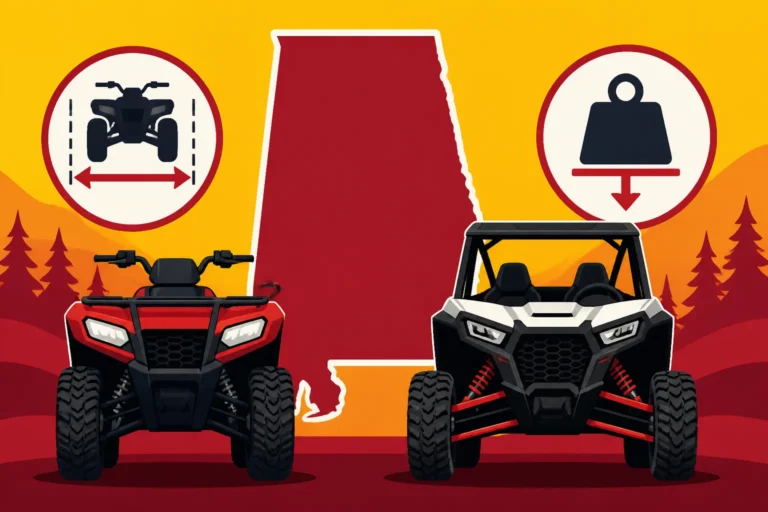
Timber operations utilize a variety of off-road machines, from basic utility ATVs (often called "quads") to larger, multi-passenger utility task vehicles (UTVs, or side-by-sides). You might also see specialized forestry equipment, but for the purpose of ATV/UTV registration, we're focused on those two main categories. A typical utility ATV, with its racks for carrying gear, might be perfect for solo scouting or light transport. A UTV, with its greater hauling capacity, enclosed cab options, and ability to carry multiple passengers, is often favored for crew transport or moving heavier loads within a timber tract.
The size and type of machine don't change the fundamental registration rules based on primary purpose and public/private use, but they do influence the practicalities. A wider UTV might have different considerations for trail access compared to a narrower ATV. Regardless of whether you’re using a Polaris Ranger, a Honda Foreman, or a Kawasaki Mule, the core questions remain: What is its main job, and will it ever touch public roads or lands? These questions are much more important than the brand or model when it comes to deciding on registration.
Navigating Registration Requirements for Timber Operations
Now that we've considered how your "timber machine" fits into Alabama's definitions, let's tackle the actual registration requirements. This is where the rubber meets the red clay, so to speak. The crucial factor here is whether your timber operations ever involve leaving private property and venturing onto public roads, rights-of-way, or other state-managed lands.
Public vs. Private Use in Timber Management
For most timber operators, their work is done exclusively on private land. This is the simplest scenario: if your ATV or UTV never leaves the private timber tract, never crosses a public road, and never accesses public easements, then under current Alabama law, you are generally not required to register it. The state's voluntary registration system is primarily designed for machines that will see some form of public use. [Alabama Private Use ATV Registration Explained] delves into this in more detail. You're operating on your own terms, on private property, and the state doesn't mandate tracking your machines in this context.
However, the moment your timber machine needs to cross a county road to get from one section of a property to another, or if you're managing timber on land that requires you to use a public right-of-way, the game changes. Even a brief crossing from one side of a road to the other, or riding along a shoulder, constitutes public use. This is where the "Public Use" tier of Alabama's voluntary registration comes into play. If there's any chance your machine will be on public land or roads, even temporarily for work purposes, then registering it is the smart and compliant move. This is outlined further in [Alabama Public Use ATV Registration Explained].
Voluntary Registration and the Public Use Tier
Alabama's off-road vehicle registration system is managed by the Alabama Law Enforcement Agency (ALEA) and is entirely voluntary. There are two tiers: Public Use and Private Use. For timber operators, the Public Use tier is the one to consider if you ever anticipate operating on public roads or rights-of-way, even for crossing. This tier carries a slightly higher fee than the private use option but offers the legal coverage to operate your machine in areas accessible to the public where permitted.
To register under the public use tier, you'll need to submit an application, provide proof of ownership (like a bill of sale), and pay the required fees. Once registered, you'll receive a decal that signifies your machine is compliant for public access. This decal should be prominently displayed on your ATV or UTV. While it's voluntary, choosing this option provides peace of mind and legal standing should you ever encounter law enforcement while moving your machine between timber stands or along public access routes. It’s far better to have the registration and not strictly need it for every minute of every day than to be caught without it when a quick crossing is necessary.
Titling for Newer Machines (Model Year 2026 and Later)
Here's where things get a bit more complex, especially for those considering new purchases for their timber operations. Starting with model year 2026, Alabama will require titles for new ATVs and UTVs. This new law, [Alabama ATV Titling Starts With Model Year 2026], introduces a mandatory titling process separate from the existing voluntary registration. This means if you purchase a brand-new ATV or UTV for your timber business with a 2026 model year or newer, you will be required to get a title for it through your county probate office or licensing commissioner.
This titling requirement is primarily about establishing legal ownership and creating a chain of title, similar to how cars are handled. It's not the same as the voluntary registration for public use, although you may still opt for the public use registration after titling your new machine if you plan to use it on public lands. The titling process ensures that machines can be more easily tracked, aiding in theft recovery and establishing clear ownership for financing or resale. For timber operators, this means factoring in the titling step when acquiring new machines, understanding that it's a separate, mandatory process from deciding on the voluntary public or private use registration.
Practical Steps for Registering an ATV or UTV for Timber Work
If you've determined that your timber machine needs to be registered for public use, or if you simply want the peace of mind that comes with it, the process is fairly straightforward. It involves gathering some paperwork, filling out an application, and paying a few fees. It's not as daunting as it might seem, especially if you have all your ducks in a row.
Essential Paperwork for Registration
To register your ATV or UTV with ALEA, you'll primarily need proof of ownership. The most common and accepted form of this is a properly executed bill of sale. This document should clearly state the buyer's name, seller's name, the date of sale, the purchase price, and crucially, the vehicle identification number (VIN) or serial number of the ATV or UTV. Make sure the serial number on your bill of sale matches the one stamped on the machine itself. Without a matching serial number, you're going to hit a roadblock.
For many operators, creating a solid bill of sale is important, whether buying from a dealer or a private party. Services like LawDepot can provide customizable bill of sale templates that ensure all necessary information is included and properly formatted, which can save you a headache down the line. Beyond the bill of sale, you'll need to fill out the official Alabama Off-Road Vehicle Registration Application. This form will ask for details about you (the owner), the machine itself, and your chosen registration tier. Having your driver's license or state ID handy will also be necessary for identification. [Alabama Registration Paperwork Explained] provides a comprehensive list of what to bring.
Fees, Processing, and Decal Placement
The cost of registering your timber machine is relatively modest. There's a registration fee itself, which varies slightly depending on whether you choose the public or private use tier. In addition, there's a small issuance charge that covers the administrative costs of processing your application and providing the decal. This charge is detailed in [What the Issuance Charge Covers on a Registration]. It's a small sum, but good to be aware of when budgeting.
Once you submit your application and fees, the processing time can vary. Generally, you can expect to receive your registration decal and certificate within a few weeks. [Alabama Registration Processing Time] gives a general idea of what to expect. It's always a good idea to submit your application well in advance of when you plan to use the machine on public lands. The decal itself must be affixed to the off-road vehicle in a clearly visible location, usually on the front fender or another easily viewable spot, as specified in the registration instructions. This ensures that law enforcement can quickly verify your machine's compliance.
Renewing Your Timber Machine's Registration
Unlike some annual registrations, Alabama's ATV and UTV registrations, whether for public or private use, are valid for a three-year period. This means you won't have to worry about renewing it every single year, which is a nice convenience for busy timber operators. [Alabama Registrations Run Three Years] outlines this cycle.
When your three-year period is nearing its end, ALEA should send you a renewal notice. It's crucial to keep your contact information updated with them to ensure you receive this notice. The renewal process is similar to the initial registration, requiring a new application and payment of the applicable fees. Staying on top of your renewal ensures that your timber operations remain compliant, especially if your machines continue to operate in areas that require public use registration. Mark your calendar, or set a reminder, so you don't accidentally let your registration lapse.
Critical Considerations for Alabama Timber Operators
Beyond the basic registration process, there are several other critical factors that Alabama timber operators should keep in mind to ensure their operations are legal, safe, and efficient. These often involve nuances of ownership, road use, insurance, and land access.
Proof of Ownership Without a Title
For many timber operators, their ATVs and UTVs are older machines that predate Alabama's new titling law. This means they likely don't have a formal title. For these machines, establishing proof of ownership for registration or in case of theft is still incredibly important. The bill of sale remains your primary document. It should be detailed and include the VIN/serial number, seller's information, and buyer's information.
If you inherited a machine or bought it in a less formal setting (like a farm auction without a proper bill of sale), proving ownership can be trickier. In such cases, a sworn affidavit from the previous owner, a statement from witnesses to the sale, or even a chain of informal receipts can help. Keeping detailed records, including photographs of the machine and its serial number, is always a good practice. [Proving You Own an Untitled Machine] offers more in-depth advice on navigating these situations. While not a formal title, solid documentation is your best defense against questions of ownership.
Road Use, Crossings, and Local Ordinances
This is perhaps one of the most common pitfalls for ATV/UTV owners in Alabama, especially those using machines for work. Generally, ATVs and UTVs are not street legal in Alabama. [Are ATVs Street Legal in Alabama?] unequivocally states this. This means you cannot simply drive your timber machine down a public road for any significant distance, even if you have it registered for public use. The public use registration allows you to ride on designated public trails or areas, not public roadways.
However, Alabama law does allow for limited road crossings for certain purposes, and some specific exemptions exist for agricultural or timber machines, often referred to as [Alabama Farm Use and Road Riding]. These exemptions are typically very narrow, permitting crossing a road at a right angle or traveling a very short distance along a shoulder to get to another part of a property. It's absolutely crucial to understand the limitations of these exemptions. Riding on a county road for a mile to get to your next timber stand is almost certainly illegal. Always check with local county and municipal ordinances too, as some areas may have specific rules that could affect even short crossings. When in doubt, it's always safer to trailer your machine rather than risk a citation.
| Use Case | Registration Tier Recommended | Road Use Implications | Titling (2026+) |
|---|---|---|---|
| Exclusive Private Timberland Use | Private Use (Voluntary) | Generally no public road use permitted beyond designated crossings where allowed by law. Machine must remain on private land. | Mandatory for MY 2026+ |
| Crossing Public Roads (Short Distances) | Public Use (Voluntary) | Limited, direct crossings at right angles may be permitted, but check local ordinances. NOT for traveling significant distances on public roads. | Mandatory for MY 2026+ |
| Accessing Public Timberlands/Easements | Public Use (Voluntary) | Permitted on designated trails or routes only. Not for use on paved public roads unless specifically marked as an OHV route. | Mandatory for MY 2026+ |
| Commercial Logging Company Operations | Public Use (Voluntary) | Same road use restrictions as above. "Farm equipment" exemption may not apply due to commercial nature. Transport via trailer for significant road distances is required. | Mandatory for MY 2026+ |
| Small Farmer/Timberland Owner | Private Use or Public Use | Depends on actual use. If strictly private, Private Use. If any public crossing/access, Public Use. May fall under farm equipment exemption for road crossing, but still highly restricted. | Mandatory for MY 2026+ |
Insurance and Liability for Commercial Operations
While Alabama does not currently mandate insurance for ATVs or UTVs used on private land, it's a monumental oversight for timber operators to forgo it. [Does Alabama Require Insurance on an ATV?] clarifies this. When you're using a machine for commercial purposes, the risks escalate dramatically. Accidents can happen, machines can be stolen, or damage can occur to property (yours or someone else's).
Liability insurance is crucial. If your UTV causes property damage or injury to another person while you're working, you could be facing substantial legal and financial repercussions. Comprehensive coverage protects your investment against theft, fire, or other damage. Given the cost of these machines and the nature of timber work, proper insurance is not just a good idea; it's a business necessity. Discuss your specific timber operations with an insurance agent to ensure you have adequate coverage for both liability and physical damage to your machines. Your general business liability policy may not automatically cover off-road vehicles, so a separate policy or rider might be required.
Documenting Landowner Permission
For timber operators who work on land they don't own, having explicit, written permission from the landowner is absolutely non-negotiable. This isn't just a courtesy; it's a legal safeguard. Without written permission, you could unknowingly be trespassing, even if you had a verbal agreement with the landowner. Verbal agreements can easily be forgotten, misunderstood, or disputed, especially if there's a change in land ownership or management.
A formal letter of permission or a land use agreement should clearly define the scope of your access, the types of machines you're allowed to use, the duration of the agreement, and any specific areas you are permitted or prohibited from entering. This protects both you and the landowner. Having a clear, written agreement is paramount, and resources like LawDepot offer templates for land use or access agreements that can be customized for your specific timber operations, ensuring all legal bases are covered. Always carry a copy of this permission with you when operating on non-owned land, as law enforcement or land managers may request to see it.
Disclaimer
This article is for general informational purposes only and does not constitute professional advice. Laws, prices and regulations vary by location and change over time. Consult a qualified professional for guidance on your specific situation.