Alabama Title for an Imported Machine
Bringing an ATV or UTV into Alabama, especially one that originated from outside the United States, can feel like navigating a maze of paperwork and regulations. Many folks find themselves scratching their heads, wondering if their pride and joy, purchased abroad, can even be officially recognized here in the Yellowhammer State. This guide will walk you through the specifics of obtaining an Alabama title for an imported machine, focusing on the crucial steps, documents, and considerations to ensure your off-road vehicle is legal and ready for adventure.
Defining "Imported" for Your Alabama ATV/UTV Title
When we talk about an "imported machine" in Alabama, it's important to clarify what that usually means, as the process can differ significantly. Most commonly, it refers to a machine brought into the U.S. from another country. However, sometimes people use the term loosely to include vehicles brought in from another U.S. state. For the purpose of titling in Alabama, particularly since the new law for ATVs and UTVs starts with [Alabama ATV Titling Starts With Model Year 2026], the international import process is much more complex.
Machines Imported from Another Country
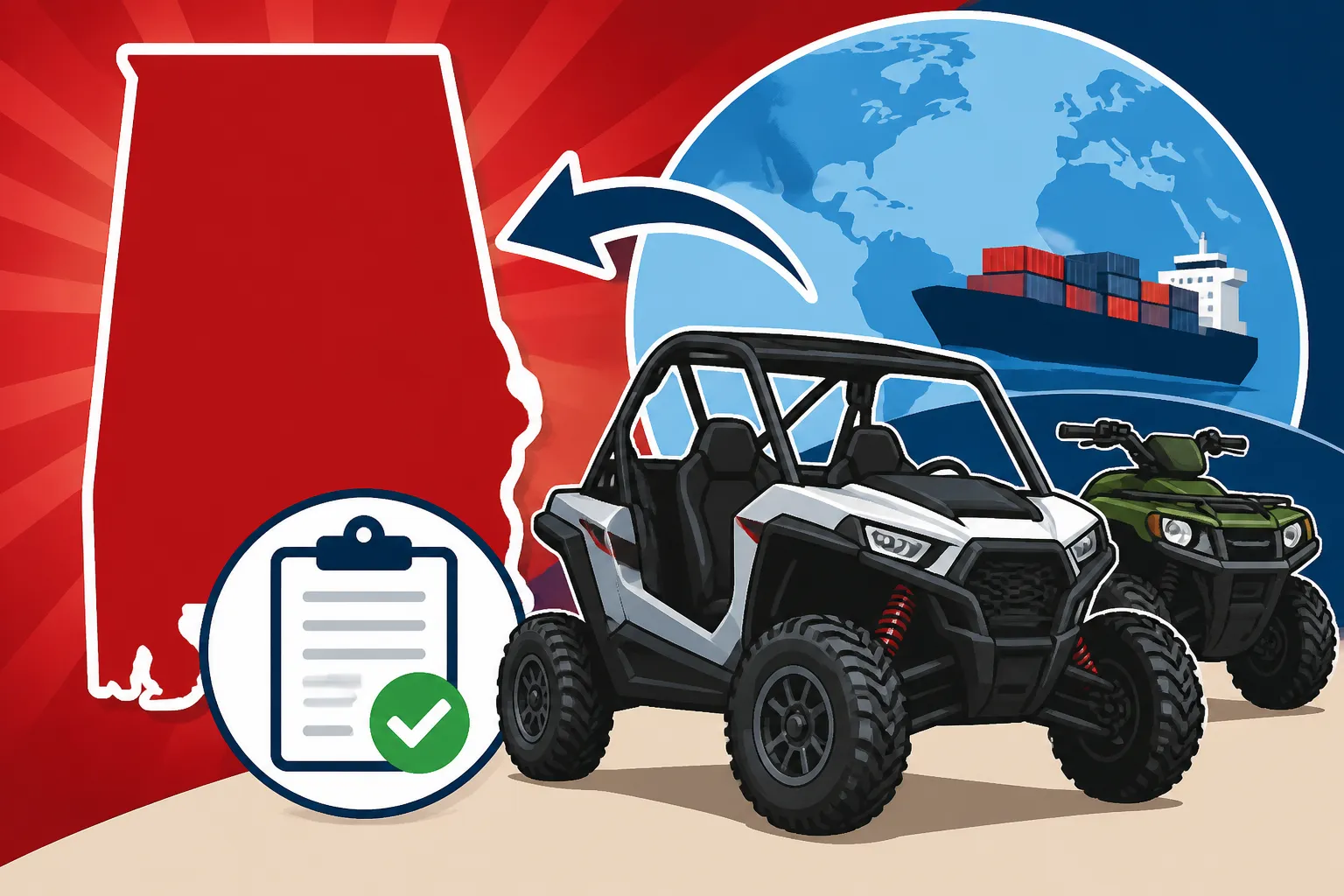
If your ATV or UTV was originally purchased in, say, Canada, Mexico, or an overseas market, and then brought into the United States, it falls under the more stringent "imported" category. This isn't just about bringing it across a state line; it involves federal customs, safety, and emissions regulations before Alabama even gets a look at it. You're not just dealing with state bureaucracy; you're dealing with federal gatekeepers first.
The primary hurdle here is proving that the machine legally entered the country and meets all federal standards. Unlike automobiles, ATVs and UTVs are generally not street-legal, so they don't have to meet all the same federal motor vehicle safety standards (FMVSS) that a car would. However, they still need to clear customs and sometimes have EPA emissions compliance. This usually means you'll have a stack of federal paperwork before you even think about state titling. Without these federal clearances, Alabama won't be able to issue a title, plain and simple.
Machines Brought in from Another U.S. State
While technically "imported" across state lines, the process for an ATV or UTV purchased in Georgia, Mississippi, or any other U.S. state and brought into Alabama is far less complicated. These machines are already considered to be within the U.S. regulatory framework. If the machine was already titled in another state, that existing title will be your primary proof of ownership.
The good news is that Alabama's new titling law, effective for 2026 model year machines and newer, largely treats these vehicles similarly to those bought new in Alabama, provided they meet the model year requirement. The main challenge often comes down to obtaining valid proof of ownership if the previous state didn't title ATVs or UTVs, or if the documentation is incomplete. You'll typically need a valid bill of sale and perhaps a prior registration if a title wasn't issued. This is where clarity in your paperwork makes all the difference, as your local county office will rely heavily on these documents to establish a clear chain of ownership.
Essential Documents for Titling an Internationally Imported Machine
The process for titling an ATV or UTV that has been brought into the country from abroad is heavily reliant on a specific set of documents. Without these in order, you'll hit a brick wall at your county title agent's desk. It's not enough to just show up with the machine; you need a paper trail that proves its legal existence and your ownership.
Customs and Federal Import Documentation
This is perhaps the most critical set of papers for an internationally imported machine. When your ATV or UTV crossed the U.S. border, it should have gone through customs. This process generates specific forms, such as a Customs and Border Protection Form 7501 (Entry Summary) or similar documentation. These documents prove that all import duties were paid and that the machine legally entered the country.
Beyond customs, there's the issue of federal compliance. While ATVs and UTVs aren't highway vehicles, manufacturers typically ensure their products meet certain EPA emissions standards. If your imported machine isn't from a manufacturer that regularly sells in the U.S. or isn't clearly marked as EPA compliant, you might need additional documentation from the manufacturer or an independent laboratory to prove it meets U.S. emissions standards. Without these federal clearances, your machine essentially doesn't exist legally in the U.S. system for titling purposes, no matter how much you love it.
Proof of Foreign Ownership and Bill of Sale
Once you've cleared federal hurdles, you need to prove you own the machine. This means providing documents from the country of origin. This could be a foreign title document, a manufacturer's certificate of origin (MCO) or manufacturer's statement of origin (MSO), or a formal bill of sale from the original seller. It's incredibly important that these documents clearly identify the machine by its serial number (VIN) and name you as the legal owner.
If your original foreign documents are not in English, you'll likely need a certified translation. Alabama county offices require legible and understandable documentation. For the transaction that brought the machine into your possession, whether it was bought directly from abroad or from an importer here, you'll need a comprehensive bill of sale. This bill of sale needs to include the full names and addresses of both the seller and the buyer, the purchase price, and most importantly, the complete serial number of the ATV or UTV. If you need a robust, legally sound bill of sale, resources like LawDepot can help you generate a document that meets these requirements, ensuring all necessary details are captured. Having a clearly worded [Alabama Bill of Sale Requirements] is paramount, especially when dealing with unique circumstances like an imported machine.
Alabama Title Application and Supporting Forms
Finally, with all the federal and foreign ownership documents in hand, you'll fill out the [Alabama Title Applications From January 2026]. This form, typically submitted to your local county probate or licensing office, will require information about the machine, its serial number, and your personal details. You'll attach all your supporting documents: the customs forms, the foreign title or MCO/MSO (with translation if needed), and your bill of sale.
The county agent will review all this paperwork to ensure everything is in order and that the machine qualifies for titling under Alabama law. Remember, only machines with a model year of 2026 or newer are eligible for titling in Alabama. If your imported machine is older than that, while you might be able to register it for public use, you won't be able to get an Alabama title for it. This is a common point of confusion for many owners, so double-check your machine's model year before you begin the titling process.
The Step-by-Step Process for Your Imported ATV/UTV Title in Alabama
Getting a title for an imported ATV or UTV in Alabama, especially one from outside the U.S., requires a methodical approach. It’s not a quick trip to the courthouse; it’s a process that demands preparation and patience. You’ll need to understand each stage to avoid unnecessary delays and frustration.
Pre-Application: Gathering Federal and Foreign Documentation
Before you even step foot in an Alabama county office, your first priority must be to secure all federal import documentation and proof of foreign ownership. This involves:
- Customs Clearance: Ensure you have the official documentation (like Form 7501) that verifies your ATV or UTV legally entered the United States and that all applicable duties were paid. Without this, Alabama won't recognize the machine's legal presence in the country.
- Federal Compliance (if applicable): While not all ATVs require specific DOT certifications like road vehicles, ensure you have any documentation showing EPA emissions compliance, especially if it's a less common brand or model.
- Foreign Proof of Ownership: Obtain the original title, manufacturer's certificate of origin (MCO), or official bill of sale from the country where the machine was first purchased. This document must clearly state the vehicle's serial number and identify the previous owner. If these documents are not in English, get a certified translation.
- U.S. Bill of Sale: Even if you have a foreign bill of sale, it's often wise to create a clear, comprehensive U.S. bill of sale for your transaction, especially if you bought it from an importer or another individual within the U.S. This document should detail the sale, including the full names and addresses of buyer and seller, purchase price, and the machine's complete serial number. You can find reliable templates for such documents on platforms like LawDepot, which can help ensure all the legal specifics are covered. This is crucial for establishing your ownership in a format Alabama officials are familiar with.
Remember, [Alabama Title Applications From January 2026] only apply to machines with a 2026 model year or newer. If your imported machine is older, you won't be able to title it in Alabama, though you can still explore [Alabama Public Use ATV Registration Explained] or [Alabama Private Use ATV Registration Explained] options.
Submitting Your Application at the County Office
Once your meticulous pile of documentation is assembled, it's time to visit your local county probate judge's office or license commissioner's office. This is where the title agent will review your application. Here’s what to expect:
- Complete the Title Application: Fill out the Alabama Application for Certificate of Title for an Off-Road Vehicle thoroughly. Double-check all fields, especially the serial number, which is paramount for identification. [Alabama Serial Numbers on the Application] must match your supporting documents exactly.
- Present All Documents: Hand over your completed application along with all the supporting paperwork: federal import forms, foreign ownership proof (with translation), and your U.S. bill of sale. The agent will scrutinize these to verify the machine's legitimacy and your ownership.
- Pay Fees: You will need to pay the appropriate titling fees. These typically include a state title fee and a county processing charge. While exact amounts can change, be prepared for these costs. Information on [Alabama Title Fees at the County] will give you an idea of the structure of these charges.
- Processing Through ALVIN: Your application will then be entered into the Alabama Vehicle Information Network (ALVIN) system. This digital system processes titles and tracks ownership for off-road vehicles. [Alabama's ALVIN System and Off-Road Titles] is designed to streamline this process, but complex cases like international imports might require extra review time.
The county office will act as your intermediary with the state. They will forward your application and supporting documents to the Alabama Department of Revenue for final approval and issuance of the title.
Waiting for Your Alabama Title
After submitting your application and paying the fees, the waiting game begins. The state will review your documentation to ensure everything is in order and that the machine is eligible for an Alabama title.
- State Review: The Department of Revenue will check for any discrepancies, verify serial numbers, and confirm that all federal and foreign documentation is sufficient. Because imported machines can present unique challenges, this review might take a bit longer than a standard in-state title application.
- Title Issuance: If approved, the state will issue your Alabama Certificate of Title. This official document is your definitive proof of ownership in Alabama. It's typically mailed to you.
- Estimated Timeframe: While exact times can vary, it’s not uncommon for an Alabama title to take several weeks to arrive, especially for more complex cases like imported machines. Be prepared for this timeframe and avoid making plans that depend on having the physical title in hand immediately after application. For general expectations, you can look into [How Long an ATV Title Takes to Arrive].
Throughout this process, maintaining clear and organized copies of all your submitted documents is a smart move. Should any questions arise, you'll have everything at your fingertips to provide clarification.
Navigating Potential Roadblocks with Imported Machine Titles
Even with the best intentions and meticulous document gathering, titling an internationally imported ATV or UTV can present some unique challenges. These roadblocks can be frustrating, but understanding them beforehand can help you prepare or find alternative solutions.
Missing or Inadequate Federal Import Documentation
One of the most common and difficult hurdles is the lack of proper federal import paperwork. If a machine was brought into the U.S. informally, without going through official customs channels, or if the original importer failed to provide the necessary forms, you'll be in a tough spot. Alabama's titling agents cannot override federal requirements. Without proof that the machine legally entered the country and met federal standards, they simply cannot issue a state title.
This situation often requires tracing back the machine's journey into the U.S., which can be incredibly challenging or even impossible if the original importer is unreachable or uncooperative. In some extreme cases, you might need to consult with a customs broker or an attorney specializing in import regulations to determine if there's any way to retroactively gain the necessary documentation. If the machine truly cannot be verified as legally imported, then unfortunately, an Alabama title for it will likely be out of reach, regardless of its model year.
Discrepancies in Ownership Records or Serial Numbers
Any inconsistency in the serial number (VIN) across your various documents can immediately halt the titling process. The serial number on your foreign title, customs forms, bill of sale, and the Alabama title application must match perfectly. Even a single digit or letter out of place will raise red flags. Furthermore, if the chain of ownership is unclear—for example, if there are gaps between the foreign owner, an importer, and you—the state may request additional affidavits or proofs of transfer.
For instance, if you purchased the machine from someone who imported it, but that person never properly documented the import or their own ownership, you might be asked for a [What a Purchaser's Certificate Does in Alabama] to clarify the transfer. If the original foreign documents are vague or lack critical information like a complete serial number or the seller's full details (like [What the Seller's Name and Address Prove]), you might need to provide supplemental evidence, such as notarized statements from previous owners, if available. This is where meticulous record-keeping or drafting robust legal documents with tools like LawDepot can prevent future headaches, ensuring every piece of information is clearly attributed and consistent.
The Model Year Cutoff for Titling
Alabama's titling law for ATVs and UTVs explicitly states that only machines with a model year of 2026 or newer are eligible for a title. This is a non-negotiable cutoff. If your internationally imported ATV or UTV is a 2025 model year or older, you simply cannot get an Alabama title for it, no matter how perfectly your federal and foreign documents are in order. This rule is firm.
For older imported machines, your options will be limited to registration for either public or private use. While this doesn't provide the same level of ownership proof as a title, it does allow you to legally operate the machine under specific conditions. You can still seek [Alabama Voluntary ATV Registration Through ALEA], which would allow you to ride on designated public lands if you choose the public use tier. However, the lack of a title means proving ownership in a future sale or in the event of theft could be more complex, often relying on your bill of sale and any registration records. This is a crucial distinction that many owners overlook when considering an older imported machine.
Disclaimer
This article is for general informational purposes only and does not constitute professional advice. Laws, prices and regulations vary by location and change over time. Consult a qualified professional for guidance on your specific situation.