Alabama ROV Width and Weight Limits
It can be incredibly frustrating to navigate the ever-changing landscape of off-road vehicle regulations, especially when you've invested in a fantastic Recreational Off-Highway Vehicle (ROV) and just want to enjoy the trails without worrying if your machine is compliant. Alabama's rules, like many states, have specific guidelines for how wide and heavy your ROV can be, and misunderstanding these can lead to headaches, fines, or even being turned away from your favorite riding spot. This comprehensive guide is here to cut through the confusion and explain Alabama's ROV width and weight limits, helping you understand exactly what your machine needs to meet the state's requirements.
Understanding Alabama's Recreational Off-Highway Vehicle Definition
Before we can even talk about limits, we need to be crystal clear on what Alabama considers an ROV in the first place. It might seem like splitting hairs, but the law often hinges on these precise definitions. Knowing the legal classification of your machine is the absolute first step toward understanding its specific requirements and restrictions.
What Makes an ROV Different from an ATV?
Many folks, especially those new to the off-road world, tend to lump all four-wheeled machines together, but the state of Alabama draws a distinct line between an All-Terrain Vehicle (ATV) and a Recreational Off-Highway Vehicle (ROV), often colloquially called a side-by-side or UTV. The biggest differences typically come down to seating, steering, and overall design. ATVs usually feature a straddle-style seat, handlebars for steering, and are designed for a single rider or, in some cases, a single passenger behind the operator.
ROVs, on the other hand, are characterized by side-by-side seating, often for two or more occupants, and they almost always have a steering wheel, foot pedals for acceleration and braking, and often a roll cage or a fully enclosed cabin structure. Think of them as miniature, rugged off-road cars. These design differences aren't just aesthetic; they directly impact how the state defines them and, crucially, the specific width and weight limits that apply. It's really important to familiarize yourself with [Alabama's ATV and ROV Legal Definitions] to grasp these foundational distinctions.
The Importance of Statutory Definitions for Owners
You might wonder why all this legal jargon matters when you just want to hit the dirt roads or explore some trails. But these statutory definitions are absolutely crucial for you as an ROV owner. They dictate everything from how your machine is registered to whether it's even eligible for titling (which, for new machines, is a coming change in Alabama). If your machine doesn't fit the legal definition of an ROV, it might be classified differently, leading to an entirely separate set of rules, or it might not be recognized at all for certain purposes.
Imagine you're trying to register your new side-by-side, and you fill out the paperwork thinking it's an ATV. You could run into issues because the system is set up to categorize machines based on their specific legal definitions. Moreover, enforcement officers rely on these definitions when they're out on the trails or roads. Misclassifying your machine, even unintentionally, could result in a citation or prevent you from accessing areas where specific vehicle types are permitted. It's about ensuring your pride and joy is legally recognized and ready for action without any unnecessary hiccups.
Alabama's Specified Width Limits for ROVs
One of the most immediate and visible distinctions when comparing different types of off-road vehicles is their width. ROVs, especially the multi-passenger models, tend to be significantly wider than traditional ATVs, and Alabama's law accounts for this with a specific maximum width.
The 80-Inch Rule and What It Means
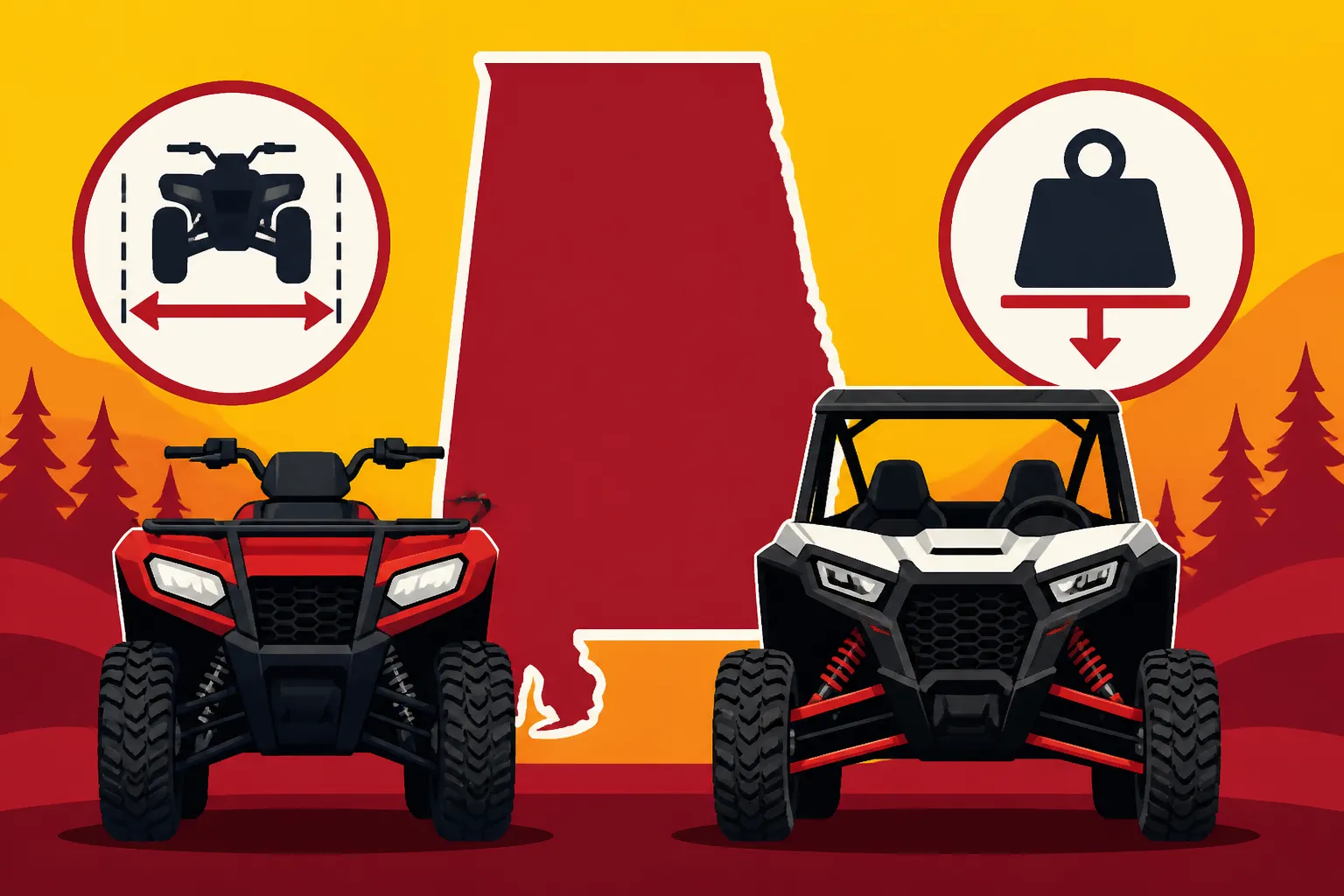
For ROVs, Alabama law specifies a maximum width of 80 inches. This measurement typically refers to the widest point of the vehicle, which almost always means from the outermost edge of one tire to the outermost edge of the tire on the opposite side. While things like mirrors might extend a little further, the tires are generally the critical measurement point for width limits. It's not usually about the width of the chassis or the cabin, but rather the full footprint your machine leaves on the ground.
This 80-inch rule has major practical implications for you as a rider. Firstly, it affects what trails you can legally and physically navigate. Many public and private trail systems, especially those originally designed for narrower ATVs or even dirt bikes, will have gates or natural bottlenecks that are exactly 80 inches wide or even less. If your ROV is wider than this, you simply won't fit, and attempting to force it could damage your machine or the trail. Secondly, it influences how you transport your ROV. An 80-inch wide machine requires a trailer that can safely accommodate that width, which is an important consideration for anyone hauling their side-by-side to a distant riding spot.
Comparing ROV Width to ATV Width
It’s crucial to understand that the 80-inch limit for ROVs is distinct from the width limit applied to ATVs. Typically, Alabama defines an ATV as having a maximum width of 50 inches. This significant difference highlights why you can't just assume all off-road vehicles operate under the same set of rules. Your side-by-side, with its broader stance, is intended for different types of terrain and may not be welcome on trails specifically designated for narrower ATVs.
This distinction can be a source of frustration for riders, particularly when trying to plan a group outing with both ATVs and ROVs. A trail that's perfect for a 50-inch quad might be completely impassable for an 80-inch side-by-side. Always check the rules of the specific park or land you plan to visit, as they often have clear guidelines based on these width classifications. You can learn more about the smaller machines in articles like [60 Inches and 1,500 Pounds], which details ATV specifics. It’s not uncommon for parks to restrict wider machines from certain sections to preserve trail integrity or ensure safety.
Alabama's Specified Weight Limits for ROVs
Just like width, the weight of your ROV is another key factor that Alabama's laws consider. These limits are in place for a variety of reasons, including safety, impact on trails, and general enforcement.
The 3,500 Pound Dry Weight Threshold
Alabama law generally specifies a maximum dry weight of 3,500 pounds for Recreational Off-Highway Vehicles. "Dry weight" is a technical term that refers to the weight of the vehicle without any fuel, oil, coolant, or other fluids, and definitely without passengers or cargo. It’s essentially the weight of the machine as it rolls off the factory floor, before anything is added. This particular measurement is important because it provides a consistent baseline that isn't influenced by how much gas you've put in or how many friends are riding with you.
The rationale behind this weight limit is multifaceted. Heavier vehicles can exert more force on trail surfaces, leading to increased erosion and wear, especially on fragile ecosystems or well-maintained paths. From a safety perspective, a heavier machine requires more braking distance and can handle differently in various situations, so the limit helps ensure a baseline for control and maneuverability. When you’re looking at purchasing an ROV, or even if you already own one, it's vital to check the manufacturer's specifications for the dry weight. Many larger, multi-passenger side-by-sides, particularly those with powerful engines and robust accessories, can approach or even exceed this 3,500-pound limit.
Conflicting Information and What to Trust
One of the most common frustrations for ROV owners is encountering conflicting information regarding weight limits. You might see one figure online, another in an old owner's manual, and hear something different from a friend. This inconsistency can be incredibly confusing and lead to uncertainty about whether your machine is truly compliant. Statutes can sometimes be updated, or different agencies might have slightly different interpretations, creating a patchwork of data.
When faced with conflicting information, your best bet is always to refer to the most current official Alabama state statute or consult directly with your county probate office or the Alabama Law Enforcement Agency (ALEA). These are the authorities that interpret and enforce the law, so their word is the definitive one. Don't rely solely on forum posts or dated articles; always seek out the official language. This issue is common enough that there are specific discussions around it, such as in [Alabama's Conflicting ROV Weight Figures], which highlights the challenge. Ultimately, the statutory limit is what matters legally, so make sure your understanding aligns with the official requirements to avoid any potential issues on the trail or during a check.
How Width and Weight Impact Registration and Riding
The dimensions of your ROV aren't just arbitrary numbers; they directly influence how you'll register your machine and, more importantly, where and how you can legally ride it in Alabama. These aspects are deeply intertwined with the state's classification system.
Public Use vs. Private Use Classifications
Alabama offers two primary registration tiers for off-road vehicles like ROVs: "Public Use" and "Private Use." While registration itself is currently voluntary for these machines, choosing the correct tier is vital, and your ROV's width and weight play a role in this decision. The "Public Use" registration is intended for machines that will be ridden on designated public lands or trails open to the general public, such as state parks or national forests (where permitted). These areas often have strict rules on vehicle type, size, and weight to manage impact and ensure safety for all users. An oversized or overweight ROV might find itself excluded from certain public trails, even if you have a public use registration.
On the other hand, "Private Use" registration is for machines used exclusively on private property, like your own land, a hunting lease, or a friend's farm. While width and weight limits might still matter for specific trails or gates on private land, state regulations are less stringent here regarding these dimensions for registration purposes. However, it's still crucial to understand that even with private use registration, if your ROV exceeds statutory limits, it might complicate things should you ever decide to try and use it on public land or attempt to move to a public use registration later. Understanding these nuances is key, and you can dive deeper into this topic with [Alabama Public Use Versus Private Use].
Road Riding and Local Ordinances
Let's address a common misconception upfront: even if your ROV meets Alabama's width and weight limits, it is generally not street legal for use on public roads and highways in Alabama. This isn't just about state limits; it's primarily due to federal Motor Vehicle Safety Standards (FMVSS). ROVs are designed for off-road use and typically do not possess the lights, signals, windshields, specific tire ratings, and other safety equipment required to be classified as a street-legal vehicle under federal guidelines. Trying to register an ROV for road use will usually hit a wall because it simply doesn't meet these federal benchmarks.
While the state does permit some limited instances of road crossing, or specific use as farm equipment on roads for short distances, these are narrow exceptions. You shouldn't assume your ROV can be driven like a car, no matter its dimensions. Furthermore, while some Alabama cities and counties have enacted ordinances allowing golf carts on specific local streets, ROVs are typically a different classification and are not covered by these rules. Always check [Are ATVs Street Legal in Alabama?] for a thorough explanation of these limitations. Trying to push the boundaries of road legality with an ROV that exceeds legal dimensions could quickly lead to being pulled over, cited, and potentially facing significant penalties, as discussed in [Alabama Penalties for Illegal Road Riding].
Practical Considerations for ROV Owners in Alabama
Beyond just understanding the legal limits, there are several practical steps and considerations that every ROV owner in Alabama should keep in mind to ensure a smooth, enjoyable, and compliant riding experience. These tips can save you a lot of hassle down the road.
Checking Your Machine's Specifications
The first and most important practical step is to know your machine's exact specifications. Don't guess; verify. Dig out your owner's manual, check the manufacturer's website for your specific model year, or even take precise measurements yourself. For width, a simple tape measure across the widest point (usually the tires) will suffice. For dry weight, rely on the manufacturer's published specifications. If you've added significant accessories like heavy bumpers, winches, or full enclosures, remember that these add to the overall weight, though the "dry weight" limit usually refers to the factory specification.
Having accurate records of your ROV's specifications is not just good practice; it can be incredibly useful when dealing with registration, insurance, or even when selling your machine. When drawing up a bill of sale, for instance, listing these details can provide clarity for both buyer and seller. Tools like LawDepot can help generate professional documents for private sales, ensuring all necessary details, including dimensions and weight, are properly recorded. This meticulous approach ensures you’re always prepared to prove your machine's compliance if ever asked.
Modifying Your ROV and Legal Limits
It's natural to want to personalize and enhance your ROV. Aftermarket accessories like lift kits, wider tires, beadlock wheels, heavier roll cages, brush guards, and sound systems are incredibly popular. However, it's absolutely crucial to understand how these modifications can impact your machine's legal standing regarding width and weight limits. A set of oversized tires alone can easily push a standard ROV beyond the 80-inch width limit. Likewise, adding heavy-duty bumpers, a winch, a full spare tire, and extra fuel cans can significantly increase its dry weight, even if the manufacturer's original dry weight was within limits.
Before making any substantial modifications, measure and weigh your ROV with the planned additions to ensure you remain within Alabama's legal limits. Exceeding these limits, even with aftermarket parts, can lead to problems. You might find yourself unable to ride at certain parks or facing issues with law enforcement. Furthermore, modifications can sometimes void manufacturer warranties or even impact your insurance coverage, so always check with your provider. It's about finding that balance between personalizing your machine and maintaining compliance so you can enjoy your ride without unexpected headaches.
ATV vs. ROV Dimensions Comparison
To help clarify the distinctions between ATVs and ROVs in Alabama, here's a table summarizing the general width and weight limits as typically defined in state statutes. Remember that specific models and modifications can alter these figures.
| Feature | All-Terrain Vehicle (ATV) | Recreational Off-Highway Vehicle (ROV) |
|---|---|---|
| Max Width | 50 inches | 80 inches |
| Max Dry Weight | 1,500 pounds | 3,500 pounds |
| Seating Type | Straddle | Side-by-side |
| Steering Type | Handlebars | Steering wheel |
| Primary Use | Single rider, utility/sport | Multi-passenger, utility/recreation |
| Typical Seating | 1-2 (tandem) | 2-6 (side-by-side rows) |
Understanding Alabama's specific width and weight limits for your ROV is more than just checking a box; it's about ensuring you can safely and legally enjoy your machine. By knowing the 80-inch width rule and the 3,500-pound dry weight threshold, along with the implications for registration, riding areas, and modifications, you'll be well-equipped to navigate the complexities of state regulations. Always verify your machine's specifications and consult official sources to stay informed, and you'll be ready for many memorable adventures on Alabama's diverse terrain.
Disclaimer
This article is for general informational purposes only and does not constitute professional advice. Laws, prices and regulations vary by location and change over time. Consult a qualified professional for guidance on your specific situation.