Alabama Permits for a Group Trip
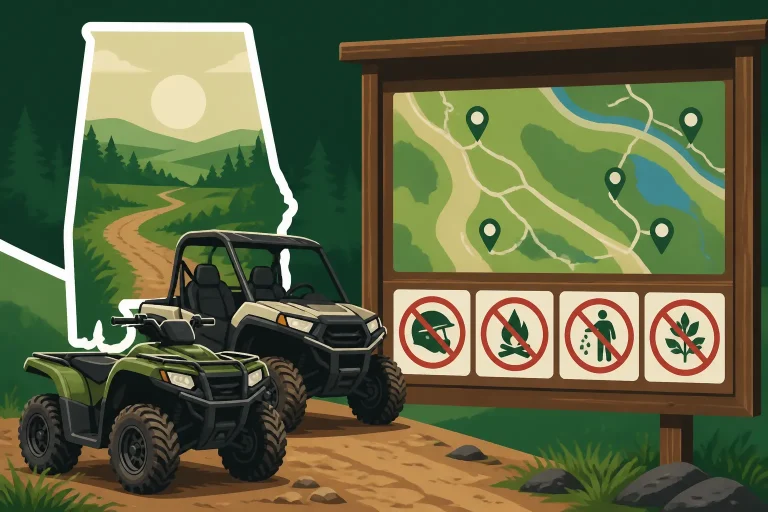
A group ride in Alabama can involve several different rule systems, even when everyone travels together. A permit that covers one rider or one tract may not cover the whole group, and a private park’s entry rules are separate from public-land requirements. The safest plan is to identify each riding area first, then confirm what every person and machine needs before setting a date.
Start With the Land You Plan to Ride
There is no single Alabama group-trip permit that automatically authorizes riding everywhere. Requirements depend on who manages the land, what kind of riding is allowed there, and whether your outing is a casual ride or an organized event.
Before collecting paperwork, list every place the group expects to ride. “Public land” is too broad for planning: a wildlife management area, a national forest route, a county riding park, and a private off-road park can all have different rules. A route that crosses from one property to another may mean checking more than one set of requirements.
| Where the group rides | What to confirm before the trip |
|---|---|
| Wildlife management area | Whether riding is allowed on the tract and date, which permits or licenses apply, and how to obtain any area or daily permit |
| National forest | Which routes are open to your machine, whether a riding permit or pass is required, and whether seasonal closures apply |
| Private OHV park | Admission, waiver, age, helmet, passenger, machine, and camping rules |
| Private land, lease, or timber property | Permission from the person or company controlling access, plus any written conditions |
| County or local riding area | Local access rules, operating schedule, permitted machines, and any group or event conditions |
Wildlife management areas
A wildlife management area, or WMA, is not a general-purpose riding area. Access can depend on the specific tract, open dates, allowed roads, and wildlife-management rules. Before the group commits, check whether off-road machines are permitted at the intended location and on the intended day. Do not assume that a route shown on a general map is open to ATVs or UTVs.
WMA credentials may involve more than one item. A rider may need a WMA license or permit, and hunting-related requirements may also matter depending on the activity and the area. Check the current rules for the exact tract rather than relying on a friend’s permit, an old map, or a prior trip. The details in Three Things You Need Before Riding a WMA and How an Area Permit Differs From a Daily Permit can help you identify what to ask.
A permit issued to one person should not be treated as permission for the rest of the group. Find out whether each participant needs an individual credential, whether a group can use one process to obtain permits, and whether the permit is tied to a particular tract or date. If the answer is unclear, contact the relevant area office or biologist before the ride. Alabama Area Biologists and Their Maps explains why local area information can be useful.
National forest routes
National forest land is also not automatically open to every machine on every road. Riders need to distinguish designated OHV routes from other forest roads and trails. Check the current forest map and local rules for the machine type, route, and season you have in mind. A road that is open to ordinary traffic is not necessarily open to an ATV, and a route that appears on a map may be closed or restricted.
Ask the appropriate forest district office whether your planned route has a permit or pass requirement, whether the whole group must obtain it individually, and whether there are temporary closures or special restrictions. Alabama National Forest Riding Permits and Which Forest Roads in Alabama Are Open to ATVs are useful starting points, but verify current conditions before departure.
Private parks and private property
At a private riding park, admission and park rules control access. Each rider may have to sign a waiver, and the park may set its own requirements for helmets, minors, passengers, machine types, and operating hours. A reservation for one campsite or one vehicle does not necessarily reserve riding access for an entire group. Confirm the park’s process and capacity directly.
Private property requires permission from the person or organization that controls it. That can include a landowner, timber company, hunting club, or leaseholder. A hunting lease does not automatically give every member permission to ride anywhere on the property, and permission for one person may not extend to guests. Ask who may ride, where machines may go, and whether the permission should be carried in writing. For more on these distinctions, see Alabama Timber Land Access Rules and Alabama Hunting Club Riding Rules.
Work Out Permits and Paperwork for Every Rider
Once you know where the group will go, make a checklist for each participant. The key question is not simply, “Does the group have a permit?” It is, “Does each person have the permission, credential, and information required for each place on the route?”
Start by separating requirements into three categories:
- Access permission: Is the land open to the planned ride, and has the controlling authority or owner allowed the group to enter?
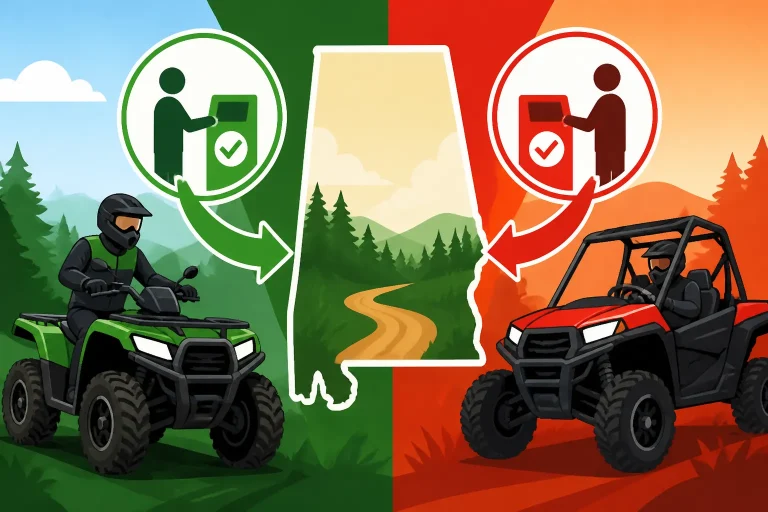
- Rider credentials: Does each participant need an individual WMA permit, license, park admission, waiver, or other documentation?
- Machine and route rules: Is each ATV or UTV allowed on that route, and does it meet the riding area’s requirements?
Do not assume that an Alabama registration record is the same as a riding permit. Registration, proof of ownership, park entry, and public-land access are different things. Alabama registration is voluntary, but a land manager or park may still require proof of permission, compliance with its rules, or other documents. Alabama Registration Is Voluntary covers the registration distinction, while Alabama Proof of Ownership on the Trail addresses the separate question of ownership records.
For a group with riders from outside Alabama, do not rely on another state’s decal or permit as a substitute without checking. Reciprocity can work differently depending on the land manager and the type of credential. Ask whether out-of-state riders have a separate process, whether a home-state document is accepted, and whether the same rules apply to guests and residents. What Visiting Riders Need to Ride Legally in Alabama provides broader context for visitors.
Build a rider-by-rider checklist
Create a simple roster with each rider’s name, machine, and the requirements that apply to that person. Include a way to mark items as confirmed, not just requested. This catches common problems such as a rider who has not completed a waiver, a minor whose parent or guardian needs to sign, or a visitor who assumes a home-state credential is enough.
A useful checklist might include:
- Full name and a reliable contact number
- Machine type and identifying details
- Required permit or license, if applicable
- Park admission or reservation status
- Signed waiver or consent form, where required
- Parent or guardian arrangements for minors
- Emergency contact
- Any landowner permission the rider must carry
- A note of route restrictions or closures that affect that rider’s machine
Keep the checklist focused. Do not collect unnecessary personal information, and do not circulate copies of sensitive documents to the whole group. One organizer can confirm completion without storing more information than the trip needs.
If a permit is issued electronically, make sure each rider knows how to retrieve it without relying on the trip organizer’s phone. A screenshot or downloaded copy may help where the issuing authority allows it, but follow the authority’s instructions. Cell coverage may be limited in remote areas, so do not assume every participant can load a website at the trailhead.
Coordinate the Group Before the Ride
A permit is only one part of a workable group plan. If several machines arrive together, the organizer should confirm that the riding area can accommodate the group and that the route suits the least capable rider and machine. The group’s size, timing, and purpose can also matter to the land manager.
A casual gathering of friends may be treated differently from a public event, commercial tour, charity ride, or organized activity advertised to others. If the outing is being promoted, charging participants, or using a managed area as an event venue, ask the park or land manager whether a separate event authorization is required. Do not assume ordinary visitor access covers an organized event.
Before announcing the trip as confirmed, contact the relevant office or park and give a clear description:
- The date or range of dates
- The approximate number of riders and machines
- The machine types, including side-by-sides if applicable
- The planned entrance and route
- Whether the group includes minors or out-of-state visitors
- Whether you plan to camp, tow, or hold an organized event
- How permits are issued and whether each person must apply separately
Ask for the current rules in writing when possible, especially if the group has received conflicting information. Record the name or office you contacted and the date of the conversation. This is not a substitute for following posted signs or updated closures, but it gives the organizer a clear reference when sharing instructions with the group.
Set a cutoff for paperwork
Give participants a deadline well before the ride. Someone who waits until the parking area to discover a permit problem can delay the whole group or force the rider to sit out. The organizer should make clear which tasks each participant must complete personally and which reservations or arrangements the organizer will handle.
Use a simple status list:
- Confirmed: The requirement is complete and the rider knows how to show it.
- Pending: An application, reservation, or answer is still outstanding.
- Not applicable: The relevant authority has confirmed the item is not required for that person or trip.
Avoid marking a requirement “not applicable” based only on assumption. If a rule is unclear, verify it with the land manager. A group message is useful for reminders, but it should not replace individual confirmation when each person has a separate permit or waiver.
For printed information, keep a copy of the route and contact details in a waterproof document pouch. Outdoor retailers, including Amazon, carry pouches that can protect paper instructions from rain and mud. Also save a digital copy on the organizer’s phone, but keep the paper backup available if service or battery becomes an issue.
Check Conditions Again Before Departure
A successful plan can still be affected by a closure, weather, a changed park schedule, or a tract-specific restriction. Recheck the riding area shortly before leaving. Confirm that the route remains open, the permit process has not changed, and the group’s arrival time fits the current operating arrangements.
For a WMA, review the current tract rules and any seasonal access information. For a forest, check the designated route map and ask about closures. For a private park, confirm hours, reservations, machine restrictions, and any weather-related changes. For private land, make sure the person who granted access still approves the group’s arrival.
Give every rider the same trip brief
Send one clear trip brief with the meeting point, arrival time, route or staging plan, required documents, land rules, and contact details. Include instructions for what to do if someone gets separated or arrives late. If the group will split into smaller riding parties, confirm that each party has a responsible contact and understands the permitted routes.
The brief should distinguish between rules that apply to everyone and requirements that vary by individual. For example, a park waiver may be required for each participant, while a reservation may be held by the organizer. A WMA credential may be personal, while access permission relates to the tract. Clear wording prevents a participant from assuming another rider’s paperwork covers them.
Make sure everyone understands that a permit is not permission to leave the designated route, ignore a gate, or enter closed property. Riders should obey signs and instructions on site even if an older map or a prior trip suggested different access. If the route is blocked or the status is uncertain, stop and check rather than rerouting across land that may not be open to riding.
Have a practical backup plan
Choose an alternate riding location only after checking its separate rules. A permit or reservation for one location should not be assumed valid elsewhere. If weather or a closure forces a change, the organizer should verify access, timing, and requirements before directing the group to a new site.
It also helps to decide in advance what happens if one rider lacks a required credential. The group may need to delay, split up, or leave that person behind rather than risk violating the site’s rules. Agreeing on that possibility before travel reduces pressure to make a poor decision at the gate.
For the day itself, keep permit instructions and contact information accessible, carry the required documents in the form the authority accepts, and follow local directions. When permits are individual, each rider should be prepared to show their own. When a park or land manager asks the group to check in together, have the organizer keep the confirmation and reservation details ready.
The simplest reliable approach is to plan from the land outward: identify each property, confirm its rules, verify every rider’s requirements, and recheck conditions before departure. That takes more coordination than assuming one group permit covers everything, but it helps prevent wasted travel and keeps the ride within the access the group has actually been granted.
Disclaimer
This article is for general informational purposes only and does not constitute professional advice. Laws, prices and regulations vary by location and change over time. Consult a qualified professional for guidance on your specific situation.