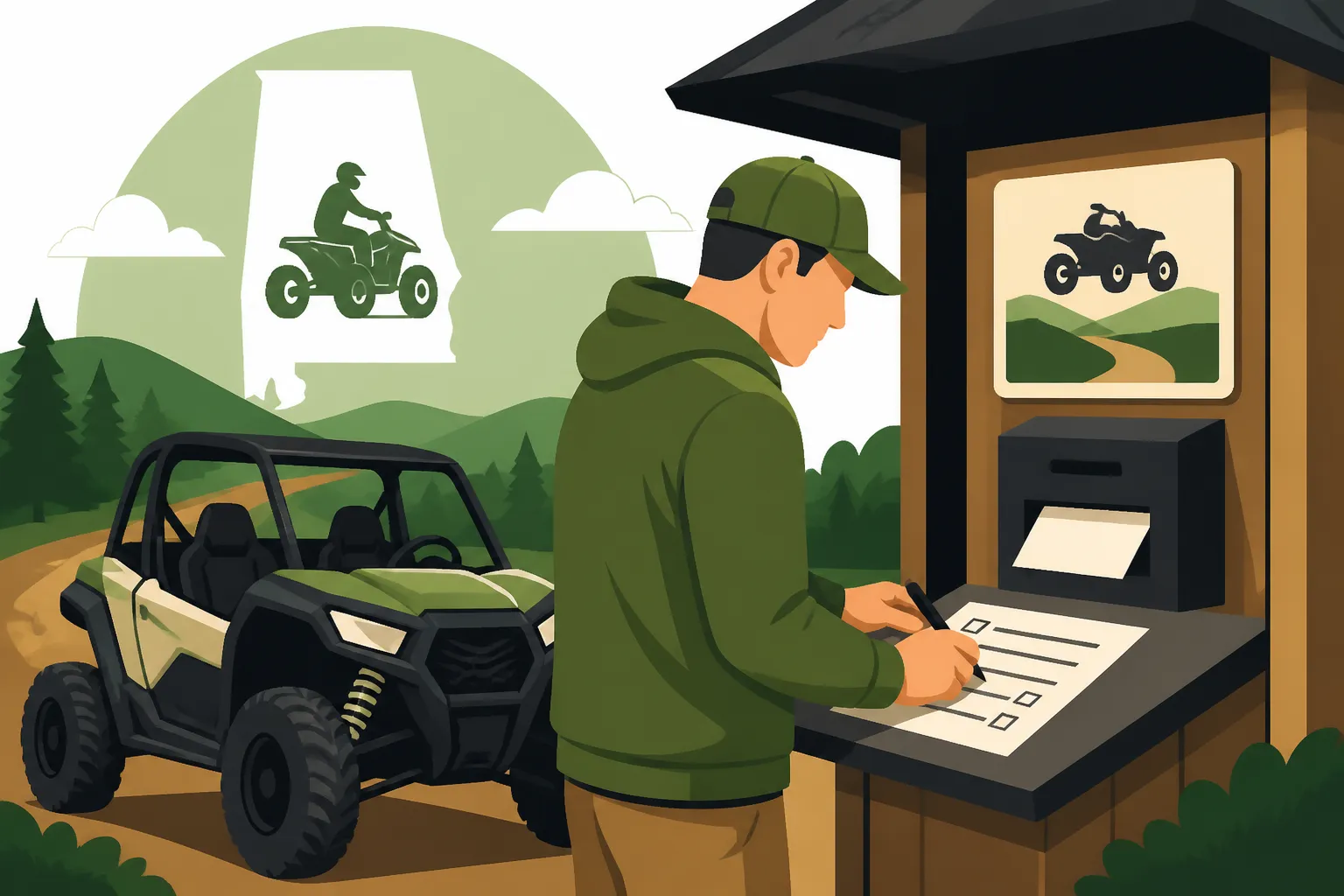
Filling Out a Paper Permit at a Kiosk
Filling Out a Paper Permit at a Kiosk
A paper permit kiosk can look straightforward until you have to decide which permit applies, what information to write down, or whether the form covers everyone in your group. For Alabama ATV and UTV riders, the answer depends on the specific public land area and its current rules. Here’s how to prepare, complete a paper permit carefully, and avoid treating it as permission to ride anywhere.
What a Paper Permit at a Kiosk Does
A paper permit is one way an area may require visitors to document their access. On some Alabama Wildlife Management Areas, riders may need to follow permit procedures in addition to meeting other access requirements. The kiosk’s form and posted instructions are the best starting point for understanding what is required at that particular area.
A permit is not a general ATV registration, a vehicle title, or an all-purpose pass for public land. It also does not override a closure, a restricted road, a landowner’s rules, or a season-specific restriction. It applies only as described by the issuing area and its current instructions.
The permit may be only one part of access
Depending on the area and your reason for visiting, access rules may involve more than a paper form. A WMA license, hunting license, area permit, daily permit, or other authorization may be relevant. Requirements can differ by area, activity, and visitor. A permit completed at a kiosk should not be assumed to replace every other credential.
If you are riding rather than hunting, confirm which rules apply to riders specifically. The requirements for hunting, wildlife observation, camping, and operating an off-highway vehicle may not be identical. Start with [Alabama WMA Riding Rules for Quads] and Which Permits to Carry on an Alabama WMA if you need to sort out the distinction.
Paper and electronic options may differ
Some areas may provide an electronic permit option, a paper form at a kiosk, or instructions that change with the area or activity. Do not assume every tract has a kiosk, that every kiosk has forms available, or that a permit issued for one area is valid at another. If an electronic option is available, check whether it replaces the paper process for your situation or whether the posted area instructions still require a physical form.
A kiosk is most useful when you know which area you are entering and can follow the directions posted there. It is not a substitute for checking access information before you tow to a trailhead. If you are unsure whether a permit is required, review Alabama WMA Rules Vary by Area and [Alabama WMA Daily Permit Steps], then confirm the current requirements for the specific tract.
A permit does not mean every route is open
A completed form does not make a closed road legal to ride, and it does not guarantee that a trail or tract is open on the day you arrive. Routes can be limited to designated roads, closed for management or safety reasons, or subject to seasonal access rules. A WMA map and its written rules matter as much as the permit itself.
Before riding, check the posted map, signs, gates, and any instructions on the permit. If you are visiting during hunting season, take extra care to confirm what areas and routes are open to riders. Alabama WMA Access During Deer Season and Alabama WMA Access During Turkey Season cover why seasonal access deserves a separate check.
Before You Leave for the Kiosk
The most reliable way to avoid a rushed or incomplete permit is to prepare before you reach the area. Kiosk conditions vary: a form may be available, the instructions may be difficult to read, or you may have limited time to complete it. Plan for the possibility that you will need to rely on the current posted directions rather than on a prefilled form or an assumption from a previous visit.
Confirm the exact area and access point
Write down the name of the WMA or tract you intend to visit, and identify the entrance or kiosk you plan to use. Similar-sounding place names, separate tracts, and nearby public lands can make it easy to select the wrong location. A permit for one tract should not be treated as valid for a different tract unless the instructions explicitly say so.
Check the area map and access rules before you leave. A general road map may show how to reach the area but not which roads are open to ATVs or UTVs. Alabama Area Biologists and Their Maps explains why area-specific information can matter more than a broad map.
Check which permit or credentials apply
Before heading out, establish whether the area requires a daily permit, an area permit, a WMA license, a hunting license, or another authorization for your activity. Do not rely on a friend’s experience at another WMA: the rules can differ between areas, and the same area may have different requirements for different activities.
A permit can also be different from proof of ownership or registration paperwork for your machine. If you are unsure what to carry for the vehicle itself, see [Alabama Proof of Ownership on the Trail]. Keep access documents and machine documents together, but understand that one does not replace the other.
Bring the details you may need to write down
Use the kiosk’s own form as the authority on what information to provide. The fields may ask for identifying or trip details, but do not assume a set list of fields applies to every area. It can help to have the following at hand:
- The full name of the area or tract you are entering.
- The date and planned activity, if requested.
- The names of the visitors covered by the permit, if the form asks for them.
- Any license, permit, or identification information the posted instructions require.
- A pen, since the kiosk may not provide one.
- A phone or offline copy of the area map and rules, if available.
Only provide information requested on the form. If a field is unclear, read the posted instructions before writing. Avoid filling in a guessed answer simply to complete every line.
Plan for limited service and weather
A kiosk may be outdoors, and the surrounding area may have limited mobile service. Save the information you need before leaving a service area. If you plan to use an electronic option instead of paper, check that it can be completed and saved without depending on a strong signal at the trailhead.
Carry a pen and protect your permit from rain, mud, and damage. A resealable document sleeve or waterproof pouch can help keep the paper readable during transport. Keep it somewhere accessible, not buried beneath riding gear or tools.
Ask before relying on a previous trip
Even if you have visited the area before, check current instructions. A previous visit does not establish that the same kiosk, form, access point, or route is still in use. If you cannot determine the current procedure from posted information or an official area resource, contact the relevant area office or biologist before making the trip. Calling a Biologist With a Question offers a practical way to prepare questions when the rules are not clear.
How to Fill Out a Paper Permit at the Kiosk
Take a moment to read the instructions before you start writing. The form itself may be brief, but the details can determine whether it applies to your visit. Follow the kiosk’s directions rather than copying a permit from someone else or relying on a general description of the process.
-
Confirm that you are at the right kiosk. Check the area name on the sign and compare it with the tract you intend to visit. If the kiosk is for a different area, do not use its form on the assumption that nearby areas share a permit.
-
Read the full set of posted instructions. Look for eligibility, activity, date, route, and submission directions. Check for separate rules for riders, passengers, minors, or people accompanying a hunting party. If a sign directs you to a different permit process, follow that direction.
-
Select the correct form or option. If multiple forms are present, choose the one that matches your activity and visit. Do not choose a hunting permit simply because you are traveling with hunters if the form is not intended for riders. When the correct form is uncertain, pause and seek clarification instead of guessing.
-
Complete every required field legibly. Use the information requested on the form, write clearly, and avoid abbreviations unless the instructions allow them. If the permit asks for a date, use the date you will actually be there. If you make a mistake, use a new form if available rather than leaving a confusing alteration.
-
Check whether the permit is individual or group-based. Do not assume one form covers every person in a vehicle or party. If the instructions specify that each visitor needs a separate permit, complete one for each person as directed. If a single permit covers a group, follow the form’s instructions about listing visitors.
-
Follow the kiosk’s submission instructions. The sign or form should explain whether you keep the permit, place a portion in a collection box, or complete another step. Do not leave a required copy behind, and do not take a portion that the instructions say to deposit.
-
Keep the permit as directed. If you are told to carry it, keep it somewhere it can be shown without rummaging through the machine or stopping in an unsafe location. If the form has a section meant to remain at the kiosk, do not remove it.
-
Review your route and conditions before unloading. Confirm that the roads you plan to ride are open to your machine and activity. A permit does not tell you that every road is open. Use the map and posted signs, and do not pass a gate or closure marker because a route appears on a general map.
-
Make sure each rider understands the limits. Tell your group which area the permit covers, what routes are allowed, and whether everyone needs separate documentation. A group leader should not assume that other riders know the permit’s limits.
If a field is unclear or the kiosk is missing
Do not invent an answer to an unclear field or treat a blank kiosk as proof that no permit is needed. Look for additional signs or instructions nearby, and check the official information for the area. If you still cannot determine what to do, contact the relevant office or area biologist before riding.
If the kiosk has no forms, is damaged, or appears to be at the wrong access point, document the issue for your own records and seek guidance. A photograph of the kiosk instructions may help you remember what was posted, but it does not replace the required permit or grant permission by itself.
After You Complete the Permit
Once the form is complete, keep it in usable condition and follow any check-in or check-out procedure. Some areas may require an additional step beyond filling out the form. Others may tell visitors to retain a copy or place a section in a designated box. The instructions at that specific kiosk determine what to do.
Keep the permit accessible and readable
If the permit must be carried, protect it from water, mud, and tearing. Store it where you can reach it safely if asked to show it. Do not attach loose paper where it can blow away or interfere with the controls of your machine.
If the permit is meant to be displayed or carried in a particular way, follow that instruction. Do not assume that folding it, photographing it, or keeping it on a phone is acceptable when the directions call for the paper original. If the form does not explain how it must be carried, ask the issuing office rather than relying on a guess.
Follow the permit’s limits throughout the visit
Pay attention to any area, date, activity, or route limitation written on the permit. A paper permit is not transferable to another tract just because the same type of form is used there. It also does not grant permission to ride on private land or on a closed public road.
Stay on routes the area allows for your machine. A road that looks like a trail may be restricted, and a route open to one type of vehicle may not be open to another. Machines Confined to Open Roads is useful background for riders who need to distinguish an open route from a nearby access track.
Carry other required documents separately
A WMA permit and vehicle paperwork serve different purposes. If you need proof of ownership, registration, or other machine records, keep those available as well. A permit does not prove that you own the ATV or UTV, and a bill of sale does not prove you have met an area’s access requirements.
For broader access planning, Three Things You Need Before Riding a WMA can help you check the basic categories of requirements. If you are bringing guests from another state, consult Alabama Visitors From Out of State rather than assuming that an out-of-state license or permit automatically satisfies Alabama requirements.
Follow check-in or check-out instructions
Some procedures may require visitors to check in, check out, or return a portion of a form. If the kiosk or permit says to do so, complete the step exactly as instructed. Check-out requirements can be easy to forget after loading up, especially if your group leaves through a different access point than it used to enter.
If there is no check-out instruction, do not create a procedure based on what another area does. Follow the rules for the tract you visited. Keep the permit until you are sure you no longer need it, particularly if you may be asked to show it during the visit.
Keep a record when the process is confusing
If you are uncertain about what was required, retain your permit or a personal record of the posted instructions when allowed. Note the area, access point, and date. This can help you ask a specific question later, but it does not cure a missing permit or an unauthorized ride.
If you discover that you completed the wrong form or missed a required step, stop and seek direction before continuing. Do not alter a permit after the fact to make it appear complete. The safest response is to clarify the issue with the area contact and follow their instructions.
Common Kiosk Mistakes and How to Avoid Them
Most permit problems come from treating the kiosk as a formality rather than as part of the area’s access rules. Slow down enough to confirm the location, activity, and instructions. A few minutes of preparation can prevent a long drive followed by uncertainty at the entrance.
| Common mistake | Why it causes trouble | Better approach |
|---|---|---|
| Using a form from a nearby tract | The form may apply only to the area named on it | Confirm the area and kiosk name before writing |
| Assuming one permit covers the whole group | The instructions may require separate permits | Check whether the permit is individual or group-based |
| Treating the permit as a route pass | A permit does not necessarily open every road or trail | Check the current map, signs, and route restrictions |
| Assuming a missing form means no permit is needed | The kiosk may be out of forms or the process may have changed | Check official area instructions before riding |
| Guessing at a field | An inaccurate answer can make the form unclear or incomplete | Ask the area contact when the field is not explained |
| Relying on an old visit | Kiosk locations and access rules can change | Verify the current process before each trip |
| Leaving the permit exposed to mud or rain | The information may become unreadable | Carry it in a protective sleeve if you must retain it |
| Confusing a WMA permit with machine paperwork | Each document serves a different purpose | Carry the access authorization and relevant vehicle records |
| Ignoring check-out instructions | A required step may be missed when leaving | Read the entire sign before beginning the visit |
| Assuming a permit authorizes private-land access | Public-area paperwork does not grant private permission | Get the landowner’s permission separately |
Do not use another rider’s form as a shortcut
A completed form can be a useful example of how to write legibly, but it should not be copied as your own permit. Dates, activities, areas, and visitor details can differ. Use a blank form and complete it for your own visit, following the kiosk’s instructions.
Do not mistake a kiosk for a registration station
A permit kiosk does not title or register an ATV or UTV. Alabama’s off-road vehicle registration and title questions are handled separately from access permits. If you need to understand registration requirements, see Alabama Registration Questions Owners Ask. Keep the processes distinct: area access concerns where and under what conditions you may enter, while registration addresses the machine’s paperwork.
Get permission for land outside the WMA
A public-land permit does not extend to adjoining timberland, a hunting lease, a pasture, or a private road. If your planned route crosses land outside the designated area, you need the appropriate permission and must follow any additional rules. Do not infer permission from an open gate, an old track, or the fact that other riders are present.
Frequently Asked Questions
Does every Alabama WMA have a paper permit kiosk?
Do not assume so. Kiosk availability and permit procedures can vary by area and activity. Check the current instructions for the specific tract before traveling, and do not treat an empty or missing kiosk as proof that no permit is required.
Can one paper permit cover everyone in my group?
Only if the form or posted instructions say it can. Some procedures may require each visitor to complete a permit, while others may allow group information on one form. Follow the instructions at that kiosk rather than relying on a different area’s practice.
Does a paper permit let me ride any road on the WMA?
No. A permit does not automatically make every road or trail open to an ATV or UTV. Check the current area map, signs, seasonal restrictions, and machine-specific route rules before riding.
Is the kiosk permit the same as a WMA license or hunting license?
Not necessarily. A paper permit, WMA license, hunting license, and machine registration are different types of authorization or documentation. Which ones you need depends on the area and activity. Confirm the current requirements for your visit instead of treating one document as a substitute for another.
Disclaimer
This article is for general informational purposes only and does not constitute professional advice. Laws, prices and regulations vary by location and change over time. Consult a qualified professional for guidance on your specific situation.