How an Area Permit Differs From a Daily Permit
An area permit and a daily permit can both relate to access on an Alabama Wildlife Management Area, but they are not interchangeable. The right choice depends on the tract, the dates you plan to visit, and what you intend to do there. Here’s how to compare them, avoid relying on a permit for the wrong activity, and check the rules before taking an ATV or UTV onto WMA land.
The basic difference between an area permit and a daily permit
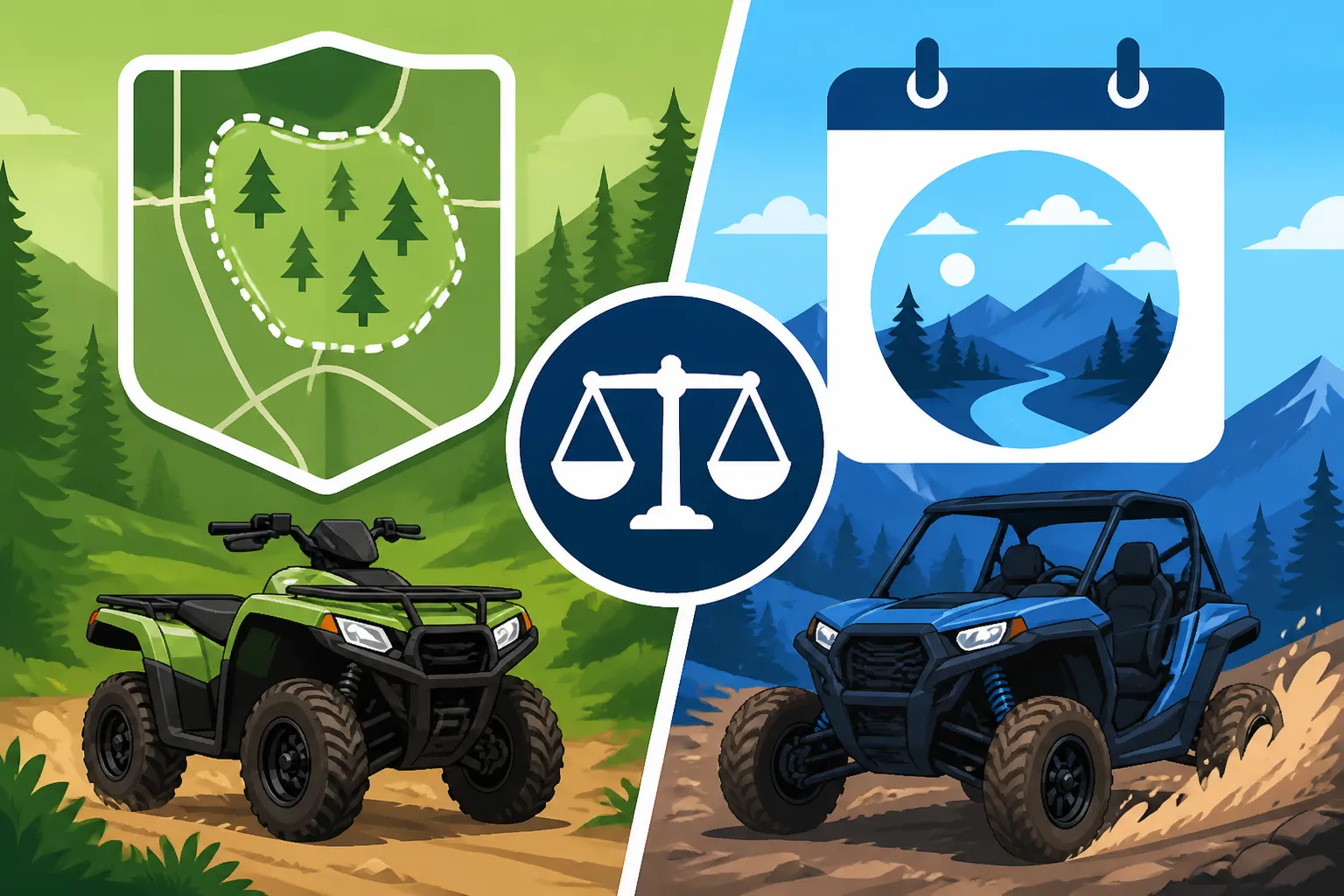
An area permit is generally tied to a particular management area or tract and may cover access across a defined period, subject to that area’s rules. A daily permit is generally tied to a particular date. It can suit a single visit when that option is available, but it does not automatically cover later visits.
Those descriptions are a starting point, not a guarantee that every Alabama WMA offers both permit types or uses them in exactly the same way. Permit availability, validity, sign-in requirements, and allowed activities can vary by area and season. Before you go, check the current rules for the specific tract rather than assuming a permit that worked at one WMA applies elsewhere. Alabama WMA Rules Vary by Area
| Question | Area permit | Daily permit |
|---|---|---|
| What does it generally cover? | Access connected to a named area or tract for the permit’s stated period | Access connected to a particular day |
| When might it make sense? | You expect to make repeated visits to the same eligible area | You are making a one-day visit or trying a tract once |
| Does it grant access everywhere? | No. It applies only as described and does not open closed or restricted areas | No. It does not override area, date, route, or activity restrictions |
| Does it automatically authorize hunting? | No. Hunting may require separate licenses, permissions, and compliance with season rules | No. A day permit is not a substitute for hunting credentials or harvest rules |
| Does it automatically authorize ATV or UTV riding? | No. Motorized access must be allowed for that area and purpose | No. Check the tract’s motorized-access rules before riding |
| What should you verify? | The named area, validity period, eligible activity, and any required sign-in | The date, tract, access instructions, and any separate credentials |
Think of the permit as one part of your access checklist, not as blanket permission. It may establish that you have completed a required access step, but it does not necessarily satisfy every other condition. A valid permit cannot make an unauthorized road open, extend an access season, or allow a machine where motorized riding is prohibited.
If you are comparing the options for a particular WMA, read the permit details closely. The name alone may not explain whether it covers the whole management area, a specific tract, or only a defined activity. The area’s current map and rules are important too. Alabama WMA Area Permits and Alabama WMA Daily Permits explain the two options in more detail.
What each permit does and does not authorize
The main practical value of an area permit is that it can make repeat visits to the same eligible area simpler, if the permit terms allow that. Instead of treating each visit as a separate daily-permit transaction, you follow the conditions for the area permit and use it within its stated validity period. Confirm whether that period is seasonal, limited to a set of dates, or defined in another way. Never infer the expiration date from when you purchased it.
A daily permit is more narrowly tied to a visit date. It can be a straightforward fit when you have one planned day on a tract, but it is not a pass for an unplanned return trip. If plans shift, check whether the permit remains valid for the new date or whether you need to obtain another one. Do not assume that a permit is transferable between dates or areas unless its instructions say so.
Neither permit type should be treated as an all-purpose WMA license. Access credentials, hunting credentials, and vehicle permissions can be separate requirements. The requirement that applies to you may depend on whether you are hunting, fishing, scouting, riding, assisting someone else, or entering the area for another purpose. A permit that covers one access requirement might not cover the rest.
That distinction matters for ATV and UTV riders. A permit does not, by itself, establish that a particular road is open to motorized travel or that riding is allowed during the dates you plan to visit. Some roads may be designated for vehicle use while other routes, trails, gates, or natural areas are closed to machines. The machine’s registration or ownership paperwork is a separate matter from permission to ride on public land. Read [Alabama WMA Riding Rules for Quads] before treating a WMA permit as authorization to ride.
A permit also does not make an otherwise restricted activity legal. It does not grant permission to enter private land within or beside a WMA, pass a gate that is closed, ignore a posted restriction, or take wildlife outside the applicable season or limits. It does not replace the rules attached to a particular tract. If the permit instructions and the area’s posted signs raise questions, pause and ask the relevant office or area contact before proceeding.
For hunters, the distinction is especially important. An access permit and a hunting license serve different purposes. A hunter may need appropriate hunting credentials and must still follow the rules for the species, season, method, and area. Likewise, a person accompanying a hunter should not assume that the hunter’s permit or license covers every person in the group. Check what each individual needs. Which Permits to Carry on an Alabama WMA is a useful companion when you are sorting out the separate documents.
How to choose based on your plans
Start with the area, not the permit type. Identify the exact WMA or tract you want to visit and confirm that your intended activity is allowed there on your planned date. Then find out which permit options apply. Choosing a permit before checking the area can lead to buying one that does not cover the tract or does not meet the requirement for your activity.
An area permit is worth considering when you expect to return to the same eligible area and its validity period fits your plans. It may be less convenient if you will visit only once, travel to several different areas, or need access only on dates outside the permit’s terms. Whether it is the better choice depends on its actual coverage, not simply how many times you expect to ride or visit.
A daily permit may fit a one-day outing, a trial visit, or a trip where you want to confirm that the area suits your group before planning more visits. It can also be useful when your schedule is uncertain, provided you understand how the date is set and what to do if your plans change. Check whether everyone in the group needs an individual permit or whether the rules treat the group another way; do not assume the permit holder can bring additional people without their own required credentials.
Use this process before you purchase or apply:
- Name the exact area and tract. Do not rely on a nearby town, access road, or familiar trail name as a substitute for identifying the WMA or tract itself.
- Confirm your purpose. Riding, hunting, scouting, and other activities may have different requirements. Be specific about what you plan to do.
- Check the dates. Look for season dates, temporary closures, and any limits on when the tract can be entered.
- Compare the permit terms. Verify the area covered, start and end dates, eligible activities, and whether the permit is valid for one visit or a broader period.
- Check separate credentials. Find out whether you also need a WMA license, hunting license, or another required authorization for your situation. Alabama WMA Licenses Explained
- Confirm vehicle access. Check whether ATVs or UTVs are allowed, which roads are open, and whether your intended route is designated for motorized use.
- Follow the permit’s instructions. If the process requires a sign-in, check-in, or proof of purchase, complete it as directed rather than relying on a receipt alone.
- Carry the required information. Keep the permit and any other required credentials available in the format accepted by the area. If you are unsure what to show, confirm before leaving home.
If you visit multiple areas, compare each one separately. A permit valid for one named WMA should not be assumed valid at a second WMA, even if both are managed under the same broader system. If your plan includes several tracts, verify each tract’s requirements and whether a single permit can cover them. How to Get an Alabama WMA Permit can help with the application or purchase steps, but the area-specific rules still determine where and when you may go.
Common mistakes that can make a permit unusable
The most common mistake is treating a permit as statewide access. A permit tied to one area does not necessarily authorize entry at another. Even when a permit has a broad validity period, the area named on it and the rules for that area still matter. Read the coverage carefully and match it to your destination.
Another mistake is confusing the permit’s validity with the area’s operating or access dates. A permit can be valid on a date when your intended activity is not permitted, or when a route is closed. Seasonal closures, hunting-season restrictions, weather-related closures, and other posted conditions may affect access. Check the current information close to your trip, especially if you are visiting after a recent storm or during a busy hunting period.
Do not treat payment or possession of a permit as proof that you have met every requirement. A receipt may show that you completed a transaction, but it may not replace a separate license, sign-in step, or other document. Review the instructions for what to carry and how to display or present it. Keep a record of the confirmation if the process provides one, but follow the area’s stated rules about what counts as proof.
A further risk is assuming a permit covers an entire group. Requirements may apply to each person or may depend on what each person is doing. Confirm the rules for children, passengers, hunting companions, and other visitors. The adult who completed the permit process should not presume that everyone in the vehicle is covered by that person’s authorization.
Riders can also confuse a WMA access permit with registration for an ATV or UTV. Those are separate questions. Alabama’s registration system and WMA access rules do not serve the same purpose, and completing one process does not automatically complete the other. Before riding, check both the vehicle-related requirements and the land-access rules. Three Things You Need Before Riding a WMA
Finally, do not rely on an old map, a past trip, or another rider’s memory as the final word. A route that was open during one visit may be closed later, and rules can differ by tract. Check current area information, pay attention to signs at gates and junctions, and ask the area contact if a permit’s wording is unclear. If you cannot confirm that your route is permitted, choose another route or wait for clarification.
A practical pre-trip check for riders and visitors
A few minutes of preparation can prevent a wasted trip or an avoidable violation. Before setting out, write down the name of the WMA, the tract or entrance you plan to use, the date, and the activity. Check that your permit covers those details. Then review the area map and any current notices for route closures or seasonal limits.
For ATV and UTV use, trace the route you intend to ride rather than assuming all visible roads are open. A map may show roads that are not currently available to the public or may not identify every temporary closure. Look for the specific motorized-access rules and signs on the ground. Stay on permitted routes, and do not use a permit as a reason to bypass gates or enter restricted areas.
If you are hunting as well as riding, make two separate checks: one for WMA access and motorized travel, and another for hunting licenses, seasons, and harvest requirements. A permit that addresses access does not replace hunting rules. The same principle applies if you are scouting or helping someone else hunt: clarify what each member of the party is authorized to do.
Keep a simple record of the information you confirmed, such as the permit details, access dates, and the area contact’s instructions. That is particularly useful when a group is travelling in separate vehicles or when the person who completed the permit transaction is not the person carrying the map. It also makes it easier to notice if a planned date or destination changes and requires a fresh check.
If your permit option is unclear, ask a direct question rather than asking only, “Is my permit good?” A more useful question is: “Does this permit cover this specific WMA and tract, on this date, for ATV riding or the activity I’m planning, and do I need any additional license or sign-in?” Specific details make it easier for the office or area contact to identify a mismatch.
For trips during a hunting season, allow extra time to check access rules and plan a route that avoids conflicts with other users. Observe signs and closures, keep noise and speed appropriate, and be prepared to turn around if conditions or posted instructions do not match your plan. A permit is useful only when you use it within the limits it actually sets.
Frequently Asked Questions
Can I use an area permit for more than one day?
Possibly, if its terms cover multiple dates and the area allows the activity during those dates. Check the permit’s stated validity period and the current rules for the named WMA. Do not assume every area permit lasts for an entire season.
Does a daily permit let me return on another day?
Not necessarily. A daily permit is generally tied to a particular date. If you want to visit again, check whether you need a new daily permit or whether another option is available.
Does either permit let me ride any road on a WMA?
No. A permit does not automatically open every road or trail to ATV or UTV use. Confirm which routes are designated for motorized access and obey closures and posted restrictions.
Does a WMA permit replace my hunting license?
No. Access permits and hunting credentials are separate requirements. Check the rules for your activity, the area, and the current season.
What should I do if the permit instructions and a trail sign seem to conflict?
Do not proceed on the assumption that the permit overrides the sign. Stop and contact the relevant area office or official contact for clarification. Follow posted closures unless you receive reliable instructions that establish otherwise.
Disclaimer
This article is for general informational purposes only and does not constitute professional advice. Laws, prices and regulations vary by location and change over time. Consult a qualified professional for guidance on your specific situation.