Alabama Private Park Insurance Rules
A private off-road park may have insurance rules that differ from Alabama’s statewide requirements and from the next park down the road. That can leave riders unsure whether their ATV or UTV needs a policy, what proof to bring, or whether a waiver is enough. The safest approach is to confirm the park’s current rules and your policy’s off-road coverage before you travel.
What private park insurance rules mean
A private park controls access to its property and can set entry conditions for riders, subject to applicable law. That may include requiring proof of insurance, asking each rider to sign a release, or imposing separate rules for passengers, minors, events, and certain machines. The exact requirements are not necessarily the same at every Alabama park.
Do not assume that an Alabama registration record, an out-of-state decal, or a signed waiver proves that you have insurance. These are different things:
- Registration or an ownership record identifies a machine or records information about it; it does not automatically provide insurance coverage.
- A waiver or release is a document a park may require you to sign before riding. It does not create an insurance policy.
- An insurance policy is a contract with an insurer. Its terms determine what is covered, where coverage applies, and what exclusions or limits may apply.
Alabama’s off-highway registration rules and a park’s admission rules answer different questions. A registration requirement, if it applies to your situation, does not by itself settle whether a private riding area will admit you without insurance. For background on the state’s registration system, see Alabama Registration Is Voluntary and Public Use Versus Private Use Tiers.
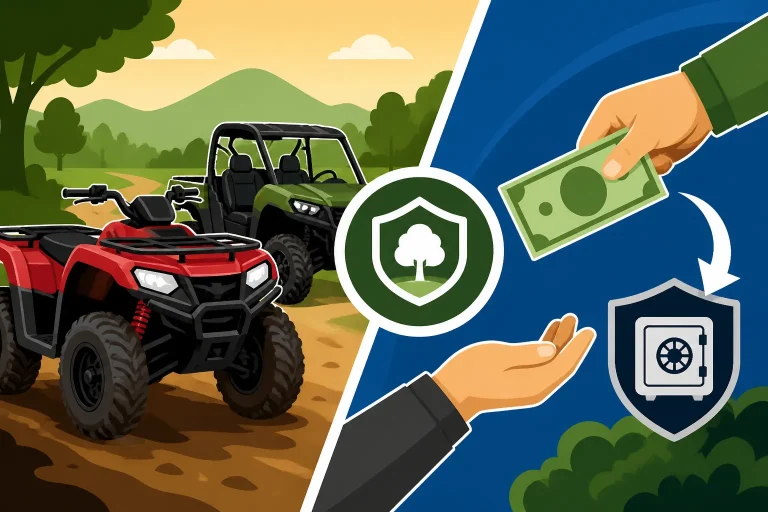
Likewise, do not assume that a private park’s insurance policy covers visitors. A property owner may carry coverage for its own operations, but that does not mean the policy pays for a visitor’s machine damage, medical care, or liability to another rider. Ask the park what it requires of riders rather than treating the park’s own coverage as your protection.
A useful starting point is to sort park rules into three categories:
| Question | What it concerns | What to confirm |
|---|---|---|
| Does the park require rider insurance? | A condition of entry or riding | Whether coverage is mandatory, and who must be insured |
| Does my policy cover this ride? | Your agreement with the insurer | Off-road use, private parks, passengers, liability, and exclusions |
| Do I need to sign a waiver? | The park’s admission paperwork | Who signs, whether minors need a parent or guardian, and when forms are completed |
A park may ask for insurance even if your machine is used only off public roads. Another park may not require proof at the gate but may still require waivers or impose other safety conditions. Treat each facility’s own current rules as the source for its entry requirements, and treat your insurer as the source for what your policy covers.
For closely related park requirements, see Alabama Private Park Waivers and Rules and Alabama Private Park Waiver Forms. Those rules may apply alongside an insurance requirement, but one does not replace the other.
What insurance to check before riding
“Insurance” can mean different types of protection. When a park says insurance is required, ask what kind it means. It may refer to liability coverage for injuries or damage you cause to someone else, coverage for your machine, or a specified proof document. Do not guess based on a vague mention on a booking page.
Liability coverage
Liability coverage may help pay for covered injuries or property damage for which you are legally responsible, subject to the policy’s terms. It is not a guarantee that every crash, claim, or injury will be covered. The insurer will apply the policy language, including exclusions, limits, and conditions.
Ask whether the policy covers riding an ATV or UTV at a privately operated off-road park. A policy that covers some uses of a machine may treat other activities differently. For example, the insurer may distinguish private-property riding from road use, organized racing, timed competition, commercial use, or riding outside designated areas. The precise answer depends on your policy; do not rely on an agent’s general statement that you are “covered” without describing the activity.
Also ask whether the policy covers liability for a passenger. A rider’s coverage should not be assumed to extend to every person on the machine or to every person involved in an incident. This matters particularly for side-by-sides, where the driver and passengers may have different legal and insurance considerations.
Damage to your own machine
Liability coverage is not the same as coverage for damage to your own quad or UTV. If the machine rolls over, hits an obstacle, catches fire, or is damaged in a collision, the policy may or may not cover the loss. Coverage can depend on the type of policy, the cause of the damage, how the machine was being used, and exclusions.
If you are financing a machine, check any insurance requirements in your financing agreement separately from the park’s entry rules. A lender’s requirements and a park’s conditions are not interchangeable. A lender may be concerned about protecting its interest in the machine, while a park may have a condition of admission for riders.
Medical and health coverage
A rider’s health insurance and an ATV or UTV policy are not the same thing. Health coverage may help with eligible medical expenses, subject to its own terms, but it does not necessarily cover another person’s injuries or damage to property. An ATV policy may also contain medical payments or similar benefits, but you need to check whether those benefits are included and what restrictions apply.
Do not assume that a waiver guarantees medical expenses will be paid, either. A release is a park document, not a substitute for health coverage or vehicle insurance. For details about the effect of a waiver, read the document carefully and ask a qualified professional if you are unsure what you are agreeing to.
Common policy questions
Before relying on a policy for a park visit, ask your insurer or agent specific questions, such as:
- Does this policy cover my exact ATV or UTV while riding at a privately operated off-road park in Alabama?
- Does it cover recreational trail riding, or are racing, competitions, or organized events treated differently?
- What liability coverage applies if I injure another person or damage another person’s property?
- Does coverage apply to passengers, and are there restrictions on who may ride?
- Is damage to my own machine covered in a rollover or trail collision?
- Are there exclusions for water, mud, jumps, alcohol, unauthorized riders, or riding outside marked areas?
- What document can I provide to the park as proof, and does it show the information the park asks for?
These are questions to take to your insurer, not assumptions about what every policy includes. If the insurer’s answer is unclear, ask for the relevant policy wording or a written explanation. A verbal assurance that does not account for the park activity may leave important questions unresolved.
How to confirm a park’s requirements
Check the park’s current rules before loading your machine, especially if you have not visited before. A general statement such as “insurance recommended” is not the same as “proof required at check-in.” Likewise, a waiver requirement does not tell you whether proof of insurance is also needed.
Use a direct confirmation process:
- Read the park’s current admission and rider rules. Look for separate language about insurance, waivers, minors, passengers, organized rides, and machine types.
- Contact the park if the wording is unclear. Ask whether insurance is mandatory or recommended, and whether that applies to every rider, every machine, or only particular activities.
- Ask what proof is accepted. The park may want a current insurance card, a declarations page, or another document. Do not assume a registration paper, receipt, or waiver will satisfy the request.
- Ask whose name must appear. Confirm whether the policyholder must be the driver, the machine owner, or another person, and whether a family policy is acceptable for a youth rider.
- Describe the actual activity to your insurer. Mention the park, off-road riding, passengers, and any planned event or competition.
- Save the response and bring the requested proof. Keep the park’s confirmation and insurance documents accessible, but avoid sharing more personal information than the park needs.
- Recheck shortly before the trip. Rules can change, and requirements for a special event may differ from ordinary day-use rules.
When you call, keep the questions specific. For instance: “Does every adult rider have to show proof of liability coverage, or is a signed waiver the only paperwork required?” Then ask whether a separate rule applies to passengers, children, or a machine owned by someone who is not riding.
This distinction matters for groups. One person may book a campsite or pay the admission, while several people bring their own machines. Do not assume the booking party’s insurance or paperwork covers the whole group. Ask whether the park requires proof from each rider, from each machine owner, or from the named driver of each vehicle. For group visits, see Alabama Permits for a Group Trip for additional planning questions about shared requirements.
What proof may look like
If a park requests proof, ask what format it accepts rather than sending a full policy file by default. An insurance card may show basic policy and vehicle details, but the park could ask for different evidence. A declarations page may contain more information than an insurance card, so confirm what is necessary and how the park wants it provided.
Check that the document relates to the machine you are bringing. If it lists a serial number or other identifying detail, make sure the information matches your vehicle. If the machine is borrowed or owned by another person, ask whether the policy and proof are acceptable for you as the operator. Do not edit a document to make it appear to meet a requirement.
If you cannot produce the requested proof, contact the park before you leave. A staff member may clarify whether another document is acceptable, but you should not count on an exception at the gate. If insurance is a firm condition and your policy does not meet it, the park may refuse access under its rules.
Waivers, passengers, and other rules that affect entry
Insurance is only one part of a park’s entry process. A private park may also require a waiver, safety briefing, wristband, vehicle inspection, or compliance with operating rules. These requirements can apply whether or not the park asks for insurance.
Read a waiver before signing it. Pay attention to who is signing, which activities it covers, what risks it describes, and whether it includes any release or assumption-of-risk language. A signed release does not mean that the park has agreed to pay your medical costs, and it does not mean your insurer will cover a loss. If a provision is unclear or consequential, get qualified legal advice before signing.
For a minor, check the park’s rules in advance to learn who must complete the paperwork. Do not assume that a child can sign the same documents as an adult, or that a parent’s signature automatically satisfies every park’s process. Parks may also set minimum ages, supervision requirements, or rider restrictions that are separate from insurance. See [Alabama Private Park Minimum Ages] and Alabama Park Rules for Minors.
Passengers create another common point of confusion. The park may set its own passenger rules, while the machine manufacturer’s intended seating capacity and your insurance policy may impose separate limits. A vehicle that has passenger seats does not automatically make every passenger arrangement permitted. Confirm both the park’s rule and your policy’s terms. For more on the park side of this question, see Alabama Park Rules for Passengers.
Other admission rules may concern helmets, alcohol, dogs, quiet hours, or campsite use. These are not insurance requirements, but violating them could affect whether you can ride or remain at the property. Review the park’s policies as a whole rather than focusing only on its insurance line. Alabama Park Rules for Helmets and [Alabama Private Park Alcohol Rules] cover two examples of rules that may be handled separately from insurance.
If you are visiting from outside Alabama, do not assume that a home-state decal or permit satisfies a park’s separate paperwork requirements. Ask what the property requires from visitors, and keep state compliance questions separate from admission conditions. Alabama Visitors From Out of State can help with the broader visitor question.
If you do not have coverage or the rules are unclear
If you discover that the park requires insurance and you do not have a suitable policy, pause before riding. Do not treat a waiver as a replacement for coverage, and do not assume the park’s own insurance will protect you. Contact the park and your insurer to understand the options before you travel.
Possible next steps include asking whether the park accepts another form of coverage, checking whether your current policy can be amended or clarified, or choosing a park whose requirements fit your situation. Only your insurer can confirm whether a policy can be changed and when coverage takes effect. Do not rely on a change until the insurer confirms it and provides the applicable documentation.
If the park says insurance is optional, that does not mean riding without coverage has no financial risk. You could still face costs for damage to your machine, injuries, or claims by other people. The appropriate coverage depends on your circumstances and the policy terms. An insurance professional can help compare options, while a lawyer can explain legal obligations or the effect of a release.
When the park’s language and an employee’s explanation appear to conflict, ask for clarification in writing. A useful follow-up might restate what you understand: whether insurance is required, the type of coverage, whose policy is acceptable, and what proof must be shown. Keep the answer with your trip information. If a special event is involved, ask whether event rules replace or add to the park’s normal requirements.
If you have already been turned away, avoid arguing that a waiver or registration record should count as insurance unless the park confirms that it accepts that document. Ask which rule was not met and whether the park has a refund or rescheduling policy. Admission and refund terms are separate from insurance coverage; see Alabama Park Refund Policies for the related planning issue.
A practical pre-trip checklist can prevent most gate problems:
- Confirm whether insurance is mandatory, recommended, or not requested.
- Find out whether the requirement applies to riders, machines, passengers, or all of them.
- Ask what type of coverage and proof the park accepts.
- Confirm that your insurer covers the specific off-road activity.
- Check rules for minors, borrowed machines, passengers, and events.
- Complete any required waiver using the park’s instructions.
- Carry the requested documents and make sure the information matches the machine.
- Recheck the rules before departure if the park visit is planned well in advance.
The central point is simple: a private park’s insurance rule is an access condition, while your policy defines your insurance protection. Neither a waiver nor a registration document should be treated as a substitute for the other. Confirm both sides—the park’s admission requirements and the insurer’s coverage—before you ride.
Frequently Asked Questions
Does every private ATV park in Alabama require insurance?
No single answer should be assumed for every property. Parks set their own entry conditions, so ask the specific park whether insurance is required and what proof it accepts.
Does signing a waiver mean I do not need insurance?
No. A waiver is a park document, not an insurance policy. It does not automatically cover medical expenses, machine damage, or liability to another person.
Will my ATV policy automatically cover riding at a private park?
Do not assume so. Ask your insurer about off-road use at a privately operated park and describe the activity, including passengers or organized events if relevant. Policy terms and exclusions control.
Can I use my registration document as proof of insurance?
Not unless the park specifically says it accepts that document for its insurance requirement. Registration and insurance serve different purposes.
Disclaimer
This article is for general informational purposes only and does not constitute professional advice. Laws, prices and regulations vary by location and change over time. Consult a qualified professional for guidance on your specific situation.