A Park in Bremen on Highway 69
Finding a riding park near Bremen, Alabama, can be harder than it sounds: map pins, old directions and trail information may not tell you whether the place is open or what machines it allows. This guide explains how to plan for a park on Highway 69, verify the details that matter, and arrive prepared for a safer day on the trails.
Finding the Bremen Park and Confirming the Details
Use Highway 69 as a starting point, not your only direction
A park described as being in Bremen on Highway 69 is associated with the Stony Lonesome area in Cullman County. Highway 69 is a useful reference when you are planning from Cullman or coming in from elsewhere in north-central Alabama, but a highway name alone is not a complete set of directions. Entrances, parking areas and check-in points can be set back from the road, and a navigation app may choose a different approach than the park expects.
Before you leave, check the park’s own contact information and ask for the entrance location, where to check in, and whether there are any access instructions for trailers. If you are towing a wide side-by-side, turning around on a narrow road or pulling into an unfamiliar driveway can be a stressful start to the day. Confirming the last turn and parking arrangement in advance helps avoid that scramble.
Search results and map listings can also become stale, or show a nearby address rather than the right entrance. If two sources disagree, do not assume the first pin you see is correct. The practical steps in [When Two Sources List Different Addresses for a Park] can help you sort out conflicting location information before you put a trailer on the road.
Confirm the park is operating before you load up
A trail park’s operating status, hours and access rules can change. A listing that appears in a map app or an old riding post does not necessarily confirm that the gate will be open on your chosen day. Contact the park directly before travelling, especially if you are planning a long drive, booking a campsite, or arranging a group ride. Ask whether the trails are open, what time check-in begins, and whether any parts of the property are temporarily closed.
This matters even more when weather has been wet. In Alabama, heavy rain can leave red clay slick, rut trails, or prompt closures while crews assess conditions. A park may be open while some routes remain unavailable. Ask specifically about the trails that match your machine and ability, rather than settling for a general “we’re open” answer. For more on interpreting changing conditions, see [Alabama Trail Closures After Rain].
If you cannot reach the park, consider delaying your departure until you can confirm the basics. A dead website, an unanswered phone or a social post from months ago is not reliable evidence that the park is closed—or open. [Calling a Park When the Website Is Dead] covers a sensible way to verify a park without relying on an old online listing.
Planning a Route and Choosing Trails
Match the route to your machine and your group
Before arriving, think about who is riding and what they are bringing. A sport quad, utility ATV and multi-passenger UTV may handle the same terrain differently. A route that feels manageable to an experienced rider on a light quad may be a poor first outing for a new rider, a young passenger or a heavy side-by-side. Ask the park which trails are appropriate for your vehicle type and whether width restrictions apply.
Do not decide that a trail is suitable based only on a short description such as “easy” or “beginner.” Surface, slope, weather and traffic all affect how challenging a route feels. A gentle section can become slippery after rain, while a narrow path may be uncomfortable for a wide machine even if the terrain itself is not steep. If you are riding with mixed experience levels, ask whether there is a route where the group can stay together without putting less experienced riders in over their heads.
Trail descriptions are most useful when you compare them with your own machine’s limits and the riders’ comfort levels. [Alabama Trail Difficulty Ratings] offers a framework for thinking through that choice. If you are bringing a side-by-side, confirm that the trails you want to ride permit it; [Alabama Trails That Allow Side-by-Sides] is a useful related guide.
Use maps to prepare, but follow the park’s rules on the ground
A map can help you understand the general area, estimate how long a loop might take, and keep a group oriented when riders become separated. An app such as onX Offroad can be useful for reviewing mapped routes and preparing offline navigation, but do not treat an app as permission to ride every line it displays. A map may not reflect a temporary closure, a current park boundary, or a rule posted at the entrance.
Before setting out, download the information you may need while you still have a reliable connection. Cell reception can be inconsistent in wooded or hilly areas, and a phone that works in town may lose service once you are on the trail. Carry a charged phone, consider a backup battery, and keep a paper map or a clear written plan if the group is unfamiliar with the park. Tell everyone where the official meeting point is in case riders get separated.
At the park, prioritize posted signs, trail markings and staff instructions over a saved route. If a marked trail is closed, do not use a digital map to argue that it is open. For broader preparation, [Alabama ATV Trail Map Downloads] explains why map access and route verification belong in the same planning process.
Preparing for Alabama Trail Conditions
Expect red clay, changing traction and weather
Alabama’s red clay can be forgiving when it is dry and surprisingly slippery when wet. A route that looked straightforward from the parking area may feel very different after a shower, particularly on a slope, in a rut or near a creek crossing. Give yourself room to brake and turn, and avoid following another machine so closely that you have no space to react if it slides or stops.
If rain is in the forecast, ask the park about conditions before you leave and again if you are staying overnight. Do not assume every trail dries at the same rate. Shaded sections and low spots can remain muddy after open ground looks passable. A group should agree in advance that riders can turn around rather than feeling pressured to continue through a section that exceeds their comfort or machine’s ability.
Mud can also be hard on equipment. Clay packed around tires, brakes, footwells and cooling areas can affect how a machine performs. A quick inspection during the day is worthwhile, especially after riding through sticky sections. For more on terrain preparation, [Alabama Red Clay and What It Does] covers the ways local clay can affect both traction and maintenance.
Pack for heat, dust and a long day outside
A day in the woods can be tiring even when the ride itself is not especially technical. Bring drinking water, food, basic first aid, and clothing suited to the forecast. Alabama heat and humidity can make a slow, shaded ride feel demanding, while a dusty trail can irritate eyes and breathing. Eye protection is practical even on a short outing, and gloves help protect hands from branches, vibration and repeated contact with controls.
Dress for the possibility of changing conditions rather than the first hour of the ride. A light rain layer, spare socks and a dry shirt can make a major difference if the weather turns or someone gets soaked crossing a wet section. Keep essential items in a secure, closed bag, not loose on a rack where vibration can shake them free. If you are riding with children or newcomers, plan breaks and make sure everyone knows how to signal that they need to stop.
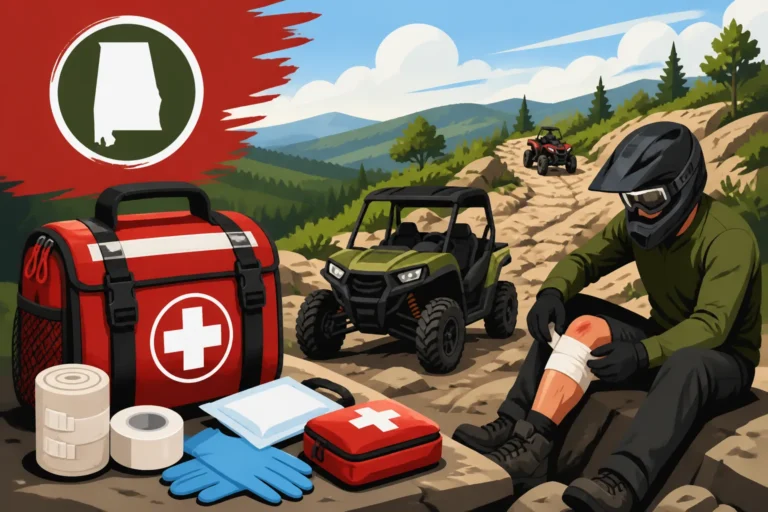
Think about basic recovery needs, too. A tire repair kit, compact tool set and a way to contact your group can be useful, but only if someone knows how to use them. Avoid carrying more gear than you can secure safely. [Packing for a Humid Day Out] and [First Aid on a Long Stony Lonesome Loop] offer more detailed checklists for a day in the Alabama woods.
Park Access, Rules and Group Logistics
Check admission, paperwork and park-specific rules
Do not assume that access requirements are identical at every Alabama riding area. A private park may have its own admission process, waiver, age rules, helmet requirements and policies for passengers. Ask what each rider must complete before entering, whether a parent or guardian needs to sign for a minor, and what documents or payment methods the park accepts. Confirm whether riders need to check in individually or whether one person can handle the group.
Read the waiver and posted rules rather than treating them as a formality. Restrictions on alcohol, speed, noise, dogs, passengers or camping may be stricter than the rules you follow at home. A machine that is permitted on private property does not automatically become legal on public roads, and registration does not turn a trail vehicle into a street-legal one. For background on the distinction between park access and registration, see [Alabama Registration Is Voluntary].
If your trip includes public land or a wildlife management area rather than only the park, check those rules separately. A private park’s admission or waiver does not replace any permit or access requirement that applies elsewhere. [Alabama Public Land Rules Compared to Private] is a helpful companion when you are combining different riding locations.
Make a plan for trailers, fuel and meeting points
Groups often spend more time coordinating arrival than expected. Decide where everyone will meet, who has the park’s contact details, and what to do if a vehicle is delayed. If several trucks are towing, confirm whether the parking area can accommodate the group and whether there is room to turn around. Do not block the entrance or assume roadside space is appropriate for unloading.
Fuel planning should account for the ride, the trip to and from the park, and any detour caused by weather or navigation. Start with a full tank where practical, and ask whether fuel is available near the park or whether riders should bring what they need. Keep fuel containers secured and follow the park’s instructions for where refuelling is allowed. If you are camping, confirm whether the site requires a separate reservation and what facilities are actually available.
For groups, choose a lead rider and a sweep rider, and agree on a regroup point before leaving the staging area. Keep the pace appropriate for the least experienced rider, and do not split the group without a clear plan. [Alabama Group Ride Planning] can help you think through responsibilities, spacing and communication before the first machine starts.
A Practical Checklist for Your Bremen Ride
Compare what to verify before you leave
A little preparation can prevent the common frustrations: arriving at the wrong entrance, discovering your machine is not allowed on a desired route, or finding that rain has changed the day’s plan. Use the table as a starting checklist, then confirm details directly with the park.
| What to check | Why it matters | What to ask or do |
|---|---|---|
| Park status and operating day | Online listings may be outdated | Confirm the park is open on your planned date |
| Entrance and parking | Highway directions may not show the correct gate | Ask for the entrance and trailer parking instructions |
| Machine type and trail access | Routes may vary by width, type or ability | Confirm which trails allow your ATV or UTV |
| Weather and trail conditions | Rain can change traction and closures | Ask about mud, closed routes and current conditions |
| Admission and waiver | Requirements are park-specific | Ask what each rider must complete before riding |
| Group plan | Riders can become separated on unfamiliar trails | Set a lead, sweep and regroup point |
| Navigation | Cell coverage may be unreliable | Save maps in advance and carry a backup plan |
| Fuel and supplies | Nearby services may not be convenient | Arrive prepared with fuel, water and basic tools |
If your trip is being planned around a particular trail mileage, event or campground, confirm that detail too. Park descriptions may combine trails, facilities or routes that are not all open at the same time. A direct question such as “Which marked routes are open for my machine today?” is more useful than assuming a general mileage figure describes what you can ride that day.
Keep a flexible plan for the ride itself
Set a realistic turnaround time and leave room for breaks, mechanical checks and slower sections. Riders often underestimate how long a new trail system takes, especially when the group includes children, first-timers or different machine types. It is better to finish a shorter route comfortably than to rush late in the day because the group planned an ambitious loop without knowing the terrain.
Agree that anyone can call for a stop if they feel unsafe, overheated or unsure about a section. That rule makes it easier for a new rider to speak up before a small concern becomes a bigger problem. If someone wants to skip an obstacle, the group should have a safe way to wait or regroup rather than pressuring that rider to attempt it.
After the ride, take a few minutes to inspect the machines, secure loose gear and clean off heavy mud before it dries. Check for damage, leaking fluid, loose straps and debris around moving or hot parts. A careful finish is part of a good outing, not an afterthought. If you are looking for more riding options beyond Bremen, [Alabama ATV Trails: Where to Ride] can help you compare the broader range of places to plan a future trip.
Disclaimer
This article is for general informational purposes only and does not constitute professional advice. Laws, prices and regulations vary by location and change over time. Consult a qualified professional for guidance on your specific situation.