Alabama Penalties for Illegal Road Riding
Riding your ATV or UTV can be an exhilarating escape, offering freedom and adventure across Alabama's beautiful landscapes. However, for many riders, the temptation to take their machine on public roads, even just for a quick hop, can lead to serious headaches and costly consequences. This guide is here to shed light on the specific penalties you could face for illegal road riding in Alabama, helping you understand the rules, validate your frustrations with confusing laws, and navigate how to best avoid those frustrating tickets and potential legal battles.
What Constitutes Illegal Road Riding in Alabama?
It's easy to assume that if a road looks like a dirt trail, it's fair game for your quad or side-by-side. Unfortunately, Alabama's laws draw a very clear line, and misunderstanding it can lead to significant penalties. The core issue revolves around the fundamental design and legal classification of your off-road machine.
The Core Prohibition: Off-Highway Means Off-Highway
At its heart, an ATV or UTV is designed, manufactured, and sold as an off-highway vehicle. This isn't just a marketing term; it's a legal designation that dictates where these machines can and cannot operate. They are built for rugged terrain, trails, fields, and private property—not for the smooth, paved, or even unpaved public roadways maintained by the state, counties, or cities.
Alabama law consistently reflects this design intent. Any operation of an ATV or UTV on a publicly maintained road, highway, or right-of-way, without a very specific and narrow legal exemption, is generally considered illegal. This prohibition isn't just about high-speed cruising; it encompasses short trips, crossing roads, or even driving along the shoulder. Law enforcement officers are trained to identify these machines and enforce the regulations that keep them off public thoroughfares.
This distinction is crucial because it sets ATVs and UTVs apart from other types of vehicles, like farm tractors or even golf carts, which may have specific provisions for road use under certain circumstances. The "off-highway" designation means your machine, no matter how much you love it, simply doesn't belong on a public road in the eyes of the law.
Exceptions and Misconceptions: Where Riders Get Confused
It’s completely understandable why many riders find themselves confused about where they can and cannot ride. Alabama's landscape is full of dirt roads, old logging paths, and unpaved county routes that look like ideal places for an ATV. However, if that road is officially maintained by a public entity, it falls under the same general prohibitions as a paved highway. The legal status of the road, not its surface, is what matters.
There are, of course, a few very limited exceptions to the general ban on ATV and UTV road use. For instance, the law often permits crossing a highway at a perpendicular angle, provided it's done safely and doesn't impede traffic. There are also specific allowances for [Alabama Farm Use and Road Riding], where a machine being actively used for agricultural purposes might be permitted to cross or briefly operate on a public road. However, these are extremely narrow exceptions and are not blanket permissions to commute or travel down public routes.
Another common misconception is that if other vehicles, such as construction equipment or even certain types of slow-moving farm machinery, are allowed on these roads, then ATVs and UTVs should be too. Unfortunately, this isn't how the law works. Each category of vehicle has its own distinct legal definition and set of operating rules. What applies to a tractor or a commercial construction vehicle rarely applies to an off-highway ATV or UTV, regardless of how much you've modified it with accessories from a company like SuperATV to enhance its utility or performance.
Understanding the Legal Framework for ATVs on Roads
To truly grasp why illegal road riding carries penalties, it helps to understand the foundational legal framework that governs these machines in Alabama. It's not just about what you can't do, but why you can't do it, stemming from federal safety standards and state classifications.
Alabama's Federal Standard Barrier to Road Use
The primary reason most ATVs and UTVs cannot be legally ridden on public roads in Alabama, or indeed in most states, lies in federal safety standards. Unlike cars, trucks, or motorcycles, off-highway vehicles are not manufactured to meet the strict Federal Motor Vehicle Safety Standards (FMVSS) that are mandated for all on-road vehicles. These standards dictate everything from braking performance and lighting requirements to emissions, tire specifications, and structural crashworthiness.
Standard off-road machines, no matter how rugged or well-built, simply don't have the features required for safe highway operation. They lack things like proper headlights, taillights, turn signals, specific mirrors, and the braking systems calibrated for high-speed road conditions. Trying to bypass these fundamental design differences with aftermarket accessories is a common pitfall. This is precisely [Why a Street Legal Kit Will Not Make It Legal]; while a kit might add a horn and blinkers, it doesn't change the underlying engineering or federal certification of the machine itself.
Without meeting FMVSS, a vehicle cannot be properly registered and licensed for road use. This fundamental lack of certification is the insurmountable barrier that keeps the vast majority of ATVs and UTVs off public streets, regardless of how capable they feel or how much you've invested in making them appear "road-ready."
The Definition of an ATV and UTV in Alabama Law
Alabama's statutes are quite specific when it comes to defining what constitutes an ATV (All-Terrain Vehicle) or a UTV/ROV (Utility/Recreational Off-Highway Vehicle). These definitions are crucial because they precisely outline the characteristics and intended use of these machines, which, in turn, dictates where they can be legally operated. Generally, these definitions classify ATVs and UTVs by factors such as width, weight, engine size, and, most importantly, their intended purpose.
Key phrases often found within these legal definitions explicitly state that such vehicles are "designed for use off public highways" or "not manufactured for use on public streets." This intrinsic design characteristic, baked into the legislative language, is the bedrock of the prohibition against road riding. It establishes that these machines are fundamentally different from vehicles like passenger cars or even street-legal golf carts. [Alabama's ATV and ROV Legal Definitions] clearly distinguish them.
These precise legal definitions are what differentiate an off-road side-by-side from, say, a low-speed vehicle or a traditional motorcycle, both of which can be legally operated on certain public roads. Even if your side-by-side from a brand like SuperATV has comfortable seats and a steering wheel like a small car, its legal classification as an off-highway vehicle means it falls under a completely different set of rules for road use.
Alabama's Low-Speed Vehicle Rules and Why They Don't Apply to Most ATVs
It's common for ATV and UTV owners to look for ways to gain road access, and sometimes, the concept of a Low-Speed Vehicle (LSV) comes up. An LSV is indeed a street-legal vehicle category in Alabama, but it comes with a very specific set of requirements. LSVs typically must have a top speed between 20 and 25 mph, be equipped with headlights, tail lights, turn signals, brake lights, mirrors, seatbelts, and a windshield. Crucially, they must also bear a manufacturer's VIN that designates them as an LSV, confirming they meet federal safety standards for this class.
The key takeaway here is that the vast majority of standard ATVs and UTVs do not qualify as LSVs, even if you modify them extensively. While companies like SuperATV offer excellent accessories—from full cabs to winches and suspension upgrades—these modifications enhance off-road capability and comfort; they do not magically transform an off-road vehicle into a federally compliant LSV. Installing turn signals and a horn on your quad does not change its fundamental design or its original manufacturer's certification. This is [Why a Standard Quad Can Never Pass the Standard].
Essentially, a "street legal kit" typically adds basic road-oriented accessories, but it doesn't address the deep-seated manufacturing and certification requirements for true street legality. You could bolt on every accessory imaginable from SuperATV, but if the core vehicle was not manufactured and certified as an LSV from the factory, it will almost certainly not be considered street-legal in Alabama. Trying to convert a regular ATV or UTV into an LSV via aftermarket parts is a common, but ultimately unsuccessful, route that often leads directly to legal trouble.
Common Penalties and Fines for Illegal Road Use
So, what happens when an Alabama law enforcement officer spots you riding your ATV or UTV where it doesn't belong? The consequences can range from a simple ticket to the immediate loss of your machine, and the costs can quickly add up.
The Initial Traffic Citation
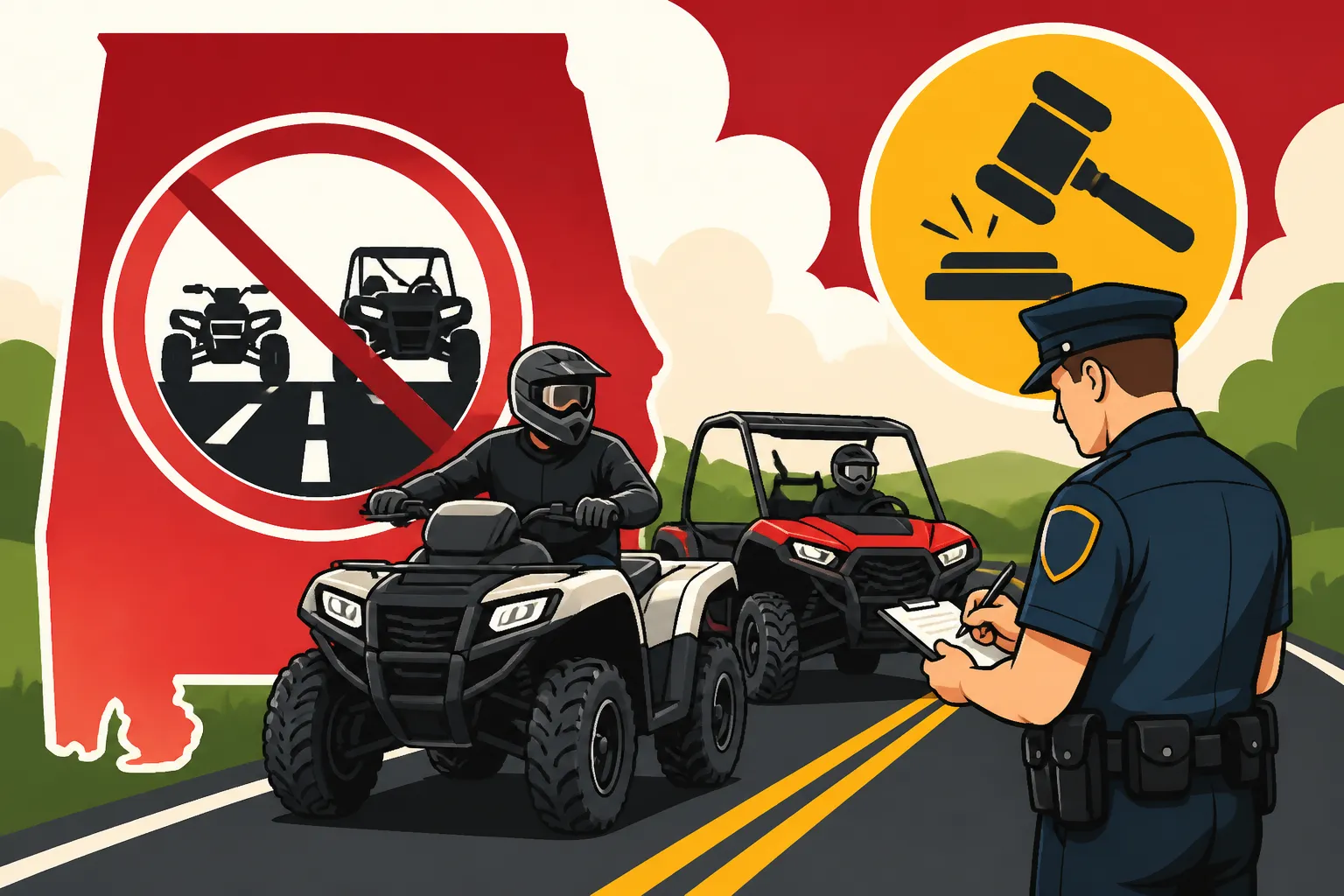
The most immediate and common consequence of illegal road riding is receiving a traffic citation. This is similar to getting a speeding ticket or any other moving violation you might incur in a car. The officer will typically pull you over, inform you of the violation – which is generally operating an unregistered or non-street-legal vehicle on a public roadway – and issue a formal ticket.
The specific fine amounts can vary somewhat depending on the county or municipality, as well as the officer's discretion. However, you should expect these fines to be comparable to other standard traffic infractions, often ranging from several tens to a few hundreds of dollars. It’s not just a polite warning; it's a formal legal document with real financial implications. For more details on what these might look like, check out [Alabama Ticket Costs for Road Riding].
Once you receive a citation, you'll typically have two main options: either pay the fine by a specified due date (which usually constitutes an admission of guilt) or appear in court to dispute the charge. It's crucial not to ignore the ticket, as doing so can lead to escalating penalties, including additional fines, suspension of your driving privileges for other vehicles, or even an arrest warrant. Always address the citation promptly, even if you intend to challenge it.
Court Costs and Administrative Fees
Beyond the base fine listed on your traffic citation, you will almost certainly face additional court costs and administrative fees. This is a surprise for many riders who only budget for the fine itself. These extra charges are levied to cover the operational expenses of the judicial system involved in processing your citation, from court clerks to judges.
These fees are often statutory, meaning they are fixed by law and are added on top of the fine, regardless of whether you plead guilty, pay the ticket online, or appear in court. In many cases, these court costs can sometimes equal or even exceed the initial fine amount, effectively doubling or tripling the total cost of a single infraction. This unexpected burden often leads to significant sticker shock for riders who thought they were just facing a minor penalty. [Alabama Court Costs for a Citation] can really add up.
It’s important to understand that even if a judge shows leniency and reduces your base fine, these court and administrative fees typically remain unchanged. This makes the financial burden of an illegal road riding citation far more substantial than most people anticipate, underscoring the importance of knowing and adhering to the rules.
Potential for Vehicle Impoundment
One of the most severe immediate consequences of illegal road riding is the potential for your ATV or UTV to be impounded. Law enforcement officers have the authority to tow and impound vehicles that are being operated illegally, especially if they deem the vehicle to be a hazard on public roads or if the driver is operating without a license or under the influence.
Impoundment is a costly affair. You’ll be responsible for the towing fees, which can vary depending on the distance towed, as well as daily storage fees at the impound lot. These charges accumulate quickly, often running into hundreds of dollars in just a few days. For older machines, these impoundment costs can sometimes even exceed the market value of the ATV or UTV, making retrieval a difficult financial decision. For an idea of what to expect, refer to [When Police Impound a Quad After a Stop].
To retrieve an impounded machine, you typically need to provide proof of ownership, pay all outstanding towing and storage fees, and, in many cases, settle any fines related to the citation. Until all these conditions are met, your valuable machine will remain in the impound lot, continuing to rack up charges, and potentially putting a significant strain on your wallet.
Additional Consequences Beyond the Fine
While fines and impoundment are immediate concerns, the repercussions of illegal road riding can extend much further, impacting your financial stability, insurance, and even your criminal record. It's a risk that often outweighs the convenience of a short road trip.
Impact on Insurance Coverage
Many ATV and UTV owners wisely carry insurance on their machines to protect against theft, damage, and liability. However, engaging in illegal road riding can severely compromise or even void your insurance coverage for any incident that occurs while doing so. Most insurance policies for off-highway vehicles explicitly state that coverage is valid only when the machine is operated legally and according to its intended use, which generally excludes public roads.
Consider this scenario: you're illegally riding your UTV on a county road and are involved in an accident, even if another driver is partially at fault. Your insurance company could, and likely would, deny any claims for damages to your machine, your medical expenses, or any liability you might have to other parties involved. This means you would be personally responsible for all repair costs, medical bills, and potential legal settlements, which could amount to tens or hundreds of thousands of dollars. This is a different scenario from just [Insuring a Machine With No Title], where the problem is lack of proof of ownership; here, it's about breaking the terms of an existing policy.
Even without an accident, merely receiving a citation for illegal road use could have long-term consequences for your insurance. Providers might increase your premiums, refuse to renew your policy, or even cancel it altogether, especially if you accumulate multiple infractions. The momentary convenience of riding on a road simply isn't worth the risk of losing vital financial protection.
Liability in an Accident
Beyond your own insurance woes, operating an ATV or UTV illegally on a public road dramatically increases your personal liability in the event of an accident. Even if you believe another party was primarily at fault, your illegal presence on the roadway can be a significant factor used against you in court. This legal principle, often called "contributory negligence" or "negligence per se," means that because you were breaking the law by being on the road, you bear some inherent fault for any incident.
Imagine colliding with a car, a cyclist, or a pedestrian while illegally riding your quad on a public street. You could face devastating lawsuits for property damage, extensive medical bills, lost wages, and pain and suffering experienced by the injured parties. Without insurance coverage—or with a voided policy—these astronomical costs would fall squarely on you, potentially leading to financial ruin, garnished wages, or even the loss of assets.
The legal system often views individuals operating illegal vehicles on public roads as inherently negligent. This presumption makes it incredibly difficult to defend yourself in civil court, even if the facts of the accident seem to favor you. The mere act of being where you shouldn't be can be the deciding factor, leading to substantial judgments against you that could take years, if not a lifetime, to repay.
Criminal Charges in Severe Cases
While most instances of illegal road riding result in traffic infractions or misdemeanor citations, certain circumstances can elevate the offense to a much more serious criminal charge. This includes situations involving repeat offenses, flagrantly reckless driving behavior, or, critically, operating your ATV or UTV on a public road while under the influence of alcohol or drugs. [Alabama DUI Law and Off-Road Machines] clearly outlines the severe consequences for impaired riding, regardless of the vehicle type or location.
Criminal charges carry significantly more severe consequences than simple civil citations. These can include immediate arrest, substantial jail time, much higher fines, and, perhaps most damaging, a permanent criminal record. A criminal record can have far-reaching negative impacts on your life, affecting your ability to secure future employment, housing, professional licenses, and even your personal reputation.
Furthermore, actions taken in conjunction with an illegal road riding stop can also lead to felony charges. This includes attempting to flee from law enforcement, resisting arrest, or leaving the scene of an accident where injuries or significant property damage occurred. What might start as a seemingly minor infraction can quickly escalate into a life-altering legal ordeal if not handled with extreme caution and respect for the law.
Avoiding Penalties: Legal Alternatives and Best Practices
The good news is that you don't have to risk fines, impoundment, or worse to enjoy your ATV or UTV. There are plenty of legal and safe ways to ride in Alabama, focusing on designated areas and proper permissions.
Riding on Private Land with Permission
The safest, most legally sound, and often most enjoyable way to ride your ATV or UTV in Alabama is on private property. When you have explicit permission from the landowner, almost all concerns about road legality simply disappear. You can ride freely, exploring trails, fields, and wooded areas without the constant worry of a traffic stop.
It's absolutely critical to secure [Written Permission From an Alabama Landowner], especially if the property isn't your own or belongs to a close family member. While a verbal agreement might feel sufficient among friends, a written permission slip can prevent misunderstandings and protect both you and the landowner from liability or trespass claims. This formalizes your access and ensures everyone is on the same page about where and when you can ride.
Alabama offers vast opportunities for private land riding. Many large landowners, including timber companies, hunting clubs, and expansive farms, allow ATV and UTV access under specific conditions. Exploring these avenues, such as checking [Alabama Timber Company Land Access] policies, can open up thousands of acres of diverse terrain for your riding pleasure, all within the bounds of the law. Always respect posted signs, private property boundaries, and any specific rules set by the landowner.
Utilizing Designated Public Riding Areas
For those who don't have access to private land or simply want a change of scenery, Alabama boasts several fantastic public riding parks and designated trail systems specifically designed for ATVs and UTVs. These areas are established to provide legal, exciting, and varied off-road experiences for enthusiasts. They are often managed by state, county, or private entities and offer hundreds of miles of marked trails.
Examples include popular destinations like [Stony Lonesome OHV Park in Alabama] in Cullman County, which offers extensive trails for all skill levels, or [Minooka Park Riding in Alabama] in Chilton County, another excellent spot for family-friendly off-road fun. These parks are regulated environments, often requiring an entry fee or a permit, and they have specific rules regarding machine types, safety gear, and operating hours. However, by riding within these designated areas, you are fully compliant with the law and can enjoy your machine without worry.
Before heading out, it's always a good practice to check the specific rules and operating hours of any public riding area you plan to visit. Some parks may have width restrictions for side-by-sides, require helmets for all riders, or have specific seasonal closures. Planning ahead ensures a smooth, legal, and truly exhilarating adventure. Also, be aware of [Alabama WMA Riding Rules] if you plan to explore Wildlife Management Areas, as they have their own set of specific regulations for off-road vehicles.
Exploring Truly Street-Legal Options
If your primary desire is to operate a vehicle on public roads, the most effective and legally sound approach is to acquire a machine that is designed and certified for that purpose from the outset. This could mean investing in a standard street-legal motorcycle, a traditional passenger car, or a purpose-built Low-Speed Vehicle (LSV) that meets all federal and state requirements.
It's important to reiterate that while aftermarket companies like SuperATV produce incredibly robust and high-quality performance and accessory upgrades for ATVs and UTVs—such as lift kits, heavy-duty axles, winches, and protective gear—these modifications are intended to enhance off-road capability, not to confer street legality. A full windshield, turn signals, and a horn from SuperATV make your side-by-side more comfortable and visible off-road, but they do not magically transform a non-FMVSS compliant off-highway vehicle into a street-legal machine in Alabama.
True street legality stems from the factory, where the vehicle is manufactured to meet stringent federal safety standards and comes with a Vehicle Identification Number (VIN) that designates it as a road-legal vehicle. [Buying a Machine Built as a Low-Speed Vehicle] is the correct path if street use is your goal. Trying to modify an off-road machine into a street-legal one through aftermarket kits is almost always an exercise in futility when it comes to Alabama law, and it’s a direct path to the penalties discussed above.
What to Do if You Receive a Citation
Receiving a citation for illegal road riding can be jarring and frustrating, especially if you felt you weren't causing any harm. However, knowing how to react and what steps to take can significantly impact the outcome.
Understanding Your Rights and Options
If you are pulled over by law enforcement and receive a citation for illegal road riding, the most important first step is to remain calm and respectful with the officer. Avoid arguing, admitting guilt, or becoming confrontational at the scene. You have the right to remain silent regarding the specifics of the alleged offense, and it's generally advisable to exercise that right beyond providing your identification.
Once you have the citation in hand, carefully read it to understand the specific charges, the designated court date, and the instructions for payment or appearance. You typically have two primary options: you can pay the fine, which usually constitutes an admission of guilt, or you can dispute the citation in court. Understanding the implications of each choice is critical.
Paying the fine is often the easiest path, but it means accepting the penalties, any associated points on your driving record (if applicable to your state's system), and the financial cost. Disputing the ticket offers the possibility of having the charges reduced or dismissed, but it requires your time, effort, and potentially legal fees. For more insight into this process, consider [Disputing an ATV Citation in Alabama]. Making an informed decision based on the specifics of your situation is key.
Gathering Information and Evidence
Should you decide to contest your citation in court, the immediate aftermath of receiving the ticket is a crucial time for gathering information and evidence that could support your case. Do not delay. As soon as safely possible, return to the location where you were stopped. Take numerous photographs of the road conditions, any relevant signage, property lines, and anything else that might pertain to your situation. Documenting the scene exactly as it was can be invaluable.
Additionally, make detailed notes of everything you remember from the interaction with the officer. This includes the time of day, weather conditions, the officer's statements, and your responses. If there were any specific circumstances that you believe exempt you from the charge—such as being on private property, utilizing a valid farm exemption, or crossing the road legally—gather any physical proof you have, like property deeds, written permissions, or maps.
If there were any witnesses to the stop, try to obtain their contact information. Their testimony, even if brief, could corroborate your account. Any piece of evidence, whether it's a timestamped photograph, a permission slip, or a detailed recollection, could be a key factor in how your case is perceived by the court.
Seeking Legal Counsel
For any traffic citation, and especially one involving potential vehicle impoundment, significant fines, or questions of criminal liability, consulting with a lawyer experienced in traffic and off-road vehicle law in Alabama is highly advisable. These situations can be more complex than they appear, and navigating the legal system alone can be daunting and detrimental to your case.
An attorney can provide invaluable guidance by assessing the strength of the charges against you, identifying any procedural errors by law enforcement, and exploring potential legal defenses. They can represent you in court, negotiate with prosecutors, and advocate on your behalf to achieve the best possible outcome, whether that's a reduction in fines, a dismissal of charges, or a more favorable plea agreement. Their expertise in the nuances of [Alabama Rules Riders Get Wrong] can be particularly beneficial.
While legal fees are an additional expense, they can often prove to be a wise investment. A lawyer's intervention can potentially save you far more money in the long run by avoiding higher fines, court costs, impoundment fees, and adverse impacts on your insurance premiums or even your overall driving record. Protecting your rights and minimizing the long-term consequences of a citation is worth considering professional legal assistance.
Summary of Penalties for Illegal Road Riding in Alabama
Here’s a quick overview of the potential consequences you could face for operating an ATV or UTV illegally on public roads in Alabama. Remember, these are general guidelines, and actual outcomes can vary by jurisdiction and specific circumstances.
| Offense Type | Initial Penalty Range | Additional Consequences | Severity |
|---|---|---|---|
| Illegal Road Operation | Fine (e.g., $50-$500+) | Court costs, administrative fees, potential insurance impact | Moderate |
| Vehicle Impoundment | Towing fees ($50-$200+), daily storage fees ($25-$50+/day) | Inability to retrieve vehicle until all fees paid, potential loss of vehicle | High |
| Reckless Driving | Higher fines, possible license suspension | Increased insurance rates, potential misdemeanor charge | High |
| Operating Under Influence | Arrest, significant fines, jail time, license suspension | Criminal record, increased insurance rates, long-term legal issues | Very High |
| Accident on Road (Illegal) | Fines, court costs, impoundment | Personal liability for damages/injuries, voided insurance coverage, lawsuits | Extremely High |
Disclaimer
This article is for general informational purposes only and does not constitute professional advice. Laws, prices and regulations vary by location and change over time. Consult a qualified professional for guidance on your specific situation.