Why a Lawn Tractor Does Not Count as an ATV
It’s a common scenario across Alabama: you’ve got a piece of property, maybe a sprawling yard, a small farm, or some wooded acreage, and you need a machine to help you get work done. Perhaps you already own a trusty lawn tractor, or you’re thinking about picking one up. Then you start hearing about ATVs and UTVs, their registration, their rules, and it’s easy for the lines to blur. Many folks wonder if their powerful riding mower or garden tractor, especially those with some heft, might actually fall under the same legal umbrella as an all-terrain vehicle. This guide will help you understand precisely why, under Alabama law, your lawn tractor is a distinct machine from an ATV, and what that means for how you can own and use it.
The Core Distinction: What Alabama Defines as an ATV
When you start digging into Alabama’s rules for off-road vehicles, one of the first things you notice is that the law uses very specific language. It’s not about how many wheels it has, or if it can go off a paved surface. It boils down to detailed technical specifications and, importantly, the manufacturer’s original design intent. These factors are key to understanding why a lawn tractor, no matter how robust, just doesn't fit the ATV mold legally.
Horsepower, Weight, and Width Limits
Alabama's legal definition for an All-Terrain Vehicle (ATV) pinpoints a very particular type of machine. Generally, it's defined as a motorized, off-highway vehicle, 50 inches or less in width, with a dry weight of 1,500 pounds or less, designed to travel on four or more low-pressure tires. This definition is crucial because it sets clear boundaries. Your typical riding lawn mower, even a larger garden tractor, might exceed the width or weight limits for an ATV, or conversely, be far too light and narrow to be confused with a utility-focused side-by-side (UTV).
Beyond the physical dimensions, the mention of "low-pressure tires" is also a significant differentiator. ATV tires are specifically designed with large treads and flexible sidewalls for optimal traction and shock absorption on uneven terrain. Lawn tractor tires, while they can vary, are primarily designed for turf protection and efficient travel over relatively smooth ground, even if they have some mild tread. They aren't built to handle the kind of punishment that an ATV tire is expected to endure on a rocky trail or through deep mud.
Purpose and Design Intent
This is perhaps the most fundamental difference: what the manufacturer intended the machine to do. ATVs are engineered from the ground up for specific purposes: recreational riding on challenging off-road trails, performing utility tasks like hauling feed or towing small implements on rugged property, or navigating difficult terrain where a standard vehicle couldn't go. They feature robust suspensions, higher ground clearance, and seating positions designed for active riding over varied landscapes.
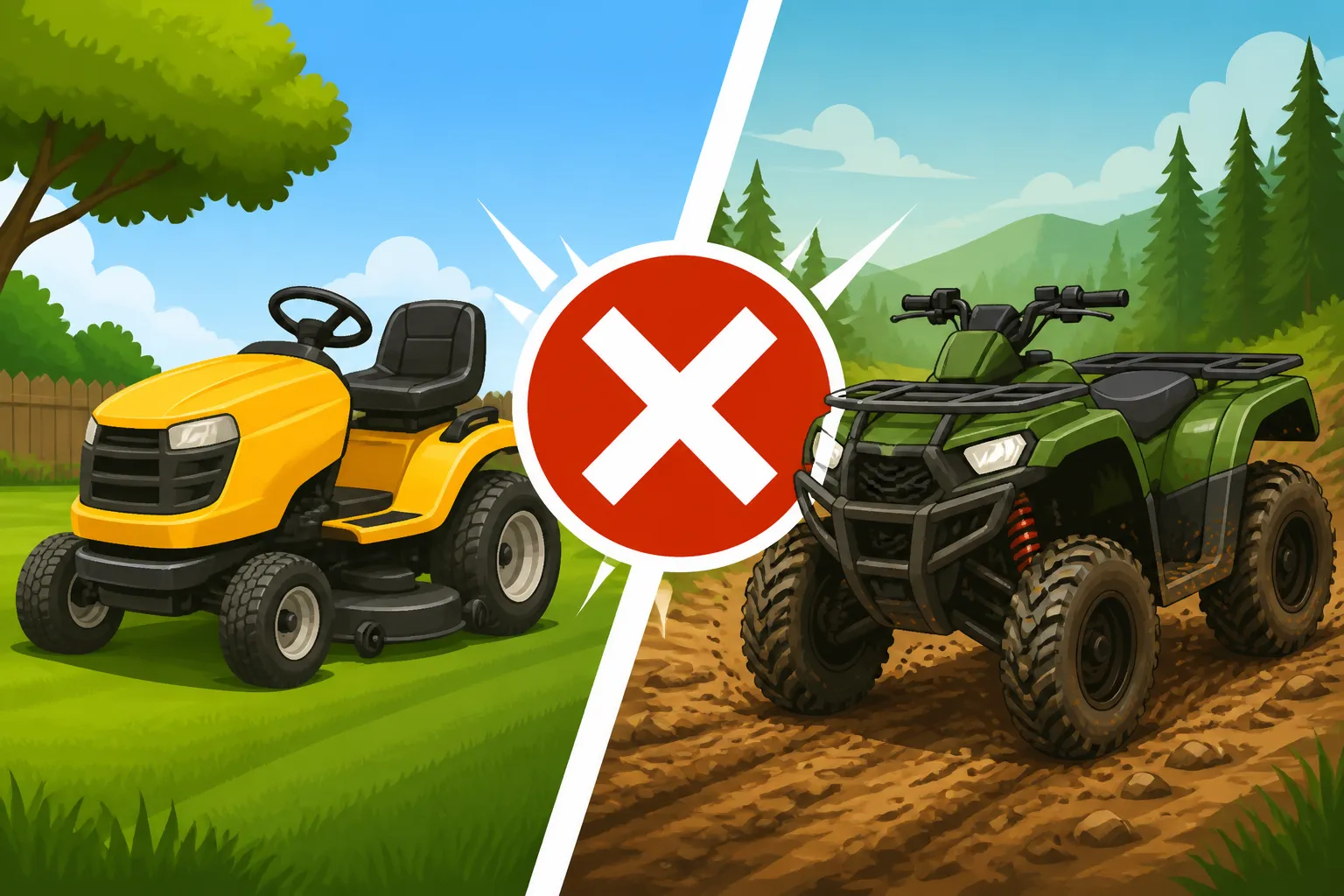
A lawn tractor, on the other hand, is built with a primary objective: efficiently cutting grass and performing light-duty yard work. Its design prioritizes maneuverability for mowing, ease of attachment for things like tillers or carts meant for gardening, and a comfortable, stable ride on mostly flat or gently sloping lawns. While you might use a powerful garden tractor to pull a small trailer of firewood or move some landscaping materials, these tasks are typically performed on relatively level, maintained surfaces. Its suspension and frame are not built for the impacts and stresses of true off-road environments.
Why This Distinction Matters for Ownership and Use
Understanding the legal difference between a lawn tractor and an ATV isn’t just an academic exercise; it has real, practical implications for how you own, operate, and even insure your equipment in Alabama. From paperwork to where you can actually ride, the distinction shapes your responsibilities and your rights.
Registration and Titling Requirements
Here’s where the rubber truly meets the road, or more accurately, where the lack of rubber on the road makes a difference. As of 2026, Alabama will begin titling new ATVs and side-by-sides. If you buy a brand-new ATV or UTV with a model year 2026 or newer, you’ll be applying for a title through your county probate office, processed through the state’s ALVIN system. This creates a clear, official record of ownership, which is crucial for proving who owns the machine and for preventing theft. Older machines, those from model year 2025 and earlier, typically won't be titled. You can learn more about this by reading [Alabama ATV Titling Starts With Model Year 2026] and [Alabama's ALVIN System and Off-Road Titles].
Lawn tractors, however, fall completely outside of these titling requirements. They are considered equipment, not vehicles in the same sense as ATVs. This means there's no state-mandated process to title a lawn tractor. For proving ownership, you'll generally rely on a bill of sale, original purchase receipts, or other private documentation. Similarly, while Alabama offers [Alabama's Voluntary ATV Registration Through ALEA] for ATVs, allowing owners to get a decal for public land use, there is no such registration option available for a lawn tractor. It's simply not part of the system.
Road Use and Public Land Access
This is often where the biggest misunderstandings arise. Neither a standard ATV nor a lawn tractor is generally considered "street legal" for operation on public roads in Alabama. The state has very strict rules about what constitutes a road-legal vehicle, aligning with federal safety standards that ATVs (and certainly lawn tractors) simply don’t meet. For a deeper dive into road rules for ATVs, you might find [Are ATVs Street Legal in Alabama?] helpful.
While some limited exceptions exist for ATVs, such as crossing a road or using them for legitimate farm purposes on certain public roads—which you can read more about in [Alabama Farm Use and Road Riding]—these exceptions are specifically crafted for ATVs and agricultural machinery, not lawn tractors. A lawn tractor's place is firmly on private property, tending to the land it was designed for. You wouldn't take your lawn tractor to a designated OHV park or riding trail, nor would you receive any benefits for trying to register it for public land use, as explored in [What Registering Gets You Before Riding Public Land]. Public land access rules are strictly for off-road vehicles that meet the specific definitions of an ATV or UTV.
Insurance and Liability
Insurance is another area where the distinction is critical. If you own an ATV, you can (and often should) purchase specific ATV insurance policies. These policies are designed to cover risks inherent in off-road riding, such as accidents on trails, theft, or liability if someone is injured while you’re operating your machine. While Alabama does not mandate insurance for ATVs in the same way it does for cars, it's a wise investment, as discussed in [Does Alabama Require Insurance on an ATV?]. You can also get coverage for untitled machines, which is relevant for many older ATVs; check out [Insuring a Machine With No Title] for more details.
Lawn tractors, conversely, are typically not insured with standalone vehicle policies. Instead, their use and any associated liability might be covered under your existing homeowner's insurance policy. This coverage is generally limited to incidents that occur on your private property or in the course of routine maintenance. Trying to use a lawn tractor in a way it wasn't intended—like taking it on an ATV trail—would likely void any potential insurance coverage and leave you personally liable for damages or injuries. It's a significant financial risk to ignore this difference.
Practical Scenarios: When Confusion Arises
The line between an ATV and a lawn tractor can sometimes feel blurry, especially when you consider modifications, private sales, or specific uses on farms. Let’s explore some common situations where this confusion pops up and clarify the Alabama legal perspective.
Converting or Modifying a Machine
It’s tempting, isn’t it? You’ve got a powerful garden tractor, and you think, "If I add some knobby tires, maybe a little lift kit, can I turn it into an off-road beast?" While you can physically modify a lawn tractor, doing so will not magically transform its legal classification into an ATV. The core design, frame, and safety standards it was built under remain unchanged. It's still a lawn tractor, just a modified one.
This is a crucial point because it directly relates to legal compliance. Just as you can't simply slap a "street legal kit" on an ATV and expect it to be legal for road use (as explained in [Why a Street Legal Kit Will Not Make It Legal]), you can't retrofit a lawn tractor to meet ATV standards. These machines are engineered for entirely different purposes, and their fundamental construction reflects that. Modifications might make your lawn tractor more capable on certain terrains, but they won't alter its legal standing in Alabama.
Selling or Buying a Used Machine
When you're dealing with private sales, clear documentation is paramount. If you're selling a lawn tractor, a straightforward bill of sale is typically sufficient to transfer ownership. It should include the machine's make, model, serial number (if available), the sale price, and the names and signatures of both buyer and seller. Resources like LawDepot can be incredibly helpful for creating robust, legally sound bills of sale quickly and easily. This helps both parties, offering protection and clarity should any questions of ownership arise later.
For ATVs, especially with the upcoming titling requirements, the paperwork trail is becoming more involved. For pre-2026 model year ATVs, you still need a solid bill of sale, and verifying the serial number is critical. [Alabama Bill of Sale Requirements] outlines what needs to be on that document. For those who bought an older machine at a farm sale with minimal paperwork, proving ownership can be tricky, as discussed in [Proving Ownership of a Quad Bought at a Farm Sale]. For machines model year 2026 and newer, a title will eventually be the primary proof of ownership. This fundamental difference in required documentation highlights the legal distinction between the two types of machines. Whether it's a lawn tractor or an ATV, using a service like LawDepot for your purchase agreements ensures you have proper proof of sale.
Farm or Property Use
Many people use both ATVs and lawn tractors on their farms or large properties, which can lead to confusion about their legal status. Alabama law does have specific exclusions for farm equipment, generally meaning that certain machines used exclusively for agricultural purposes on a farm are exempt from many regulations that apply to recreational vehicles. For example, you can learn more about [Alabama Excludes Farm Equipment] from the state's ATV chapter. While an ATV might sometimes qualify for this "farm equipment" designation if used solely for agriculture, and even benefit from specific agricultural registration tiers like [Alabama Registration for a Farm Machine], a lawn tractor is typically just equipment within the farm context, not a "vehicle" that needs to navigate these specific regulations.
The practical use of both machines on a farm underscores their distinct roles. An ATV might be used for checking fences across rough pastures, hauling tools to a remote field, or even retrieving game during hunting season. A lawn tractor's primary role remains maintaining the grounds, mowing orchards, or towing a sprayer for weed control on relatively level land. If you're managing a farm and need various legal documents, from land leases to equipment transfers, remember that services like LawDepot can provide templates tailored to your needs, whether for agricultural equipment or other assets.
Common Misconceptions and Legal Realities
Despite the clear legal definitions, certain misconceptions persist about lawn tractors and their relationship to ATVs. It’s vital to address these head-on to prevent potential legal issues or safety hazards.
The "Small Vehicle" Trap
Just because a machine is motorized, relatively small, and can operate off paved roads doesn't automatically classify it as an ATV in Alabama. This is a common trap where people group all "non-car" motorized vehicles together. Consider golf carts, for instance. They are also motorized, used on private property, and sometimes even on designated public streets in certain communities, yet Alabama explicitly [Alabama Excludes Golf Carts From the Chapter] from its off-road vehicle statute. This means a golf cart isn't an ATV, and its rules of operation are entirely separate. In fact, [Why a Golf Cart Is Not an ATV in Alabama] explains this difference in detail.
The same logic applies to a lawn tractor. Its design, intended use, and the specific legal language used in Alabama statutes clearly place it in a different category than an ATV or UTV. Equating them based on their "small vehicle" status overlooks crucial legal distinctions that carry real consequences for owners.
Enforcement and Penalties
Operating any motorized vehicle outside of its legal parameters can lead to penalties. If you were to somehow take a lawn tractor onto a public ATV trail that is clearly designated for OHVs, you could face issues. Park rangers or local law enforcement would likely view it as operating an unauthorized vehicle in a restricted area, potentially leading to fines or having your equipment impounded.
Moreover, regardless of the type of machine, trespass laws in Alabama are strict. Riding any motorized vehicle, be it an ATV or a lawn tractor, on private property without permission is illegal and can lead to charges. [Alabama Trespass Law for Riders] clarifies that knowing and respecting property lines and obtaining proper permission is crucial for all riders. The consequences of illegal riding or operating an unauthorized vehicle in a designated area apply across the board, making it essential to understand the correct classification of your machine and where it is legally permitted to operate.
To summarize the key differences between a lawn tractor and an ATV in Alabama:
| Feature | Lawn Tractor | All-Terrain Vehicle (ATV) |
|---|---|---|
| Primary Purpose | Mowing grass, light yard work, property maintenance | Off-road recreation, utility tasks on challenging terrain |
| Alabama Legal Status | Agricultural/yard equipment, not a regulated OHV | Defined as an Off-Highway Vehicle (OHV) |
| Titling (2026 onwards) | Not Titled | Required for new machines (Model Year 2026+) |
| Registration | Not Registered | Voluntary registration available through ALEA |
| Road Use | Not legal for public roads | Not generally street legal, limited exceptions apply |
| Public Land Access | Not permitted on OHV trails/areas | Permitted in designated OHV areas |
| Insurance Coverage | Typically via homeowner's policy | Specific ATV/OHV insurance recommended/available |
| Key Differentiators | Turf tires, mowing deck, seating for grass cutting | Low-pressure tires, robust suspension, off-road focused |
Disclaimer
This article is for general informational purposes only and does not constitute professional advice. Laws, prices and regulations vary by location and change over time. Consult a qualified professional for guidance on your specific situation.