Alabama ATV Width and Weight Limits
It can be incredibly confusing to figure out the exact rules for your ATV or UTV in Alabama, especially when it comes to something as fundamental as its size. Many riders find themselves scratching their heads, wondering if their machine is too wide for certain trails or too heavy for a specific classification. This guide is here to untangle the specifics of Alabama's width and weight limits for your off-road machine, helping you understand where you can ride and what rules apply. We'll dive into the legal definitions, the practical implications for public land access, and why these numbers are critical for everything from trail choice to potential road legality.
Understanding Alabama's Core Definitions for ATVs and UTVs
Alabama law, like that of many states, defines off-road vehicles with specific parameters for width and dry weight. These aren't just arbitrary numbers; they're the foundational criteria that determine how your machine is classified, and subsequently, where and how you can operate it. Getting these definitions straight is the first crucial step for any ATV or UTV owner in the state. Without this clarity, you might unknowingly find yourself on the wrong side of a park regulation or, worse, a state statute.
What Counts as an All-Terrain Vehicle ATV
When we talk about an All-Terrain Vehicle, or ATV, Alabama has a pretty clear picture in mind. The statute typically defines an ATV as a motorized, off-highway vehicle designed to travel on three or more low-pressure tires, generally having a seat designed to be straddled by the operator and handlebars for steering control. But beyond that general description, specific dimensions come into play.
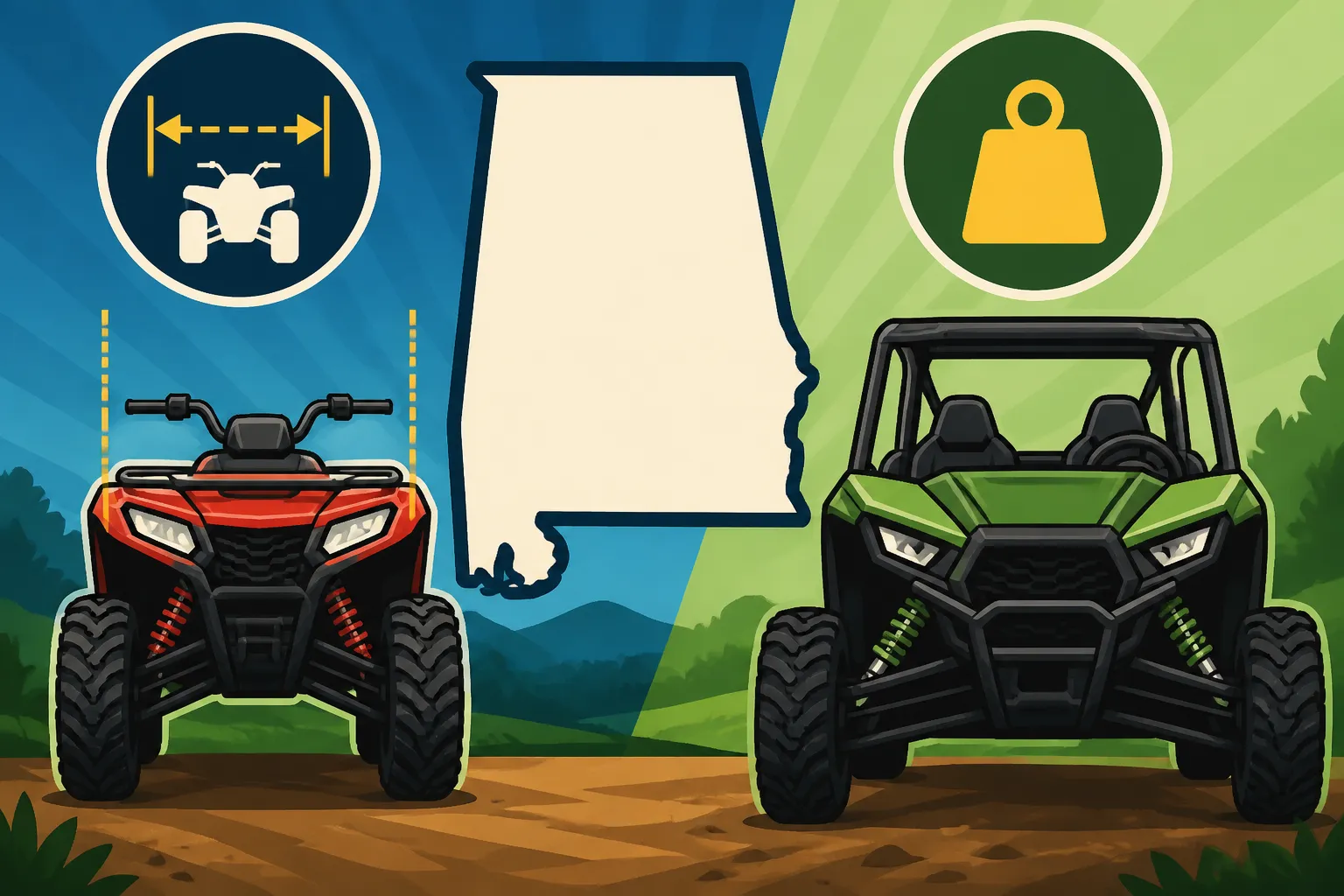
Crucially, an ATV is often limited to "60 Inches and 1,500 Pounds" dry weight. This 60-inch width limit is measured from the widest point of the machine, usually across the tires, and the 1,500-pound dry weight limit means the vehicle's weight without fuel, oil, or coolant. These aren't just suggestions; they are the legal boundaries that differentiate an ATV from other types of off-road machines, especially the larger side-by-sides. If your quad exceeds these dimensions, it may not legally be classified as an ATV under state law, which can have ripple effects for everything from registration to trail access.
It's also important to remember that the definition of an ATV in Alabama often includes the phrase "Non-Highway Tires in the Definition." This means the tires are specifically designed for off-road use, not for highway speeds or conditions. This detail reinforces the machine's intended use and helps to further distinguish it from vehicles that might otherwise look similar but are built for on-road travel. Understanding these core specifications is vital for every rider, as it sets the stage for how your machine is viewed by authorities and park operators across the state.
Distinguishing a Recreational Off-Highway Vehicle ROV UTV
Then we move on to the Recreational Off-Highway Vehicle (ROV), more commonly known as a Utility Terrain Vehicle (UTV) or side-by-side. These machines generally offer a different riding experience, often with steering wheels, foot pedals, and side-by-side seating, hence the nickname. Just like ATVs, ROVs have their own distinct width and weight parameters that legally set them apart.
For ROVs, Alabama law typically allows for a wider machine, often up to "80 Inches for a Side-by-Side." This larger width accommodates their multi-person seating and cargo capabilities, making them popular for everything from trail riding with friends to hauling gear on a hunting trip. The dry weight limit for an ROV is also significantly higher, usually around "3,500 Pounds Dry for a Side-by-Side." These figures reflect the more robust construction and greater utility of these vehicles compared to traditional ATVs. Knowing these limits is especially critical when purchasing a new machine or when trying to determine if your existing UTV fits within the legal definition.
It's worth noting that Alabama has had "Alabama's Conflicting ROV Weight Figures" in different parts of its statutes, which can certainly add to the confusion for owners. While the general definition often cites the 3,500-pound dry weight, other sections might mention different figures, sometimes related to specific uses or older interpretations. This is why it's always a good idea to check the most current information or consult with an official if you are right on the edge of a weight limit. These discrepancies highlight the importance of staying informed and understanding that even within state law, nuances exist that can impact your machine's classification.
Why These Definitions Matter for Riders
You might be thinking, "Why do these exact measurements and weights matter so much?" The answer is simple: they dictate almost everything about your off-road experience in Alabama. These precise legal definitions are the foundation upon which all other regulations are built, affecting everything from where you can actually take your machine to how it might be registered. Ignoring them is like trying to build a house without checking the foundation – eventually, you'll run into problems.
Firstly, these definitions directly influence where you can ride. Many public lands, parks, and even private trail systems have gate widths or trail restrictions that are designed around these legal classifications. A machine that's too wide, for example, might simply not fit through a designated trail entrance, effectively barring you from that area. Furthermore, understanding the difference between an ATV and an ROV is crucial for topics like [Alabama's ATV and ROV Legal Definitions] and how they apply to specific rules for different machine types. These distinctions can impact everything from required safety equipment to permissible operating hours in certain areas.
Secondly, these classifications play a significant role in administrative processes, particularly in the realm of ownership and usage. While Alabama's titling law for ATVs and UTVs starts with Model Year 2026, the underlying definitions for what constitutes an ATV versus an ROV will still be essential for proper titling and subsequent registration. For older machines, even if they aren't titled, their classification dictates how they interact with voluntary registration options. Moreover, understanding whether your machine falls under the ATV or ROV definition can even influence choices like [Alabama Public Use Versus Private Use] registration tiers, as the expectations and permissible uses for each machine type can differ. Getting these foundational definitions correct ensures you're riding legally and responsibly, avoiding potential fines or misunderstandings with authorities.
The Impact of Width and Weight on Riding Public Lands
Once you understand how your ATV or UTV is legally defined by its width and weight, the next critical step is to understand how these numbers directly affect your access to Alabama's beautiful public riding areas. It's not just about what your machine is on paper; it's about what it can do and where it can go in the real world. Ignoring these practical limitations can lead to frustration, wasted trips, or even citations.
Trail Access Restrictions in Parks and WMAs
Perhaps the most immediate and tangible impact of your machine's width and weight is on trail access within Alabama's public parks and Wildlife Management Areas (WMAs). Many of these areas have specific rules designed to protect the environment, manage trail traffic, and ensure rider safety, and these rules often involve physical barriers. It's not uncommon to find gates or bollards at trailheads that are precisely 60 inches wide, effectively allowing ATVs through but blocking wider side-by-sides.
Take [Stony Lonesome OHV Park in Alabama] as an example. With its vast network of trails, you'll find different sections catering to various machine types, but even within such a large park, certain trails or access points might have width restrictions. Similarly, places like [Minooka Park Riding in Alabama] will have their own set of guidelines. Imagine driving for hours to a riding park, only to find that your new 72-inch wide UTV cannot access half the trails because of physical barriers. This is a common and incredibly frustrating scenario for riders who haven't done their homework. Understanding "Why Your Machine Is Too Wide for Stony Lonesome" or other parks before you load up your trailer is paramount.
For WMAs, the rules can be even more stringent. [Alabama WMA Riding Rules] often limit machines to designated roads or trails, and even then, there might be width or weight restrictions to prevent damage to sensitive ecosystems or to keep larger machines off paths intended for smaller vehicles. These restrictions are put in place for a reason – to maintain the integrity of the natural landscape and ensure sustainable use for all outdoor enthusiasts. Always check the specific park or WMA's regulations before you go; what's allowed in one area might be strictly prohibited in another.
Navigating Designated Versus Undesignated Routes
The width and weight of your off-road machine also dictate your ability to navigate different types of routes, particularly when it comes to the distinction between designated public areas and more informal or undesignated trails. This differentiation is a cornerstone of responsible public land use and can significantly impact where you can legally and safely ride in Alabama.
On federal lands, such as national forests, the rules often specify that off-road vehicles are confined to designated routes. These are typically marked forest roads or trails that are managed for vehicular traffic. The size of your machine, particularly its width, will determine which of these routes are even accessible. A wider ROV might be limited to forest roads, whereas a narrower ATV might be able to access single-track trails if they are explicitly designated for such use. [Can You Ride an ATV in Alabama's National Forests?] is a question that requires a thorough understanding of these designated routes and their specific width limitations, which often change by district or even by season.
Conversely, riding on undesignated routes or attempting to create new trails is generally frowned upon and often illegal. These areas are not maintained for motorized use and may not be able to handle the weight or width of an off-road vehicle without causing significant environmental damage or erosion. When considering [What Counts as a Designated Public Area in Alabama], remember that the definition almost always implies established, marked, and maintained routes. Straying from these not only risks damage to the environment but also potential fines and the closure of access for all riders. Understanding your machine's dimensions helps you identify which parts of a public area are genuinely open to you, ensuring you respect the land and the rules.
Equipment Checks and Enforcement on Public Ground
It's not just about theoretical limits; park rangers, WMA officials, and even local law enforcement are equipped to verify that your machine complies with published width and weight regulations. When you pull up to a trailhead or are encountered on a public trail, don't be surprised if your machine's dimensions become a point of inquiry. [Alabama Equipment Checks by Deputies] can happen, and they're not just looking for safety gear or registration decals.
Authorities might use physical measuring tapes to check width, especially at gates or entry points where a machine barely fits. While they might not carry portable scales for instant weight verification, they are often familiar enough with common models to know if a particular machine, especially one that has been heavily modified, clearly exceeds standard limits. If your machine is visibly much wider or heavier than the limits for a specific trail or area, you could be asked to leave, denied entry, or even face a citation. This can be a significant inconvenience, especially if you've traveled a long distance to ride.
The enforcement of these limits is ultimately about safety and resource protection. Oversized or overweight machines can damage trails not designed for them, create safety hazards for other users, and contribute to environmental degradation. Therefore, being prepared to demonstrate your compliance by knowing your machine's specs and having appropriate documentation is always a good idea. This proactive approach ensures a smoother and more enjoyable experience when venturing out onto Alabama's public lands.
Road Use and the Federal Standard Barrier
This is where things often get incredibly confusing and, frankly, quite frustrating for many ATV and UTV owners in Alabama. The dream of simply hopping on your quad or side-by-side and heading down the road to a gas station or a friend's house is, for the vast majority of machines, just that: a dream. The core issue lies in federal regulations that create a significant barrier, largely rooted in how these vehicles are manufactured and their inherent width and weight characteristics.
Why Most ATVs and UTVs Aren't Street Legal
The fundamental reason most ATVs and UTVs aren't street legal in Alabama, or anywhere else for that matter, comes down to a set of federal motor vehicle safety standards (FMVSS). These standards, particularly "Federal Standard 500 in Plain English" (officially 49 CFR 571.500), were established for low-speed vehicles (LSVs) and effectively draw a line in the sand between vehicles designed for highways and those designed strictly for off-road use. Your typical ATV or UTV is manufactured as an off-road machine; it does not meet the federal requirements for things like crashworthiness, lighting, braking, and emissions that are mandatory for vehicles driven on public roads.
The width and weight of these machines play a significant role here. While an ATV might be a "60 Inches and 1,500 Pounds" machine, and an ROV "80 Inches for a Side-by-Side" and "3,500 Pounds Dry for a Side-by-Side," these dimensions alone don't confer street legality. In fact, their very design—wide stance, knobby tires, high ground clearance—is antithetical to the stability and safety requirements for on-road vehicles. As a result, Alabama, like most states, prohibits their use on public roads unless they fall into a very specific, federally compliant category, or a local ordinance makes a narrow exception for a very limited scope of use. This is why when people ask "Are ATVs Street Legal in Alabama?", the answer is almost universally "no" for typical off-road models.
The bottom line is that your standard quad or side-by-side simply wasn't built with road safety in mind according to federal guidelines. It's a harsh reality, but an important one for owners to grasp. As the title [Why a Standard Quad Can Never Pass the Standard] implies, the manufacturing intent and design specs of these machines fundamentally prevent them from meeting the stringent requirements necessary for regular road use. This isn't just a state rule; it's a deep-seated federal distinction that shapes vehicle design and classification.
Low-Speed Vehicle LSV Classifications
While the vast majority of ATVs and UTVs aren't street legal, there's a distinct category of vehicles that are designed to be street legal at lower speeds: the Low-Speed Vehicle (LSV). These vehicles are built from the ground up to meet the federal safety standard 49 CFR 571.500, which includes specific width and weight limits, along with a host of other requirements.
An LSV typically has a top speed of 20-25 mph, and its width and weight are generally within certain parameters to ensure it can operate safely on roads with lower speed limits. [Alabama Low-Speed Vehicle Rules] detail the specific requirements for these machines, which often include headlamps, tail lamps, turn signals, stop lamps, reflex reflectors, mirrors, a parking brake, VIN, and even safety belts. Crucially, they must be manufactured to meet these federal standards, not simply modified after the fact. The designation "Why 25 mph Is the Legal Line" is key here, as exceeding this speed disqualifies a vehicle from the LSV category, pushing it into a different, more stringent class of motor vehicle.
So, if you're looking for a small, open-air vehicle that you can legally drive on certain public streets in Alabama, an LSV might be what you're actually after, rather than trying to make an ATV or UTV fit the bill. Understanding [What a Low-Speed Vehicle Standard Requires] helps clarify that these are fundamentally different machines from your typical off-road quad or side-by-side. They are purpose-built for low-speed road use, and their width and weight are integral to meeting those specific federal guidelines.
The Problem with "Street Legal Kits"
This is a common pitfall and a source of much misunderstanding: the allure of "street legal kits" for your ATV or UTV. You've probably seen them advertised: kits promising to add all the necessary lights, mirrors, and horns to transform your off-road machine into a road-legal vehicle. While these kits might give your machine some of the accessories required for road use, they fundamentally fail to address the core federal safety standards and design limitations that prevent most ATVs and UTVs from being truly street legal.
The critical issue is that simply adding a turn signal or a rearview mirror doesn't change how your machine was manufactured or what federal safety tests it has passed. Your ATV or UTV, with its distinct width, weight, suspension, and chassis design, was not built to conform to the crashworthiness, braking, and emissions standards for highway vehicles. Therefore, adding a "street legal kit" does not magically reclassify your machine under federal law. It doesn't allow it to meet "Alabama's Federal Standard Barrier to Road Use." In fact, it often gives owners a false sense of security, potentially leading to citations or worse if they are stopped by law enforcement.
This is why we stress [Why a Street Legal Kit Will Not Make It Legal]. Unless your vehicle was manufactured as a Low-Speed Vehicle (LSV) or a traditional motor vehicle from the outset, no aftermarket kit can overcome the fundamental design and federal compliance hurdles. It's a costly misconception that can lead to disappointment and legal trouble. Always remember that road legality is determined by manufacturing standards, not by bolt-on accessories.
Exclusions and Special Use Cases
While Alabama's width and weight limits define what generally constitutes an ATV or UTV, it's equally important to understand what doesn't fall under these classifications. There are specific categories of vehicles that, despite sometimes sharing visual characteristics with off-road machines, are explicitly excluded from these rules or have their own unique set of regulations due to their primary purpose or design. Knowing these exclusions can prevent misclassification and ensure you're following the correct guidelines for your specific vehicle.
Agricultural and Farm Equipment Exemptions
Alabama's statutes recognize that some vehicles are primarily used for work, specifically in agriculture, and provides specific exemptions for them. If your machine's primary purpose is bona fide agricultural activity, it might be exempt from certain ATV/UTV classifications and registration rules, even if its width or weight might otherwise fall into those categories. This is a common and very practical exemption in a state with a strong agricultural presence.
For example, a UTV that is consistently used for hauling feed, checking fences, or transporting tools across a farm might be considered [Farm Equipment Under the Definition]. This means that its operation on private farm property, or even limited crossings on public roads directly related to farm work, may not be subject to the same strict regulations as recreational off-road use. [Alabama Excludes Farm Equipment] from the specific chapter of law that governs recreational ATVs and ROVs, which is a significant distinction. This exemption acknowledges that farmers often rely on these machines as essential tools for their livelihood.
However, it's crucial to understand that this exemption is not a blanket pass for all uses. If a farmer takes their "farm machine" out for recreational trail riding on a public OHV park, those recreational rules will likely apply. The exemption primarily covers the machine when it's genuinely engaged in agricultural work. For questions about [Alabama Registration for a Farm Machine] and how the 1.5 percent farm equipment sales tax rate might apply, it's always wise to consult with your county officials to ensure you meet all criteria for the exemption.
Golf Carts and Other Excluded Vehicles
Another common area of confusion arises with vehicles like golf carts. They are motorized, often ride on low-pressure tires, and can sometimes resemble smaller UTVs. However, Alabama law explicitly classifies them differently from ATVs and ROVs. This is a critical distinction that affects everything from where they can be operated to whether they require any form of registration.
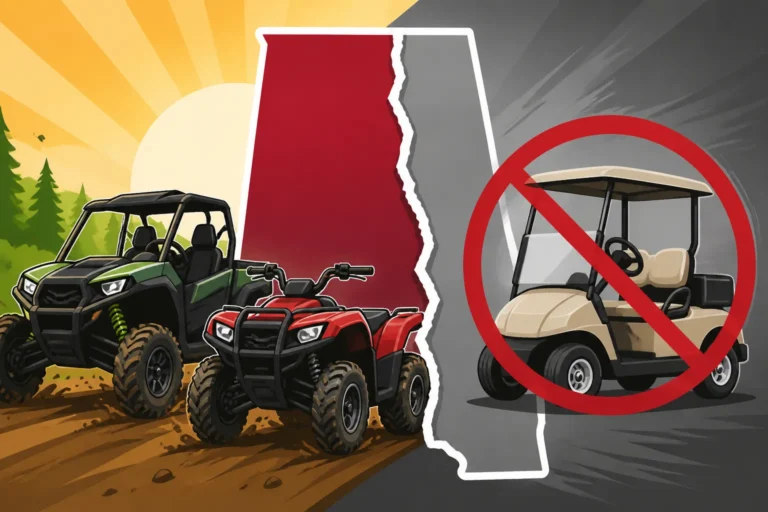
The main reason is that Alabama "Excludes Golf Carts From the Chapter" that defines and regulates ATVs and ROVs. A golf cart's design, typical speed, and intended use for golf courses or private communities set it apart. They do not meet the definitions of either an ATV or an ROV, primarily because they are not designed for rugged off-road terrain or high performance. This is why you'll often find specific local ordinances in towns and cities that permit golf cart use on certain streets, entirely separate from any ATV/UTV regulations. [Why a Golf Cart Is Not an ATV in Alabama] stems from these distinct legislative classifications.
Beyond golf carts, other motorized vehicles like lawn tractors or industrial utility vehicles designed for specific tasks (e.g., airport baggage tugs) are also typically excluded from the ATV/ROV definitions. These machines have their own operational contexts and rarely, if ever, fall under the purview of off-road vehicle statutes. Understanding these exclusions ensures that you're applying the correct set of rules to your vehicle, avoiding unnecessary confusion or misinterpretation of the law.
Practical Considerations for Overweight/Oversized Machines
What if you own a highly customized UTV that pushes or even exceeds the typical "80 Inches for a Side-by-Side" or "3,500 Pounds Dry for a Side-by-Side" limits? While Alabama's statutes provide general definitions, the reality is that many aftermarket modifications can push machines beyond these manufacturer specifications. This can lead to a host of practical challenges that riders must consider.
One major hurdle for an oversized machine is restricted trail access. As discussed earlier, many riding parks and public land areas have physical barriers or internal rules against vehicles exceeding certain dimensions. You might find your heavily modified, extra-wide side-by-side simply unable to navigate certain sections of trails or even enter the park itself. This means your riding options become severely limited, potentially making your investment in a larger machine less versatile than you hoped.
Furthermore, transport becomes a bigger issue. An exceptionally wide or heavy machine might require a specialized trailer, or it might exceed the legal width limits for transport on public roads, even on a trailer. This can lead to the need for special permits or simply make it much harder and more expensive to haul your machine to riding areas. Lastly, while less direct, machines that fall outside standard classifications can sometimes face challenges with insurance. While [Alabama Insurance for an Untitled Machine] is already a consideration for many, an unusual size or weight might prompt additional questions from insurers, potentially affecting coverage or premiums. Always consider the full lifecycle costs and limitations of an oversized or overweight machine before making significant modifications or purchases.
Navigating Documentation and Proof of Compliance
Understanding the legal definitions and practical implications of width and weight limits is essential, but it's equally important to be able to prove your machine complies. In situations ranging from park entry checks to law enforcement encounters, having the right documentation and knowing your vehicle's exact specifications can save you a lot of hassle. This section will guide you through how to prepare for such scenarios.
Understanding Manufacturer Specifications
The most authoritative source for your ATV or UTV's width and weight is its manufacturer. Every new machine comes with a set of specifications that outline its exact dimensions, dry weight, engine size, and other critical details. These are the numbers that state agencies and park operators will refer to when determining if your vehicle meets their criteria. If you have any doubt about your machine's classification, always start with the official specs.
These specifications are typically found in your owner's manual or on a data plate affixed to the machine itself. For newer machines, this information is usually clear and readily accessible. When you fill out forms like those for [Alabama Registration Paperwork Explained], having these manufacturer details on hand ensures accuracy. Even if you don't need to list the precise width and weight on every document, knowing them internally helps you confirm your machine's compliance with other regulations.
For older machines or those purchased through a private sale, you might need to do a bit more digging. If the owner's manual is lost, you can often find specifications online by searching for your specific make, model, and year. The key is to rely on official manufacturer data, not anecdotal evidence or estimates. This forms the bedrock of proving your machine's legal classification and suitability for various riding conditions. Your [Alabama Purchaser's Certificate Requirements] or [Alabama Bill of Sale Requirements] might also contain or refer to these specifications, solidifying the initial record of your machine's details.
When to Measure Your Machine
While manufacturer specifications are the gold standard, there are definitely times when physically measuring your machine becomes a wise, if not necessary, step. This is especially true for older models where documentation might be scarce, or for any machine that has undergone significant modifications. Don't just assume your machine fits; verify it.
You should consider measuring your machine in a few key scenarios. Firstly, if you're planning to visit a new riding park or WMA that lists specific width or weight restrictions, and you're unsure if your machine will comply. It's far better to know definitively before you load up and drive hours, only to be turned away at the gate. Secondly, if you've made aftermarket modifications like installing wider tires, wheel spacers, or a lift kit that might alter the factory width or height. Even seemingly minor changes can push a machine over the limit.
Accurate measurement is crucial. For width, measure from the outermost edge of your tires, including any bulge, while the tires are properly inflated. For weight, a truck scale or a specialized ATV/UTV scale is ideal for dry weight. If you're near a commercial weighing station, they can often provide an accurate weight measurement for a small fee. This proactive step helps you avoid unpleasant surprises and ensures you're riding within the established parameters for your chosen destination.
Maintaining Records for Verification
Having accurate information about your machine's width and weight is one thing; being able to present that information quickly and clearly is another. Maintaining good records is a simple yet effective way to ensure smooth sailing when dealing with park officials, law enforcement, or even when selling your machine. These records serve as your proof of compliance and ownership.
Consider keeping a digital or physical folder with essential documents. This should include a copy of your bill of sale (which often lists basic specs), the owner's manual (or at least the pages with key specifications), and any registration paperwork. For those looking for generic templates for important documents like a bill of sale, resources like LawDepot can offer various forms that help you organize essential information about your machine, including its make, model, year, and serial number, which can often be cross-referenced with manufacturer specs. While LawDepot doesn't store your specific ATV's details, it provides the framework to create clear and complete records.
In a scenario where you're asked about your machine's dimensions at a trailhead, being able to quickly pull up a photo of the spec page from your manual on your phone, or refer to a well-organized [Alabama Bill of Sale Requirements] document, can instantly clarify the situation. This level of preparedness eliminates doubt and shows officials that you're a responsible rider. For situations like [Proving You Own an Untitled Machine], comprehensive records of purchase and specifications are even more vital, providing a clear history of your machine. Don't underestimate the power of good documentation; it's your best defense against misunderstandings or challenges regarding your machine's legal status.
Here's a quick reference table to help visualize the key differences in width and weight between typical ATVs and ROVs in Alabama:
| Feature | All-Terrain Vehicle (ATV) | Recreational Off-Highway Vehicle (ROV/UTV) |
|---|---|---|
| Width | Generally up to 60 inches | Generally up to 80 inches |
| Dry Weight | Typically up to 1,500 pounds | Typically up to 3,500 pounds |
| Seating | Straddled seat, handlebars | Side-by-side bucket seats, steering wheel |
| Tires | Non-highway low-pressure tires | Non-highway low-pressure tires |
| Purpose | Single-rider or small utility/recreational | Multi-passenger, heavy utility/recreational |
Disclaimer
This article is for general informational purposes only and does not constitute professional advice. Laws, prices and regulations vary by location and change over time. Consult a qualified professional for guidance on your specific situation.