Alabama Spark Arrestor Requirements
Alabama riders often assume a spark arrestor is either required on every ATV and UTV or nowhere at all. The practical answer depends on where you ride: federal forest rules, public-land conditions, and private park policies can differ. Here’s how to check your machine, avoid relying on a stock muffler’s appearance, and confirm the rule before unloading.
What Alabama’s spark-arrestor requirements mean
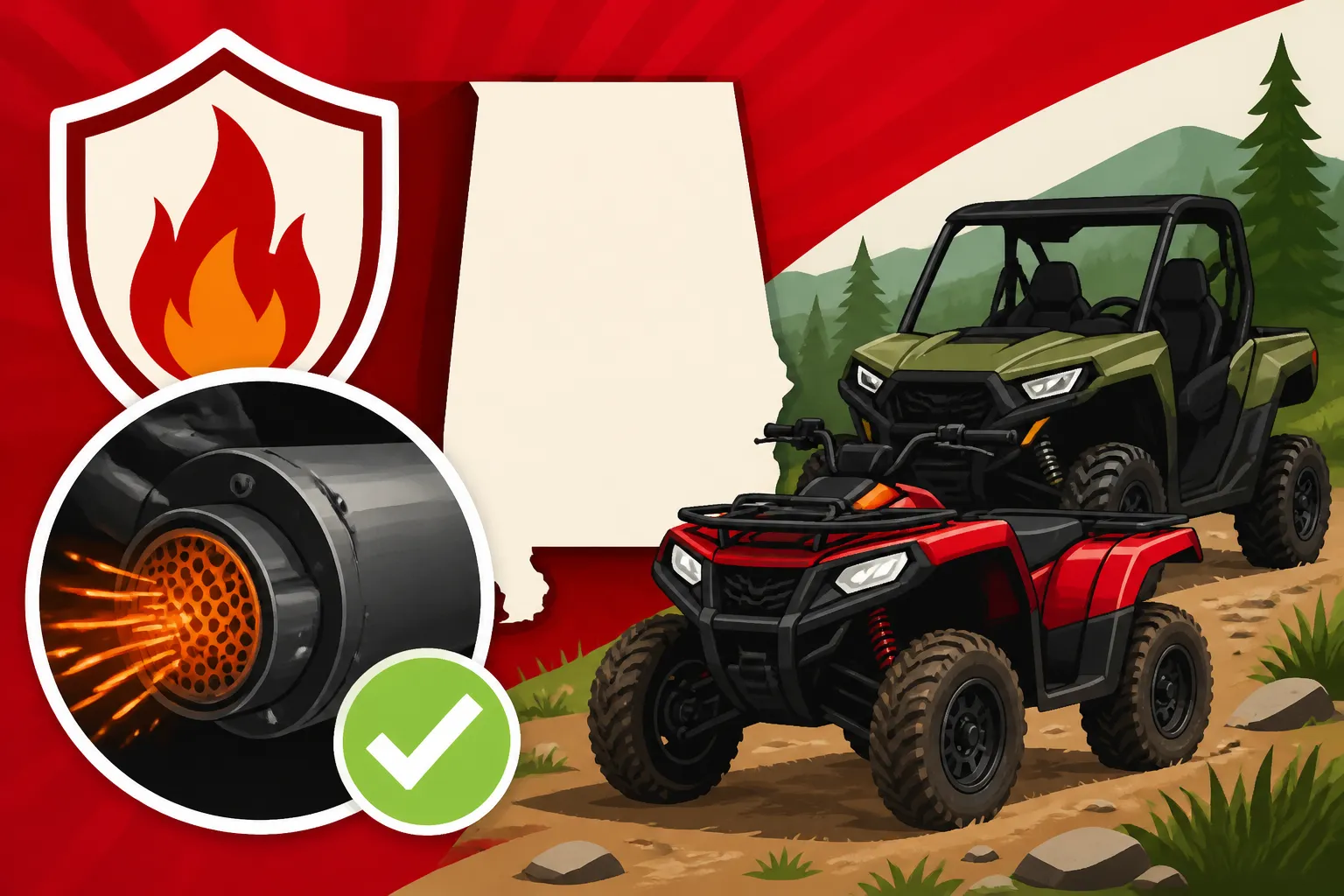
A spark arrestor is a device in an engine’s exhaust system that helps keep hot particles from escaping and starting a fire. It is not the same thing as a muffler. A muffler controls noise; a spark arrestor is intended to reduce the chance of burning debris leaving the exhaust. Some exhaust systems combine both functions, but you should not assume that any muffler automatically provides spark-arrestor protection.
There is not one simple rule that makes every spark-arrestor requirement in Alabama identical. The rule can depend on the land you are using and the conditions in effect there. Federal land, state-managed public land, and private riding areas may have different requirements. A rule that applies on one trail system may not apply on your own property, and a machine that passes a basic inspection at one park may need different documentation at another.
For riders using National Forest System lands, federal regulations generally require an effective spark-arresting device on an internal-combustion engine, with exceptions such as motorboats. That means Alabama’s national forests are an important place to check before riding. The device must be properly installed, maintained, and working; a missing or damaged screen is not a useful spark arrestor simply because the machine originally came with one.
Alabama has several national forests, including Bankhead, Conecuh, Talladega, and Tuskegee. But knowing that a ride is in a national forest is only the first step. You also need to confirm that the specific road or route is open to your type of machine and that no temporary closure or fire restriction changes what is allowed. See Which Forest Roads in Alabama Are Open to ATVs and Alabama National Forest Riding Permits before planning a federal-land ride.
On other public land, check the rules for the specific area instead of assuming the federal rule applies in exactly the same way. Wildlife management areas, for example, have area-specific regulations and access conditions. A permit by itself does not necessarily answer whether your machine needs a spark arrestor or which roads you can use. Review Alabama WMA Riding Rules and the current information for the tract you plan to visit.
Private riding parks set their own operating rules, subject to any applicable laws. A park may require an intact spark arrestor, prohibit certain exhaust modifications, or check the exhaust at the entrance. Another park may have different inspection procedures. Read the park’s current rules or contact its office before you travel; Alabama Private Park Waivers and Rules explains why a park’s own requirements matter alongside state and federal rules.
| Where you ride | What to verify about the spark arrestor |
|---|---|
| National forest land | Check the applicable Forest Service requirements, route access, closures, and current fire restrictions |
| A wildlife management area | Check the current area rules and the requirements for the specific tract |
| A private OHV park | Ask the park whether it requires a spark arrestor, inspection, or specific exhaust equipment |
| Private property | Check applicable local rules, fire conditions, and any requirements imposed by the landowner |
| An organized ride or event | Confirm the organizer’s equipment rules as well as the rules for the land being used |
This distinction matters because “Alabama requires it” and “this place requires it” are not interchangeable statements. Even when there is no single requirement for every private-property ride, a land manager or park can still make a spark arrestor a condition of access. Fire danger can also lead to temporary restrictions that are separate from the ordinary equipment rule. Check Alabama Fire Restrictions in Dry Months when conditions are dry or a burn restriction may be in effect.
How to tell whether your ATV or UTV has a working spark arrestor
Start with the owner’s manual and the exhaust-system documentation for the exact year, make, and model. Look for a clear statement that the exhaust includes a spark arrestor, not just a muffler or a noise-control system. If the exhaust has been replaced, modified, or repaired, the original manual may no longer describe the parts currently installed.
The exhaust outlet can offer clues, but appearance alone is not proof. A visible screen may be part of the spark-arresting system, yet an owner should not assume that every screen qualifies. Likewise, a quiet machine may still lack a spark arrestor. Look for manufacturer documentation or markings that identify the component and its intended function. If you cannot identify it, ask the machine manufacturer, an authorized dealer, or the land manager what documentation they will accept.
Check the whole exhaust system, not only the outlet. A device can be ineffective if it is loose, damaged, removed, clogged, or altered. Avoid drilling, cutting, or removing components to increase exhaust flow unless you have confirmed that the change will not defeat a required spark-arresting function. A modification that seems minor can create trouble at a gate inspection or leave you unable to show that the machine meets the applicable rule.
A practical pre-ride inspection includes:
- Identify the installed exhaust. Check whether it is original or aftermarket, and note the manufacturer and part details.
- Confirm the spark-arrestor function. Use the manual, product documentation, or a knowledgeable service professional rather than guessing from appearance.
- Inspect for damage or changes. Look for a missing screen, loose parts, an altered outlet, excessive buildup, or signs that a required component has been removed.
- Follow the manufacturer’s maintenance instructions. Clean or service the device only as directed; an improperly reassembled system may not work as intended.
- Keep useful records. Save the manual, product information, and service paperwork where they are easy to access before a trip.
For an aftermarket exhaust, ask the seller or manufacturer for documentation tied to the exact product and machine. Do not rely solely on a listing that uses vague wording such as “quiet,” “off-road,” or “race” exhaust. Those descriptions do not establish that a spark arrestor is included or that it meets a particular land manager’s standard.
If you are shopping for a replacement screen or exhaust component, match it to the machine and exact exhaust model. Online listings, including those on Amazon, can be useful for locating parts, but listing descriptions and fitment details should be checked against the manufacturer’s documentation. A part that fits physically may not satisfy the rule for the land where you plan to ride.
The safest approach when the equipment is unclear is to contact the land manager before the trip. Describe the machine and exhaust, and ask what proof they accept. If the response depends on a particular standard or marking, ask for the name of that standard or the wording to look for in the product documentation. That is more reliable than arriving at a trailhead and trying to settle an equipment question at the gate.
Checking rules for public land, parks, and changing conditions
Before riding, identify who manages the place. A route may pass through land with a different manager than the road used to reach it, and a map that shows an unpaved road does not necessarily show that ATVs or UTVs are permitted there. Separate the questions: Is the route open to your machine? Is the spark arrestor required? Are temporary restrictions in effect?
For National Forest System land, look for current information from the relevant forest or district. Confirm the machine’s permitted route, any seasonal closure, and whether fire-related orders are active. A forest-wide map may not show every temporary restriction, so check current notices as well as route maps. Alabama Public Land Rules Compared to Private can help clarify why permission and requirements change with the land manager.
For a wildlife management area, consult the current area map and regulations. Access can depend on the tract, season, activity, and permit requirements. Do not treat a hunting or WMA permit as blanket permission to ride every road, and do not assume that a rule on one area applies to another. If the instructions are unclear, contact the responsible area office or biologist. Alabama Area Biologists and Their Maps offers more on getting area-specific information.
For a private park, use the park’s current posted rules or contact its staff directly. Ask whether the spark arrestor must be a particular type, whether the park checks it on arrival, and whether modified exhaust systems are allowed. Also ask whether the rule differs for ATVs and UTVs, or for particular riding areas. A park can change its operating rules, so an old social-media post or a friend’s memory may not reflect the current policy.
Fire restrictions deserve a separate check, especially after dry weather. An operating spark arrestor does not automatically allow every kind of riding during a closure, and compliance with an equipment rule does not cancel a temporary restriction on access. Check Alabama Park Rules for Helmets for an example of how park rules can add conditions beyond general state requirements, and review Alabama Sound Limits on Public Land if your exhaust has also been modified for sound.
If you are organizing a group ride, pass the requirement along before anyone leaves home. Ask participants to check their own machines, and give them a contact point for questions. This avoids discovering at the entrance that one machine has an open exhaust, a missing screen, or no documentation. For an event on public land, the organizer should also confirm any access or event permissions that apply; Alabama Permits for a Group Trip may help with the broader planning.
A pre-ride checklist for Alabama riders
A few minutes of checking can prevent a denied entry, an unnecessary trip, or a fire-safety problem. Use this sequence whenever you are riding somewhere new or returning after a long break:
- Name the land manager. Determine whether the destination is federal land, a wildlife management area, a private park, or private property.
- Confirm machine access. Check that the specific route is open to your ATV or UTV, not merely to highway vehicles or other users.
- Ask about the spark arrestor. Confirm whether one is required and what the manager considers acceptable proof.
- Check for current restrictions. Look for closures, fire orders, seasonal rules, and special event requirements.
- Inspect the exhaust. Make sure the relevant component is present, secure, and maintained according to the manufacturer’s instructions.
- Carry useful information. Keep the owner’s manual or product documentation available, especially if the system is aftermarket.
- Recheck before departure. Rules and conditions can change between planning and the ride, particularly when fire danger is elevated.
If you discover that your exhaust does not have a required spark arrestor, do not treat a quiet muffler or an online seller’s generic description as a substitute. Ask the land manager what equipment it accepts, then have the correct component installed and maintained. If the machine’s exhaust has been altered and you are uncertain whether it still qualifies, get the question answered before entering the area.
The key is to separate three issues: Alabama-wide requirements, rules set by the land manager, and the condition of the equipment on your particular machine. For many riders, the practical answer comes from the last two. Check the place, confirm the component, and do not assume the rule is the same on a national forest road, a WMA tract, and a privately operated riding park.
Disclaimer
This article is for general informational purposes only and does not constitute professional advice. Laws, prices and regulations vary by location and change over time. Consult a qualified professional for guidance on your specific situation.